Study Guide CP20260901
Table of Contents
“Deus sive Natura” (God or Nature) 3
Human Appreciation for Nature 4
Natural Interest in Seeing Nature As God 5
Born in a Revolutionary Republic 6
The Reformation and the Dutch Revolt 8
The End of Religious Tolerance in Iberia 9
“New Christians" / "Conversos" 10
Depiction of a mass baptism in Grenada in 1500 — Muslim 10
converts were called "Moriscos" 10
Spinoza's Family Background 12
Dutch Tolerance for Religious Dissenters 13
Cosmopolitan Havens for Free Thought 14
Uriel da Costa's Challenge of Judaism 16
Uriel da Costa speaking in a synagogue 16
Uriel da Costa's Provokes a Response 18
Uriel da Costa questioned inherited assumptions of Rabbinic Judaism 18
Uriel da Costa's Rejection of Religion 20
Spinoza's Expulsion from the Synagogue 23
Spinoza's Avocation As a Philosopher 25
Spinoza's Ethics published posthumously in 1677 26
“Demonstrated in Geometrical Order" 27
Logical Proofs Built on Reason Alone 28
Euclidian-Like “Proofs" for Metaphysics 29
Proofs that Are Difficult to Follow 30
“Substance”: A Key Philosophical Term 31
Spinoza's Definition of “Substance” 32
Some Quirks of Spinoza's Definition 33
Spinoza's Ontological Argument 39
Consequences of Spinoza's Ontology 40
The Logic of Proposition XIV 41
A Different Definition of God 42
A Medieval Christian conception of creation 42
The Operations of God (or Nature) 44
God Acts in the Only Way God Would 46
The Best of All Possible Worlds 48
The Principle of Sufficient Reason 50
Every contingent fact has a sufficient reason 50
How Does the System Function? 52
Glossary 1: Archaeological Sites 59
Glossary 3: Books Mentioned 62
Glossary 5: Geographic Location 66
Glossary 6: Graphics Referenced 69
Glossary 7: Linguistics Terms 75
Glossary 8: Non English Words 76
Glossary 10: Philosophical Terms 82
Glossary 11: Previous Lectures or Episode 86
Glossary 12: Religious Studies Terms 87
Glossary 13: Scientific Terms 90
Transcript
The Theology of Spinoza
Our topic this evening is the theology of Spinoza.
“Deus sive Natura” (God or Nature)
This has been, um, popularly requested for a whole long time, and, um, I finally, uh, knuckled under and decided I'd do a bunch of reading and try to do my best at it. So Baruch Spinoza is best known for his metaphysics, his theology that rejects the conception of a transcendent, infinite God that created a finite cosmos. So this is the philosophical inheritance of Plato and many of the schools of, um, Gre- Greek, uh, ancient Greek philosophy.
And this is also the religious position of the Abrahamic religions as, um, Rabbinic Judaism, Christianity, and then later Islam all, um, developed their theologies. They borrowed a lot of philosophical apparatus from ancient Greek philosophy, uh, including for especially Platonism. Um, and so that is the inheritance that Spinoza, uh, will have been very familiar with. But he challenged that, rejected it, and instead produced a, um,
a vision of the universe that is strictly monist. In other words, everything is one. God and the universe are one, that God and nature can be defined then as synonyms. So one of his most famous phrases then is Deus sive Natura, which means God or nature. In other words, treating the God, the word God and its definition as essentially synonymous with nature.
Human Appreciation for Nature
So of course, there is a human appreciation that many of us have for nature.
Most people, I think it's natural. So we may well have visited places that are natural wonders, that are awe-inspiring. Um, I mentioned we're about to go to Alberta, so Andrew is going to, uh, go bike riding in Banff, um, in a couple of weeks here, and that will be pretty amazing. Um, we went to-- my family had a reunion in Niagara Falls. It's still amazing even every time you go back to it and so forth. It's also difficult not to be, you know, awestruck at the rich diversity of life on Earth.
Um, among all of the different things that YouTube feeds me in my algorithm are, um, different ways that, uh, that beavers when they're reintroduced into desolate habitats are able all by themselves to, um, create just incredible amounts of biodiversity and so forth. And, uh, you know, there's just an amazing, amazing-- I mean, like you can watch how smart octopuses are as they, as they solve puzzles and things like that.
So there's an incredible-- it's how hard not to, uh, appreciate all of the wonders of nature.
And of course, if we are interested in, in science fiction or science reality and, uh, just in my lifetime, the incredible advances in physical cosmology as we are studying the, uh, size and scope and scale and age of the universe, which is so vast as to be essentially inconceivable to the human mind. Um, all of that, I think, um,
naturally resonates when, um, we have a proposition like Spinoza's Deus sive Natura.
Natural Interest in Seeing Nature As God
So like I say, for these reasons and more, a proportion of us may naturally be attracted to the idea that a philosopher has used logic to rationally argue that God is nature in some meaningful sense. But in order to follow Spinoza to get us there, this is going to require us to redefine a whole bunch of words, um, using them very technically and not-- and using them technically in ways that are different from how other philosophers and theologians have used the words.
And these definitions for words, terms, are terms that are not limited to God and nature, but all sorts of other technical terms that, um, will lead us to some, I think, unexpected conclusions, um, more unexpected than perhaps God or nature as synonyms. Um, so here we go.
Born in a Revolutionary Republic
Let's look, uh, at the background of Spinoza. So Spinoza is born in 1632 in Amsterdam, um, a leading city of the Dutch Republic. So the Dutch Republic,
which is a confederacy, it has seceded from the Holy Roman Empire, and it had also abjured the rule of their, uh, hereditary monarch, King Philip II of Spain, uh, the son of Ch- Emperor Charles V. So the-- one of the heirs of this entire vast Habsburg inheritance.
Um, and, uh, you know, that-- they did that in 1588, and in the course of that time was still in the middle or towards the end anyway of fighting what's called the Eighty Years' War with Spain, um, during which time Spain was successfully able to, um, uh, capture and reoccupy the Spanish Netherlands. So places, um, that are now mostly Belgium, but essentially Flanders and Hanault and Brabant and Luxembourg and things like that. Um, whereas the Spanish were unable to, um, go further north to capture places like Zeeland, Utrecht, Holland, and Friesland, and so on.
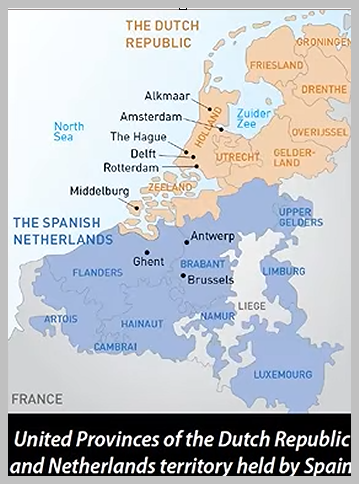 Um, essentially, um, as you can kind of see in the map here, this is a, a map which shows how different, um, geographically the Netherlands are than in the Middle Ages and today because of, um, how active, um, the people of the Netherlands are and effective they are at reclaiming land, um, from all of the ocean and so forth. So the people of the Netherlands are very effective at reclaiming land from the sea, but there's also lots of water available, so so many rivers are coming out of these very low land places, and, um, that has means there's all kinds of canals and dikes and things like that.
And so it is very hard for large armies to travel around in there, and when they do, you know, they can break the dikes and things like that and trap them. So essentially, the, um, northern part is able to, um, maintain its independence, and this is the sort of revolutionary, um, space in which Spinoza is born.
The Reformation and the Dutch Revolt
One of the major causes for the Dutch Revolt was the Protestant Reformation.
And so Calvinism had spread throughout the Low Countries at the end of the 16th century. Um, and we have, like, picture here of, uh, Calvinist iconoclasts destroying all the religious statues in Holland and so forth, for example. The Habsburg Holy Roman Emperor, Charles V, this, um, essentially the culmination of this idea that the Habsburgs, um, inherit everything. And so they had been the, um, heirs on the one hand of all of the, um, uh, the patrimony of the, um, the
Dukes of Burgundy from the French inheritance, and also of the Austrians, and also of, um, Castile and León of Spain, and then also all of the Spanish colonies in the Americas.
That had all come together for him, but it also came together at this moment, um, uh, when he's have to fight off the, um, uh, the Ottomans from attacking Austria and also from within, from within the Holy Roman Empire, um, having to fight off this, um, uh, internal rebellion of Protestantism as, um, as independent or semi-independent, uh, rulers across the Holy Roman Empire were able to, um, uh, make their own religious policy, essentially. And so Charles V sort of, um, kind of failed to stamp out Protestantism in, uh, Germany, and his son also is working on and has been working on, uh, doing the same in the Netherlands.
The End of Religious Tolerance in Iberia
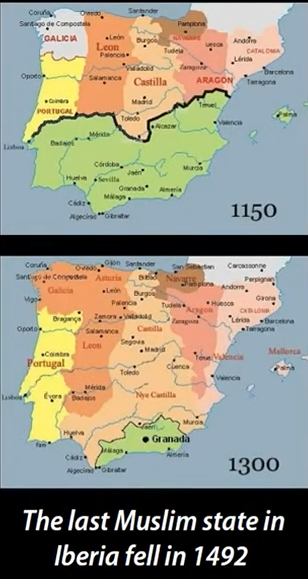 So Spinoza's ancestors originally had been Jews living in Portugal.
And so until 1492, the medieval Iberian Peninsula was divided between a large number of Christian and Muslim kingdoms, and so everywhere from Portugal on the one side to León, Castile, and Aragon on the others, Navarre. Uh, slowly over the course of the Middle Ages, um, the Muslim realms in Andalusia were, uh, conquered and absorbed by their Christian, uh, neighbors until at the very end, there's this one last holdout in the Kingdom of Granada. hat was finally conquered by Ferdinand and Isabella in 1492. And this led, uh, the Iberian monarchs of, uh, Castile and, uh, Aragon and Portugal to, um, require all Muslim and Jew-- uh, Muslims and Jews in Iberia to convert to Christianity or be expelled from the peninsula.
“New Christians" / "Conversos"
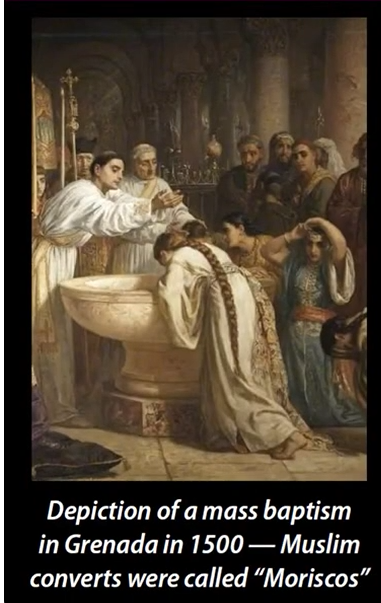 Depiction of a mass baptism in Grenada in 1500 — Muslim
converts were called "Moriscos"
So there were already significant numbers of what were called New Christians, that is to say, um, Jews who had previously been forced or otherwise incentivized to convert to Christianity. So a forced baptism is when, you know, the local leader says, "We're, we're, um, converting. We're gonna, um, make everybody be baptized, or we're gonna steal all your children and baptize all of them." But other incentives included if you wanted, let's say, to be, um, if you're a relatively rich person and you wanted to become a government official, you would have to c- you know, convert to Christianity in order to do it.
And so there was a big population of what's sometimes called Conversos in the Spanish, New Christians, um, or pejoratively called Marranos if they were converted from Judais- uh, from Judaism, Moriscos if they were converted from Islam. And so, um, nevertheless, while there were these populations of, um, New Christians or former Jews, many believed, including the kings of Spain themselves, believed that many of them were secretly practicing Judaism in secret, in other words, that they were part of crypto-Judaism. And this was, um, used as the basis for both the Portuguese and Spanish inquisitions to hunt them out, hunt people out to find out if they actually were secretly practicing Judaism. And, you know, even though these ac-accusations were often very overblown, actually a lot of people were secretly, um, practicing Judaism.
Spinoza's Family Background
So, Spino-Spinoza's ancestors had originally been Jews living in Portugal. They had been publicly converted, and they became New Christians, but the family continued to practice Judaism in secret. And at a certain point, because of the Portuguese Inquisition, they came under increasing threat of persecution And that may have influenced their decision to move ultimately, uh, to Holland.
Dutch Tolerance for Religious Dissenters
So the Dutch Republic had opened its borders to religious dissenters, and this tolerance also extended to Jews who were allowed to practice their religion relatively openly, especially as long as they weren't too loud about it.
But anyways, a lot better than it had been, certainly in Spain and Portugal. And even in some cases, um, uh, Jews practicing Judaism were allowed to hold political office in the Netherlands without converting or pretending to convert, as had always been the norm before, going all the way back to, um, uh, the Merovingian kingdom of the Franks, which had a number of, um, Jewish royal officials in the court of the King of the Franks who were able to become, um, court officials by e-either converting or prevent-- pretending to convert to Christianity.
And so Spinoza's father, Michael de Spinoza, was a wealthy Amsterdam merchant, and, um, his wealth allowed him also to serve or be elected as an officer in a local synagogue, the Talmud Torah Synagogue, the Talmud Torah School that's associated with the synagogue.
Cosmopolitan Havens for Free Thought
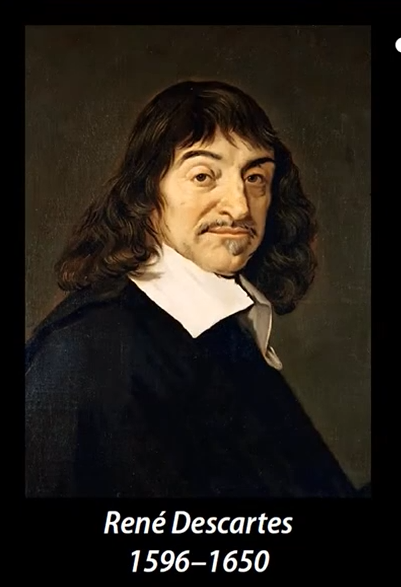 Um, and in an era when wars were raging across Europe over ideas and over religion, Amsterdam became sort of a refuge for all kinds of dissenting thinkers. And so an example is the French Catholic polymath, Descartes, who spent most of his adult life in the Nes-- Netherlands because it allowed him the freedom to publish, let's say, free-thinking ideas that weren't welcome, uh, in his home, uh, nation of France.
And so, for example, he published in sixteen thirty-seven in Amsterdam his, uh, in the Netherlands anyway, his discourse on the method, which includes the famous phrase, cog-cogito, ergo sum, I think, therefore I am.
Uriel da Costa
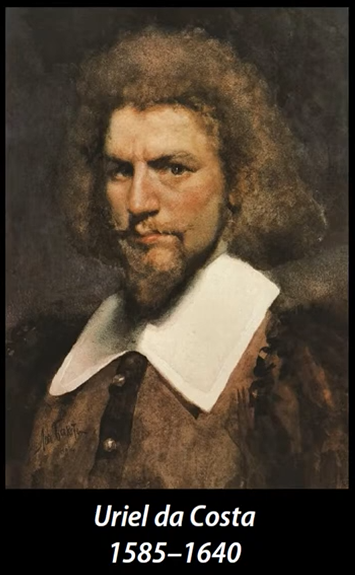 So through Spinoza's mother's family, he was related to a Jewish philosopher named Uriel da Costa. So born as Gabriel Fuesta da Costa to a family of these new Christians that I was talking about in Portugal, um, Uriel migrated to Hamburg in sixteen fourteen, where he took this new name. So he switched, I guess, from, um, Gabriel, the angel Gabriel to the angel Uriel.
But anyway, so he openly then converted to Judaism, but, um, now able to practice his religion for the very first time. Um, he became kind of fairly quickly disenchanted with the rabbinic leadership of the local Jewish community in Hamburg, which he found to be, um, really focused on rituals and arguing over, um, legal interpretation of, uh, uh, the Hebrew Bible and how-- what-- the implications for that for daily life in, in Hamburg and so forth.
Uriel da Costa's Challenge of Judaism
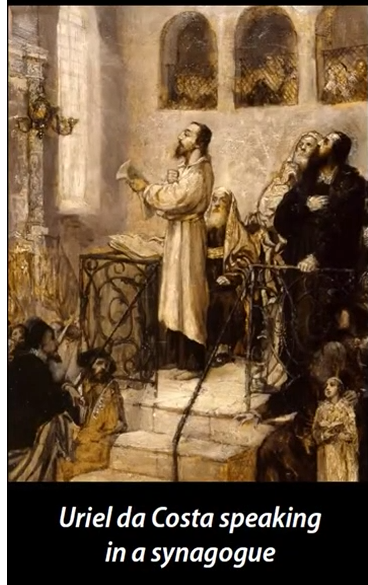 Uriel da Costa speaking in a synagogue
In his first known work, the Propositas Contro Tradicao, so Propositions Against the Tradition, um, da Costa wrote and kind of nailed up eleven theses, sort of, uh, like, um, Martin Luther's many theses, which called into question contemporary Jewish custom, um, from a literal reading of the Torah. So he pointed out all of these different places where if you read the Torah literally, this doesn't seem to align with how, um, the rabbis are interpreting, um, uh, custom and behavior and how they're supposed to operate. And in part because, you know, of course, there's a long, um, rabbinic tradition of debate over how these different things should be lived. And so, um, if you go back and skip the intermediary and go straight to the Torah, you may have, have a different reading from what the rabbis have all argued and decided in your community.
Da Costa's early work caused him to be excommunicated by Jewish leaders in Hamburg and also in the Venetian Republic, and at a certain point, he decided to relocate to Amsterdam, uh, where he was by sixteen twenty-three.
Uriel da Costa's Provokes a Response
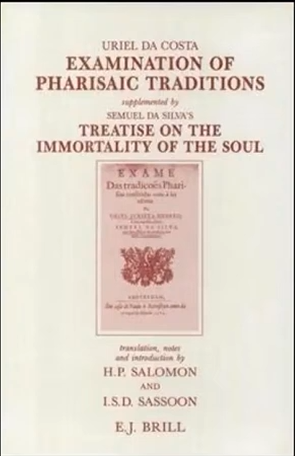 Uriel da Costa questioned inherited assumptions of Rabbinic Judaism
In Amsterdam, he published another work that was a little bit more, um, more of an attack, something called the Examination of Pharisaic Traditions, in which he argued, I would say correctly, that the Torah does not support the doctrine of the immortality of the soul. We've had lectures on, um, uh, the evolution of the idea of afterlife. And when we look back at, um, the Torah, we-- the first-- the five books attributed to Moses, the, um, the Pentateuch, um, the authors who are writing that are not, um, uh, they're not, they're not part of participating in a worldview that has, um, the immortality of the soul, where people are gonna go to heaven or hell after a day of judgment or anything like that.
Instead, when we look at things like the, um, the covenant that God makes with Abraham, he doesn't say, "Abraham, if you follow all my commandments, you're gonna go to heaven." He says, "You'll have a great long life, and you'll live to the maximum of what humans are able to do, and then you're going to have, you know, wealth, and you'll also have, um, an infinite posterity, so you'll be the father of many nations."
And so these are the kinds of, um, of values and, and things that were relevant to the authors of the source text of the Torah, not a belief that, um, they would one day be one with God in, in an afterlife and because of the immortality of the soul.
That's a later development within Second Temple Judaism.
So, um, faced with this argument, though, it's not an argument that, um, Jewish leaders in Amsterdam wanted to hear, um, they, uh, those leaders then went to the, uh, Dutch government, the Amsterdam city fathers, uh, pointing out, "Hey, you know, this is actually an attack on Christianity too. You know, uh, you know, Genesis, Exodus, Leviticus, Numbers, and Deuteronomy are part of the Christian Bible."
And so, um, and they agreed, and so the, uh, government fined da Costa for r-publishing the book and then had his book, uh, burned publicly. 19:09
Uriel da Costa's Rejection of Religion
And so, um, and they agreed, and so the, uh, government fined da Costa for r-publishing the book and then had his book, uh, burned publicly. 19:09
So ultimately, as, uh, his skepticism continued, da Costa doubted whether the Torah was divinely sanctioned at all. Um, he was-- he questioned whether Moses is actually the author. We now can say, um, conclusively that Moses is not the author. And, uh, so he was right there, and he also, um, proposed, or at least that he believed that maybe, um, uh, if Moses did write it, that he was just making it up sort of thing, or whoever the human author was just making it up.
And indeed, um, he started to propose that maybe all religion is simply a human invention. And, um, instead of, um, being interested therefore in inherited religion
, uh, de Costa sketched out sort of a proposal for a, a better religion, a true religion that would be based on natural law, philosophical law, and especially rejected things like, um, legalisms, uh, that he might, that, that he finds in the, um, uh, Hebrew Bible that he found so annoying to all of the arguing over that and whether you should do that or this or that, things that are pretty far removed from ethics and are instead, um, from his perspective, just an arbitrary custom. And he was also, um, very opposed to ceremony and things like that, that he regarded as empty. Nevertheless, um, not popular in his own community, the Jewish community, and, um, persecuted religiously, um, uh, de Costa ultimately committed suicide in sixteen forty.
And so that, in that year, um, his distant relative, Spinoza, was a child of only eight years old. Spinoza was also living in Amsterdam, but unlike, um, like this painting that was done many centuries later, uh, which is-- I had the idea that maybe de Costa actually was directly influencing Spinoza. It's more likely that the influence is indirect since, um, uh, Spinoza's part, you know, as a relative, but also part of the same Jewish community that had been, um, you know, seriously affected by all the ideas that de Costa had brought and was still probably arguing about that.
And people, um, um, probably continued to, you know, think about the challenge that he had that maybe Moses didn't write the Torah and so forth. And so this is part of the background, um, that Spinoza, Spinoza's childhood as he's growing up in this very kind of freewheeling, freethinking, um, revolutionary society.
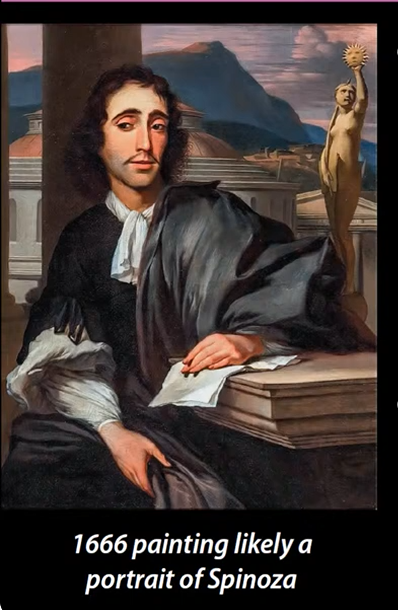 Spinoza's Early Life
So as a boy in Amsterdam, Spinoza attended the Talmud Torah school, which was attached to the Beit Yaakov Synagogue. And attending that school, he learned to read the Torah in Hebrew, and he also learned to study rabbinic commentaries in Spanish, the sort of inherited, um, language of, um, of all of the, the thought in his community. Um, then his father, who had been a very wealthy merchant, fell on increasingly hard, uh, times. Um, his older brother, um, who had been intended to be, uh, the guy who would lead the business, died, um, meaning that Spinoza had to kind of go into the business for a while. Um, and then as his daughter-- h-as his father, um, kind of health, his health failed and he ultimately died, um, this made Spinoza himself the head of the family, the head of the household, which allowed him to begin expressing his own views that he didn't feel comfortable doing while his, uh, father was head of the household.
Spinoza's Expulsion from the Synagogue
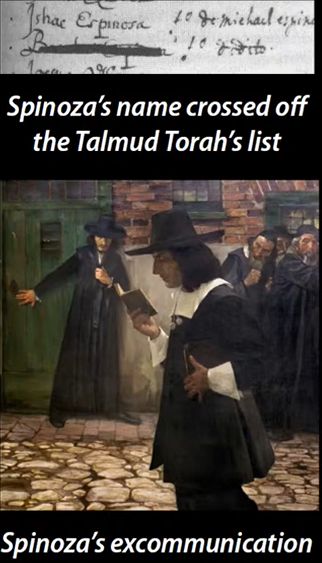 These views were very much out of alignment with the Talmud Torah's leaders who expelled Spinoza, citing his abominable heresies. And so we actually have a, um, a, a student list, um, which had Spinoza's name that, and ha- and we have it, it's been crossed off. And so, um, he was expelled from the community.
And meanwhile, through the course of his father's illness, his father's wealth had essentially been wiped out, and this caused Spinoza to legally renounce the estate. So he essentially became, um, uh, legally disenfranchised from his father to also get, escape his father's debts and so forth. And when, um, he left, he left behind his former Jewish identity, the community, so he no longer participated in that.
Student of Van den Enden
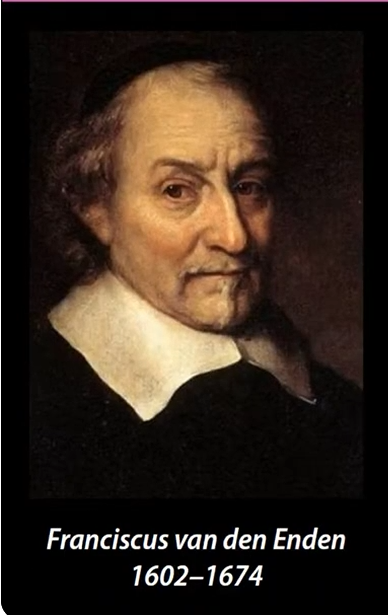 Spinoza took up lodging and began to study Latin with a former Jesuit, a, uh, thinker named Franciscus van den Eyden, Enden, who was part of the Amsterdam circle of thinkers who challenged traditional religion. Van den Enden was a proponent of building a utopia in the New World. So, uh, the Dutch had begun planting a colony in, where is it? Modern-day New York, New Amsterdam, the New Netherlands. And Van den Enden wanted to have that society, um, um, practice a democracy and have radical equality so that there aren't any rich and poor and so forth. Everything, um, is in this, um, everyone is on the same level and so forth.
Um, the, you can see how, like, in these kinds of, um, places of new ideas and how m- how, um, the New World ends up being a place where everybody imagines a
utopia where you could make some kind of, um, new, different, idealized society. Obviously, one, though, that, um, requires displacing, uh, the inhabitants that already live there.
Spinoza's Avocation As a Philosopher
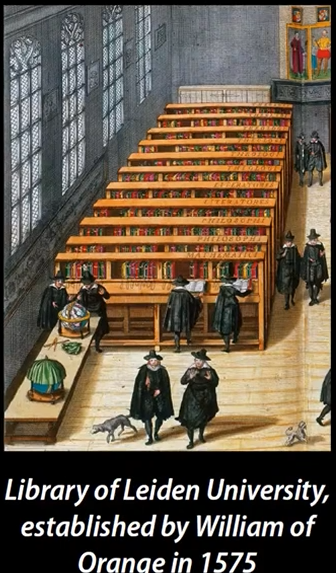 So Van den Enden probably introduced Spinoza to the works of Descartes, and Spinoza also audited classes in Cartesian philosophy when he attended Leiden University around sixteen fifty-eight. So this was a new foundation, um, of the, uh, from the late sixteenth century where William of Orange, the great, um, leader of the Dutch Revolt, Protestant figure, um, or the Protestant, uh, Revolt, um, um, created this center of learning.
And so from this time forward, um, Spinoza, who'd, you know, again, had renounced, uh, his father's old business as a merchant, took on a day job as a lens grinder that, um, paid his bills, but he had as his major advocation a devotion to philosophical inquiry. And as he, you know, thought and wrote, he also, um, gathered a small circle of friends and fans who were sort of, uh, around him, and that constituted his sort of philosophical life.
Spinoza's Ethics
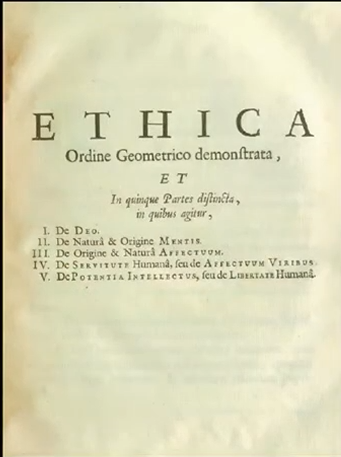 Spinoza's Ethics published posthumously in 1677
Spinoza considered his magnum opus a book entitled Ethics Demonstrated in Geometrical Order, which he composed between six- sixteen sixty one and sixteen seventy five. So during his lifetime, Publi-- Spinoza published very infrequently,
um, in order to circumvent persecution. He knew he was kind of a radical thinker, and he didn't want, uh, like De Costa, to have his, uh, book burned and to have him, um, you know, face fines or worse. And so for this reason, uh, this book, this ma-major book of his, The Ethics, was only published, uh, after his death, in the year of his death.
“Demonstrated in Geometrical Order"
The subtitle of the book, Demonstrated in Geometrical Order, is pretty telling.
Um, and we, we may ask ourselves, "Okay, well, what does geometry have to do with topics like ethics," as he's calling it, or also what we know as contents of this, the meta-- his metaphysics, his theology. What does it have to do-- What does geometry have to do with God?
So the ancient Greek mathematician Euclid, writing around the year three hundred BC, produced a book about geometry that became incredibly influential both in antiquity and the Middle Ages, but especially in the early modern era for its use of logic and especially logical proofs. So if you took geometry in high school or maybe in university, this may have been where you were introduced to logical proof. So I took, um, in my high school, we had a cour- It was called plane and solid geometry, and it really, you know, was less about learning the Pythagorean theorem, and it was more about learning, um, essentially Euclidean logical proofs, where you would take a, um, a definition of what is a point or what is a line or what is a line segment, and you would, um, go from those definitions to establish, um, logical proofs about, you know, like the Pythagorean theorem, about what the area of a, of a triangle is or something like that.
And so this, um, you know, again, this, this is such a remarkable book and, um, was so influential that a lot of people would like to take that same system that you could apply so elegantly to geometry and apply it to other important facets of life.
Logical Proofs Built on Reason Alone
So speaking of, um, making logical proofs, so like his earlier contemporary, Descartes, who lived from fifteen ninety six to sixteen fifty, so I mean, overlapping with him but earlier, and his later contemporary, Leibniz, who's operating or who's alive from sixteen forty six to seventeen sixteen, Spinoza regarded reason as the chief source and the chief test of knowledge. And so all three of these thinkers are thus proponents of rationalism, and this is, uh, counterweighted against the other great, uh, philosophical tradition of the early modern period here, empiricism. Empiricists like John Locke, who argued that knowledge isn't innate but is best gained by careful observation of the sensible world outside the mind.
So, um, in some ways, this is a, a question that goes all the way back to Plato and Socrates and the pre-Socratics. Um, how do we, um, do we trust? How do we gain knowledge? Um, is it, uh, through our senses, where we are gaining knowledge of the sensible world? Or is it through reason, where we are, uh, within the mind understanding, um, the universe that is intellectible, in other words, understood through our reason alone? So, uh, Spinoza's definitely on the, um, on the reason side.
Euclidian-Like “Proofs" for Metaphysics
So these elegant mathematical proofs that Euclid creates for his geometry form sort of a template and a model that Spinoza proposes to apply to metaphysics,
beginning with how to understand God, to then address philosophical problems like the mind-body question and ultimately to ethics, which is the title of his work.
So following Euclid, this ancient geometer means that Spinoza begins his work with definitions which are then used to prove various propositions. And so you can see even this, in this printed edition of, uh, The Ethics, the first part here, De Deo, on God, is how it begins, and it then says “definitiones”, so it begins with definitions.
Proofs that Are Difficult to Follow
 Um, and so background history is in my wheelhouse, and that's what we've done so far in this presentation as we're looking at, um, all of the background history of Spinoza's family, of the Netherlands, of, of, uh, crypto-Jewish communities and now Jewish communities operating in the open. And also I'll just say, though, that Euclidean geometry and also rationalist philosophy are a little bit outside that same wheelhouse, but we'll do our best here.
So philosophers widely regard Spinoza's system as among the most difficult to follow, and I did a bunch of reading for, um, this presentation, and I also fi- found it difficult to follow. And in part, this is because, uh, Spinoza, uh, has very idos- idiosyncratic ways that he defines terms like substance or attributes, uh, which are very important in the philosophical tradition, but he does it in quite a different way.
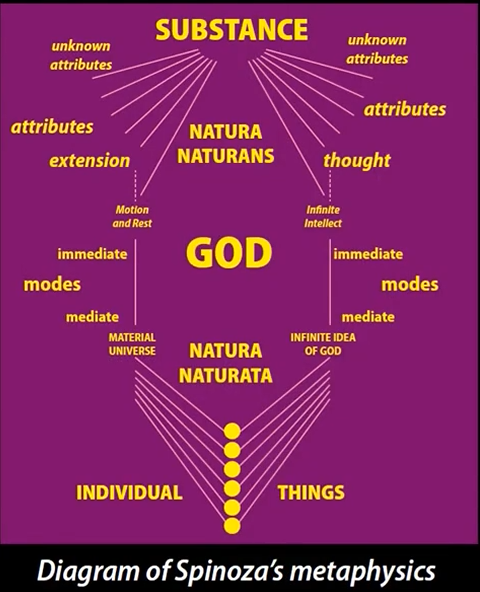
And so we have here on the left a sort of a diagram of Spinoza's metaphysics that includes, um, uh, words that he's defining like substance, like attribute, mode, and ultimately, uh, God as well. And we'll see if we can't make some sense of it as we go through.
“Substance”: A Key Philosophical Term
 So substance has long been a very core, important philosophical term. So ancient Greek philosophers like Plato, who argued that the material world, all of the objects that we can, um, experience with our senses, that they, in fact, derive their ex- what existence they have from eternal forms. So they are, um, uh, mere reflections of something that is providing them with substance.
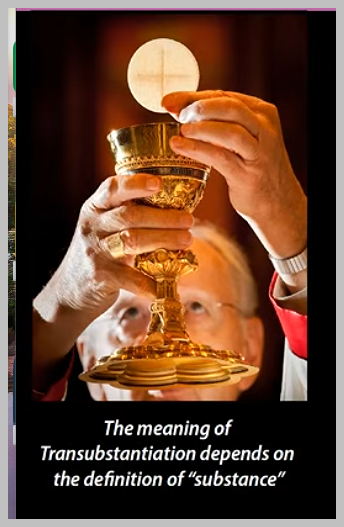
Aristotle defined substance, ousia in ancient Greek, as the fundamental independent reality that underlies all other things in the universe. And so when, for example, Christian theologians, um, started to, uh, try to understand their very complicated, um, view of God, where there's only one God, but God is existing in three persons, how is that gonna work? They used this, um, philosophical idea and definition of substance, and that's why we have words like consubstantiation. So the, uh, uh, Father is consubstantial, uh, with the Son and so forth. The persons of the Trinity are consubstantial. And of course, we have the, the famous word transubstantiation for, um, uh, the doc def- doctrine of the Eucharist, this idea that, that, uh, the substance of the host and the wine, the bread and the wine, um, their, their substance, whatever substance means, changes as opposed to their material changes. Although many people argue about the material as well. But essentially, substance here is the key philosophical term. The material stays the same. The substance or purpose changes.
Spinoza's Definition of “Substance”
So Spinoza gives his definition of the word substance as definition number three in part one of his ethics. So he says,
| "By substance, I understand that which is in a, in itself and is conceived in itself. In other words, that the conception of which does not need the conception of another thing from which it must be formed." |
And, and really, this is how Spinoza writes. So it's a very, um, thick slog for people to go through it. So, so what does that mean? So self-conception and the lack of dependence on any other thing, that part of it's pr- fairly clear. That's not unexpected. So Descartes also had sort of a similar definition of substance as a thing that does not depend on any other thing.
Some Quirks of Spinoza's Definition
However, Spinoza's insistence that a substance is in itself is less expected. So Edward Cur- Edwin Curley, a professor of philosophy at the University of Michigan,
um, he explains that this definition of substance existing in itself is an assertion that the substance is causally or logically independent of any other thing. It's just in itself. It's not-- nothing caused it. It doesn't n- uh, it's n- it's not part of anything else. So Spinoza says substance does not need knowledge of another thing and claims that, uh, knowledge of other th-- for-- uh, to have knowledge of a thing is to have knowledge of its cause.
So, um, so if, uh, you know, in having knowledge of itself, it has knowledge of its cause, which leads him to the conclusion that substance must contain its own cause or reason for being, meaning that in this sense, substance is in itself. And I have to tell you that, uh, one of the reason why I've relied on other professors to try to explain this is I'm not, I'm not sure. I don't know that I agree with Spinoza that that, that that follows, but it's also a difficult f- uh, route to get there. But the point of it is anyway, so Spinoza wants to argue that substance is in itself.
More Logical Consequences
So um, and so he actually, uh, I'm missing a slide where we w- where we essentially we have where I go through the argument of that, which results in a logical contradiction, and that causes us to an, uh, an-- reject an initial premise that the substance could be caused by something independent of that substance. And so essentially, this is a p- the ending of a proof. So, um, so Spinoza puts together a logical proof. That proof speculates that is it possible that, um, uh, a substance could be caused, uh, could have something caused by anything independent of it. And because he shows that that contradicts, um, he's essentially using a Euclidean style, uh, geometrical proof to argue that a substance is a causa sui. In other words, it's sui generis, it w-- or generating by itself. In other words, it's self-causing.
More Logical Consequences
Spinoza also argues that a substance must be infinite because for the substance to be finite would require something outside of the substance t- to limit it. So the first substance would be limited by the second substance. And for that to be so, the knowledge of the first substance could not be had independent of knowledge of that second limiting substance. And that's also contrary to Spinoza's definition of substance, which doesn't allow for, um, that second, uh, uh, knowl- that knowledge outside of itself.
ALL Aboard…
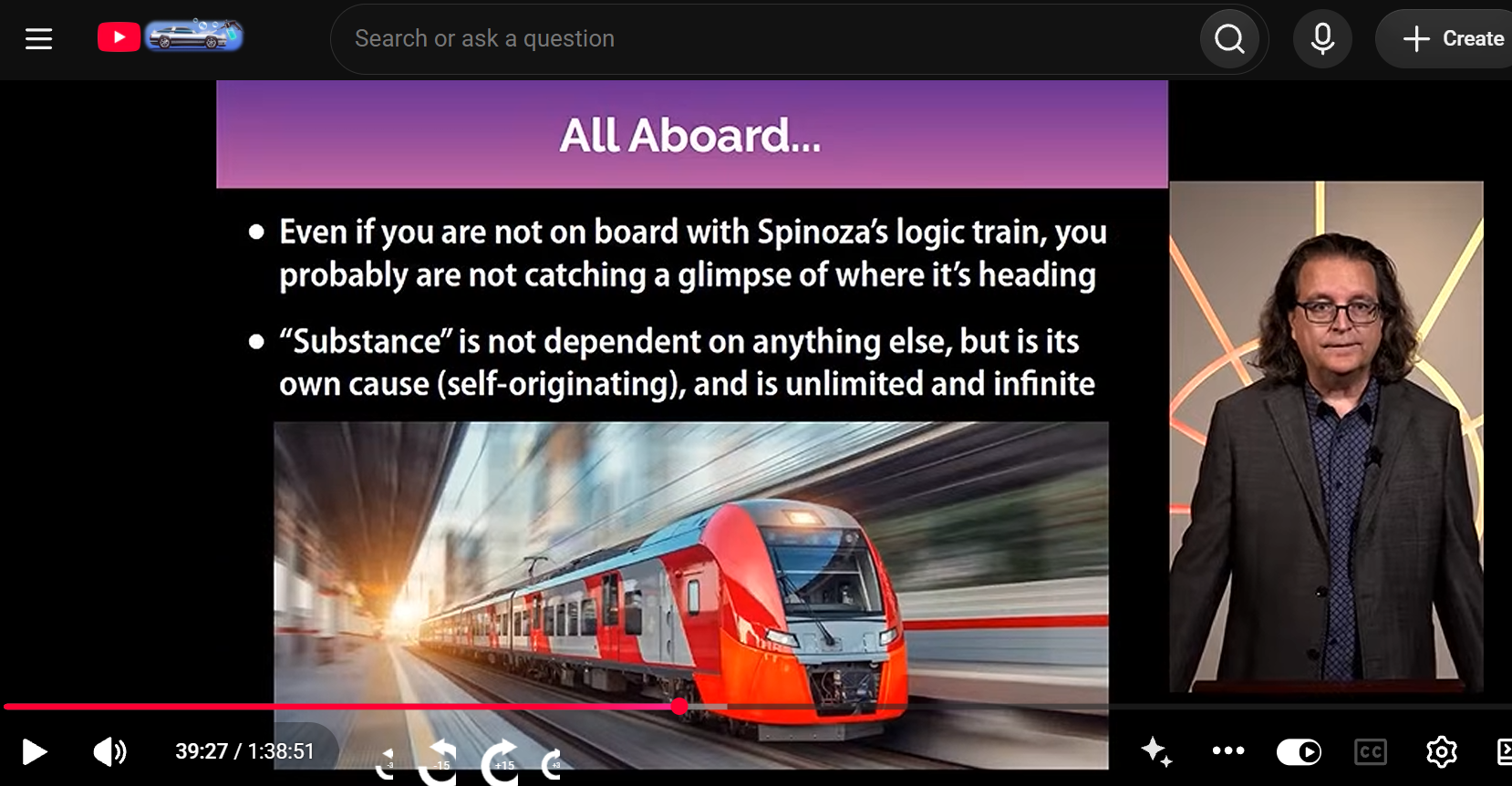
So in any event, um, all of these complicated arguments about substance are pretty, pretty relevant because even if we're not on board with the logic train that Spinoza has, um, you may be catching a glimpse of where this is heading. So substance is not dependent on anything else, but it's its own cause, it's self-originating, and it's unlimited, it's infinite. So maybe we're starting to think, "Well, what are, what are things that are …………………Something that is self-causing, self-originating, unlimited, infinite, and so forth.
Ontological Arguments
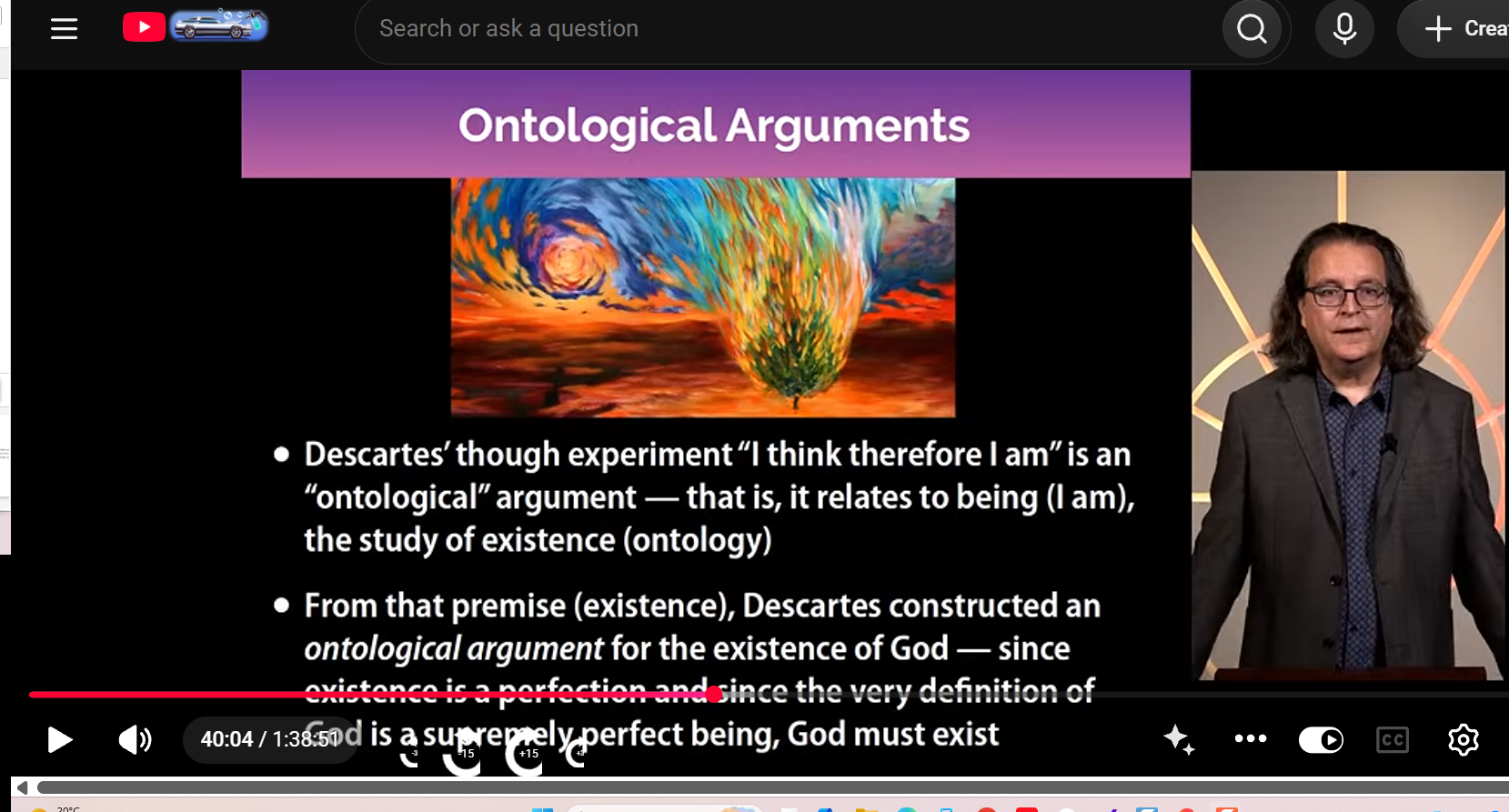
Descartes used a thought experiment, “I think therefore I am” and this is an ontological argument. That is to say, it relates to existence on the study of existence, ontology, because it's about being. So when you say “I am” , that's about being.
And so from this premise about existing, uh, the fact that we're thinking proves that we're existing, Des-Descartes constructed a ontological argument for the existence of God. And so, um, since existence is a perfection according to Descartes, and since the very definition of God is a supremely perfect being, then God must exist, um, because, um, uh, because God is the, uh, essentially the embodiment of, of that perfection and, and it's more, um, only perfect if God actually exists.
And so like the ontological argument that we did with Anselm of Bec,
um, where Anselm, a medieval, um, theologian and philosopher, attempted to again use ontology, the idea of existence, in order to argue, in order to prove that God actually exists. Um, this doesn't necessarily, um, convince everybody today. Nevertheless, um, this is where, uh, things were going for rational philosophers at the time.
Spinoza's Ontological Argument
Spinoza defines God as a being absolutely infinite and a substance consisting of infinite attributes. So again, in order to, um, in order to make proofs on the Euclidean model, you have to start by defining things, and then you make logical propositions that result from that. So you'd define a point as something that has no, um, you know, is in, uh, that in, in mathematics or in geometry, you define a point as something that occupies no actual physical space or size, no, no dimensions to it.
Um, and so for Spinoza, God is a being absolutely infinite and a substance. We've been talking about, um, his kind of unique definition of substance, a substance con-consisting of infinite attributes, and he also has to define what attributes are.
So since existence belongs to the nature of a substance, for Spinoza, if God could be conceived as not existing, then God's essence would not involve existence. But this contradicts the definition of an absolutely infinite substance, and therefore God exists as a necessary being, as a substance, according to Spinoza. So essentially, this is an ontological argument for being. God is a necessary being.
Consequences of Spinoza's Ontology
But armed with this rather different definition of substance, Spinoza's ontological argument for God has very different consequences from that of Descartes. So specifically, when Spinoza gets to his fourteenth proposition, he makes the claim that besides God, no substance can be conceived.
The Logic of Proposition XIV
And so the logic of this proposition works sort of like this. God, by, uh, Spinoza's definition, definition number six, is an absolutely infinite being, a substance consisting of infinite attributes. God is a substance whose essence involves existence, and therefore God necessarily exists. So we have those, um, premises.
Suppose, therefore, some substance other than God exists. If it did, it would have to be explained by an appeal to some attribute of God. So God has an infinite attributes. One of those attributes we know is, um, potentially anyway is ex- one of the, is existence, um, which would mean that two substances, God and this other substance that we're supposing about, they would both possess the same attributes.
Spinoza has already shown logically in an earlier proposition that it's impossible for two substances to share the same attribute. At least he's shown that to his satisfaction. And so this supposition we've had about a second substance other than God has now led us to a contradiction. And so Spinoza has proved by logic resulting from his definitions that no substance other than God can exist. So in other words, there is only one substance in the universe, which Spinoza has already identified as God, defined as an absolutely infinite being,
a substance consisting of infinite attributes, attributes as Spinoza has defined attributes.
A Different Definition of God
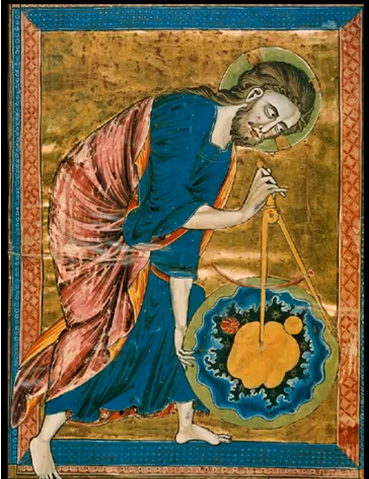 A Medieval Christian conception of creation
So we can already see how Spinoza's definition of God really differs from Orthodox theology, theology, um, of contemporary Catholics and Protestants and Jews in his time period, all of which picture an infinite God that transcends a finite cosmos. So most metaphysical formulas define God as a necessary being the way, um, Spinoza does with attributes like limitlessness, self-generation, etc. Those are all agreed. He's all agreed.
But In a, in everybody else's conception, the material universe is then a separate finite substance that is dependent on God for existence. So there is something apart from God, which is creation. So God shares some of these attributes that Spinoza agrees with, but, um, there is a dualism, a separation, uh, between God and creation for, um, traditional, um, metaphysics and theology in Chris-- Judeo-Christianity.
Spinoza's Radical Monism
So, if there's only one substance and that substance is God, then everything that we observe in creation is God. The universe itself must be God. So Spinoza's conception here goes way beyond monotheism, a single infinite God that is the first cause, the source of everything, to a very radical monism. This is an idea that everything is ultimately one, and we only see division and separation and so forth,
um, that, that that really is an illusion because the system is what, uh, the dynamic system is all one.
The Operations of God (or Nature)
So this gets us closer to understanding Spinoza's equation of God as being synonymous with nature, God or nature, as everything in the cosmos, um, are part of a system that is God and is flowing from God. And so, um, all of those things beyond the attributes Spinoza, uh, defines as modes, and both the infinite and finite modes are part of this system.
And so within this conception, Spinoza concludes that God is the sum of the natural and physical laws of the universe, and certainly not an individual entity or a creator. So, so rather than seeing a creator outside the universe, um, we're talking about God being the sum of all of the natural physical laws of the universe, and indeed also the universe.
Does God Have Freedom?
While in no way operating then like an anthropomorphic being, the way you would read about in a literal reading of several biblical accounts like Genesis and so forth, Spinoza nevertheless says God, his God, God or nature, is an free being in the sense if we ask, uh, how-- "In what sense is, um, this universal conception of God, is that-- how is that God?" So Spinoza says,
"That thing is called free which exists from its-- from necessity of its own nature alone, and is determined to action by itself alone."
So, uh, God or nature, um, exists from its own nature and necessity and also is acting by itself alone, and so therefore, uh, in some sense, it is free or has, has freedom.
God Acts in the Only Way God Would
Nevertheless, God is operating within Spinoza's definition of free, which is in accordance with God's nature as the active principle from which all modes naturally flow.
So this means that--maybe means that it doesn't seem so free at all to us. So Spinoza argues
“Things could not have been produced by God in any other way or in any other order than is the case.”
So, because God or nature is always acting as God would act, which is presumably acting in accordance with the sum of natural and physical laws of the universe, um, God always would do all the same things. Um, uh, the outcome, while technically free, nevertheless feels predetermined.
And so this may be, you know, arguing on some kind of, in, in the, in the, um, free will versus determinism, um, spectrum. It may be arguing some kind of compatibilism, but it may be more like determinism. In other words, essentially, this is the only way the universe could possibly have gone.
“Attributes” and “Modes”
Um, we've already seen that God defines God as possessing infinite attributes, but in his work, he only specifies, uh, two of these, thought and extension. So God's thought is encompassing all of those, those laws, and extension is this vast infinite space and dynamism that we see in the universe. And in addition, as we saw, he talks about modes. So he defines modes,
"By mode I understand the affections of substance or that which is in another thing through which it is also conceived."
So unlike the substance, which is in itself, it's isolated, it's all alone, it's self-generating, and so forth, it's not dependent on anything, it can't be dependent on anything, and there can only be one of the substance. Mode, by contrast, is all these things in God that are dependent on God, and this includes, uh, things that are infinite modes, that is to say, things that follow and are part of God's absolute nature, the ongoing, um, law of gravity or, uh, the speed of light or all those kind of things, or-- and then those things that are modes that are finite, things that are particular and limited, things that, uh, in the universe that flow from God, are part of God, presumably including, uh, th- finite things like us.
 The Best of All Possible Worlds
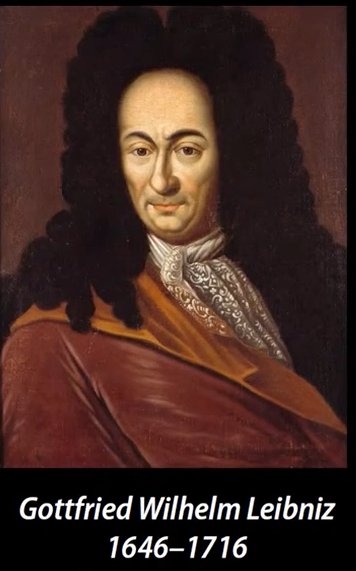
So when I was hearing about this operation of Spinoza's God, this idea that, um, God is essentially always going to operate in ways according to, uh, natural law, um, this reminded me of the operation of his contemporary rationalist philosopher, Leibniz. So Leibniz, who is famous for all kinds of things, should be included is his amazing hair here, but it also includes, um, independently developing, uh, calculus independently from Newton and so forth.
Um, Leibniz is also, um, a philosopher who, uh, envisions, um, a very different conception of God, uh, than, than Spinoza, one that is pretty compatible with Christianity. But, um, Leibniz's transcendent God is essentially goodness itself. And so Leibniz argues that God always chooses the choice that results in the maximum good, and that therefore, um, the universe c- also could not be any other way, in the same way that, um, Spinoza's universe couldn't be any other way.
Um, and on top of that, for Leibniz, that this world that we exist in-- Sorry, this universe is the best of all possible universes, um, because God is-- would-- being good wills it that way. And this is one of, um, um, one of the arguments that is made for the problem of evil. So we, um, ha- live in a world where there's all sorts of misfortune and suffering and everything like that, and yet, um, people argue that God is infinite and good and all-powerful and all those things.
Why then does God allow suffering when God obviously could stop all suffering if God is infinite? Um, Leibniz says, "No, no, no. If, um, ev-- because everything has a num- number of effects, saving, you know, one baby from drowning or whatever may have, you know, some terrible effect that we don't know about. And so therefore, um, God has in every case picked the right, um, the best possible, um, the maximum good in terms of the consequences, and this world becomes the best possible world."
This becomes questioned in the next generation, for example, when, um, there's just a horrible, um, earthquake in Lisbon, so much s-suffering and death, and people, um, um, kind of ridicule, uh, Leibniz as naive. But it's an, um, I still think an interesting ar-argument that he makes.
 The Principle of Sufficient Reason
Every contingent fact has a sufficient reason
So while Leibniz's God is completely different from Spinoza's, Leibniz is also, I think, seemingly presenting a compatibilist or determinist view of God's free will, in the sense that, uh, because God is goodness, goodness self, God al- is always good, and so therefore is never going to choose bad. Uh, in the same way, if, uh, God is always going to-- for Spinoza, is always going to be acting in accordance with all of the laws of nature and so forth, then the universe is always gonna be that way.
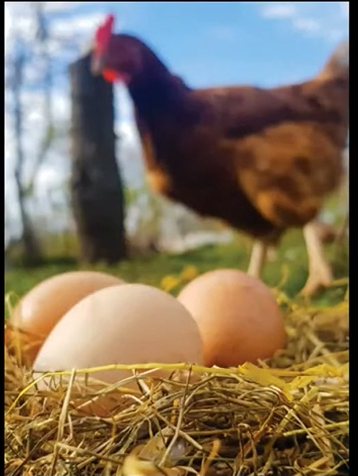
Leibniz, um, part of the reason why he gets this idea and bases this is because he's associated with the principle of sufficient reason, which is, um, something that is more or less means that, um, everything has a cause. So, um, the question of causation that is famous is, you know, which comes first, the chicken or the egg? The, um, uh, the cause of the chicken is the egg, and the cause of the egg is the chicken.
Um, the principle of sufficient reason is more technically s- idea-- the idea that every contingent fact has a sufficient reason. And, um, Spinoza also, um, is a proponent of this principle, um, just like Leibniz more famously is, but Spinoza perhaps uses it even more frequently and consistently in his arguments.
Do We Have Free Will?
So given that God or nature always acts in accordance with the way God or nature ought to act in Spinoza's, um, concept, what about-- what does that mean for us humans? So we are a finite component, a mode within, um, this system as part of God. Do we have free will? So in answer to the question of human determinism, Spinoza wrote,
"Infants, the ba-babies believe that it is by free will that it seeks the breast, seeks to nurse. The angry boy believes that by free will he wishes vengeance. The timid man thinks that it is with free will that he seeks flight. The drunkard believes that by a free command of his mind he speaks all the things which when sober he wishes had left unsaid. All believe that they speak by a free command of the mind, whilst in truth they have no power to restrain the implu- influ- impulse which they have to speak."
And so, again, this seems to be expressing a determinism, although, um, it's potentially also could be made-- a stretch could be made, an argument that this is compatibilism. We've had a ar-- we've had, um, whole lectures on free will and determinism, and the idea, um, it's always complicated as to when you are looking at, at motivations like this, the complica- the complication is what is the, um, um, what's the agent or expression of free will if you have all of these, um, uh, motivations, whether it's instinct in the form of babies, or whether it is all the things that have built up to you leading you to be, um, the timid person who is always gonna fligh- flee when such and such happen. Um, uh, is there a place for free will to actually act, or are we just having an illusion of that?
How Does the System Function?
So how does the overall system of Spinoza's God, who is the universe, function? So Spinoza describes a very dynamic system where God's infinite activity, um, is called natura naturans, that is nature naturing. And then he further describes the system where a finite mode produced by God may cause another finite mode, which then has an, uh, causes another one. So in other words, some things are, are directly caused by God, and some things are infinite and ongoing, like the rules of the universe or infinite aspects of what God's doing.
Other things, um, may have indirect causes where, um, God has caused something which in turn causes something, which in turn causes something, and so on. The, um, the chickens and eggs keep causing each other. And that's called natura naturata, nature natured. And so, uh, both of these are nevertheless types of modes which are part of this same infinite and single substance God or nature.
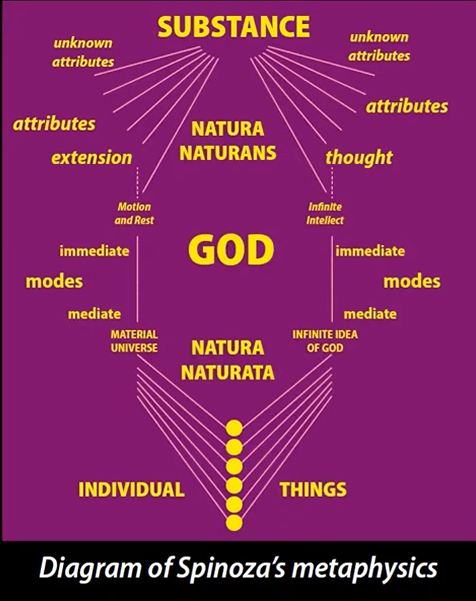 Looking Back at the Chart
So if we go back to that chart that I flashed earlier without us knowing any of these kind of things, um, having gone through this brief but a little bit still tangled overview of Spinoza's metaphysics, some of these, um, ideas, uh, that substance, that there's a single substance which therefore is identified with God, and there's only one, so it's all of the universe, which is operating with an infinite number of attributes, most of which therefore is identified with God, and there's only one, so it's all of the universe, which is operating with an infinite number of attributes, most of which are unknown, but include the attributes of extension and thought, and that those, um, are also resulting in God's dynamism of natura naturans and naturora naturata, the, um, the infinite, uh, effects and causation that's happening, uh, again and again and again, um, through, uh, the material universe and the infinite idea of, uh, of God in these different kinds of modes, which are the finite and infinite modes, which result ultimately in individual things.
And so, um, like we say, now we can see that attributes and modes are ways that he uses to conceive of this complex dynamic universe, nevertheless sharing a single substance in his conception.
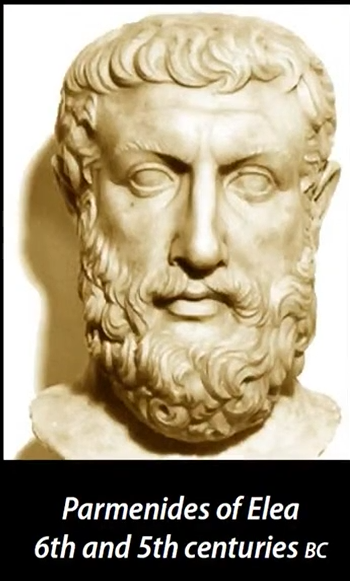 Reminiscent of Parmenides
So when I saw that, you know, this sort of overall picture, uh, of this monist universe, this, um, was very reminiscent to me immediately of Parmenides. So Parmenides was a incredibly important pre-Socratic philosopher, um, operating in the sixth and fifth centuries BC, um, who, um, in contrast to, uh, Heraclitus, who said, uh, who thought everything was in flux and said you can never step into the same river twice because it's not the same anymore, everything has changed.
Parmenides, um, again focused on a very strict logic, argued that being what is, that being exists and being cannot not exist, and not being what is not is completely unthinkable and impossible. Nature abhors a vacuum, you can't have it, because you can't speak or think of nothing. You have to think of something. Even when you're thinking of nothing, you're, um, using the word nothing. You can't picture nothing. We picture black usually or something like that. It's not nothing.
So from, um, this, Parmenides reasoned that all reality is one. So, uh, everything that exists has al- al- always existed and that in fact nothing comes into being because to that, for that to have happened, there would have had to have been non-existence, which is not possible. And so therefore, um, the universe is again a continuous uniform, but in Parmenides' view, unchanging sphere of being.
So another radical monist, although, um, unlike Spinoza's system, which is incredibly dynamic and always, uh, having change, Parmenides, um, saw changes essentially an illusion that where nothing ever changes.
Zeno's Paradoxes
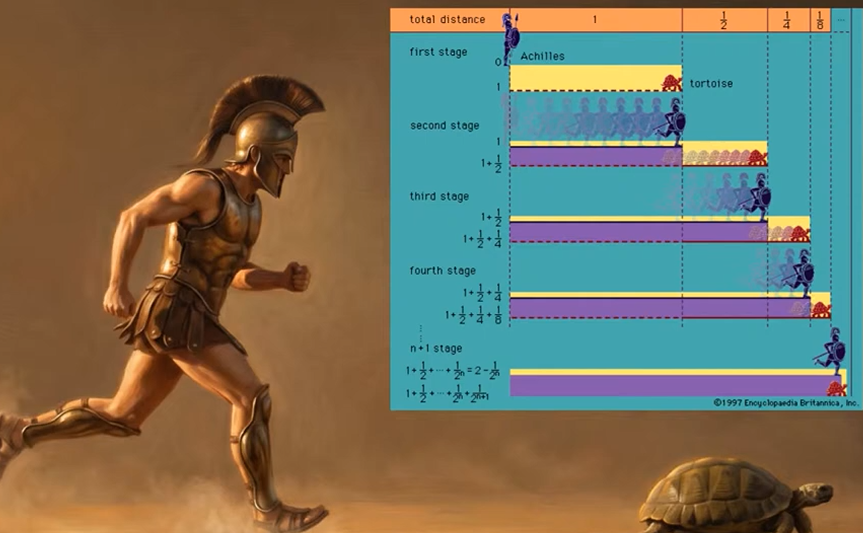 And in order to try to make that case, um, uh, disciples of his like, like Zeno, uh, offered up all sorts of, again, logical or mathematical paradoxes like the idea that, uh, essentially Achilles racing to catch up to a tortoise and pass a tortoise
never can do so mathematically because when they start a distance of one unit apart, um, over time, uh, when, when Achil- when Achilles has crossed that path, the tortoise will have gone, uh, you know, it's going at half the speed or whatever, will have gone one point five. Achilles is at one. When we get to, uh, when Achilles gets to one point five, the tortoise will have got to one point five plus, you know, one point five four. You know, so in other words, once and a half and a quarter, an eighth and so forth. In other words, there's always this fraction further that the tortoise has gone within the amount of time that Achilles has gotten to that.
So this is an idea that, um, that essentially this logarithmic thing happens, and you'll never actually achieve the, um, a- achieve this end state. Um, which was, uh, convincing to a bunch of people, but, uh, always for me, um, I have always had my-- a lot of trouble getting my head around this, this idea of monism, and I'm personally, um, have been more, um, inclined to and taken with, uh, with, with Plato's idea and his dualism than with, um, either, um, Parmenides' monism or frankly Spinoza's monism as interesting as the idea is.
Engagement in the Chat
And so just in terms of our engagement in the chat, um, I might ask you gu- guys:
- What do you make of Spinoza's conclusion that we and everything, that we're all part of, um, this single substance that he identifies as God or nature?
- Have you found the idea of monism attractive, this idea that everything is ultimately, uh, one?
- And if so, why?
Accused of "Atheism”
 I'm interested in that.
Um, what we can say is that at the time and subsequently, um, Spinoza, because his definition of God is so far removed and so actually incompatible with what other theologians of his day and after have said, he's been accused therefore of atheism, which is a charge that everybody, you know, runs up. I mean, again, the Christians were accused of, uh, atheism by, uh, the, the practitioners of the old gods because, um, uh, because they didn't believe in the old gods. They didn't believe in Zeus and Jupiter and-- or Zeus at Ju- slash Jupiter and, and, um, Hera, Juno, and so forth.
Um, similarly, um, uh- Um, other ancient schools of philosophy were, were accused of atheism because, um, they were identifying, uh, a, a different kind of divine,
Plato's god or so, so on, than, uh, Socrates than, again, the traditional gods.
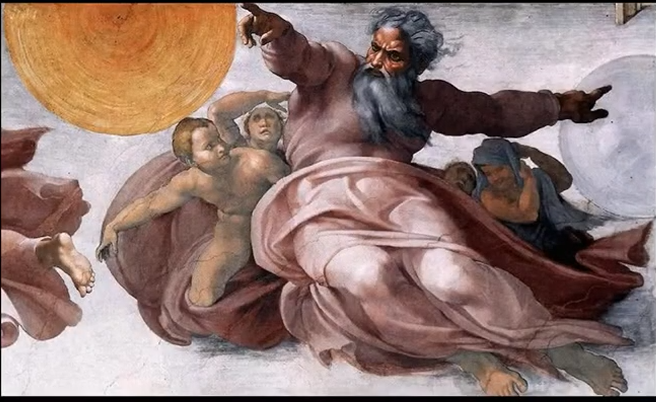
But I would also argue that, um, most of orthodox Christian theology is also incompatible with a literalist or anthropomorphic vision of God that many people have who are Christian, but they, um, read the Bible, you know, literally and have this sort of vision of God that is based on texts that predate, um, Christian theology.
And so, um, in terms of theologians and Islam to-- I'm sorry, Christianity as well-- I'm sorry, Judaism as well, so Maimonides or, um, Anselm or Thomas Aquinas and so forth, if you take their definitions of, um, of God, this also is very different for any way from a literal anthropomorphic vision of God.
So I don't think that this is in any way, um, a fair charge for Spinoza.
“Prophet of Pantheism”
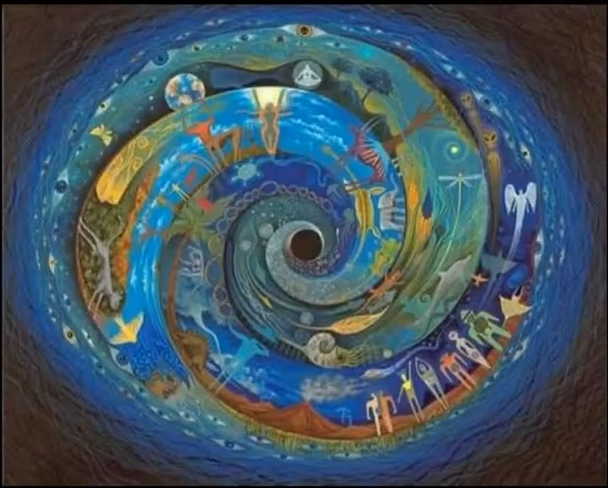 Um, and so rather, um, he's also been seen as a prophet of pantheism, um, a worldview that, you know, essentially says that God is everything. So this monist idea that God and the material universe are one, and this seems like a much more, um, uh, appropriate charge or label for, for Spinoza's system.
And that is my understanding of, uh, the theology of Spinoza, something that is very interesting to, um, uh, to contemplate, but very hard to go through the logic to, to get us there.
Glossary 1: Archaeological Sites
| Archaeological Site / Artifact | Summary of Archaeological Findings, Dating, & Significance | Source |
|---|---|---|
| None (N/A) | No archaeological sites, excavations, strata, inscriptions, or artifacts are discussed or referenced in this lecture. | 260901 |
Glossary 2: Bible Passages
| Bible Passage | Categorization & Context | Source |
|---|---|---|
| Genesis 1–3 (Anthropomorphic & Creation Accounts) | Alluded to - Portrays God with human-like features and emotions (an anthropomorphic vision of God). This literalist portrayal is contrasted with Spinoza’s theology of an infinite, non-anthropomorphic God. | 260901 |
| Genesis 12, 15, 17 (Abrahamic Covenant) | Referenced - Discussed in the context of the covenant God makes with Abraham. God promises Abraham a long life, wealth, and infinite posterity rather than a heavenly afterlife, supporting Uriel da Costa's argument that the Torah does not teach the immortality of the soul. | 260901 |
| Genesis (Book of) | Referenced - Mentioned as part of the five books of Moses (the Pentateuch) / Christian Bible that the Amsterdam city fathers protected from Uriel da Costa's critical publications. | 260901 |
| Exodus (Book of) | Referenced - Mentioned as part of the five books of Moses (the Pentateuch) / Christian Bible that the Amsterdam city fathers protected from Uriel da Costa's critical publications. | 260901 |
| Leviticus (Book of) | Referenced - Mentioned as part of the five books of Moses (the Pentateuch) / Christian Bible that the Amsterdam city fathers protected from Uriel da Costa's critical publications. | 260901 |
| Numbers (Book of) | Referenced - Mentioned as part of the five books of Moses (the Pentateuch) / Christian Bible that the Amsterdam city fathers protected from Uriel da Costa's critical publications. | 260901 |
| Deuteronomy (Book of) | Referenced - Mentioned as part of the five books of Moses (the Pentateuch) / Christian Bible that the Amsterdam city fathers protected from Uriel da Costa's critical publications. | 260901 |
Glossary 3: Books Mentioned
| Book Title | Author / Attributed Creator | Source |
|---|---|---|
| Discourse on the Method | René Descartes | 260901 |
| Elements | Euclid | 260901 |
| Ethics Demonstrated in Geometrical Order | Baruch Spinoza | 260901 |
| Examination of Pharisaic Traditions | Uriel da Costa | 260901 |
| Propositions Against the Tradition (Propositas Contro Tradicao) | Uriel da Costa | 260901 |
| The Torah (including Genesis, Exodus, Leviticus, Numbers, and Deuteronomy) | Moses (traditionally attributed) | 260901 |
Glossary 4: Chronology
| Historical Date, Era, or Century | Key Event, Battle, Reign, or Council | Source |
|---|---|---|
| 6th and 5th centuries BC | Parmenides of Elea, an influential pre-Socratic philosopher and radical monist who argued that all reality is one and unchanging, operates. | 260901 |
| 300 BC | Euclid writes his landmark book on geometry, establishing Euclidean logical proofs that would later deeply influence rationalist philosophy and Spinoza's methodology. | 260901 |
| 14th and 15th centuries | Significant numbers of Iberian Jews and Muslims convert to Catholicism (becoming "Conversos" or "New Christians") under coercion or social incentives. | 260901 |
| 1492 | The Kingdom of Granada, the last Muslim state in Iberia, is conquered by Ferdinand and Isabella, leading to the forced conversion or expulsion of all Jews and Muslims from the peninsula. | 260901 |
| 1500 | A mass baptism of Muslim converts (referred to as "Moriscos") is depicted in Granada. | 260901 |
| 1575 | The Library of Leiden University is established by William of Orange during the Dutch Revolt. | 260901 |
| 1588 | The northern provinces of the Netherlands abjure the rule of King Philip II of Spain, secede from the Holy Roman Empire, and establish the Dutch Republic. | 260901 |
| End of the 16th century | Calvinism spreads throughout the Low Countries, becoming one of the major causes for the Dutch Revolt. | 260901 |
| 1596–1650 | Lifespan of René Descartes, the French Catholic polymath, philosopher, and rationalist who spent most of his adult life in the Netherlands. | 260901 |
| 1614 | Gabriel Fuesta da Costa migrates from Portugal to Hamburg, openly converts to Judaism, and takes the name Uriel da Costa. | 260901 |
| 1623 | Uriel da Costa relocates to Amsterdam after being excommunicated by Jewish leaders in Hamburg and Venice. | 260901 |
| 1632 | Baruch Spinoza is born in Amsterdam, Dutch Republic. | 260901 |
| 1637 | René Descartes publishes his Discourse on the Method in the Netherlands, introducing his famous philosophical premise "Cogito, ergo sum." | 260901 |
| 1640 | Uriel da Costa commits suicide in Amsterdam when his distant relative, Baruch Spinoza, is eight years old. | 260901 |
| 1646–1716 | Lifespan of Gottfried Wilhelm Leibniz, the German rationalist philosopher who formulated the "best of all possible worlds" argument and the principle of sufficient reason. | 260901 |
| 1658 | Spinoza audits classes in Cartesian philosophy at Leiden University. | 260901 |
| 1661–1675 | Spinoza composes his magnum opus, Ethics Demonstrated in Geometrical Order. | 260901 |
| 1666 | A portrait of Baruch Spinoza is painted (likely his likeness). | 260901 |
| 1677 | Baruch Spinoza dies, and his Ethics is published posthumously to avoid religious persecution during his lifetime. | 260901 |
| 1755 | A devastating earthquake strikes Lisbon, causing widespread suffering and death, which prompts intense philosophical skepticism toward Leibniz's concept of the "best of all possible worlds" in the next generation. | 260901 |
Glossary 5: Geographic Location
| City, nation, region, body of water, or topographic location named in alphabetical order | Geographical and historical description | Source |
|---|---|---|
| Alberta | A province in western Canada, mentioned as a destination where Andrew is going bike riding in Banff. | 260901 |
| Amsterdam | A major city in the Dutch Republic (modern-day Netherlands) that served as a refuge for dissenting thinkers and religious refugees, and the birthplace of Baruch Spinoza in 1632. | 260901 |
| Banff | A town and mountain national park located in Alberta, Canada, noted in the lecture as an awe-inspiring natural wonder. | 260901 |
| Belgium | A modern European nation, historically corresponding to Flanders, Brabant, Hainaut, and Luxembourg—the Spanish Netherlands reoccupied by Spain during the Eighty Years' War. | 260901 |
| Dutch Republic | A confederacy of northern Netherlands provinces (including Holland, Zeeland, Utrecht, Friesland) that declared independence from Spain and became a haven of religious tolerance and free thought. | 260901 |
| Granada | The last Muslim state on the Iberian Peninsula, which fell to Ferdinand and Isabella in 1492, prompting the expulsion or forced conversion of Jews and Muslims. | 260901 |
| Hamburg | A prominent German port city where Uriel da Costa migrated in 1614, openly converted to Judaism, and was eventually excommunicated by Jewish leaders. | 260901 |
| Iberian Peninsula | A region in southwestern Europe (comprising Spain and Portugal) that was historically divided into Christian and Muslim kingdoms before being unified under Christian rule. | 260901 |
| Lisbon | The capital city of Portugal, which suffered a devastating earthquake in the generation after Spinoza, famously prompting thinkers to challenge Leibniz's optimism. | 260901 |
| Niagara Falls | A massive group of waterfalls on the border of Canada and the United States, referenced as an awe-inspiring natural wonder visited by the speaker's family. | 260901 |
| Portugal | A nation on the Iberian Peninsula, original home of Spinoza's ancestors who converted under duress to become "New Christians" while secretly practicing crypto-Judaism. | 260901 |
| Spain | A major European power that fought the Eighty Years' War to keep the Netherlands under Habsburg rule, and whose monarchs enforced religious conformity through the Inquisition. | 260901 |
| Venetian Republic | A historic maritime republic in northern Italy whose Jewish leaders joined those of Hamburg in excommunicating Uriel da Costa for his challenges to rabbinic tradition. | 260901 |
Glossary 6: Graphics Referenced
| Name and subject of charts, maps, slides, diagrams, or timelines displayed in the lecture in alphabetical order | Description of visual information conveyed | Source |
|---|---|---|
| Achilles and the Tortoise Paradox Diagram | Infographic illustrating Zeno's paradox of motion, demonstrating sequential stages where Achilles pursues but mathematically never passes a tortoise. | 260901 |
| "A Medieval Christian conception of creation" | Medieval manuscript illustration showing an active, anthropomorphic God holding a compass to measure and create the boundary of the circular cosmos, demonstrating a dualistic view where creation is separate from God. | 260901 |
| "All Aboard..." Slide | Presentation slide depicting a fast-moving modern red train next to the presenter, with bullet points summarizing Spinoza's logical train of thought about how "substance" is self-originating, unlimited, and infinite. | 260901 |
| "Creation of the Sun, Moon, and Plants" by Michelangelo | Detail of the famous Sistine Chapel ceiling fresco showing a dynamic, powerful God flying through the sky with arms outstretched, representing the traditional transcendent creator God that Spinoza rejected. | 260901 |
| "Diagram of Spinoza's metaphysics" | Concept diagram showing "Substance" at the top splitting into attributes of "extension" and "thought," which flow down into immediate and mediate "modes" (the material universe and infinite idea of God, Natura Naturata), ending with "individual things." | 260901 |
| "Every contingent fact has a sufficient reason" Image | Slide graphic featuring three fresh chicken eggs in a nest with a hen in the background, illustrating the causality cycle (the chicken and the egg) to represent the Principle of Sufficient Reason. | 260901 |
| "Library of Leiden University" | Historical print illustrating the Leiden University library in 1575, depicting large bookshelves arranged by subject (Theologia, Philosophia, Mathematica) and scholars discussing ideas, demonstrating the centers of Dutch intellectualism. | 260901 |
| Map of Iberia in 1150 and 1300 | Dual map showing the shifting political boundaries of the Iberian Peninsula, tracking the Christian kingdoms (León, Castile, Aragon, Portugal) expanding and the Muslim realms shrinking until only Granada remained. | 260901 |
| Map of the Dutch Republic and Spanish Netherlands | Geographic map detailing the territory of the independent northern United Provinces of the Dutch Republic versus the southern Spanish Netherlands held by the crown of Spain during the Eighty Years' War. | 260901 |
| "Mass baptism in Granada in 1500" | Historical painting depicting the forced conversions of Muslims (Moriscos) to Christianity, showing infants and mothers crying as a Catholic priest administers baptism in Granada, illustrating the rise of the Inquisitions. | 260901 |
| "Ontological Arguments" Slide | Presentation slide featuring a vibrant painting of a burning bush and text summarizing René Descartes' ontological argument that since existence is a perfection, a supremely perfect being (God) must necessarily exist. | 260901 |
| Portrait of Baruch Spinoza (1666) | Oil painting showing a young, dark-haired Baruch Spinoza sitting at a writing desk in a black cloak and classical white collar. | 260901 |
| Portrait of Franciscus van den Enden (1602-1674) | Close-up portrait of the ex-Jesuit Dutch philosopher, radical democrat, and Latin tutor of Spinoza. | 260901 |
| Portrait of Gottfried Wilhelm Leibniz (1646-1716) | Painting of the German rationalist philosopher and mathematician wearing an elaborate, dark, curly, full-bottomed wig and formal European attire. | 260901 |
| Portrait of Parmenides of Elea | Marble bust sculpture of the pre-Socratic Greek philosopher, depicting him with curly hair and a classical philosopher's beard. | 260901 |
| Portrait of René Descartes (1596-1650) | Oil painting showing the French rationalist philosopher with shoulder-length dark hair, a mustache, and a prominent white collar. | 260901 |
| Portrait of Uriel da Costa (1585-1640) | Renaissance/Baroque portrait painting of the Portuguese Jewish philosopher who challenged Rabbinic tradition and was excommunicated. | 260901 |
| "Spinoza's excommunication" and Name Crossed Off | Composite image displaying a historical list of Talmud Torah students where Spinoza's name is heavily crossed out with ink lines, paired with a painting depicting Spinoza walking pensively past members of the synagogue. | 260901 |
| "The meaning of Transubstantiation..." | Photograph showing a priest holding up the consecrated host and chalice during Mass, used to illustrate the theological concept of "substance" vs. physical material. | 260901 |
| "The Theology of Spinoza" Title Slide | Title graphic showing a large portrait of Baruch Spinoza next to the logo for Centreplace and the presenter's video feed. | 260901 |
| Title Page of Spinoza's Ethica | Cover page of the posthumously printed 1677 book Ethica Ordine Geometrico demonstrata, outlining its geometric method and its parts. | 260901 |
| "Uriel da Costa speaking in a synagogue" | Nineteenth-century painting showing Uriel da Costa standing on a platform, pleading his case or speaking to members of the synagogue congregation who look on skeptically. | 260901 |
| Uriel da Costa's Examination of Pharisaic Traditions Book Cover | Modern publication cover page showing the title of Uriel da Costa's controversial book which questioned the immortality of the soul and led to his persecution. | 260901 |
Glossary 7: Linguistics Terms
| Linguistic, philological, grammatical, or language-acquisition terms | Explanation and pedagogical definition | Source |
|---|---|---|
| Literal reading | A method of interpreting a text based on the direct, primary meaning of its words, without relying on allegorical, mystical, or subsequent rabbinic interpretations. | 260901 |
| Pejorative | A word or phrase used to express contempt, disapproval, or a low opinion of someone or something, such as the historical term "Marranos" used for converted Jews. | 260901 |
| Synonym | A word or phrase that means exactly or nearly the same as another word or phrase in the same language, as Spinoza treats the words "God" and "nature." | 260901 |
Glossary 8: Non English Words
| Non-English, ancient, and transliterated terms | English definition and translation | Language of origin |
|---|---|---|
| ousia | Substance, essence, or fundamental independent reality | Greek |
| Baruch | Blessed (the Hebrew first name of Spinoza) | Hebrew |
| Beit Yaakov | House of Jacob (the name of the synagogue in Amsterdam) | Hebrew |
| Talmud Torah | Study of the Law / Study of the Torah (the name of the school attached to the synagogue) | Hebrew |
| Torah | Law, teaching, or instruction (specifically referring to the first five books of the Hebrew Bible) | Hebrew |
| causa sui | Cause of itself / self-causing | Latin |
| cogito, ergo sum | I think, therefore I am | Latin |
| De Deo | On God (the title of the first part of Spinoza's Ethics) | Latin |
| Deus sive Natura | God or Nature | Latin |
| natura naturans | Nature naturing (the active principle or self-generating aspect of God/Nature) | Latin |
| natura naturata | Nature natured (the passive, created effects/modes flowing from God/Nature) | Latin |
| sui generis | Of its own kind / unique / self-generating | Latin |
| Propositas Contro Tradicao | Propositions Against the Tradition | Portuguese |
| Conversos | Converts (Jews or Muslims who converted to Christianity under duress/incentives in Iberia) | Spanish |
| Marranos | Swine / Pigs (a pejorative term used for Jewish converts to Christianity) | Spanish |
| Moriscos | Little Moors (a pejorative term used for Muslim converts to Christianity) | Spanish |
Glossary 9: People Named
| Individual Named | Biographical Description and Role | Source |
|---|---|---|
| Achilles | Hero of Greek mythology, featured in Zeno's paradox of motion racing against a tortoise. | 260901 |
| Anselm of Bec | Medieval theologian and philosopher who formulated an ontological argument for God's existence. | 260901 |
| Baruch Spinoza (Spinoza) | Dutch philosopher (1632–1677) known for his monist metaphysics, theology, and his magnum opus Ethics. | 260901 |
| Charles V | Habsburg Holy Roman Emperor who inherited a vast empire and fought Protestantism. | 260901 |
| Edwin Curley | Philosophy professor at the University of Michigan who specializes in Spinoza. | 260901 |
| Euclid | Ancient Greek mathematician writing around 300 BC whose geometric proofs served as a template for Spinoza's Ethics. | 260901 |
| Ferdinand | King of Aragon who, with Isabella, conquered Granada in 1492 and forced religious conversions or expulsion. | 260901 |
| Franciscus van den Enden | Former Jesuit and Latin tutor of Spinoza who introduced him to Descartes and proposed a New World radical democratic utopia. | 260901 |
| Gottfried Wilhelm Leibniz (Leibniz) | German rationalist philosopher and mathematician (1646–1716) who argued this is the best of all possible worlds. | 260901 |
| Heraclitus | Pre-Socratic Greek philosopher who argued everything is in constant flux. | 260901 |
| Isabella | Queen of Castile who, with Ferdinand, ordered the expulsion or conversion of Jews and Muslims in 1492. | 260901 |
| John Locke (Locke) | Early modern English empiricist philosopher who argued knowledge is gained through observation of the sensible world. | 260901 |
| Maimonides | Medieval Jewish philosopher whose philosophical definitions of God differ from literal anthropomorphic views. | 260901 |
| Martin Luther | Protestant Reformer mentioned in comparison to Uriel da Costa for nailing up theses challenging church traditions. | 260901 |
| Michael de Spinoza | Baruch Spinoza's father, a wealthy Amsterdam merchant and synagogue officer. | 260901 |
| Moses | Biblical figure traditionally credited with writing the Torah. | 260901 |
| Parmenides of Elea (Parmenides) | Pre-Socratic Greek philosopher (6th and 5th centuries BC) who argued that all reality is one and unchanging. | 260901 |
| Philip II of Spain | Habsburg monarch who ruled Spain and the Netherlands, whose reign sparked the Dutch Revolt. | 260901 |
| Plato | Ancient Greek philosopher who advocated dualism and the theory of eternal forms. | 260901 |
| René Descartes (Descartes) | French rationalist philosopher (1596–1650) famous for "I think, therefore I am" and his ontological argument for God's existence. | 260901 |
| Socrates | Ancient Greek philosopher who examined the nature of knowledge, ethics, and reason. | 260901 |
| Thomas Aquinas | Medieval Catholic theologian and philosopher whose definitions of God contrast with anthropomorphic portrayals. | 260901 |
| Uriel da Costa (Gabriel Fuesta da Costa) | Relative of Spinoza and Jewish philosopher (1585–1640) who challenged Rabbinic tradition and eventually committed suicide. | 260901 |
| William of Orange | Leader of the Dutch Revolt who established Leiden University in 1575. | 260901 |
| Zeno | Ancient Greek philosopher and disciple of Parmenides who proposed mathematical paradoxes to defend monism. | 260901 |
Glossary 10: Philosophical Terms
| Philosophical terms, logical fallacies, metaphysical concepts, or ethical frameworks | Explanation of philosophical concept | Source |
|---|---|---|
| Attribute | In Spinoza's metaphysics, a characteristic or expression of the single infinite substance (God or Nature) that the intellect perceives as constituting its essence. The lecture mentions that Spinoza specifies only two attributes: thought and extension. | 260901 |
| Causa sui | Latin for "self-causing." A philosophical term indicating something that contains its own cause or reason for being, originating entirely from itself and not dependent on any external cause. | 260901 |
| Compatibilism | A philosophical framework proposing that free will and determinism are mutually compatible and can coexist within the same system. | 260901 |
| Consubstantiation | A theological concept utilizing the philosophical definition of "substance" to describe how different divine entities or persons of the Trinity share the same fundamental substance. | 260901 |
| Determinism | The philosophical view that all occurrences, including human actions and choices, are completely determined by previously existing causes or natural laws, rendering the traditional concept of human free will an illusion. | 260901 |
| Dualism | A metaphysical framework, such as Plato's or Descartes' philosophy, which posits that reality consists of two distinct, independent substances (e.g., a transcendent God and a separate creation, or mind and body). | 260901 |
| Empiricism | The early modern philosophical tradition, represented by thinkers like John Locke, which asserts that knowledge is not innate but is best acquired through sensory observation and experience of the material world. | 260901 |
| Metaphysics | The branch of philosophy concerned with the fundamental nature of reality, existence, and the underlying principles of the universe, including concepts like substance, cause, and being. | 260901 |
| Mode | In Spinoza's metaphysics, the "affections" or finite and infinite expressions of the single substance. Modes are dependent on the substance (God or Nature) for their existence and conception. | 260901 |
| Monism (Radical Monism) | The metaphysical position asserting that all of reality is ultimately composed of a single, unified substance, rejecting any fundamental division or separation between God and the universe. | 260901 |
| Natura naturans | Latin for "nature naturing." Spinoza's term for the active, self-causing, dynamic aspect of the single substance (God or Nature) as the active principle from which all things flow. | 260901 |
| Natura naturata | Latin for "nature natured." Spinoza's term for the passive aspect of the substance, consisting of the finite and infinite modes (effects, individual things) that flow from the active principle. | 260901 |
| Ontology (Ontological Argument) | The study of existence and being. An ontological argument (such as those by Anselm, Descartes, or Spinoza) attempts to prove the necessary existence of God strictly through logical reasoning about the definition of being or perfection. | 260901 |
| Principle of Sufficient Reason | The rationalist philosophical principle asserting that every contingent fact, event, or state of affairs must have a sufficient reason, cause, or ground explaining why it is so and not otherwise. | 260901 |
| Rationalism | The philosophical doctrine, championed by Descartes, Spinoza, and Leibniz, which regards human reason as the chief source, test, and validator of knowledge. | 260901 |
| Substance | Traditionally defined by Aristotle as the fundamental independent reality underlying all things. Spinoza redefines it as that which exists in itself and is conceived through itself, being completely independent, infinite, and singular. | 260901 |
| Transubstantiation | The Catholic theological doctrine explaining the Eucharist, which asserts that the underlying substance of the bread and wine changes into the body and blood of Christ, while their physical, material properties remain the same. | 260901 |
Glossary 11: Previous Lectures or Episode
| Name of previous lecture or episode mentioned (in alphabetical order) | Concise description of the lecture/episode | Date of Original Release | Source |
|---|---|---|---|
| A History of the Afterlife | Traces the development of modern ideas about the afterlife, heaven, and hell from pagan origins to the present. | 2024-05-20 | 260901 |
| Proving God's Existence: The Ontological Argument | Explores the history and formulations of the ontological argument, focusing primarily on Anselm of Bec. | 2026-08-29 | 260901 |
| The History of Free Will | Traces the debate between free will and determinism from antiquity to the Middle Ages. | 2024-05-07 | 260901 |
Glossary 12: Religious Studies Terms
| Religious studies, theological, and critical terms | Scholarly definitions and descriptions of how the terms are used in context | Source |
|---|---|---|
| Abrahamic religions | Religions (Judaism, Christianity, Islam) that trace their origin back to the patriarch Abraham and traditionally worship a transcendent, creator God. | 260901 |
| Calvinism | A major branch of Protestant theology that spread in the Low Countries during the 16th century, leading to iconoclasm and conflict with the Catholic Habsburg rulers. | 260901 |
| Consubstantiation | A theological doctrine regarding the real presence of Christ in the Eucharist, where the substance of the bread and wine coexists with the substance of Christ's body and blood. | 260901 |
| Crypto-Judaism | The secret adherence to Judaism while publicly professing another faith. The Spanish and Portuguese Inquisitions actively hunted down Conversos suspected of this practice. | 260901 |
| Iconoclast | A person who destroys religious images or opposes their veneration. The lecture mentions Calvinist iconoclasts destroying religious statues in Holland. | 260901 |
| Inquisition | An ecclesiastical tribunal established by the Catholic Church (specifically the Spanish and Portuguese inquisitions in the lecture) to hunt down and punish heresy and crypto-Judaism. | 260901 |
| Monotheism | The belief in a single, supreme, transcendent personal God who created the universe, contrasted in the lecture with Spinoza's radical monism. | 260901 |
| Protestant Reformation | The 16th-century religious, intellectual, and cultural upheaval that splintered Catholic Europe, initiating new branches of Christianity like Calvinism. | 260901 |
| Rabbinic Judaism | Mainstream Judaism based on both the written Torah and rabbinic commentaries, whose legalistic and ritualistic focus was challenged by Uriel da Costa. | 260901 |
| Second Temple Judaism | The historical phase of Judaism (c. 515 BCE to 70 CE) during which theological ideas like the afterlife and the immortality of the soul first developed. | 260901 |
| Theology | The systematic study of the nature of the divine, religious doctrines, and beliefs. The lecture specifically focuses on Spinoza's theology. | 260901 |
| Transcendent God | A theological concept of God as being entirely separate from and existing outside of the physical cosmos, a view held by orthodox Abrahamic traditions and rejected by Spinoza. | 260901 |
| Transubstantiation | The Catholic theological doctrine that the bread and wine offered in the Eucharist are completely changed in substance into the actual body and blood of Christ. | 260901 |
Glossary 13: Scientific Terms
| Scientific, cosmological, physical, or biological terms named in alphabetical order | Scientific explanation and contextual relevance | Source |
|---|---|---|
| Biodiversity | The variety of plant and animal life in the world or in a particular habitat, a high level of which is usually considered to be important and desirable. In the lecture, the speaker notes the rich diversity of life on Earth, specifically mentioning how beavers create incredible amounts of biodiversity when reintroduced to desolate habitats. | 260901 |
| Logarithmic | Relating to a logarithmic scale or progression; mathematical divisions that decrease or increase exponentially. The speaker references a "logarithmic thing" occurring in Zeno's paradox (Achilles and the Tortoise), where Achilles continuously covers fractional increments of distance but mathematically never catches the tortoise. | 260901 |
| Physical cosmology | The branch of physics and astrophysics that deals with the study of the physical origins, evolution, and large-scale structure of the universe. The speaker mentions that incredible advances in physical cosmology in their lifetime have revealed a universe so vast and ancient as to be inconceivable, which naturally resonates with Spinoza's proposition of an infinite universe. | 260901 |
| Speed of light | A fundamental physical constant representing the maximum speed at which all conventional matter, energy, and information in the universe can travel. The speaker cites the speed of light and gravity as examples of "infinite modes"—ongoing, absolute physical laws that dictate how Spinoza's dynamic universe functions. | 260901 |