Transcript
Introduction
Contradictions in the Passion Stories by Centre Place

Contradictions in the Passion Stories
Contradictions in the Passion Stories by Centre Place
Transcript
(476) Contradictions in the Passion Stories - YouTube
https://www.youtube.com/watch?v=fkMLZlWHpYw
Transcript:
(00:05) Good evening, welcome to our History, Theology, Philosophy lecture series. I'm John Hamer, and I'm streaming to you, as always, from Toronto Centre Place, where Leandro is with me monitoring your comments and questions on the various platforms where we're streaming, so that after the formal lecture, we can have our regular interactive Q&A and dialogue. I remind you, as always, that these lectures all build on one another. We've done hundreds of hours of them now, and if you want to go back and find any one of those, they're conveniently located at
(00:44) our website, centreplace.ca/lectures, where you can sort them by category. Although, at this point, some of the categories are really long, so maybe we need subcategories—more subcategories. As we're looking forward to upcoming lectures, the one tonight is part of a series of different Easter lectures that we're doing this Easter season. So, next week we're going to do part two, which is "Contradictions in the Easter Stories." We'll look at how each of the individual canonical gospels, and some of the gospels that didn't make it into the
(01:25) canon, tell different details of the Easter stories. Tonight's lecture is going to tell the trial, and so it'll pick up the crucifixion and the resurrection stories. And the week after that, we're going to have a real treat, because Leandro, fresh off of his graduation from seminary, is going to come back and do a lecture for the first time since he enrolled. And so he's going to look at this very popular idea, in the 19th century anyway, that associated Jesus and Christ and the Easter story
(02:09) with what's now maybe looked at as a problematic category that people came up with in the 19th century called the "Dying and Rising Gods"—so, different gods that died and then are resurrected. Leandro is going to look at where that idea came from and maybe some differences and some similarities in the Christian story. Our lectures are listener-supported. If you'd like to make a donation, we really appreciate the super chats that people give in YouTube and stars on Facebook. You can also make a
(02:47) contribution to get it with a tax receipt by going to our website, centreplace.ca/donate. Our topic this evening is "Contradictions in the Passion Stories." This is part of our Easter series, this is the first part. And so, what we're going to look at is the ways, especially the four canonical gospels, tell the story leading up to Jesus's crucifixion. And then, in the next part that we'll do next Tuesday, we will look at the crucifixion stories themselves and the Easter stories—the resurrection stories.
Earliest Passion Accounts
(03:37) The very earliest account of the passion stories doesn't come from the gospels; it comes, as is normal, from Paul, who is of course the first Christian whose writings survive. And so we read in his letter to the Corinthians, his first letter to the Corinthians, chapter 15, this very often quoted passage where Paul says, "I handed on to you this community that he has planted as of first importance what I in turn had received."
(04:14) So this is something that he didn't formulate, but this is something that is central to his understanding of what it means to be Christian, as the emerging group is going to be known: that Christ died for our sins in accordance with the scriptures, that he was buried, and that he was raised on the third day in accordance with the scriptures. So that's the component of the living Jesus of Nazareth, but then after his death, that he appeared to Cephas (that is to say Peter) and then to the twelve, and then he appeared to more than 500 brothers and sisters at one time,
(04:56) most of whom are still alive at the time Paul was writing this letter, though some have died, he admits. Then he appeared to James, Jesus's brother, then to all the apostles, who Paul understands to be a much larger group of missionaries than simply the twelve. Last of all, as to one untimely born, he appeared also to me, Paul says. So although, as you can kind of see in that, Paul is much more concerned with appearances of the risen Christ to the twelve, to all of these women and male disciples, apostles, and also other figures, his narrative does include the
(05:40) idea that Christ died for our sins, was buried, and was raised on the third day, and that this was all in accordance with what the scriptures had said—that is to say, as he is reading the Hebrew Bible translated into Greek, the Septuagint, which is now becoming the Christian Old Testament, that that is predicting his understanding of what the Messiah is, what the Christ is, and Jesus's life and resurrection is therefore in accord with that. So in addition to that really important kind of very early version of
(06:19) the passion, in that same letter to the Corinthians, Paul gives details about what we call the Last Supper and also about Jesus's betrayal. And so he says, "I received from the Lord, but I also handed on to you," that same kind of formula. This is an important thing he is what he's saying: that the Lord Jesus on the night when he was betrayed took a loaf of bread, and when he'd given thanks, he broke it and said, "This is my body that is for you; do this in remembrance of me."
(06:59) And in the same way, he took the cup also after supper, saying, "This cup is the new covenant in my blood; do this as often as you drink it in remembrance of me." So that last part is already becoming a spiritual practice, a sacramental formula, and we're seeing in that the prototype of what's going to be the Christian sacrament of communion, or Eucharist, or the Lord's Supper. And so Paul is aware of that tradition being associated with the night that Jesus was betrayed, or when Jesus was handed over. Paul also cites crucifixion as the method of Jesus's
(07:47) execution in multiple places, and in that same letter to the Corinthians, he indicates that those responsible for the crucifixion were the quote "rulers of this age." So Paul says, "You know, we speak God's wisdom, a hidden mystery which God decreed before the ages for our glory, and which none of the rulers of this age understood." So this hidden mystery, this Christ that has existed before all of the ages, is something that we are testifying of, but none of and which none of the rulers of this age understood; for if they had, they would
(08:29) not have crucified the Lord of glory. So the rulers of this age crucified the Lord, who is Christ, who is Jesus. All of these statements that Paul is making accord with the little we can know about the historical Jesus's execution from non-Christian sources. And so, in the Roman historian Tacitus, who wrote a book of Annals at the very beginning of the 2nd century, who is actually very negatively disposed towards Christianity (he calls it a "most mischievous superstition"), Tacitus likewise confirms that Christus, as
(09:14) he calls him, from whom the name of the religion has its origin, suffered the extreme penalty—that is, he was executed during the reign of Tiberius at the hands of one of our procurators, Pontius Pilatus. So this confirms that the Romans were responsible for the execution, the official in charge was Pontius Pilate, and although Tacitus here calls him a procurator, this is because contemporary Judea is run by procurators. At the time of Pilate, it was actually a prefect; in any event, it's a similar thing. So he's a prefect in the portion of his account
(09:53) of Jesus that most scholars today accept as authentic. The Jewish-Roman historian Josephus gives us similar information in his Jewish Antiquities book. So he says, "And when upon the accusation of the principal men among us—that is to say, Jewish authorities in Jerusalem—when they accused him, Pilate had him, Jesus, condemned to a cross; and those who had first come to love him did not cease."
(10:28) So even though Pilate crucified the founder of this movement, Jesus, the movement didn't end with him; so the movement didn't cease. So again, this confirms that Pilate is the official in charge of the execution. The standard Roman method of execution is employed: crucifixion. But this adds the detail that certain Jewish authorities brought the accusation, so there's something going on in the local politics, and both leaders—the locals and also the Roman authorities—were ready to get rid of this guy. So this much, at least, is historical.
Timeline and Historicity
(11:11) So we have the idea that Jesus of Nazareth, the historical Jesus, traveled from Galilee where he was from and where the bulk of his career had been lived, to Jerusalem where he's then betrayed by one of his own disciples to Roman authorities under the command of the prefect Pontius Pilate. And Pilate is probably acting with support of a faction of the local leaders. Pilate is pretty confirmed as a historical figure; we actually have a contemporary inscription that he had erected in the provincial capital, Caesarea Maritima. So the Caesar,
(11:53) city on the Mediterranean that bears Pilate's name, and Pilate then had Jesus executed by crucifixion.
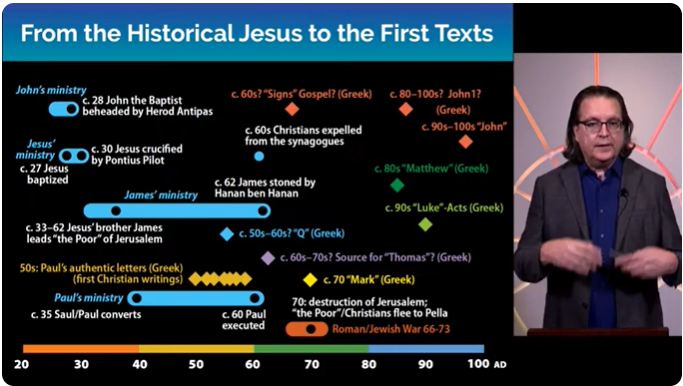
So if we do a little bit of a timeline to ground ourselves: Jesus's ministry then is at the very end of the 20s probably, and he's probably crucified around 30, sometimes estimated to 33. The Christian/proto-Christian communities continue on; so they wouldn't have been called Christian at first. The central community in Jerusalem is led by Jesus's brother James, and we've called it before "the poor of Jerusalem." Maybe around 35, Paul converts
(12:40) and starts to be a sort of self-appointed or an appointed apostle by vision. And in the course of that, as he is establishing Christian communities beginning in the 50s, he starts writing these letters, which are the earliest Christian sources that survive. Possibly then in that same time is when some of the other Christian writings that don't survive are composed, and that could include the source that scholars call Q, the sayings gospel, and also potentially a signs gospel, which would be a source or the earliest
(13:23) component of the gospel of John; maybe also an early saying source for the gospel of Thomas; and also in here may be an early passion source, that is, a source for both Mark and John and some of the other early gospels. By the time we get to 66 to 73, there is the Roman-Jewish war, that includes the destruction of Jerusalem, the ending of the community there—the Christian community there that has to flee to a town called Pella—and that is the context in which the author of Mark is writing the first
(14:00) narrative gospel and the first gospel that survives. And then from there come the next gospels that made it into the canon: Matthew, Luke, and John. So that grounds us. There is significantly more detail about the passion stories given in the four canonical gospels than that little bit that we can glean out of Paul, and so this may include additional events that have historicity. Each of these early Christian communities that produce the gospels have an oral tradition that's coming down to them,
(14:44) but they also undoubtedly include details that are literary—in other words, that don't go back to the historical Jesus. And while all four versions are broadly similar, each gospel differs in specific details, and this is because the gospel writers are not historians, and they're not seeking to create a biography or a history, but rather they have a religious portrait where they're attempting to have the idea of proclaiming Jesus as the Messiah, proving that to readers so that people will become one in this
(15:26) new movement in the body of Christ. So the passion stories are very, very important to that end in each of the gospels, and so in all the narrative gospels, the canonical gospels, just this final one week in Jesus's life actually takes up a significant component of the writing.
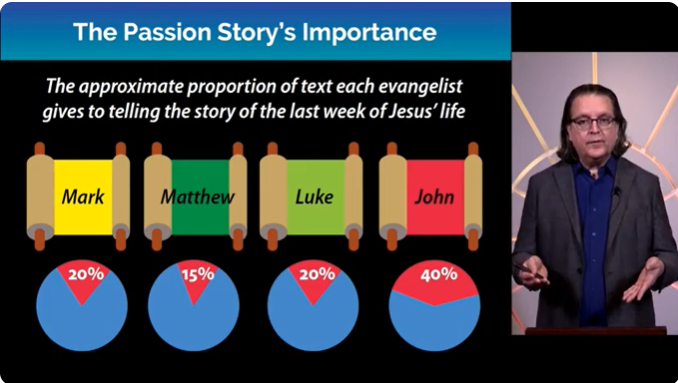
So, about 20% of Mark and Luke is devoted to the last week, 15% of Matthew, and fully 40% of the Gospel of John is all devoted to this one week. Normally, as we do these kind of gospel studies, we expect that the accounts in Mark, Matthew, and Luke are
(16:14) going to be very, very similar, and the gospel of John is going to be kind of an odd man out which tells the story very differently. And that's because Mark is a source for Matthew and Luke; the authors of Matthew and Luke have the text of Mark right in front of them as they are writing their gospels. Specifically, you know, Luke says that they are critical of people who've tried to tell this story before, and so Luke doesn't particularly like the way that Mark has told the gospel and is correcting or changing things
(16:52) that Luke reads in Mark's text, and is in some cases deleting a bunch of it. Matthew is doing something similar, although the author of Matthew doesn't say so explicitly the way Luke does, and we can also tell that the author of Matthew is far less likely to delete things, although he will also make corrections. Normally, though, the gospel of John is a completely different literary tradition; it's not literally dependent on either of the three. So the author of John does not have a copy of one of these three, or all
(17:31) of these three gospels in front of them, but instead is drawing from some of the same sources in the sense of there's an oral tradition and there is also one more written tradition that they all do have access to. But the passion narrative is strange. So when we were just talking about this last week, the Gospel of John now suddenly shares an unusual amount of really specific details, and even phrases and characters and so on, with the other three gospels. And so this sudden alignment that the fourth gospel
(18:12) has with the other three has long suggested to scholars that there's maybe some additional relationship between the two traditions for at least this section of the story. And so there's a couple possibilities, which is maybe, maybe the authors of John were actually aware of Mark, or maybe at least the passion section of Mark. So maybe that might be something like where the author of John has been to a community where Mark is being read and they've heard it read, they remember what's being said, and they come back, they don't have
(18:51) a copy of it, and are reacting to it or are making use of it in some way. So that's possible. If so, then John is maybe trying to fix Mark the way the other two authors did, at least about this portion, the passion portion. Another possibility that a lot of scholars have floated is that there is this pre-Markan source, something that the author of Mark is making use of—a lost passion gospel that would be pretty bare bones and simple—that doesn't exist anymore, but that same
(19:30) passion source is being used then by the author of Mark, and is also being used by the authors of John. This may be a source that is underlying other fragments that we have, like the gospel of Peter, which doesn't make it into the canon but some scholars like John Dominic Crossan say may be dependent on this lost passion gospel source. That said, whereas the other source for the synoptics, the lost and then hypothetical gospel Q, the sayings source—whereas that I think is the scholarly consensus that describes most
(20:15) conclusively how it's possible—the relationship between Matthew, Luke, and Mark—this one, this idea of a lost passion gospel, isn't anywhere near as clear-cut. And it's because it's harder to see like very direct literary seams. So you can see in Matthew and Luke they have all of these sayings of Jesus that are very, very similar to each other that are not in Mark, and so they've got to have taken them from somewhere. In the passion source here, we would have a lot of details that are very compelling as to
(20:52) how similar they are, but it isn't clear that they have directly copied from something that they're literally dependent on each other. So of course there's other traditions again that the gospels are preserving—non-witness accounts. Each one of these is also being produced by an early Christian community; that community has its own traditions. They're not eyewitnesses, but they have known eyewitnesses maybe. And in any event, another thing that has happened is that they have also grown out of a
(21:28) tradition of Christian apostles, Christian prophets, walking around and speaking in the spirit, and in a lot of cases speaking in the spirit about the risen Christ. And so they also may not be able to tell within their own tradition what is supposed to have gone back to the historical Jesus and what maybe is a vision of a Christian apostle speaking in the spirit. Nevertheless, some of the things that are included within the, let's say, special Matthean tradition or Lucan tradition or Johannine tradition, may include memories of the
Scriptural Sources and Typology
(22:00) historical Jesus. But one thing that we can tell is that all of these evangelists are using another written source: the Septuagint. So the scriptures, like Paul was talking about. Because each one of these early Christians believed, like Paul testified, that Jesus's life was lived in accordance with the scriptures, whenever they were writing something about—you know, they're trying to write out what Jesus's life was like, and they don't have any memory of that time period, they don't have any memory of those details—well, they could just go
(22:41) back to the Septuagint. They can just go back to the Old Testament and find some kind of a quotation—certainly Messianic prophecies, but in a lot of cases just quotations in general—and say, "Well, because Jesus's life was lived according to the scriptures, and this is in the scriptures, this is something that he must have done." And so they would directly bring things from the Old Testament and rework it as something in Jesus's life. So we can see that happening in the passion stories in a lot of places, and I can just list here some of the
(23:22) most obvious ones. So, the Psalms. The Book of Psalms includes a collection of poems; it includes an abstract figure that scholars call the "innocent sufferer." So, as you were kind of saying, the speaker is embodying the innocent sufferer, and early Christians identified the innocent sufferer as prefiguring Christ typologically. So, this is a way that God is communicating and talking about universal truths. This ancient source is talking about
(24:02) what would then be lived in Christ. And so in Psalm 22, which is a lament of this innocent sufferer, he mourns, "My God, my God, why have you forsaken me?" And so this provides the direct literary source for Jesus's last words as given in the Gospel of Mark. So in Mark 15:34, we read, "At 3:00 Jesus cried out with a loud voice, 'Eloi, Eloi, lama sabachthani?' which means, 'My God, my God, why have you forsaken me?'" So that same innocent sufferer in the Psalms provides additional details for how Jesus is treated on the cross. So we read in the Psalms, "They gave me poison
(24:56) for food, and for my thirst they gave me vinegar to drink." And so that detail, taken from the Psalms, is added into Mark's account of the crucifixion of Jesus, where we read, "Someone ran, filled a sponge with sour wine, put it on a stick, and gave it to him to drink." Another example is the soldiers wagering over the division of Jesus's clothing. In Mark, "They crucified him and they divided his clothes among them, casting lots to decide what each should take." So that's Jesus's clothes being divided by the soldiers, and that, again,
(25:37) is drawn directly from Psalm 22 where it says, where the innocent sufferer says, "They divided my clothes among themselves, and for my clothing they cast lots." So the Septuagint, the Old Testament, is a source that is available to the authors of Mark, Matthew, Luke, and John; and sometimes they access it indirectly. Matthew and Luke connect to it indirectly by the fact that Mark has built from it first. That said, because many readers, Christians both in antiquity and today, assume that the gospels are
(26:21) historically accurate—in antiquity they assumed that this sort of thing happened—in modern times we have a brand new and very specific idea of historicity that wasn't available to the ancients because they didn't have our modern understanding of academic history. Nevertheless, many readers read it as if it's all history. Christians then tend to conflate all four accounts together; in other words, they may be recognizing that these aren't all the same account, and yet since it's all describing one
Jesus's Entry into Jerusalem
(27:00) thing that just happened, the way to make sense of it is to simply glump it all together. And therefore, essentially, all of the different details are not seen as contradictions but rather are glumped together as missing in the others. But this misunderstands what the evangelists are trying to do and the portraits the evangelists individually are trying to paint. So for example, since we know that the author of Luke is using Mark as a source, when there is a detail in Mark—when there's a Markan detail and Luke deliberately deletes that—you
(27:37) know, again, that's a deliberate omission because Luke is seeing that and saying, "Okay, well I don't want to have that; that doesn't fit my understanding of Jesus, that's not part of the portrait I'm trying to paint." And so if we then lump it back in and just make a big salad of all of the gospels, we're missing the portrait that Luke is trying to paint, and so on. By lumping them all together, you're missing the individual portraits. So in all four canonical accounts of the passion story, as I say,
(28:10) Jesus and his disciples have come from Galilee. So they're from up there, this northern region which has a very mixed population; so there's Greeks and Jews. It's not all—and it's also not ruled directly by the Romans the way Judea is. So Judea, the province that includes Samaria and Idumea, centered on Jerusalem and Caesarea, that's what's ruled by Pontius Pilate. Galilee and Perea are under one of the Herodians, the Tetrarch; as is
(28:58) another region up there, Ituraea and Trachonitis. And all of this orange area here—Gilead and Phoenicia and Gaza—are directly part of the Roman province of Syria. So it's all Roman, but it's administered differently. Anyway, so Jesus and his followers, who are from Galilee, have come down to Jerusalem to celebrate the Passover festival. But then the details in all the four accounts differ, including the chronology. They encounter opposition from Roman and Jewish authorities in the city who are able to arrest Jesus with the help of one of his own disciples—so,
(29:33) a traitor—and then those authorities have a trial and execute him in all four passion narratives. So in Mark, the earliest of these narrative gospels to survive, the events of the last week of Jesus's life kick off as Jesus and his disciples are approaching Jerusalem on this trip. They arrive at the villages of Bethphage and Bethany—so these are little villages sort of immediately east of Jerusalem—and he instructs his disciples to find a colt which he then rides into Jerusalem. And on hearing of his arrival, this vast crowd gathers, and they lay
(30:18) down their cloaks in front of his path and also leafy branches, in this huge celebration. They're all excited that he has arrived in the city. The crowd shouts hosannas, recognizing Jesus as the Messiah, but with variations in each gospel. I think this is interesting, the way each one of these is recorded. So in Mark, what the crowd says is, "Hosanna! Blessed is the one who comes in the name of the Lord! Blessed is the coming kingdom of our ancestor David!"
(30:51) So David is the model of the kingship, but the crowd here isn't shouting that Jesus is the king; "Blessed is the king," in this particular case, it's one coming in the name of the Lord, coming into the kingdom of our ancestor David. In Matthew, though, the crowd shouts, "Hosanna to the Son of David!"
(31:15) And so "Son of David" is a phrase that essentially means to the Messiah, to the prince, a person who should be the heir to the king. "Hosanna to the Son of David! Blessed is he who comes in the name of the Lord! Hosanna in the highest heaven!" In Luke we have, "Blessed is the king who comes in the name of the Lord! Peace in heaven..." Luke is very interested in Jesus as the Prince of Peace; this is another thing that the angels declare at his birth in the Lucan story, "...and glory in the highest heaven!" That also reminds you a little
(31:55) bit about the angels singing in the Lucan Christmas story. And in John, what the crowd says is, "Hosanna! Blessed is the one who comes in the name of the Lord, the King of Israel!" So these later two gospels are making the claim that the crowd was actually shouting out the king. It's only in Luke that Pharisees in the crowd, who are really nervous about this spectacle, say essentially, "You know, all of these people are calling you king." They yell to Jesus, "Teacher, order your disciples to stop!" to which Jesus answers, "If these
(32:34) were silent, the stones would shout out." So that is Luke's detail. Although Mark does not say so explicitly, the crowd here is reacting to the fulfillment of a Messianic poem. It's not just early Christians who are among the sects of Judaism that are awaiting a Messiah; apocalypticism has become extremely popular and many are waiting—waiting for a Messiah, and they read through the Hebrew scriptures in order to find them. So in Zechariah chapter 9, there is a poem where it says, "Rejoice greatly, O daughter Zion! Shout aloud, O daughter
(33:21) Jerusalem! See, your king comes to you; triumphant and victorious is he, humble and riding on a donkey, on a colt, the foal of a donkey." So, even though that's a Messianic prophecy that Mark is aware of, which is why Jesus was riding on a donkey, and he's a king and people recognize him as a king entering Jerusalem, Mark doesn't actually explicitly quote that scripture. Nor does Luke in Luke's repetition of Mark's story. John, however, is aware of the prophecy which he quotes, though presumably from memory,
(34:07) since he misquotes it. So he says, "Do not be afraid, daughter of Zion. Look, your king is coming, sitting on a donkey's colt." So it's kind of a reworking of the prophecy, not a direct quote. And this is not unusual at all in antiquity because people tended to take scripture and they memorized it a lot more. There was a lot more memorization; people had less access to the books, they had fewer books, and memorization was more part of learning. And this is something that we have the author of Mark constantly doing, too. Mark
(34:41) frequently misquotes, because we can tell, therefore, that Mark doesn't have the scrolls in front of him as he's quoting or having Jesus quote the New Testament—sorry, the Old Testament—in creating his teachings. And so then often, because Matthew, the authors of Matthew, and the author of Luke know the scriptures better, they will silently correct the quotes that Mark is sort of making from memory, kind of misquoting. Matthew also quotes the Septuagint of Zechariah; he does it actually properly, so Matthew probably
(35:19) has access to the scrolls. But the Septuagint has actually mistranslated the original Hebrew to read... So, the original Hebrew had said, "riding on a donkey, on a colt, the foal of a donkey," and so this is just part of normal Hebrew poetry repetition. But in the Septuagint it becomes, "riding on a donkey and on a colt, the foal of a donkey," as if there's two different animals here. And so this causes Matthew to have, in Matthew's version of the story, Jesus riding on both a donkey and also with her colt by her. And so that is where we get all of
(35:55) these pictures where Jesus has two animals. So this comes from, anyway, a misreading and a misinterpretation of the Hebrew poetry in Zechariah's prophecy. So in the Gospel of Mark, this episode, this Palm Sunday episode, is followed the next day by Jesus entering the temple, which is a vast platform; it has a market and everything, it's not just the little temple. He doesn't actually get to go into the Holy of Holies or anything like that. This is the outer portions of the temple where there's a marketplace, where he overturns
The Temple Conflict
(36:31) the tables of the money changers and also those selling doves to be sacrificed. Matthew and Luke follow Mark's narrative, but in John—John has the story and knows the story, but it's not part of the passion. The authors of John have taken it and relocated the story to the very beginning of the gospel, immediately after the story of the Wedding at Cana, the story where Jesus turns water into wine. It's a story that exists only in John; it's the first of the signs, potentially, of the signs gospel as a source of John. But in any event, it's the
(37:12) beginning of the ministry in John. And so unlike the synoptics, the Gospel of John has Jesus going to Jerusalem multiple times in order to, for example, insert this story very early in his ministry, as opposed to where it is in Matthew, Luke, and Mark. In the synoptics, Jesus's actions in the temple are cited as contributing to the decision by Jerusalem authorities to seek to rid themselves of him. So we read in Mark 11:18, "When the chief priests and scribes heard it"—when they heard that he'd done all of this overturning of the
(37:56) money changers' tables—"they kept looking for a way to kill him, for they were afraid of him, because the whole crowd was spellbound by his teachings." So this guy has become really popular; they just saw how popular he was when this triumphal entry happened, and so they want to get rid of him. But they want to be able to—they want to kill him, but they want to be able to do it in secret. So according to the synoptics, a second provocation is Jesus teaching a parable, the Parable of the Wicked Tenants, which essentially describes
(38:33) how there's a lord who has property and the tenants are refusing to pay their due for being there, and he sends different officials, and ultimately he sends his son and they all kill him. So then, in different versions, there are different versions of it, but in some of the versions, then the lord comes and gets rid of—expels—the wicked tenants and replaces them. And so Jewish leaders interpret this as being against them; so their understanding of right religion is going to be gotten rid of and there's going to
(39:09) be a new sect in town. You know, by the time we're getting to the way the gospels are written, Christianity will displace them, and so that also is cited as a second provocation that leads the leaders to want to get rid of Jesus. Neither of those is the reasoning or the motivation provided in John, because there are no parables in John; Jesus doesn't teach that way. This is again an example of how different the fourth gospel is from the other three. And also, like I say, since that incident with the money changers has been changed in the
(39:48) chronology and is being put now at the very beginning of Jesus's ministry, they need to have something else to set them off. And so Jewish authorities are given very different motivations for opposing Jesus in the fourth gospel. So in John 11, after Jesus performs this great sign that he's the Messiah—of raising his friend Lazarus from the dead, a story, by the way, that is again only in John—we then read that the chief priests and Pharisees called a meeting of the council and they said, "What are we to do? This man is
(40:29) performing many signs. If we let him go on like this, everyone will believe in him, and the Romans will come and destroy both our holy place—our temple—and our nation." But one of them, Caiaphas, who was high priest that year, said to them, "You know nothing at all! You do not understand that it is better for you to have one man die for the people than to have the whole nation destroyed."
(41:01) Okay, and so let's, I guess, unpack this. This is written—the gospel is written decades after, as we saw—the Romans have destroyed Jerusalem and its temple, and the people, the locals in Judea, have also been rounded up; so many have been killed or sold into slavery and so on. And this may reflect kind of a Christian response to complaints or arguments that non-Christian Jews have made in the 80s and 90s, that that devastation maybe happened, it was because you Christians have been impious; you have started saying that
Motivations for Opposition
(41:44) Jesus is the Messiah and that he is God and things like that, and that's why we've had to kick you out of the synagogues. You also—all of this impiety you've had has caused this whole destruction, this devastation that we've all felt. And so this may be a Christian apologetic kind of answer to that, as this complaint is retrojected back into the lifetime of Jesus; it's one possibility. So there are other motivations as well in the Gospel of John. So of course Christians understand Jesus to be the
(42:23) Messiah, that is to say the "anointed one." That would mean a title that is given to both the priests, the high priest, but also the lost kings, the lost Davidic line in Judea and Jerusalem. And Messiah is just translated into Greek as "Christ," or it's our English version of the Greek version of our English version of the Hebrew "Messiah." So Jesus is understood that way in all four gospels, but each of them tell what that means in different ways. So in the Gospel of Mark, throughout most of the whole gospel, Jesus teaches
(43:02) this truth in secret, and he always instructs his disciples not to talk about it. So he'll perform some incredible miracle and then he tells everybody, "Don't tell anybody about this," or one of his disciples will shout the testimony, "You are the Christ, you're the Messiah," and he'll say, "You're right, but you're not supposed to talk about this now." And so that's—it's called the "Messianic Secret"; it's often talked about in the Gospel of Mark. So it's an interesting position that Mark has. By
(43:34) contrast, in John, Jesus from the very first verse very openly declares his divinity. Jesus, as described in the Gospel of John, is the Logos, God's Word; he's with God in the beginning, he is God—not the Father, but divine somehow. And so Jesus then throughout the text frequently connects himself with God with the formulation... and he continuously will say things where he says "I am," and "I am" is the name of God revealed to Moses at the burning bush in the Book of Exodus. So in John alone, Jesus continually quotes Yahweh's words to
(44:24) Moses: "I am that I am," which is a pun in Hebrew on the name Yahweh. It's not probably the real origin of the name Yahweh or Jehovah, but it's the biblically given folk etymology. And so there are the "Great I Am" sayings as the main teachings in the Gospel of John—there's not parables, but they are: "I am the Bread of Life," "I am the Light of the World," "I am the Door," "I am the Good Shepherd," "I am the Resurrection and the Life," "I am the Way, the Truth, and the Life," "I am the True Vine." And he says "I am" a lot more times than just when
(45:04) he's making these big "I Am" statements. So for anybody who is not God, in Second Temple Judaism, these "I Am" statements equating yourself with Yahweh speaking to Moses, that's blasphemy, and it would be providing, therefore, explicit motivation for the opposition of Jewish authorities in the Gospel of John. So just as the Johannine Christian community has testified that Christ is the Messiah and is the Son of God, is divine in these special ways, and that that has caused them to be in schism with other non-Christian Jews and caused
(45:49) them to be expelled ultimately from the synagogues for continually preaching that and bugging everybody about that when everybody else doesn't believe that—so too the authors of John have retrojected those claims, put them into the mouth of Jesus in this gospel. And so, for example, in John 8, Jesus is talking to a crowd of Jews. You know, Jesus, of course, the historical Jesus is a Jew, but now the people in the Johannine community—the community that is producing the Gospel of John—they've separated from
(46:28) their former co-religionists, and so "the Jews" are becoming a different group. So Jesus says, "Your ancestor Abraham rejoiced that he would see my day; he saw it and was glad." Then the Jews said to him, "You are not yet fifty years old, and have you seen Abraham?" Jesus said to them, "Very truly, I tell you, before Abraham was, I am."
(46:59) So again, he's equating himself here with the Logos, God's Word; he's saying, "Before Abraham existed as a mortal human being on earth, I am." So he's God. So they picked up stones to throw at him; that's the traditional punishment for blasphemy, but we read that Jesus hid himself and went out of the temple. The next major event in Mark is the anointing of Jesus's feet. So, a woman uses expensive funerary ointment at Bethany two days before the Passover feast, at least in Mark's chronology, and Matthew also follows Mark's source closely. So we'll read this from
The Anointing of Jesus
(47:44) Matthew chapter 26: While Jesus was in Bethany, that town—that little village that's just to the east of Jerusalem—in the home of Simon the leper, a woman came to him with an alabaster jar of a very expensive perfume, which she poured on his head as he was reclining at the table. When the disciples saw this, they were indignant. "Why this waste?" they asked. "This perfume could have been sold at a high price and the money given to the poor." Aware of this, Jesus said to them, "Why are you bothering this
(48:26) woman? She has done a beautiful thing to me. The poor you will always have with you, but you will not always have me. When she poured this perfume on my body, she did it to prepare me for burial." So this is a funerary perfume; this woman is actually symbolically showing that, you know, we're at the last week here of Jesus's life. And so even though it's an expensive and valuable thing, there was an important reason to make this statement. So in both Mark and Matthew, just as we
(49:06) read the Matthew account here, the setting is the home of somebody called Simon the leper, who doesn't otherwise appear in the text. And this woman who does this is entirely anonymous; she is not described as a sinner or a prostitute. That doesn't exist in Mark's original account here or in Matthew's account. Further, the people complaining about the waste of the perfume are, you know, his disciples in general—anonymous disciples who are objecting to the waste. Luke tells a different version of the
(49:47) story. Luke, in fact, has chosen to remove the story from the passion narrative; so it is not taking place a couple days before the Passover. Luke places it much, much earlier and then gives it an entirely different setting, message, and meaning. Luke sets the story not in Bethany in the home of Simon the leper, but at the home of an anonymous rich Pharisee. And Luke makes this anonymous woman into a "sinner"—so presumably Luke means a prostitute here. So that's where we get that idea that the woman anointing Jesus's feet is a prostitute.
(50:26) And rather than prefiguring Jesus's death, Luke uses the story to contrast the relative inhospitality of this rich religious authority. Here's a person who should have really understood and welcomed Jesus, but the person who really understands Jesus is actually a woman who is on the margins of society—somebody that society sees as a sinner. And Luke here makes a big deal that the woman is also washing Jesus's feet with her tears. So it's no longer this prefiguring of Jesus's death; rather,
(51:12) this is about Jesus's ministry: why he's received not by the rich and powerful, the religious authorities of his day, but instead is received by women, people who are seen as unclean or sinners, people who are at the margins of society. These are the people who are being called into the new Christian community in Luke's version of the story. Finally, we have John's version of the story. This keeps it in its original passion setting; it's set still in Bethany, but this time it's placed at the house of Mary and Martha, and it actually
(51:54) takes place before Palm Sunday. So this is in John's gospel before we have that Jesus getting on the colt of the donkey and riding into Jerusalem; this takes place earlier in John's version, in John's chronology. Mary and Martha are famous because they are sisters in Luke's gospel who represent two very different archetypes of discipleship: so Martha is getting the house ready, making sure that everything is set for hospitality, whereas Mary is simply basking in Jesus's presence and is listening to Jesus share ideas.
(52:37) And Martha wants Jesus to tell Mary to cut it out and help her do the grunt work of keeping things in order, and Jesus says that Mary has chosen the better part. And so this is an archetype that church members read and they tend to always be sympathetic with Martha, because we all have to keep the church clean and that kind of thing. But in any event, those are archetypes that are only in Luke's gospel. In John's gospel, Mary and Martha are identified as sisters of
(53:13) Lazarus, the guy who is Jesus's very close friend, whom he's raised from the dead—again, like I said, that only exists in John's gospel. And in this story, it's Mary of Bethany who replaces the anonymous woman anointing Jesus's feet. So we read in the Gospel of John chapter 12: "Six days before the Passover"—so it's earlier, it's not two days as in Mark—"six days before the Passover, Jesus came to Bethany, to the home of Lazarus, whom he had raised from the dead. There they gave a dinner for him. Martha served, and Lazarus was one of
(53:55) those reclining with him. Mary took a pound of costly perfume made of pure nard, anointed Jesus's feet, and wiped them with her hair. The house was filled with the fragrance of the perfume. But Judas Iscariot, one of the disciples, the one who was about to betray him, said, 'Why was this perfume not sold for 300 denarii and the money given to the poor?' He said this not because he cared about the poor, but because he was a thief; he kept the common purse that all the disciples had, and he used to steal what was put into it. Jesus said, 'Leave her
(54:33) alone. She bought it so that she might keep it for the day of my burial. You always have the poor with you, but you do not always have me.'" So I read that whole thing out because you can kind of see how similar it was to the Matthew story, but there's a bunch of very interesting differences. So, for example, it's in this Gospel of John that Judas Iscariot is given the role of objecting, as opposed to... and again, it's also one of the ideas that, in John, it's part
(55:13) of the passion story because it's prefiguring that Jesus is going to die. So even though Luke moved the story away from the passion and away from Bethany, and Luke changed the anonymous woman into a sinner, bizarrely this is the single source of the misidentification of Mary Magdalene as a prostitute. Mary Magdalene is one of the most important female disciples of Jesus; she's not in any version of this story, but at a certain point people start conflating everybody. And so, Pope Gregory I conflated
(55:57) Mary of Bethany with Mary Magdalene with the woman who was a sinner, and thus started describing Mary Magdalene as a reformed prostitute. But this is just from a misreading of the gospels by conflating them all together and mistaking different characters for different people; there's really no connection of the sinful woman to Mary Magdalene. All right, the next component of the passion story has already debuted here in John's gospel: it's Judas Iscariot, Jesus's betrayer. So as we've seen all the
The Betrayal by Judas
(56:36) way back when we were looking at Paul, Paul, writing within a couple decades of Jesus's execution, is already aware of the tradition that Jesus has been "handed over." And all four of the gospels identify the betrayer as a character known as Judas Iscariot, one of the twelve, one of the disciples. But the motivations that they give him and the details of how it happened differ. Mark doesn't actually give a motivation for Judas. We read in Mark 14: "Then Judas Iscariot, who was one of the twelve, went to the chief priests in order to
(57:18) betray him to them—to betray Jesus to the chief priests. When the priests heard it, they were greatly pleased and promised to give him money. So he began to look for an opportunity to betray him." You know, so there's money involved, but he didn't say he's going to come to them to betray him for money; they're happy that he's going to betray him, and they offer money after. Matthew makes the motivation mercenary from the start. So Judas goes to the chief priests in Matthew's account and says, "What are you willing to give me if I deliver him to
(57:54) you? If I give him over, what are you gonna give me?" And Matthew alone makes the amount of the money thirty pieces of silver, and he clearly does this in order to reference another verse in Zechariah, where the speaker in Zechariah 11:13 says, "I took the thirty shekels of silver and I threw them into the treasury in the house of the Lord."
(58:22) Um, so by having Judas be paid thirty pieces of silver, Matthew is then later in his story able to fulfill Zechariah's verse—it's not really a prophecy, but anyway—this verse that he's echoing. So after Judas betrays Jesus and he feels terrible, he runs back to the chief priests and he says, "I've sinned, for I have betrayed innocent blood."
(58:47) The priests say, "Well, you know, what is that to us? That's none of our business." And so then Judas takes the thirty pieces of silver and he throws the money into the temple, and then he goes and hangs himself—one of the two contradictory ways that the evangelists create an end to Judas. So he hangs himself after throwing away the pieces of silver in Matthew's account. In Acts, which is the second part of Luke's account, he takes the money, he buys a field, and he trips and falls over and kills himself in the field. So
(59:24) two different versions, but Matthew's one you can see where it comes from, which is this phrase in Zechariah. So again, because all of the evangelists, all early Christians, believed that Jesus lived according to the scriptures, anytime they didn't have a detail of how his life was lived, they could go back to the scriptures; they could go to the Septuagint, they could find a verse and they could see, "Oh, well that must have happened because Jesus lived according to the scriptures," and they were able to incorporate that into the narrative that
(59:59) they were creating. By contrast, Luke and John give Judas's betrayal a more cosmic motivation: it's Satan, it's the devil that is entering into Judas. And this is kind of a rare Lucan-Johannine agreement; usually Luke and John aren't agreeing as much. So in Luke 22 we read, "Then Satan entered into Judas called Iscariot, who was one of the twelve. He went away and conferred with the chief priests and officers of the temple about how he might betray them."
(1:00:40) So it's not money for Judas in Luke; it's about Satan's control over Judas. Similarly in John chapter 13, we read that the devil had already decided that Judas, son of Simon Iscariot, would betray Jesus. So in John, Judas does not even go to meet with the priests to plot, much less get paid off by them; it's decided that he's going to betray them, but he doesn't have a meeting ahead of time. The next event of the passion is the Last Supper, the next major scene in Mark. So we've already seen in Paul that this tradition was known to be
The Last Supper
(1:01:25) associated with the end of Jesus's life, as Paul wrote to the Corinthians decades earlier than Mark was composed. In the synoptics—in Mark, Matthew, and Luke—the meal that we call the Last Supper takes place "on the first day of Unleavened Bread, when the Passover lamb is sacrificed." So that's the day when the Passover lamb is sacrificed; it's explicitly a Passover meal. But in John it takes place on a different day: the meal takes place just before the feast of the Passover, because Jesus will himself be put to death on the afternoon
(1:02:06) of the Passover, when the lambs are slaughtered. So they're not eating the Passover meal when the lamb is already prepared, because it's more important to the author of John to have Jesus slain at the same moment that the Passover lambs are. You know, the Gospel of John wants to really equate Jesus as the sacrificial lamb, and in other places portrays Jesus as the "Lamb of God." And that is also in the Johannine text of the Apocalypse of John—not written by the same author, but sharing Johannine themes where Jesus
(1:02:47) is the Lamb of God who is sacrificed. So like I say, the gospels are theological books, they're not histories or biographies. You know, these two details can't both be historical. There's lots of mental gymnastics that go into how you square them. The gospels are giving two different days for when Jesus's crucifixion happens: one is on the day of the Passover itself, and one of the others is saying, "No, it's happening before that." And people have tried to work that out, but it's just that they conflict,
(1:03:22) because it was more important to the author of John, not historicity, but rather to directly equate Jesus as the sacrificial lamb, than it was to present the Last Supper as a Passover meal. Next, in John anyway, is also something only in John: during this meal that they're having, Jesus has a spiritual practice where he washes the feet of all of the disciples. This, on the one hand, is a... he's following after what Mary of Bethany had done in the preceding chapter, since she had anointed Jesus's feet, but now he's washing the feet of
(1:04:02) the disciples to show, again, this kind of hospitality. But it's also embodying servant-hood ministry. Jesus's kingdom, which is not of this world, is also not a hierarchy where there is some kind of an absolute leader that we're all slaves to in this very negative sense, but rather, as being servants, we are served by the leadership. And this is a demonstration of a spiritual practice; it was probably practiced in the Johannine spiritual community or early Christian community. It's a spiritual practice that Christians—
(1:04:42) some Christians—often do. The Popes, for example, regularly do this, but other Christian sects do as well. So, the next phase after this in all of the gospels is that Jesus predicts that he will be betrayed. This is after the preparations for the Passover meal in the synoptics, and after the washing of the disciples' feet in John. So we read in Mark: "When they had taken their places and were eating the Passover meal, Jesus said, 'Truly, I tell you, one of you will betray me—one who is eating with me.'" And
(1:05:22) they began to be distressed and to say to him one after another, "Surely not I?" And he said to them, "It is one of the twelve, one who is dipping bread into the bowl with me. For the Son of Man goes as it is written of him, but woe to the one by whom the Son of Man is betrayed! It would have been better for that one not to have been born."
(1:05:50) So Jesus says that one of the twelve is betraying him, one of the people at the table, but he doesn't say which one in Mark. And Luke has Jesus make a similarly general prediction like that so that none of them can tell who he means. But Matthew makes the identity of the betrayer much more clear. So, you know, we had in Mark all the people saying, "You don't mean me, you don't mean me," but in Matthew it's Judas who says that. Judas, the one who would betray him, said, "Surely you don't mean me, Rabbi?" Jesus answered, "You have said so." So that should make it fairly
(1:06:26) clear to everybody in the Matthean version. The general prediction in John causes that same confusion, and so when that happens Peter motions to one of the major characters in the Gospel of John—a character that exists only in John—who is anonymous, unnamed, but is always identified as "that other disciple, the one whom Jesus loved." And so that other disciple, the beloved disciple, was "reclining close to Jesus's heart." And so Peter wants him to find out, "You know, who does Jesus mean? Who is going to betray him?" So
(1:07:03) while reclining next to Jesus, this anonymous beloved disciple asks him, "Lord, who is it?" Jesus answered, "It is the one to whom I give this piece of bread when I have dipped it in the dish." So it's the same thing that is in all the others, but it's all reworked a little differently here. When he dipped the piece of bread, he gave it to Judas, son of Simon Iscariot. After Judas received the piece of bread, Satan entered into him. Jesus said to him, "Do quickly what you are going to
(1:07:42) do." And so they're all sitting there watching it, but they don't understand what's going on. No one knew why Jesus said that to Judas. Some of them thought that because Judas had the common purse, Jesus was telling him, "Buy what we need for the festival," or that he should go give something to the poor—whatever, do something that he needed. So after receiving the piece of bread, Judas immediately went out; and it was night. So, as with Matthew, we have Jesus specifically identifying Judas as the traitor in the Gospel of John, but
(1:08:14) the real reason why no one understood what he meant at the time is maybe made a little more clear in the Gospel of John. Immediately after this in the synoptics, Jesus institutes the Lord's Supper using a formula similar to the one that Paul recorded. So I read this before at the beginning of the lecture about Jesus breaking the bread, giving thanks and so on. The Markan version is very similar: we read in Mark, "Jesus took a loaf of bread, and after blessing it, broke it, and gave it to them, and said,
(1:08:53) 'Take; this is my body.' And then he took a cup, and after giving thanks he gave it to them, and all of them drank from it. And he said to them, 'This is my blood of the covenant, which is poured out for many.'" Matthew has a formula that follows Mark, but adds after "This is my blood of the covenant, which is poured out for many," he adds into that "for the forgiveness of sins." So this is another understanding of the meaning of it in the Matthean community. Luke's formula doesn't mention forgiveness of sins but adds
(1:09:35) kind of complexity: first Jesus shares the cup, then shares the bread, and then there's sharing of the cup again. So maybe in the Lucan community, a somewhat different understanding of the tradition had developed. The authors of John are certainly aware of the Christian practice of sharing the Lord's Supper, but no similar formula is mentioned in the Gospel of John here. We know that the Johannine community understands about this practice that has become communion, or the sacrament of
(1:10:09) the Lord's Supper, because there's a place earlier in John chapter 6 where Jesus is teaching a group of Jews and he's teaching them the "I am the Bread of Life" teaching, and he's comparing himself to manna, that is, the bread that God gave the children of Israel as they're wandering in the wilderness—a kind of magic bread that comes from heaven. So in that chapter, Jesus says to them, "I am the Bread of Life. Your ancestors ate manna in the wilderness, and they died."
(1:10:46) So they're all dead now; it's not—they didn't die from the manna, but they died from old age and so forth in the meantime. "This is the bread that comes down from heaven, so that one may eat of it and not die. I am the living bread that came down from heaven. Whoever eats of this bread will live forever; and the bread that I will give for the life of the world is my flesh."
(1:11:10) Then the Jews disputed among themselves, saying, "How can this man give us his flesh to eat?" So Jesus said to them, "Very truly, I tell you, unless you eat the flesh of the Son of Man and drink his blood, you will have no life in you." So again, this symbolic metaphor, this understanding of Jesus's body as the bread in the communion, the understanding of Jesus's blood as the wine in the communion, which is meant meaningfully—is nevertheless many, many times in the first and second and third centuries and up to the present,
(1:11:54) giving Christians the reputation that it's meant literally, and that therefore Christians are thought to be cannibals, or their enemies say they're cannibals. And certainly when Pliny the Younger, who's the governor of Bithynia, is kind of interrogating Christians, this is a rumor that he's trying to track down; but after he's tortured some deaconesses, he finds out, "Well, no, they're just eating—they're just eating normal, wholesome, good food." So there's no cannibalism going on. So it's a charge that comes from this idea. But in any event,
(1:12:23) this is something that we can see: the people in the Johannine community do know about this practice of the blood and the body, the bread and the wine. Nevertheless, despite John's awareness of the practice and also that long tradition of associating it with the Last Supper—so we had that Paul said that all the way back, that this is something that Jesus did on the night he was handed over—nevertheless, in the story of the Last Supper in the fourth gospel, an institution of the Lord's Supper is absent,
(1:13:03) unless... unless that story I read a couple slides ago, where Jesus is breaking bread, dipping it in a bowl and giving it to Judas, who then receives it from Jesus—unless that's meant to describe communion. It's an understanding that was very unsettling to some early Christians, if that was the intent of the author, and so some of the scribes even in our manuscripts of John (alternate traditions) actually delete where it says that Judas received it. They didn't want it to look like Judas is
(1:13:39) receiving communion from Jesus. But that may be how it's meant; it can't be known for sure. John alone gives the Last Supper as the occasion when Jesus institutes a "New Commandment." So Jesus says, "I command you that you love one another; just as I have loved you, you should also love one another. And by this, everyone will know you're my disciples, if you have love for one another."
(1:14:12) And indeed, one of the reasons why, when I was saying that the Gospel of John devotes a lot more time to this last week, many more long teachings are included now within the Gospel of John than the much more fast-paced action that happens in the other gospels. All four gospels next have Jesus predicting that Peter will deny him, and they pretty much use the same words, like the ones we'll read here in Luke 22: "I tell you, Peter, the cock will not crow this day until you have denied three times that you know
(1:14:47) me." This is then followed by an ending of them being in the upper chamber where the Last Supper has happened, and now as they go to another location where Jesus is now going to pray in the nighttime. In Mark and Matthew, the action moves to a place called Gethsemane, where Jesus takes what the synoptics portray as his inner trio of disciples: Peter, James, and John. These are singled out several times in the Gospel of Mark and the other two gospels that follow him. So he asks them to come
Gethsemane and Arrest
(1:15:29) and pray with him, and then as he prays, Jesus says, "Abba, Father, for you all things are possible. Remove this cup from me; yet not what I want, but what you want." So, three times as he's praying, he comes back and he finds that the disciples have been unable to stay awake while praying with him. As opposed to Mark and Matthew, who name the spot as Gethsemane, Luke gives the location as the Mount of Olives. And in Luke's version, Jesus only catches the disciples sleeping one time at the very end of his prayer.
(1:16:11) But in an interesting component of the prayer—or the description of the prayer as some manuscripts of Luke have it—there are these extra two verses. These were not in the original, but have become important imagery. The interpolated verses added into the prayer in Luke say, "Then an angel from heaven appeared to him—to Jesus—and gave him strength. In his anguish he prayed more earnestly, and his sweat became like great drops of blood falling down on the ground."
(1:16:54) In the Gospel of John, by contrast, this time is used by the evangelist to insert a very long theological prayer that Jesus gives on behalf of his disciples. And it's only after that prayer that Jesus and the disciples go "across the Kidron Valley to a place where there was a garden." And so we can kind of see here, in this map of Jerusalem at the time of Jesus, the walled area; the valley immediately on the eastern wall is called the Kidron Valley, then there's a mountain called the Mount of Olives, and there is a place, the traditional
(1:17:30) site of Gethsemane. All of these are conflated together because none of the accounts say the same thing: Mark and Matthew call it Gethsemane; it's only John that calls it a garden; Luke is saying it's on the Mount of Olives. You put those all together, and now the traditional spot is a garden called Gethsemane at the base of the Mount of Olives. So all four gospels tell similar stories of Jesus's arrest, but again there's interesting differences. We start with the earliest one, in Mark: we read Jesus says to the disciples who
(1:18:08) are with him, "The hour has come. The Son of Man is betrayed into the hands of sinners. Get up; let us be going. Look, my betrayer is at hand." And immediately, while he was speaking, Judas, one of the twelve, arrived, and with him there was a crowd with swords and clubs from the chief priests, the scribes, and the elders. Now the betrayer had given them a sign, saying, "The one I will kiss is the man; arrest him and lead him away under guard."
(1:18:40) So when he—Judas—came, he went up to Jesus at once and said, "Rabbi," and kissed him. Then they, the guards, laid hands on him and arrested him. But one of those who stood near drew his sword and struck the slave of the high priest, cutting off his ear—so, one of Jesus's disciples. Then Jesus said to them, "Have you come out with swords and clubs to arrest me as if I were a rebel? Day after day I was teaching in the temple and you did not arrest me, but let the scriptures be fulfilled."
(1:19:14) And then all the rest—all of the disciples—deserted him and fled. And a certain young man was following him, wearing nothing but a linen cloth. They, the guards, caught a hold of him, but he left the linen cloth and ran off naked. So in all three synoptics... so that's the Markan version. In Matthew and Luke, Jesus also is betrayed by Judas with a kiss—that's a sign—and the disciple who cuts off the ear of the high priest's slave is anonymous; so we don't know who that is.
(1:19:53) The young man here is also anonymous, but that's not included in the other two stories. In Matthew's gospel, concerning the anonymous disciple with the sword, Jesus says, "Put your sword back in its place. For all those who draw the sword will die by the sword." So, "if you live by the sword, you'll die by the sword." It's only in Luke's version that we have Jesus healing the ear of the high priest's slave. Mark's version, like I said, kind of emphasizes this chaos of the disciples scattering, including this young man who flees without his linen cloth; like I say, that's deleted by both Matthew and Luke.
(1:20:29) Matthew doesn't really like to delete Markan stuff, so he just found maybe the chaos unsettling. The chaos of the disciples all fleeing and abandoning Jesus is also lacking in John's version. The version in John alone identifies Peter as the disciple who cuts off the ear of the high priest's slave, and the Gospel of John also gives that slave a name: he's called Malchus, which means "king." In John's version, though, Judas does not kiss Jesus; so that sign is not present. Instead, when Judas approaches along with a group that includes chief
(1:21:06) priests and Pharisees, but also temple police and soldiers, Jesus is the one who calls out to them. So we read in John 18: then Jesus, knowing all that was to happen to him, came forward and asked them, "Whom are you looking for?" They answered, "Jesus of Nazareth." Jesus replied, "I am he." So it's another one of these "I am" statements; here again Jesus is equating himself with Yahweh, he's declaring "I am." And this becomes revelatory to Judas, who realizes Jesus's divinity in this moment. Judas, then, we read, who betrayed him, was
(1:21:50) standing with them. When Jesus said to him, "I am he," they stepped back and fell to the ground. So in contrast to just the account that we just read in Mark, it is always in this portrayal in John's gospel: Jesus in the garden here is fully aware of everything that is going to happen; he is always in command of the situation. You know, as he gives himself over freely to the guards and soldiers here, he says to Peter, "Sheathe your sword. Am I not to drink the cup the Father has given me?" So he knows that this is the destiny that he has to
(1:22:30) fulfill. In all four gospels, then, Jesus is next taken before Jewish officials to be investigated. Matthew and John give the high priest's name as Caiaphas, although John says that the initial trial is at the home of Caiaphas's father-in-law, Annas. Meanwhile, Luke and Mark leave the high priest unnamed. There are just differences of those kinds of details throughout. In John's gospel, Peter is joined by this important character in John's gospel, the "other disciple," the disciple whom Jesus loved. It turns out that disciple has some
Trials and Denials
(1:23:08) kind of personal connection with Caiaphas, and thus he is able to get Peter into the courtyard. That's the explanation of why Peter is in there, and then once he's in the courtyard, different people ask him if he's one of Jesus's disciples. This begins in John's version with a woman who guarded the gate; it's always a woman because in Mark and Luke it's called a female servant of the priest, and in Matthew it's called a servant girl of the priest. So some woman who is a servant or an employee of some kind of the high priest starts it
(1:23:47) off, and from there Peter denies him three times—denies knowing Jesus three times. And when we hear that at the end, immediately a rooster crowed. It's a fairly similar story of Peter's denial in all four gospels. In Mark and Matthew, in terms of the charges before the Jewish authorities, witnesses try to say that Jesus has threatened to destroy the temple. They quote him as saying that, "if you take this temple and I... and I will destroy it." I mean, he looked at the temple and,
(1:24:25) using that as a visual, saying, "Take this temple, and after three days if it first is destroyed, I will raise it up again." And so the idea though is that that's a metaphorical teaching; in other words, Jesus, if he is killed, he'll be resurrected on the third day. And so because the witnesses don't agree, they're not able to use that charge. But then in all three of the synoptics, Jewish authorities ask Jesus whether he is the Messiah: "Are you the Son of God? Are you the Messiah?" And sort of surprisingly, in Mark, Jesus says, "I
(1:24:57) am." It's not a statement that he's normally making; it may not be as charged as the way it's said in the Gospel of John, but he is coming out and admitting it, which is unusual because there's been this "Messianic Secret." As Jesus is telling people not to say anything about it, now he's going to tell about it. So he says, "I am." And then he quotes Daniel: so there is a very important Messianic prophecy in the Book of Daniel, where it says, "You will see the Son of Man seated at the right hand of Power, coming in the clouds of heaven."
(1:25:16) So Jesus is saying he is the... not just the "Son of Man" the way it's sometimes used in the gospels, he is actually the cosmic Son of Man figure—that is to say, a divine Messiah. And that all by itself is enough to establish a charge of blasphemy for the Jewish authorities here in Mark. In Matthew and Luke, Jesus is a little
(1:25:56) more circumspect. So in Matthew, when the priest asks Jesus, "Are you the Messiah? Are you the Son of God?" Jesus replies, "You have said so." So he doesn't confirm it the way he does in Mark. And when he's asked whether he is the Son of God in Luke, Jesus replies again, "You say that I am." Not "I am," but "You say that I am." Nevertheless, in both Matthew and Luke, Jesus does go on to quote Daniel, which is to say that he claims he is the cosmic Son of Man figure, which really is the same as announcing that he is the Messiah. And
(1:26:34) so in all three cases, Jewish authorities have the testimony they need to be convinced themselves that Jesus here is being blasphemous, that he and his sect (the Christians) are all heretics as far as they're concerned. And so they next have to send Jesus to Pilate. What's sort of surprising, maybe most surprising of all to me, is that John... in John is where Jesus is the most coy. So he was very forthright and explicit that he's the Messiah, and in Mark, where he had had this Messianic Secret all this
(1:27:16) time, he pretty much confirms everything. In Matthew and Luke... now in John, where Jesus from the very start of this book has been openly speaking of his divinity, now he refuses to say anything to the high priest. So the high priest questioned Jesus about his disciples and about his teaching. Jesus answered, "I have spoken openly to the world; I have always taught in synagogues and in the temple, where all the Jews came together. I have said nothing in secret. Why do you ask me? Ask
(1:27:49) those who have heard what I said to them; they know what I said." So he doesn't implicate himself to the high priest. Nevertheless, in the same way, he is set off to Pilate for trial in John as well as the other three. And so now in his trial before the Roman authorities—in his trial before Pontius Pilate—previously, the religious authorities are worried about, "is he blasphemous?" are he and these people in his movement... what's now become "Christians" as the gospels are written in the time frame of
(1:28:24) the gospels... "are they all heretics?" That doesn't work for the civil authorities, and so the charge that is brought to Pontius Pilate is insurrection. In all four gospels, Pilate asks Jesus, "Are you the king of the Jews?" to which Jesus answers in Mark and Luke, "You say so"—that same kind of response that he's giving to the priests in Matthew and Luke—or "You have said so" in Matthew. Or again in John, we now have that same kind of thing: "You say that I am a king." By the time the gospels are being written, Christian
(1:29:05) tradition has increasingly begun to exonerate Pilate in ways that have now been worked into the gospel tradition. So, Pilate was certainly... it was under his authority that the historical Jesus is executed. But as Christianity has separated now by the end of the first century from Judaism and is less a sect of Judaism and is now emerging after the schism as its own religion in its own right, and it is working to like live under Roman rule—that is, not to face persecutions like happened under Nero locally anyway in
(1:29:47) Rome—the Christians are wanting to present themselves as: "No, we are not trying to overthrow Roman rule; our religion is compatible with Roman rule," and so on. And so Pilate has begun a long tradition of being rehabilitated already by the time the gospels are written. So all four gospels have Pilate offer the crowd, who have gathered for the festival, the opportunity to have Jesus pardoned. And so they state there's this tradition—it's not known outside of the gospels, but in any event—the gospels state
(1:30:26) there is a tradition where, on the Passover, the Roman prefect will pardon and release a criminal. And so Pilate gives them the choice: you can either take this convicted insurrectionist called Barabbas, or you can have Jesus. And the crowd, in all four cases, wants to release Barabbas. In the Gospel of Matthew alone, the detail is added that Pilate doesn't want any part of this; he publicly washes his hands of responsibility in front of the crowd. And then the crowd chants back, "You know, take the responsibility on us
(1:31:10) and on our children," which is again an idea that Matthew has added for his own purposes as an evangelist. It is not something that the crowd would have said at the historical Jesus's time, if any of this has any historicity to it. But in any event, unfortunately, it has had consequences where it's fueled anti-Semitism in Christianity historically. In any event, no matter how much Pilate, as described in the gospel accounts, would like to
(1:31:53) avoid this decision, as much as the gospel writers want to exonerate him, nevertheless the crowds are intent; they all yell, "Crucify him!" which Pilate then has the ultimate authority in doing, and he orders it done. And so that leads us all the way up through the trials. And so when we get into part two of this, which we're going to do next week, we're going to look at the accounts—the differing accounts of the execution of Jesus and then the differing accounts of the Easter story, of the resurrection of Jesus. And so that will be our lecture
Concluding Remarks and Q&A
(1:32:32) for next week, which we'll do: "Contradictions in the Easter Stories," beginning with the Good Friday story and then the Easter story. All right, so I am going to get a glass of water while Leandro gathers your questions. I want to begin by thanking people for the support they've already given during the lecture here. So JM, thank you; Fire Everliving, thank you so much; Captain Sunshine; SM; and also Anders and Alistair, thank you so much. What... you have to read what... oh yeah, I haven't gotten there yet. I also want to
(1:33:25) thank Zorak 1997 who... oh wow, thank you so much! Zorak says, "Here is a buck for every upvote gained in the first hour. Well owned, and I hope you keep them coming. Get yourself a nice necktie." Okay, well very good, thank you Zorak; I really appreciate that. And also I appreciate... I wasn't... obviously Leandro was watching the chats; I'm just lecturing on and lecturing away. But it's always fun to hear that people have been helping out like you've been helping out, encouraging people to do likes so and shares, and so I appreciate
(1:33:59) that so much. Costa Rica Sloth, thank you for your support. Costa Rica Sloth says, "If crucifixion is central to Christianity, why didn't Paul or Mark focus on it? If Jesus was executed instead of being crucified, would this change Christianity? If so, how?" Well, so, Jesus is executed by crucifixion; so crucifixion is the means by which Jesus is executed. If you mean if Jesus was killed some other way, how would it have changed Christianity... well, I guess I would say that one of the reasons
(1:34:44) that it's a crucifixion is that this is the Roman response to a perceived insurrection. And so that works very well theologically and thematically for Christianity, because Jesus, in presenting teaching about a Kingdom of God—a Kingdom of Heaven—you know, the word "kingdom" in the Greek there is the same word in Greek that is used when the Greeks are talking about the Roman Empire. The Romans don't call their empire a "kingdom," but it would be the "Kingdom of the Romans," the "Roman Kingdom." And so the idea,
(1:35:23) theologically, I think is that the Roman Empire is all about power, dominion, hierarchy, where everybody—where slaves are ultimately the basis of everything and they have no rights and are completely mistreated. Whereas Jesus's kingdom turns that upside down; and as we saw in this story, Jesus himself, despite being God himself, exhibits servant-hood ministry. So he himself washes the feet of the other disciples, who in turn are to serve others. And so, execution by crucifixion puts
(1:36:09) Jesus directly in opposition to the forces of worldly empire; so he has a spiritual empire that turns worldly empire upside down. If he were executed a different way—so if he were executed by stoning, let's say—then that would be a direct confrontation with... that's a tradition of heresy, how you kill heretics and other people like that within Judaism. And so that would be a much more direct confrontation with Jewish authorities, and so it would make the religions more antagonistic. So even though there have been very terrible
(1:36:46) episodes of anti-Semitism and Christians having pogroms and killing Jews all the way up leading up to the Holocaust, the religions are not universally incompatible. There have actually been... the rules were against that. The church, when it's operating properly, has taught, you know, that there should be tolerance and Christians and Jews should be getting along as both worshiping the same God.
(1:37:22) So I think it's good that it's not a direct confrontation between Christians as a schism that have a completely different authority structure than Jews, and they're fighting each other that way, which might be embodied if Jesus had been executed by stoning. That's just a speculation on that. Anthony Freeman, your first super chat, thank you so much for your support. Let's see some other questions. Ricky Palacios says, "How does the passion account in 1 John and 2 John factor into the
(1:38:06) canonical gospels? Does the author of the Book of John use these epistles (the Epistles of John) as sources?" So, they're definitely from the same tradition. I was going to go through... this lecture already got fairly long, so I was going to go through and look at, let's say, the rest of the different iterations of the passion story as they exist in the other parts of the Bible. So there are also lots of formulations actually in the Book of Acts, when Peter will go and give a sermon, or Paul will go and give a sermon,
(1:38:46) that will actually give kind of a... the sermon will often include kind of like a version of the passion story in some cases, which might actually... they're not historical probably to Peter or Paul, but they may include like an early Christian formulation. The same thing we can have pulling out, like you say, of the Epistles of John, which are sharing lots of the same themes and ideas as the Gospel of John—they're coming from the same community—but I didn't go through and look at it. And so that would be really interesting if
(1:39:20) we maybe did a part four of this, although it won't be Easter anymore; so maybe we'll do it next year at Easter, look at how the passion story is expressed in the epistles, the Book of Acts, and also the Book of Revelation. Kelly Higgins, thank you so much for your support. You have a future lecture idea: "The Ethics of Jesus." I like that; that's a really great idea. So we will have Leandro write that down for me and we'll do that. Okay. Questions... so Zorak 1997 says, "Is it possible when Paul or Mark wrote, they
(1:40:04) were unsure of the death date and chose the Passover to align Jesus with Moses and further posit his unexpected execution as a blood lamb sacrifice? Yes, I think it is possible." So, part of the issue, you know, part of the issue we have—like I say—with Paul: I think doesn't actually say that it was on the Passover; he says "on the night that he's handed over." Mark says it's on the Passover, and John moves it to the couple days before the Passover. So, to your point, you know, it may well
(1:40:45) be so. How did they pick those dates? So maybe there is a tradition, maybe it historically did happen on the Passover. It would be a reason why Jesus and the apostles would go into town, it would be a reason why Pilate would be there along with other authorities. Pilate otherwise would be probably hanging out in Caesarea. So it doesn't not make sense; I mean, as a setting it does make sense. But it also... we can't know for sure that that's the date that it happened. Are we going to thank some other supporters? Is that what you're thinking?