Chronological Framework
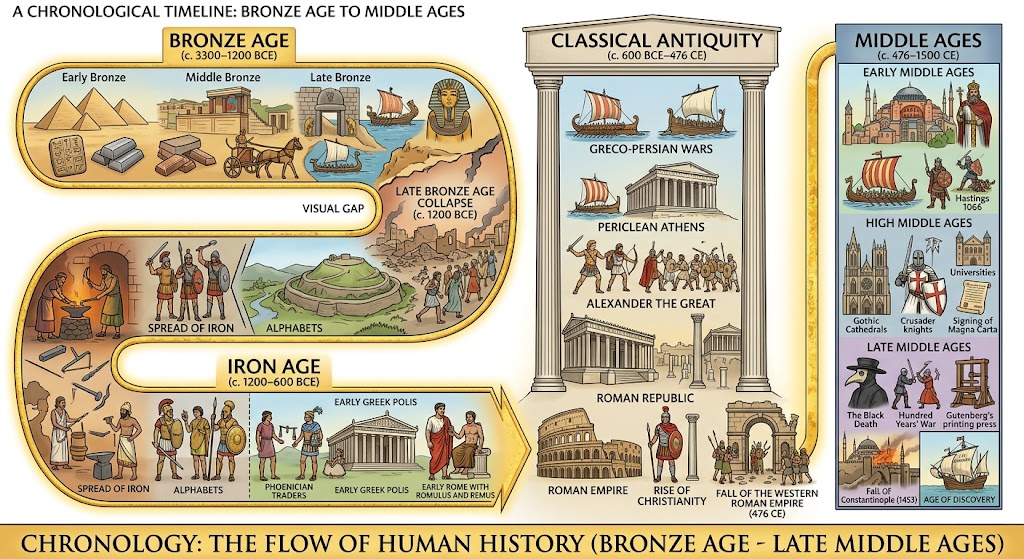
11. Chronology (Dates, Eras & Periods)
- 3rd Millennium BCE: Early Bronze Age Levantine and Mesopotamian civilizations.
- 146 BCE: Destruction of Corinth by the Roman Republic.
- 140–37 BCE: Rule of the Hasmonean / Maccabean Dynasty in Judea.
- 44 BCE: Refounding of Corinth as a Roman colony by Julius Caesar.
- 412–323 BC: Approximate dates for the life of Diogenes of Sinope.
- 720 BCE: Fall of Samaria and the Northern Kingdom of Israel to Assyria.
- 587 BCE / 587 BC: Fall of Jerusalem and destruction of Solomon’s Temple by the Babylonians.
- 539 BCE / 539 BC: Fall of Babylon to the Persian Empire; return of the Jewish exiles.
- 8th Century BC: Era of the divided monarchies of Israel and Judah.
- 1st Century BCE / 1st Century BC: Late Second Temple period.
- 30s AD: Ministry, arrest, and crucifixion of Jesus under Roman rule.
- 50s AD: Paul’s missionary journeys and meetings with Peter and James in Jerusalem and Antioch.
- 70 CE: Siege and destruction of the Second Temple in Jerusalem by the Romans.
- 1st Century CE / Late 1st Century: Composition of early Christian epistles, gospels, and the Johannine writings.
- 2nd Century CE / Late 2nd Century: Rise of early Christian theological debates (Marcion, Gnosticism) and consolidation of apostolic traditions.
- 325 CE (1700 years ago): First Council of Nicaea and formulation of the Nicene Trinitarian doctrine.
- Middle Ages / Medieval Era: Medieval Christian theology, Dantean afterlife imagery, and scholasticism.
- 17th Century: Life and philosophical work of Baruch Spinoza during the Dutch Golden Age.
- 19th Century: Rise of historical-critical Biblical scholarship and the Documentary Hypothesis.
- 1897: First Zionist Congress organized by Theodor Herzl in Basel.
- 1920s: Flat Earth controversies led by Wilbur Glenn Voliva.
- 1945: Discovery of the Nag Hammadi Gnostic codices.
- 1946–1956: Discovery and excavation of the Dead Sea Scrolls at Qumran.
- 1948: Establishment of the modern State of Israel.
- 20th & 21st Centuries / Modernity: Modern critical scholarship, archaeology, and contemporary theological debates.