Paul Revere
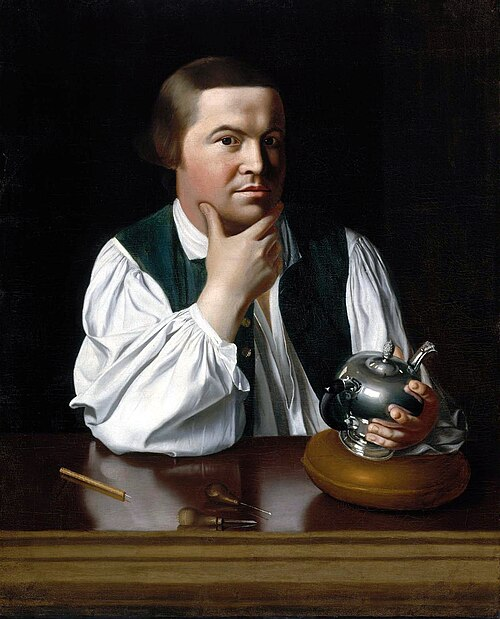
Portrait of Paul Revere, 1768
Paul Revere (December 21, 1734 O.S. (January 1, 1735 N.S.)[N ^1] – May 10, 1818) was an American silversmith, military officer and industrialist who played a major role during the opening months of the American Revolutionary War in Massachusetts, engaging in a midnight ride in 1775 to alert nearby minutemen of the approach of British troops prior to the battles of Lexington and Concord.
Born in the North End of Boston, Revere eventually became a prosperous and prominent Bostonian, deriving his income from silversmithing and engraving. During the American Revolution, he was a strong supporter of the Patriot cause and joined the Sons of Liberty. His midnight ride transformed him into an American folk hero, being dramatized in Henry Wadsworth Longfellow's 1861 poem, "Paul Revere's Ride". He also helped to organize an intelligence and alarm system to keep watch on the movements of British forces. Revere later served as an officer in the Massachusetts Militia, though his service ended after the Penobscot Expedition, one of the most disastrous American campaigns of the American Revolutionary War, for which he was absolved of blame.
Following the war, Revere returned to his silversmith trade. He used the profits from his expanding business to finance his work in iron casting, bronze bell and cannon casting, and the forging of copper bolts and spikes. In 1800, he became the first American to successfully roll copper into sheets for use as sheathing on naval vessels.
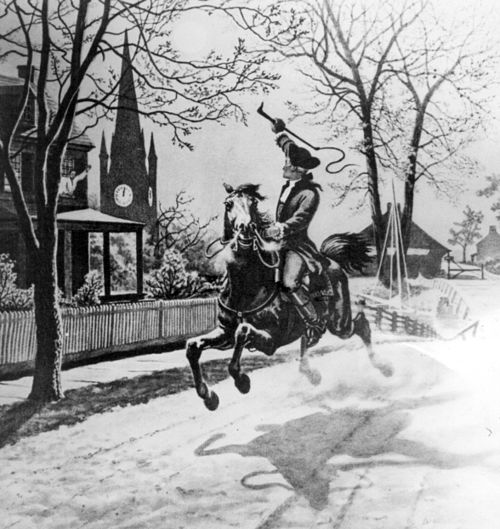
A 20th-century depiction of Revere's ride
Paul Revere's midnight ride was an alert given to minutemen in the Province of Massachusetts Bay by local Patriots on the night of April 18, 1775, warning them of the approach of British Army troops prior to the battles of Lexington and Concord. In the preceding weeks, Patriots in the region learned of a planned crackdown on the Massachusetts Provincial Congress, then based in Concord, by the British authorities in the colony.
Sons of Liberty members Paul Revere and William Dawes prepared the alert, which began when Robert Newman, the sexton of Boston's Old North Church, used a lantern signal to warn colonists in Charlestown of the British Army's advance by way of the Charles River. Revere and Dawes then rode to meet John Hancock and Samuel Adams in Lexington, ten miles (16 km) away, alerting up to 40 other Patriot riders along the way. Revere and Dawes then headed towards Concord with Samuel Prescott.[43]
The trio were intercepted by a British Army patrol in Lincoln. Prescott and Dawes escaped but Revere was returned to Lexington by the patrol and freed after questioning. By giving the minutemen advance warning of the British Army's actions, the ride played a crucial role in the Patriot victory in the subsequent battles at Lexington and Concord. The ride has been commemorated in a range of cultural depictions, most notably Henry Wadsworth Longfellow's 1861 poem, "Paul Revere's Ride", which has shaped popular memory of the event, despite its factual inaccuracies.
War years
Because Boston was besieged after the battles of Lexington and Concord, Revere could not return to the city, which was now firmly in British hands. He boarded in Watertown, where he was eventually joined by Rachel and most of his children (Paul Jr., then 15, remained in Boston to mind the family properties).[44] After he was denied a commission in the Continental Army, he tried to find other ways to be useful to the rebel cause. He was retained by the provincial congress as a courier, and he printed local currency which the congress used to pay the troops around Boston.[45]
Militia service
Upon returning to Boston in 1776, Revere was commissioned a major of infantry in the Massachusetts militia in that April, and transferred to the artillery a month later.[55] In November he was promoted to lieutenant colonel, and was stationed at Castle William, defending Boston harbor. He was generally second or third in the chain of command, and on several occasions he was given command of the fort.[55] He applied his engineering skills to maintaining the fort's armaments, even designing and building a caliper to accurately measure cannonballs and cannon bore holes.[55] The service at Castle William was relatively isolated, and personality friction prompted some men to file complaints against Revere.[56] The boredom was alleviated in late August 1777 when Revere was sent with a troop of soldiers to escort prisoners taken in the Battle of Bennington to Boston, where they were confined on board prison ships,[57][58] and again in September when he was briefly deployed to Rhode Island.[59]
During the Revolutionary War, Revere continued his efforts to move upwards in society into the gentry. After his failed efforts to become a military officer he attempted to become a merchant, but was hindered by a number of factors: while he was a fairly well-off member of the artisan class, he did not have the resources to afford the goods he would have sold as a merchant, nor were lenders in England willing to lend him the required startup capital. Other American merchants of the time were able to continue their business with colleagues in England. However, Revere's inexperience as a merchant meant that he had not yet established such relationships and was not able to communicate as effectively on unfamiliar matters. Another factor preventing Revere's success as a merchant was the economic climate of the time period after the war known as the Confederation Period; while the colonies had seen a time of economic growth before the war, the colonies experienced a severe post-war depression, constraining the overall success of his business.[73]
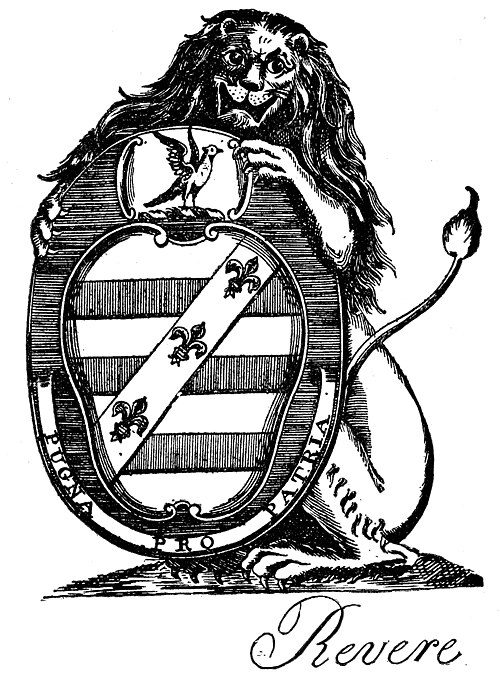
Revere Coat-of-Arms engraved by Paul Revere
While Revere struggled as a merchant, his success as a silversmith enabled him to pursue and leverage more advanced technological developments for the purposes of mass production. For example, rolling mills greatly improved the productivity of his silver shop and enabled his business to move further away from manufacturing high-end customized products in order to focus instead on the production of a more standardized set of goods.[74] In the 18th century, the standard of living continuously improved in America, as genteel goods became increasingly available to the masses.[75] Revere responded particularly well to this trend because his business was not solely manufacturing custom, high end purchases. Smaller products like teaspoons and buckles accounted for the majority of his work, allowing him to build a broad customer base.[76]
Revere's increased efficiency left financial and human resources available for the exploration of other products, which was essential to overcoming the fluctuating post-war economic climate.[77] In addition to increasing production, the flatting mill enabled Revere to move towards a more managerial position.[78]
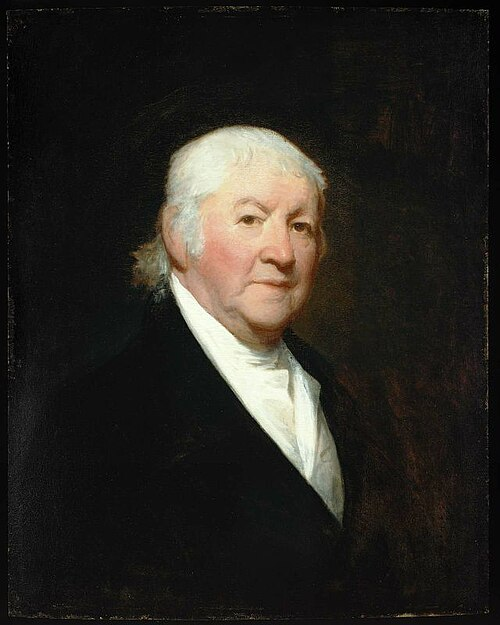
1813 portrait of Revere by Gilbert Stuart
After the war, Revere became interested in metal work beyond gold and silver. By 1788 he had invested some of the profits from his growing silverworking trade to construct a large furnace, which would allow him to work with larger quantities of metals at higher temperatures. He soon opened an iron foundry in Boston's North End that produced utilitarian cast iron items such as stove backs, fireplace tools, and sash-window weights, marketed to a broad segment of Boston's population.[79] Many of Revere's business practices changed when he expanded his practice into ironworking, because he transitioned from just being an artisan to also being an entrepreneur and a manager. In order to make this transition successfully, Revere had to invest substantial quantities of capital and time in his foundry.[80]
Freemasonry
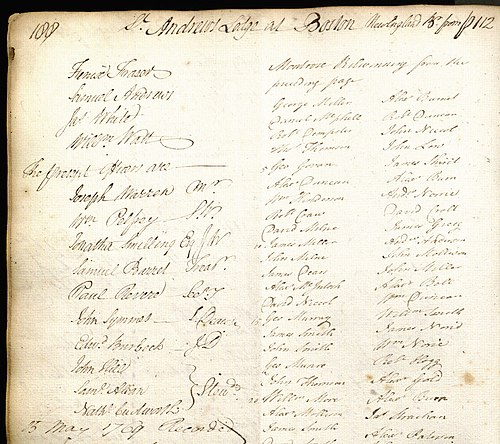
Revere was a Freemason as a member of Lodge St. Andrews, No. 81, in Boston, Massachusetts. The Lodge continues to meet in Boston with the No. 4 under and the jurisdiction of the Grand Lodge of Massachusetts. The date he joined the Lodge is not known but was sometime after the inauguration of the Lodge on St Andrew's Day, November 30, 1756, and before May 15, 1769, when he is recorded in the Grand Lodge of Scotland membership register as the Lodge Secretary. Joseph Warren and William Palfrey are also recorded, on the same page, as members of the Lodge as being Master and Senior Warden respectively. (see image)[90][91]
He subsequently became the Grand Master of the Freemasons of Massachusetts from 1795 to 1797.[92] During his tenure, Revere, along with Governor Samuel Adams and Deputy Grand Master, Colonel William Scollay, deposited a box containing an assemblage of commemorative items under the cornerstone of the Massachusetts State House on July 4, 1795.[93]
Politics and final years
Revere remained politically active throughout his life. His business plans in the late 1780s were often stymied by a shortage of adequate money in circulation. Alexander Hamilton's national policies regarding banks and industrialization exactly matched his dreams, and he became an ardent Federalist committed to building a robust economy and a powerful nation. Of particular interest to Revere was the question of protective tariffs; he and his son sent a petition to Congress in 1808 asking for protection for his sheet copper business.[94] He continued to participate in local discussions of political issues even after his retirement in 1811, and in 1814 circulated a petition offering the government the services of Boston's artisans in protecting Boston during the War of 1812.[95] Revere died on May 10, 1818, at the age of 83, at his home on Charter Street in Boston.[96] He is buried in the Granary Burying Ground on Tremont Street.[97][98]
Legacy
After Revere's death, the family business was taken over by his oldest surviving son, Joseph Warren Revere.[99] The copper works founded in 1801 continues today as the Revere Copper Company, with manufacturing divisions in Rome, New York, and New Bedford, Massachusetts.[100]
Revere's original silverware, engravings, and other works are highly regarded today, and can be found on display in museums including the Museum of Fine Arts, Boston[101] and the Metropolitan Museum of Art.[102] The Revere Bell, presented in 1843 to the Church of St. Andrew in Singapore by his daughter, Mrs. Maria Revere Balestier, wife of American consul Joseph Balestier, is now displayed in the National Museum of Singapore. This is the only bell cast by the Revere foundry that is outside the United States. For a time, it was displayed behind velvet ropes in the foyer of the United States Embassy in Singapore.[103]
The communities of Revere, Massachusetts,[104] and Revere, Minnesota,[105] bear his name, as do Revere Beach[104] in Revere, Massachusetts; Revere Avenue in The Bronx, New York City;[106] Paul Revere Road in Arlington, Massachusetts;[107] and Paul Revere Apartments[108] in Seattle.
A 25-cent 1958 U.S. postage stamp in the Liberty Series honors Paul Revere, featuring the portrait by Gilbert Stuart. He also appears on the $5,000 Series EE U.S. Savings Bond.[109] Ryan Reynolds released a Mint Mobile commercial that features Avery Revere, a direct descent of Paul Revere.[110]
Paul Revere Mall is a corridor located in Boston's North End behind Old North Church. It features the Equestrian statue of Paul Revere by Cyrus Edwin Dallin.
Descendants
- Joseph Warren Revere, son
- Maria Revere Balestier, daughter
- Joseph Warren Revere, grandson; artist, Navy officer, and Union Army general
- Paul Revere, great-grandson; Morristown lawyer
- Paul Revere Jr. (3rd great-grandson)[116]
- Paul Revere III (4th great-grandson)[116]
- Pauline Revere Thayer, daughter of Paul Revere III
- Avery Revere (4th great-granddaughter)[116]
See also
- Israel Bissell, who rode to Philadelphia with news of the battles of Lexington and Concord
- Sybil Ludington, who is said to have performed a similar ride in New York
- Jack Jouett, rode to warn Thomas Jefferson and the Virginia legislature of a British raid
- Revere Bells, one of Revere's highest-profile products
- Revere Copper Company, the business founded by Paul Revere and later managed by his son and grandsons
- Johnny Tremain, 1943 children's novel by Esther Forbes set in Boston prior to and during the outbreak of the Revolution
See PDF for complete article.
Downloaded
Thursday, April 23, 2026 07:38PM