Central Intelligence Agency
This article was updated by Wikipedia four days prior to my download. rk.
Seal of the Central Intelligence Agency
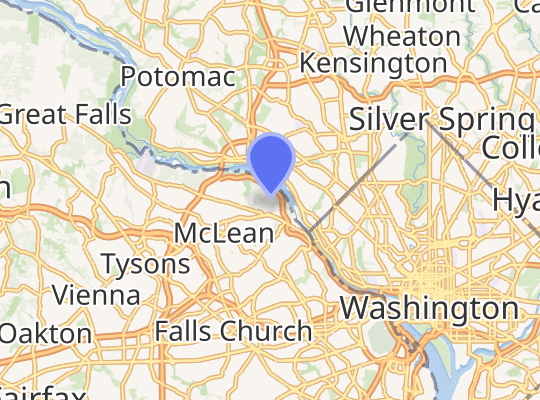
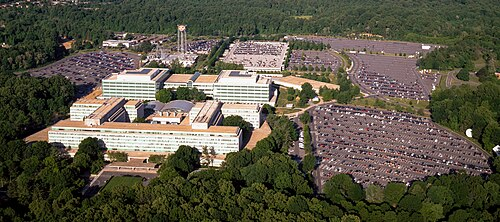
George Bush Center for Intelligence in Langley, Virginia
rk NOTE: Is that where he left it, if he had any?
Saturday, April 25, 2026 08:27PM
The Central Intelligence Agency (CIA) /ˌsiː.aɪˈeɪ/ is a civilian foreign intelligence service of the federal government of the United States tasked with advancing national security through collecting and analyzing intelligence from around the world and conducting covert operations. The agency is headquartered in the George Bush Center for Intelligence in Langley, Virginia, and is sometimes metonymously called "Langley". A major member of the United States Intelligence Community (IC), the CIA has reported to the director of national intelligence since 2004, and is focused on providing intelligence for the president and the Cabinet, though it also provides intelligence for a variety of other entities including the United States Armed Forces and foreign allies.
The CIA is headed by a director and is divided into various directorates, including a Directorate of Analysis and Directorate of Operations. Unlike the Federal Bureau of Investigation (FBI), the CIA has no law enforcement function and focuses on intelligence gathering overseas, with only limited domestic intelligence collection.[8] The CIA is responsible for coordinating all human intelligence (HUMINT) activities in the IC. It has been instrumental in establishing intelligence services in many countries, and has provided support to many foreign organizations. The CIA exerts foreign political influence through its paramilitary operations units, including its Special Activities Center. It has also provided support to several foreign political groups and governments, including planning, coordinating, training and carrying out torture, and technical support. It has been involved in many regime changes and carrying out planned assassinations of foreign leaders and terrorist attacks against civilians.
During World War II, U.S. intelligence and covert operations had been undertaken by the Office of Strategic Services (OSS). The office was abolished in 1945 by President Harry S. Truman, who created the Central Intelligence Group in 1946. Amid the intensifying Cold War, the National Security Act of 1947 established the CIA, headed by a director of central intelligence (DCI). The Central Intelligence Agency Act of 1949 exempted the agency from most Congressional oversight, and during the 1950s, it became a major instrument of U.S. foreign policy. The CIA employed psychological operations against communist regimes, and backed coups to advance American interests. Major CIA-backed operations include the 1953 coup in Iran, the 1954 coup in Guatemala, the Bay of Pigs Invasion of Cuba in 1961, and the 1973 coup in Chile. In 1975, the Church Committee of the U.S. Senate revealed illegal operations such as MKUltra and CHAOS, after which greater oversight was imposed. In the 1980s, the CIA supported the Afghan mujahideen through Pakistan's ISI, and the Nicaraguan Contras, and after the September 11 attacks in 2001, played a role in the Global War on Terrorism.
The agency has been the subject of numerous controversies, including its use of political assassinations, torture, domestic wiretapping, propaganda, mind control techniques, and drug trafficking, among others.
Purpose
When the CIA was proposed, its purpose was to create a clearinghouse to collect, analyze, evaluate, disseminate foreign intelligence and carry out covert operations.[9]
As of 2013, the CIA had five priorities:[3]
- Counterterrorism
- Nonproliferation of weapons of mass destruction
- Indications and warnings for senior policymakers
- Counterintelligence
- Cyber intelligence
Organizational structure
Main article: Organizational structure of the Central Intelligence Agency
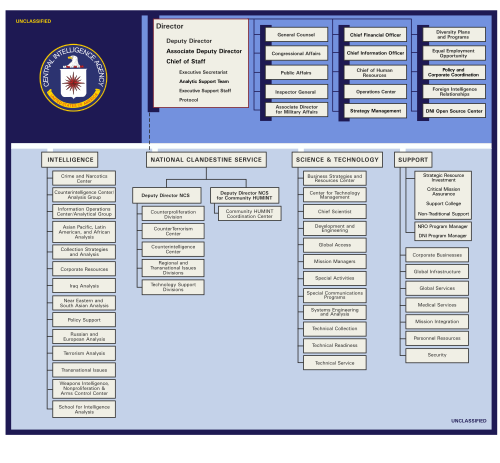
The organization of the Central Intelligence Agency as of 2009.
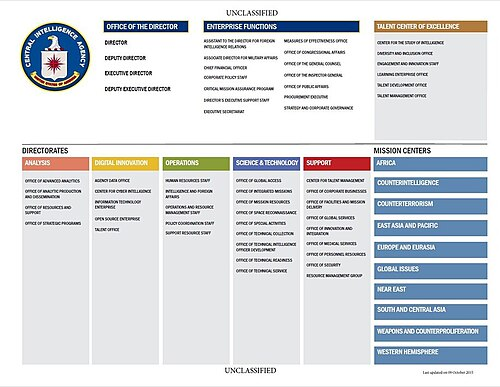
In 2015, under the tenure of John Brennan, the CIA underwent its largest organizational restructuring since its founding in 1947.[10]
Executive Office
The director of the Central Intelligence Agency (D/CIA) is appointed by the president with Senate confirmation and reports directly to the director of national intelligence (DNI); in practice, the CIA director interfaces with the DNI, Congress, and the White House, while the deputy director (DD/CIA) is the internal executive of the CIA and the chief operating officer (COO/CIA), known as executive director until 2017, leads the day-to-day work[11] as the third-highest post of the CIA.[12] The deputy director is formally appointed by the director without Senate confirmation,[12][13] but as the president's opinion plays a great role in the decision,[13] the deputy director is generally considered a political position, making the chief operating officer the most senior non-political position for CIA career officers.[14]
The Executive Office also supports the U.S. military, including the U.S. Army Intelligence and Security Command, by providing it with information it gathers, receiving information from military intelligence organizations, and cooperating with field activities. The associate deputy director of the CIA is in charge of the day-to-day operations of the agency. Each branch of the agency has its own director.[11] The Office of Military Affairs (OMA), subordinate to the associate deputy director, manages the relationship between the CIA and the Unified Combatant Commands, who produce and deliver regional and operational intelligence and consume national intelligence produced by the CIA.[15]
Directorate of Analysis
The Directorate of Analysis, through much of its history known as the Directorate of Intelligence (DI), is tasked with helping "the President and other policymakers make informed decisions about our country's national security" by looking "at all the available information on an issue and organiz[ing] it for policymakers".[16] The directorate has four regional analytic groups, six groups for transnational issues, and three that focus on policy, collection, and staff support.[17] There are regional analytical offices covering the Near East and South Asia, Russia, and Europe; and the Asia–Pacific, Latin America, and Africa.
Office of Strategic Research
The DI created the Office of Strategic Research in 1967. CIA official John Paisley served as Deputy Chief of the office.[18] The office provided support to the Team B competitive analysis exercise that delved into the threats of the Soviet Union. Material supplied by double agent, "Hero", Oleg Penkovsky was used by the agency in the early 1970's. The office conducted military analysis, such as whether Iraq had the capabilities to defeat Kuwait.[19] In 1981 the office allegedly dissolved due to a restructuring.
Directorate of Operations
Main article: Directorate of Operations (CIA)
The Directorate of Operations is responsible for collecting foreign intelligence (mainly from clandestine HUMINT sources), and for covert action. The name reflects its role as the coordinator of human intelligence activities between other elements of the wider U.S. intelligence community with their HUMINT operations. This directorate was created in an attempt to end years of rivalry over influence, philosophy, and budget between the United States Department of Defense (DOD) and the CIA. In spite of this, the Department of Defense announced in 2012 its intention to organize its own global clandestine intelligence service, the Defense Clandestine Service (DCS),[20] under the Defense Intelligence Agency (DIA). Contrary to some public and media misunderstanding, DCS is not a "new" intelligence agency but rather a consolidation, expansion and realignment of existing Defense HUMINT activities, which have been carried out by DIA for decades under various names, most recently as the Defense Human Intelligence Service.[21]
This Directorate is known to be organized by geographic regions and issues, but its precise organization is classified.[22]
Directorate of Science & Technology
Main article: Directorate of Science & Technology
The Directorate of Science & Technology was established to research, create, and manage technical collection disciplines and equipment. Many of its innovations were transferred to other intelligence organizations, or, as they became more overt, to the military services.
The development of the U-2 high-altitude reconnaissance aircraft, for instance, was done in cooperation with the United States Air Force. The U-2's original mission was clandestine imagery intelligence over denied areas such as the Soviet Union.[23]
Directorate of Support
Main article: Directorate of Support
The Directorate of Support has organizational and administrative functions to significant units including:
- The Office of Security
- The Office of Communications
- The Office of Information Technology
Directorate of Digital Innovation
The Directorate of Digital Innovation (DDI) focuses on accelerating innovation across the Agency's mission activities. It is the Agency's newest directorate. The Langley, Virginia–based office's mission is to streamline and integrate digital and cybersecurity capabilities into the CIA's espionage, counterintelligence, all-source analysis, open-source intelligence collection, and covert action operations.[24] It provides operations personnel with tools and techniques to use in cyber operations. It works with information technology infrastructure and practices cyber tradecraft.[25] This means retrofitting the CIA for cyberwarfare. DDI officers help accelerate the integration of innovative methods and tools to enhance the CIA's cyber and digital capabilities on a global scale and ultimately help safeguard the United States. They also apply technical expertise to exploit clandestine and publicly available information (also known as open-source data) using specialized methodologies and digital tools to plan, initiate and support the technical and human-based operations of the CIA.[26] Before the establishment of the new digital directorate, offensive cyber operations were undertaken by the CIA's Information Operations Center.[27] Little is known about how the office specifically functions or if it deploys offensive cyber capabilities.[24]
The directorate had been covertly operating since approximately March 2015 but formally began operations on October 1, 2015.[28] According to classified budget documents, the CIA's computer network operations budget for fiscal year 2013 was $685.4 million. The NSA's budget was roughly $1 billion at the time.[29]
Rep. Adam Schiff, the California Democrat who served as the ranking member of the House Intelligence Committee, endorsed the reorganization. "The director has challenged his workforce, the rest of the intelligence community, and the nation to consider how we conduct the business of intelligence in a world that is profoundly different from 1947 when the CIA was founded," Schiff said.[30]
Office of Congressional Affairs
Further information: CIA's relationship with the United States Congress
The Office of Congressional Affairs (OCA) serves as the liaison between the CIA and the U.S. Congress. The OCA states that it aims to ensure that Congress is fully and currently informed of intelligence activities.[31]
The office is the CIA's primary interface with congressional oversight committees, leadership, and members. It is responsible for all matters pertaining to congressional interaction and oversight of U.S. intelligence activities. It claims that it aims to[32]
- ensure that Congress is kept informed of intelligence issues and activities by providing timely briefings and notifications
- facilitate prompt and complete responses to congressional requests for information and inquiries
- maintain a record of the Agency's interaction with Congress
- track legislation that could affect the Agency
- educate Agency personnel about their responsibility to keep Congress fully and currently informed
Training
Further information: CIA University, National Intelligence University, and Warrenton Training Center
The CIA established its first training facility, the Office of Training and Education, in 1950. Following the end of the Cold War, the CIA's training budget was slashed, which had a negative effect on employee retention.[33][34]
In response, Director of Central Intelligence George Tenet established CIA University in 2002.[33][16] CIA University holds between 200 and 300 courses each year, training both new hires and experienced intelligence officers, as well as CIA support staff.[33][34] The facility works in partnership with the National Intelligence University, and includes the Sherman Kent School for Intelligence Analysis, the Directorate of Analysis' component of the university.[16][35][36]
For later-stage training of student operations officers, there is at least one classified training area at Camp Peary, near Williamsburg, Virginia. Students are selected, and their progress evaluated, in ways derived from the OSS, published as the book Assessment of Men, Selection of Personnel for the Office of Strategic Services.[37] Additional mission training is conducted at Harvey Point, North Carolina.[38]
The primary training facility for the Office of Communications is Warrenton Training Center, located near Warrenton, Virginia. The facility was established in 1951 and has been used by the CIA since at least 1955.[39][40]
Budget
Main article: United States intelligence budget
Details of the overall United States intelligence budget are classified.[3] Under the Central Intelligence Agency Act of 1949, the Director of Central Intelligence is the only federal government employee who can spend "unvouchered" government money.[41] The government showed its 1997 budget was $26.6 billion for the fiscal year.[42] The government has disclosed a total figure for all non-military intelligence spending since 2007; the fiscal 2013 figure is $52.6 billion. According to the 2013 mass surveillance disclosures, the CIA's fiscal 2013 budget is $14.7 billion, 28% of the total and almost 50% more than the budget of the National Security Agency. CIA's HUMINT budget is $2.3 billion, the SIGINT budget is $1.7 billion, and spending for security and logistics of CIA missions is $2.5 billion. "Covert action programs," including a variety of activities such as the CIA's drone fleet and anti-Iranian nuclear program activities, accounts for $2.6 billion.[3]
There were numerous previous attempts to obtain general information about the budget.[43] As a result, reports revealed that CIA's annual budget in Fiscal Year 1963 was $550 million (equivalent to US$5.8 billion in 2025),[44] and the overall intelligence budget in FY 1997 was US$26.6 billion (equivalent to US$53.3 billion in 2025).[45] There have been accidental disclosures; for instance, Mary Margaret Graham, a former CIA official and deputy director of national intelligence for collection in 2005, said that the annual intelligence budget was $44 billion,[46] and in 1994, Congress accidentally published a budget of $43.4 billion (in 2012 dollars) in 1994 for the non-military National Intelligence Program, including $4.8 billion for the CIA.[3]
After the Marshall Plan was approved, appropriating $13.7 billion over five years, 5% of those funds or $685 million were secretly made available to the CIA. A portion of the enormous M-fund, established by the U.S. government during the post-war period for reconstruction of Japan, was secretly steered to the CIA.[47]
Relationship with other intelligence agencies
Foreign intelligence services
The role and functions of the CIA are roughly equivalent to those of the Federal Intelligence Service (BND) in Germany, MI6 in the United Kingdom, the Australian Secret Intelligence Service (ASIS) in Australia, the Directorate-General for External Security (DGSE) in France, the Foreign Intelligence Service in Russia, the Ministry of State Security (MSS) in China, the Research and Analysis Wing (R&AW) in India, the Inter-Services Intelligence (ISI) in Pakistan, the General Intelligence Service in Egypt, Mossad in Israel, and the National Intelligence Service (NIS) in South Korea.
The CIA was instrumental in the establishment of intelligence services in several U.S. allied countries, including Germany's BND and Greece's EYP (then known as KYP).[48][citation ^needed]
The closest links of the U.S. intelligence community to other foreign intelligence agencies are to Anglophone countries: Australia, Canada, New Zealand, and the United Kingdom. Special communications signals that intelligence-related messages can be shared with these four countries.[49] An indication of the United States' close operational cooperation is the creation of a new message distribution label within the main U.S. military communications network. Previously, the marking of NOFORN (i.e., No Foreign Nationals) required the originator to specify which, if any, non-U.S. countries could receive the information.
A new handling caveat, USA/AUS/CAN/GBR/NZL Five Eyes, used primarily on intelligence messages, indicates that the material can be shared with:
Australia,
Canada,
United Kingdom, and
New Zealand.
The task of the division called "Verbindungsstelle 61" of the German Bundesnachrichtendienst is keeping contact to the CIA office in Wiesbaden.[50]
Saturday, April 25, 2026 08:33PM
Central Intelligence Agency - Wikipedia
Immediate predecessors: