8 Approach
4709 AIM 7-4-4 Vortex Behavior url
A crosswind will decrease the lateral movement of the upwind vortex and increase the movement of the downwind vortex.
4328
Choppers use category A MDA or DH (AGL) with half the published visibility (97.3)
For other than “copter-only” approaches, the required visibility minimum for Category I approaches may be reduced to one-half the published visibility minimum for Category A aircraft...
...but in no case may it be reduced to less than one-quarter mile prevailing visibility, or, if reported, 1,200 feet RVR.
- IPH Helicopter Instrument Procedures pg 7-9
4956.4
IPH Stabilized Approach
4956.3
4749
Circling Approach
4712
Takeoff and Landing Under IFR
a helicopter may not be operated below DH unless... 4713
minimum climb gradient 4699
asterisk next to the S-ILS 9* and S-LOC* = use the higher set of the two minimums displayed
4684.4
BARO-VNAV and LNAV approaches are terminated at the missed approach point
4708
The greatest vortex strength occurs when the generating aircraft is heavy, clean, and slow....the basic factor increasing vortex strength is weight
4296
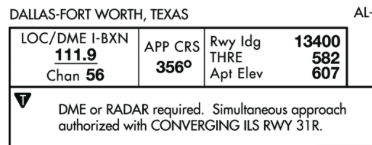
"Converging ILS RWY 36L" provides localizer and glide slope
DME is available, as indicated by the channel numbers.
"No voice capability" is indicated by the underline on the I-BXN 111.9 frequency.