SENATE
U.S. Senate (1953–1960)
See also: 1952 United States Senate election in Massachusetts and 1958 United States Senate election in Massachusetts
 Campaign slogan for Kennedy's 1952 U.S. Senate campaign in Massachusetts
As early as 1949, Kennedy began preparing to run for the Senate in 1952 against Republican three-term incumbent Henry Cabot Lodge Jr. with the campaign slogan "KENNEDY WILL DO MORE FOR MASSACHUSETTS".[94]
Joe Sr. again financed his son's candidacy—persuading the Boston Post to switch its support to Kennedy by promising the publisher a $500,000 loan[95]—while John's younger brother Robert emerged as campaign manager.[96] Kennedy's mother and sisters were also highly effective canvassers, hosting a series of "teas" at hotels and parlors across Massachusetts to reach out to women voters.[97][98] In the presidential election, Republican Dwight D. Eisenhower carried Massachusetts by 208,000 votes, but Kennedy narrowly defeated Lodge by 70,000 votes for the Senate seat.[99] The following year, he married Jacqueline Bouvier.[100]
Kennedy underwent several spinal operations over the next two years. Often absent from the Senate, he was at times critically ill and received Catholic last rites. During his convalescence in 1956, he published Profiles in Courage, a book about U.S. senators who risked their careers for their personal beliefs, for which he won the Pulitzer Prize for Biography in 1957.[101] Rumors that this work was ghostwritten by his close adviser and speechwriter, Ted Sorensen, were confirmed in Sorensen's 2008 autobiography.[102]
At the start of his first term, Kennedy focused on fulfilling the promise of his campaign to do "more for Massachusetts" than his predecessor. Although Kennedy's and Lodge's legislative records were similarly liberal, Lodge voted for the Taft-Hartley Act of 1947 and Kennedy voted against it. On NBC's Meet the Press, Kennedy excoriated Lodge for not doing enough to prevent the increasing migration of manufacturing jobs from Massachusetts to the South, and blamed the right-to-work provision for giving the South an unfair advantage over Massachusetts in labor costs.[103] In May 1953, Kennedy introduced "The Economic Problems of New England",[104] a 36-point program[105] to help Massachusetts industries such as fishing, textile manufacturing, watchmaking, and shipbuilding, as well as the Boston seaport.[106] Kennedy's policy agenda included protective tariffs, preventing excessive speculation in raw wool, stronger efforts to research and market American fish products, an increase in the Fish and Wildlife Service budget (including funds for US FWS *Albatross III*), funds to rehabilitate the South Boston Army Base, shipbuilding contracts at the Fore River Shipyard in Quincy, Massachusetts, and the development of hydroelectric and nuclear power in New England—such as the Yankee Rowe Nuclear Power Station in Rowe, Massachusetts, which began construction in 1958.[107][108][109] Kennedy's suggestions for stimulating the region's economy appealed to both parties by offering benefits to business and labor, and promising to serve national defense. Congress would eventually enact most of the program.[106] A Massachusetts Audubon Society supporter, Kennedy wanted to make sure that the shorelines of Cape Cod remained unsullied by industrialization. On September 3, 1959, Kennedy co-sponsored the Cape Cod National Seashore bill with his Republican colleague Senator Leverett Saltonstall.[110][111]
As a senator, Kennedy quickly won a reputation for responsiveness to requests from constituents (i.e., co-sponsoring legislation to provide federal loans to help rebuild communities damaged by the 1953 Worcester tornado), except on certain occasions when the national interest was at stake.[112][113] In 1954, Kennedy voted in favor of the Saint Lawrence Seaway which would connect the Great Lakes to the Atlantic Ocean, despite opposition from Massachusetts politicians who argued that the project would hurt the Port of Boston economically.[114]
In 1954, when the Senate voted to condemn Joseph McCarthy for breaking Senate rules and abusing an Army general, Kennedy was the only Democrat not to cast a vote against him.[115] Kennedy drafted a speech supporting the censure. However, it was not delivered because Kennedy was hospitalized for back surgery in Boston.[116] Although Kennedy never indicated how he would have voted, the episode damaged his support among members of the liberal community in the 1956 and 1960 elections.[117]
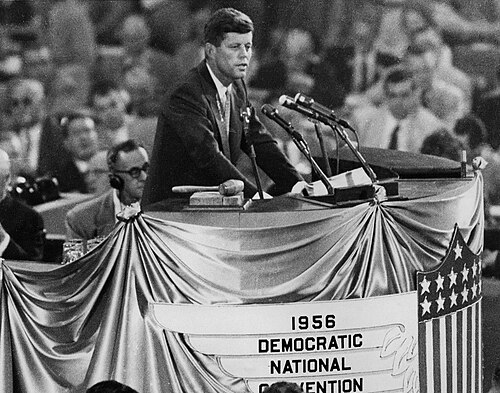
In 1956, Kennedy gained control of the Massachusetts Democratic Party,[118] and delivered the state delegation to the party's presidential nominee, Adlai Stevenson II, at the Democratic National Convention in August.[119] Stevenson let the convention select the vice presidential nominee. Kennedy finished second in the balloting, losing to Senator Estes Kefauver of Tennessee, but receiving national exposure.[120]
In 1957, Kennedy joined the Senate's Select Committee on Labor Rackets (also known as the McClellan Committee) with his brother Robert, who was chief counsel, to investigate racketeering in labor-management relations.[121] The hearings attracted extensive radio and television coverage where the Kennedy brothers engaged in dramatic arguments with controversial labor leaders, including Jimmy Hoffa of the Teamsters Union. The following year, Kennedy introduced a bill to prevent the expenditure of union dues for improper purposes or private gain; to forbid loans from union funds for illicit transactions; and to compel audits of unions, which would ensure against false financial reports.[122] It was the first major labor relations bill to pass either house since the Taft–Hartley Act of 1947 and dealt largely with the control of union abuses exposed by the McClellan Committee, but did not incorporate tough Taft–Hartley amendments requested by President Eisenhower. It survived Senate floor attempts to include Taft-Hartley amendments and passed but was rejected by the House.[123] "Honest union members and the general public can only regard it as a tragedy that politics has prevented the recommendations of the McClellan committee from being carried out this year," Kennedy announced.[124]
That same year, Kennedy joined the Senate's Foreign Relations Committee.[125] There he supported Algeria's effort to gain independence from France and sponsored an amendment to the Mutual Defense Assistance Act that would provide aid to Soviet satellite nations. Kennedy in 1959 introduced a controversial bill to eliminate from the National Defense Education Act of 1958 a provision requiring loyalty oaths and affidavits from aid recipients.[126]
Kennedy cast a procedural vote against President Eisenhower's bill for the Civil Rights Act of 1957, and this was considered by some to be an appeasement of Southern Democratic opponents of the bill.[127] Kennedy did vote for Title III of the act, which would have given the Attorney General powers to enjoin, but Majority Leader Lyndon B. Johnson agreed to let the provision die as a compromise measure.[128] Kennedy also voted for the "Jury Trial Amendment." Many civil rights advocates criticized the vote as one that would weaken the Act.[129] A final compromise bill, which Kennedy supported, was passed in September 1957.[130] As a senator from Massachusetts, which lacked a sizable Black population, Kennedy was not particularly sensitive to the problems of African Americans. Robert Kennedy later reflected, "We weren't thinking of the Negroes of Mississippi or Alabama—what should be done for them. We were thinking of what needed to be done in Massachusetts."[131]
Most historians and political scientists who have written about Kennedy refer to his U.S. Senate years as an interlude.[134] According to historian Robert Dallek, Kennedy called being a senator "the most corrupting job in the world." He complained that they were all too quick to cut deals and please campaign contributors to ensure their political futures. Kennedy, with the luxury of a rich father who could finance his campaigns, could remain independent of any special interest, except for those in his home state of Massachusetts that could align against his reelection.[135] According to author Robert Caro, Majority Leader Lyndon Johnson viewed Kennedy as a "playboy", describing his performance in the Senate and the House as "pathetic" on another occasion, saying that he was "smart enough, but he doesn't like the grunt work".[136] Author John T. Shaw acknowledges that while his Senate career is not associated with acts of "historic statesmanship" or "novel political thought," Kennedy made modest contributions as a legislator, drafting more than 300 bills to benefit Massachusetts and the New England region, some of which became law.[137]
In 1958, Kennedy was re-elected to the Senate, defeating his Republican opponent, Boston lawyer Vincent J. Celeste, with 73.6 percent of the vote, the largest winning margin in the history of Massachusetts politics.[99] In the aftermath of his re-election, Kennedy began preparing to run for president by traveling throughout the U.S. to build his candidacy for 1960.[138][121]
DOWNLOADED:
Sunday, November 16, 2025 07:51PM
FROM
WIKIPEDIA