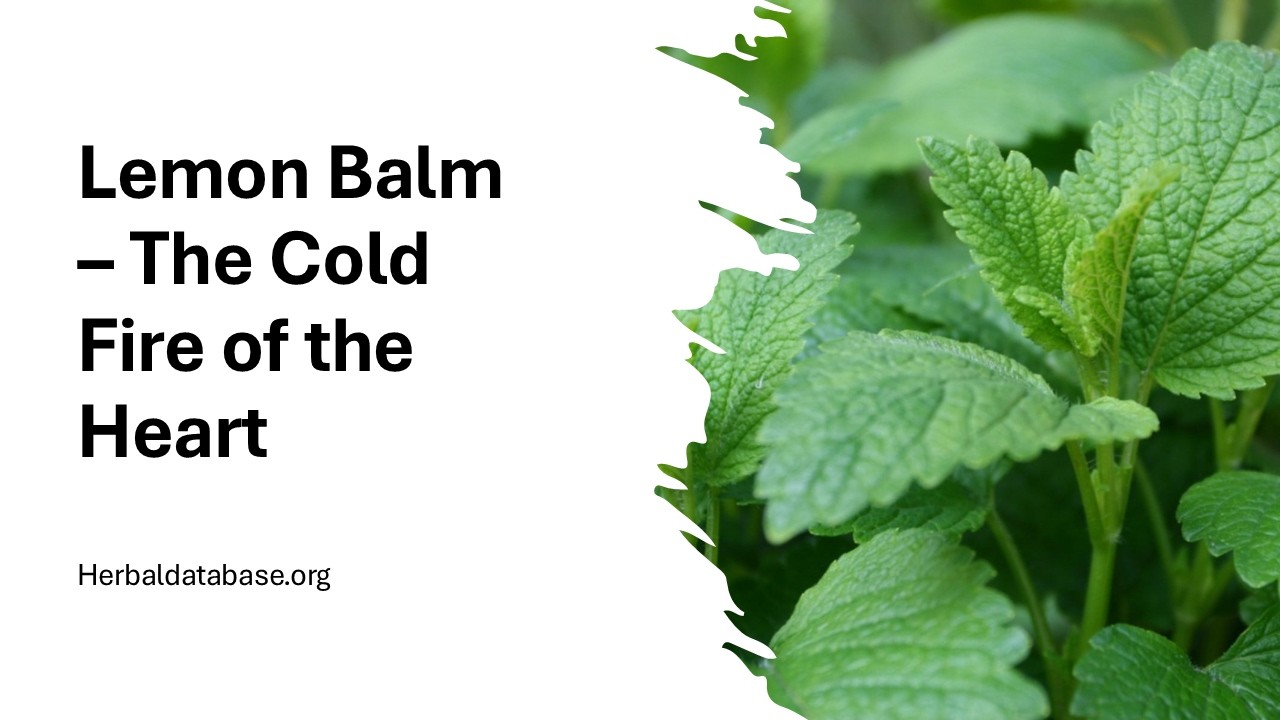
Lemon Balm (Melissa)
See also: Melissa (genus)
Medicinal Parts:
the oil extracted by distillation, the dried leaves, the fresh leaves and the whole plant
Qualities: (taste) a bit bitter , astringent, sour ;(warmth) cold (moisture) dry, diaphoretic
Trophism: heart, uterus, brain, stomach, intestines, nerve
Ground: Choleric & Sanguine krases; Hematic/Sulphuric/Brown Iris & Lymphatic/Carbonic/Blue Iris constitutions
Videos
Lemon Balm Herb Benefits: Treat Stress, Anxiety, Insomnia & More
DIY Herbs: Lemon Balm
Lemon balm was widely used in ancient Greece and Rome. Avicenna, the great Arabic physician (980–1037), said that lemon balm caused “the mind and heart to be merry.”
Lemon balm clears heat, calms the heart, improves concentration, cleanses the liver, improves chi circulation, lifts the spirits, and protects the cerebrum from excess stimuli. It eases anxiety and nervousness and helps with insomnia and fatigue.
German studies indicate that lemon balm’s volatile oils help protect the cerebrum from excess external stimuli. It affects the limbic system and helps balance emotional states. It makes an uplifting bath herb.
It is a good herb for children; a cup of tea before bed can help prevent nightmares and allow for a good night’s sleep, and it is excellent to calm the nerves and boost the mood of schoolchildren who are anxious about upcoming tests.
Not to be confused with Nepeta cataria var citriodora (Lemon cat mint)
This is the most cooling of all the mints. It is one of the few sour mints. Like most sour plants, it is cooling and sedative. It combines this property with the typical nerve-calming powers of the mint family to make an strong, but safe and simple sedative. These powers are much more marked when the plant is tinctured fresh. A tincture of fresh melissa should be on the shelf in every household as a general sedative.
Constituents
Listing on Duke's Phytochemical Database
Essential oil (including linalol, geraniol, aldehydes, citral, citronelal), glycoside (?), saponin (?) crystalline bitters, catechin tannins 3-4%, organic acids, stachyose, minerals
The major characteristic constituents are the hydroxycinnamic acids (rosmarinic [up to 6%], p-coumaric, caffeic and chlorogenic acids), and an essential oil (0.02–0.37%) composed of more than 40% monoterpenes and more than 35% sesquiterpenes. The most significant terpenoid components are citral (a mixture of the isomers neral and geranial), citronellal, geraniol, nerol, linalool, farnesyl acetate, humulene (a-caryophyllene), b-caryophyllene and eremophilene. Other constituents include flavonoids, tannins and acidic triterpenes (e.g. ursolic and oleanolic acids)
Effects
It has mild sedative and carminative, spasmolytic, antibacterial, antiviral, anti-oxidative and anti-hormonal effects. Essential oil of lemon balm which is used in aromatherapy, oil of lemon balm is considered the therapeutic principle mainly responsible for most of the activities mentioned, but plant phenolics, especially rosmarinic acid, are also considered to contribute to the therapeutic potential of M. officinalis.
Melissa is a general remedy for some and a specific for others. While it will generally sedate most people, it is particularly suited to conditions of sympathetic excess, hyperadrenalinism, or hyperthyroidism. It is especially indicated when these tendencies are associated with the stomach or heart. Heart palpitations, atrial fibrillation, high blood pressure (combine with Hawthorn and Linden flower), and even aneurysm have found a treatment in melissa. It is sometimes combined with Lycopus (Bugleweed)in hyperthyroidism or is specific by itself. Keynote symptoms include sweaty palms (an indication for nervousness or sympathetic excess)), a rapid or superficial pulse, and an elongated, pointed, red tongue.
In addition to being cooling, sedative, and calming, melissa is diaphoretic, so it is applicable in fevers with nervousness and in the fevers of young children. It is also used in nervous depression following exhaustive fevers and for convalescence when the digestion has been long irritated. (Mathew Wood)
Its mechanism involves multiple pathways: rosmarinic acid inhibits the enzyme GABA-transaminase, which breaks down GABA — our primary inhibitory neurotransmitter. The result is sustained GABAergic tone, similar in principle to how certain pharmaceutical anxiolytics work, but far more gently and without receptor downregulation with normal therapeutic doses.
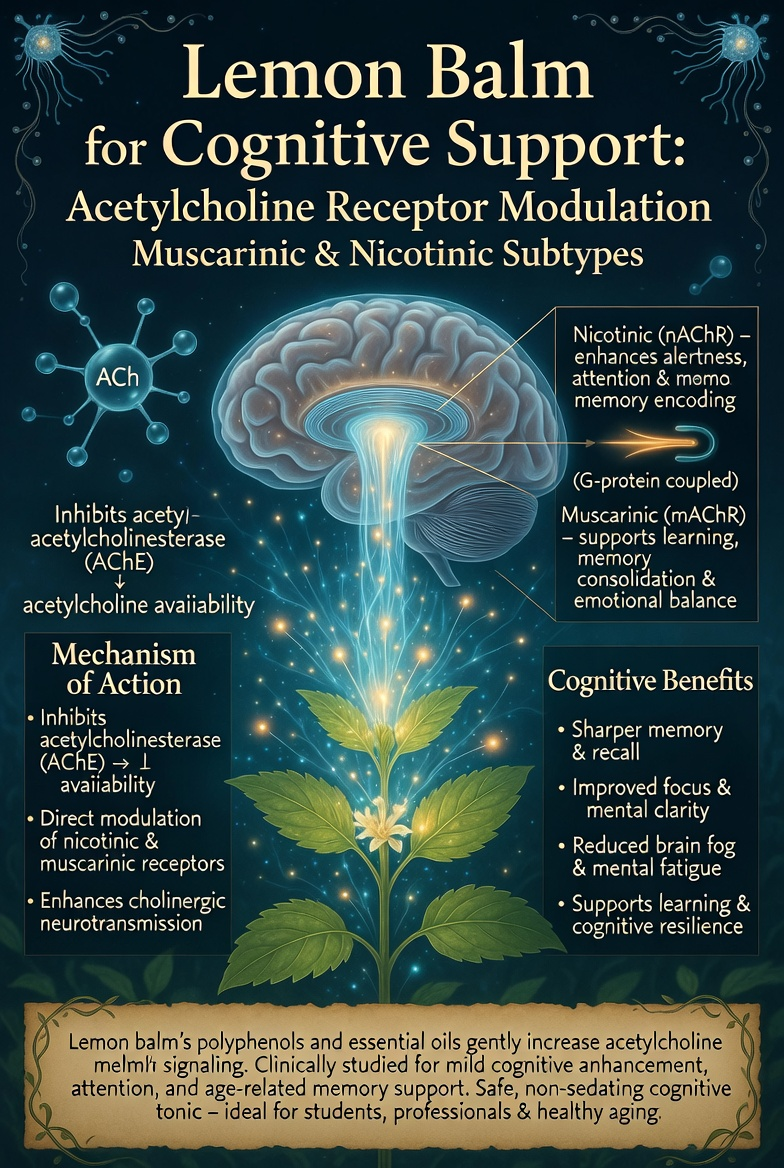
Additionally, Lemon Balm acts on acetylcholine receptors — both muscarinic and nicotinic subtypes — which explains its traditional use in cognitive support, particularly in the anxious, forgetful, overthinking patient who can't consolidate memory because the nervous system is perpetually in threat-response mode.
Uses
Uses supported by clinical data
Externally, for symptomatic treatment of herpes labialis
Approved by Commission E:
Nervousness and insomnia
Lemon Balm is used for nervous agitation and sleeping problems. In folk medicine it is utilized as infusions of the flowering shoots for nervous complaints, lower abdominal disorders, meteorism, nervous gastric complaints, hysteria and melancholia, chronic bronchial catarrh, nervous palpitations, vomiting, migraine, nervous debility, headache, and high blood pressure. It is used externally for rheumatism, nerve pains and stiff necks (compress)
It acts as a locally acting antiviral, used in topical applications for cold sores and shingles. It helps ease sadness and depression, calm mania and hysteria, enhance sleep and aid memory and concentration.
Homeopathic: for menstrual irregularities.
- CLEARS HEAT, SUPPORTS AND STABILIZES THE HEART; CALMS AND DREDGES THE LIVER, CALMS THE SPIRIT AND INDUCES REST
heart fire: agitation, palpitations, insomnia
liver Yang rising (liver/endocrine disharmony): intense headache in temples and vertex, burning eyes, hot flushes, blurred vision, ringing in ears
HIGH BLOOD PRESSURE
MIGRAINE, insomnia in excess conditions
– Nervousness, depression, anxiety, panic attacks, insomnia.
– Debility and weakness of nervous origin.
– Nervous headache (cold infusion).
Thyroid and Heart
– Anxiety and palpitations; hyperthyroidism.
– Heart palpitations, atrial fibrillation, high blood pressure, associated with nervousness.
*– Pulse rapid or superficial.
- CIRCULATES THE QI AND LOOSENS CONSTRAINT: RELAXES THE NERVE AND FREES SPASMS
heart Qi constraint:nervous unrest, anxiety, palpitations, heart pains
lung Qi constraint: wheezing due to difficult breathing, irritating dry cough
SPASMODIC ASTHMA
stomach Qi constraint: difficult digestion with colic, flatulence, vomiting
kidney Qi constraint with internal wind: pain in kidney or sacral area, abdominal pain and swelling, agitated depression
uterus Qi constraint; irritability, irregular and painful menstruation
bladder Qi constraint: suppressed or scanty and frequent dribbling urination
DYSMENORRHEA, DYSURIA
– Spasm in the upper respiratory centers, convulsive coughing, asthma.
- CAUSES SWEATING, RELEASES THE EXTERIOR AND SCATTERS WIND HEAT: RESOLVES FEVER AND EXPELS PHLEGM
external wind heat; onset of infections with feverishness, aches and pains, unrest, delirium
lung phlegm heat: full cough, coughing up white or greenish phlegm, wheezing
ACUTE or CHRONIC BRONCHITIS
Fevers
– Recent colds and fevers (hot tea, to promote perspiration).
– Acute febrile conditions in children.
– Depression following exhaustive fevers and long irritation of the digestion
- RESTORES THE HEART, NERVE AND UTERUS AND RESTORES ESSENCE; HARMONIZES LABOR AND CHILDBIRTH; LIFTS THE SPIRIT AND RIDS DEPRESSION
heart Qi deficiency: fatigue, palpitations, shortness of breath, mental confusion brain & nerve deficiency; poor memory and thinking, depression, weakness, fainting
heart blood & Spleen Qi deficiency: as above, but with dream-disturbed sleep, poor appetite
Kidney Essence deficiency; loss of hearing and vision, weak knees and legs, loose teeth, early cessation of menstruation
INFERTILITY, sterility
PROPHYLACTIC AND REMEDIAL in the LAST THREE WEEKS OF PREGNANCY and during LABOR
DIFFICULT, PAINFUL LABOR
MELANCHOLY and DEPRESSION in both deficiency & excess conditions
- ARRESTS BLEEDING, RESOLVES CONTUSION AND SWELLING; DISSIPATES TUMORS, RESTRAINS INFECTION AND CLEARS PARASITES
BLEEDING FROM NOSE, blood in spittle, urine or stools
ECCHYMOSIS due to injury; engorged breasts
HEAD AND NECK swellings, scrofula
TUMORS
EYE INFLAMMATIONS, mouth ulcers
INTESTINAL WORMS; INSECT STINGS
6 DIGESTION
– Elongated, pointed, red tongue.
– Dyspepsia, upset stomach, flatulence.
– Nervous indigestion (hot tea after a meal).
– Nausea and vomiting.
7 FEMALE
– Conception: said to promote.
– Menstruation: deficient and painful.– Leucorrhea.
– Menopause: hot flashes (combine with peach leaf).
– Excessive sexual excitement.
8 SKIN
– Burns, blisters, herpetic sores, stings and burns; burning, nettling pain (external).
– Sweaty palms.
Has an effect on the telomeres in the skin, telling them to exfoliate or slough off dead skin cells faster. Useful to protect the skin from ionizing radiation damage. Tells the skin to work faster, calms the skin. Good for immediate protection of skin from radiation.
ADHD
Research has clearly demonstrated the plant’s ability to impact the limbic system of
the brain and “protect” the brain from the powerful stimuli of the body and should be part of any ADHD formula.
Antihistamine
Lemon balm’s antihistamine action is useful to treat eczema and headaches and accounts for the centuries-old tradition of placing the fresh leaf on insect bites and wounds
Antioxidant Property
Essential oil of lemon balm has been shown to have antioxidant properties which are due to the presence of mono and sesquiterpenes components, caffeic acid and flavonoids (Dobelis, 1986). Rosmarinic acid had an activity to protect the liver from damage with its antioxidant action. In some recent studies on lemon balm has shown that, it is useful in treating hyperthyroidism and Graves disease.
Antispasmodic
Antispasmodic activity has been found in lemon balm is due to presence of ethanol extract of leaves and essential oil. Lemon balm oil is very useful for muscles and joint pain. Lemon balm oil is also used for curing arthritis (Brendler, 2005)
Antitumor
The tea has been shown to inhibit the division of tumor cells.
Antiviral activity
Aqueous extracts inhibited the replication in vitro of herpes simplex virus type 2, influenza virus A2 (Mannheim 57) and vaccinia virus at a concentration of 10% (20). A dried aqueous extract of the leaves inhibited the replication of herpes simplex viruses in vitro at a concentration of 200mg/ml. A condensed tannin isolated from an aqueous extract of the leaves inhibited haemagglutination induced by Newcastle disease virus or mumps virus; protected eggs and chick cell cultures from infection by Newcastle disease virus; and prevented haemagglutination by Newcastle disease, mumps and parainfluenza viruses 1, 2 and 3, but not by influenza viruses A and B . A tannin-free polyphenol fraction of an aqueous extract of the leaves was active against herpes simplex and vaccinia viruses in egg and cell culture systems. Aqueous extracts of the leaves have also been reported to have activity against Semliki Forest virus, influenza viruses and myxoviruses in vitro.
Herpes simplex
An open multicentre study of 115 patients with herpes simplex infections of the skin and transitional mucosa demonstrated that external applications of a 1% lyophilized aqueous extract of Lemon balm in a cream base reduced the healing time of herpetic lesions from 10–14 days to 6–8 days. Treatment with the cream also prolonged the recidivation-free intervals, as compared with other topical virustatic preparations containing idoxuridine and tromantidine hydrochloride. A subsequent randomized, double-blind, placebo-controlled study of 116 patients with herpes simplex infections of the skin and transitional mucosa demonstrated a significant reduction in the size of herpetic lesions within 5 days in patients treated with the same cream (P = 0.01), as compared with placebo treatment.
(WHO-VOL2 pg 193-184)
Psychoneurological activity
Lemon balm has Psychoneurological activity. Treatment with lemon balm had shown to improve cognitive performance and mood reduces induced stress and anxiolytic effects in humans (Cunningham, 2000).
Gastrointestinal Tract
Traditionally lemon balm has been used for gastrointestinal tract disorders, to promote digestion. According to the German commission E monograph Melissa is indicated in functional gastrointestinal complaints especially for spasm in the digestive tract and flatulent dyspepsia and carminative properties (De Sousa, 2004.)
Spiritual Properties
Lemon balm has long been known as an herb that balances the feelings and the emotions. It helps resolve moodiness and melancholia. It was sacred to alchemists, and the plant-based philosopher’s stone is made from an alchemical preparation of this plant. In a metaphorical sense, Melissa guides us as we traverse the misty emotional state of the Moon and enables us to view our emotions and feelings without getting lost in them. This is an excellent herb for children, who function on Moon energy for the first years of their lives.
OTHER USES:
Used in potpourris. In the 16th century, it was rubbed on beehives to encourage the bees to create honey. Because it contains citronella oil it is used in insect repellants.
The Physiomedical Dispensatory by William Cook, M.D., 1869
This herb forms a pleasant and slightly aromatic drink, which may be used without hesitation by all classes of fever patients, in preference to cold water. It slightly favors the flow of sweat and urine, soothes the nerves, and sometimes promotes the menstrual flow moderately. It is a popular family remedy in recent colds, and an adjunct to less pleasant diaphoretics.