2.2 Tree-by-Tree Color Guide
Oaks, Hickories, Sumacs, Maples, Sycamores, and Black Gum in Autumn

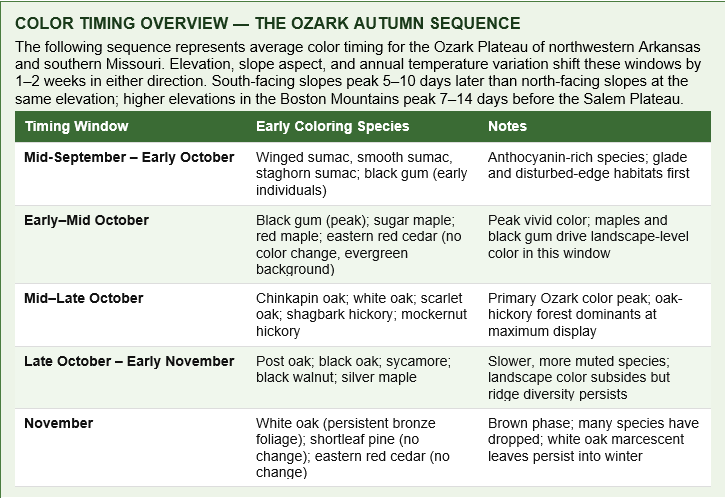
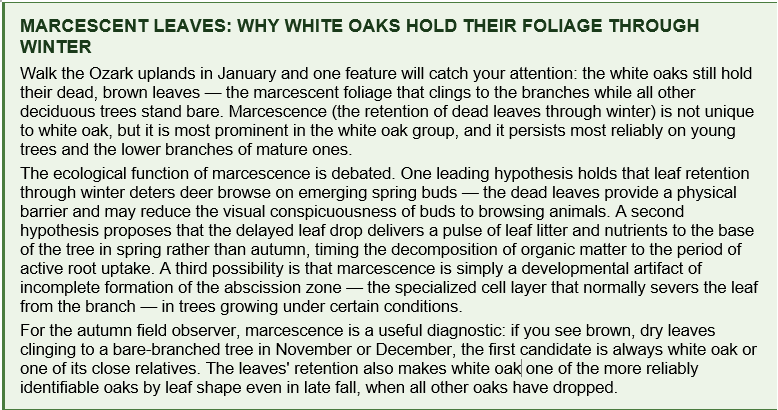
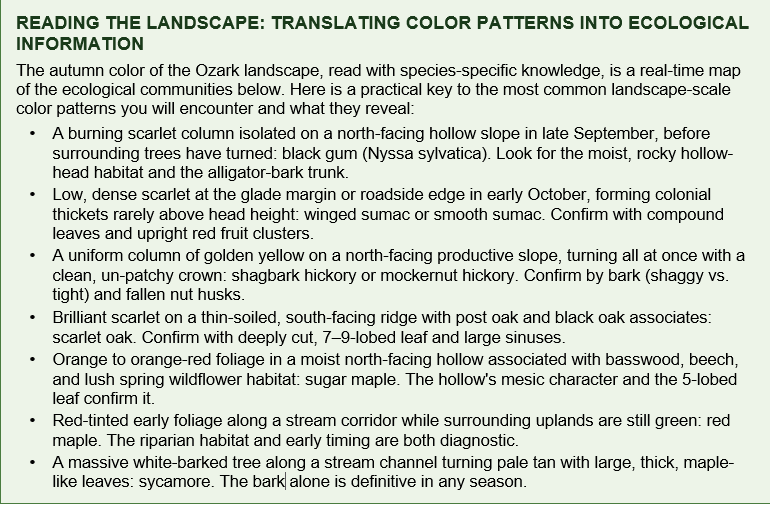
Drive any gravel road through the Ozark Plateau on a still morning in mid-October and the hillsides will tell you, if you know how to read them, exactly which trees are growing where. The ridge top burning scarlet and deep wine above the limestone outcrop is black gum — Nyssa sylvatica — one of the first hardwoods to turn and always among the most vivid, its lower branches still holding the summer's deep green while the crown ignites above them. The long amber column running down the hollow's south-facing slope is a shagbark hickory, its compound leaves yellowing as a unit the way all hickories do, precisely and uniformly, with none of the patchwork of an oak. The blaze of orange-red running low across the glade margin — low enough to catch at ankle height, low enough to be nearly underfoot — is winged sumac, which will have peaked before most of the oaks have colored at all. The oaks themselves are slower, deeper, more various: the white oaks will work through bronze and burgundy for three weeks before they let go, while the black oaks go red and the post oaks rust and the scarlet oaks — where you find them on the thin-soiled south-facing ridges — justify every syllable of their name. Each species is doing something chemically distinct as it shuts down for the season, and the colors you see across the Ozark landscape are the visible signatures of those distinct biochemical processes — readable, if you learn the vocabulary, as reliably as species identifications in any other season.
HOW TO USE THIS LESSON
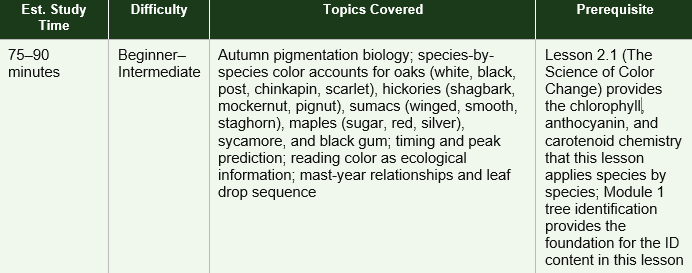
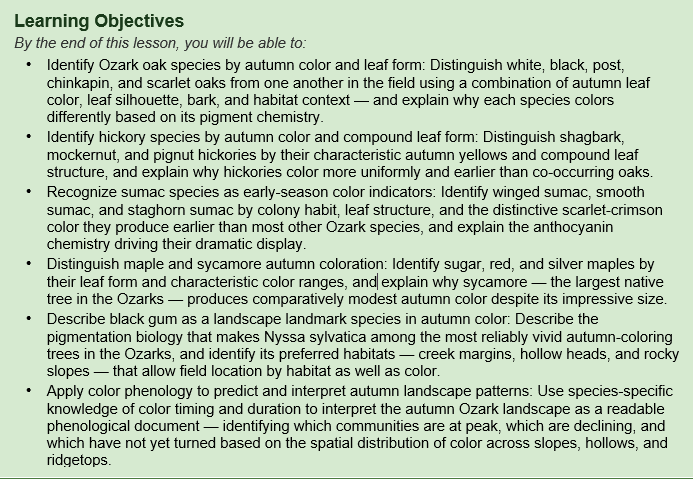
Lesson 2.2 is a species-by-species field reference and ecological guide to the trees that define the Ozark autumn landscape. Where Lesson 2.1 addressed the chemistry of color change — chlorophyll breakdown, carotenoid expression, and anthocyanin synthesis — this lesson applies that chemistry to the specific trees you will encounter in the field, translating biochemical process into on-the-ground identification and ecological interpretation.
The lesson is organized into five parts. Part 1 provides a brief ecological framework: why different tree species produce different colors at different times, and what those differences reveal about the ecological and physiological strategies of the trees themselves. Parts 2 through 5 are species accounts organized by genus or functional group — oaks, hickories, sumacs, and then the remaining major species (maples, sycamore, black gum). Each species account addresses characteristic color range, timing relative to the season, leaf form for confirmation, habitat context for field location, and any distinctive identification features that separate it from visually similar species. Part 5 closes with a phenological synthesis: how to read the autumn Ozark landscape as a whole by integrating the species-specific information from the preceding parts.
This lesson is designed to be used alongside field observation. Read it before your next outdoor session, then take it with you — either as a digital reference or in printed form — and work through the species accounts in the order the landscape presents them to you. The reflection questions and field activity at the end require outdoor observation; do not attempt them from memory or photograph libraries. The Ozark autumn is the laboratory for this lesson, and your quality of engagement with it will determine your quality of learning
PART 1 - Why Each Tree Colors Differently
The Ecological and Biochemical Logic Behind Species-Specific Autumn Color
The autumn color of any given tree species is not arbitrary. It is the visible expression of that species' particular combination of pigment chemistry, photosynthetic investment strategy, and evolutionary history — a product of decisions made over millions of years of selection in the Ozark forest that happen to be legible, in the month of October, as color. Understanding why different species color differently is not merely an intellectual exercise; it is the foundation of using autumn color as a reliable field identification tool.
Three variables drive species-level color differences in the Ozark autumn. First, chlorophyll investment: a tree that has invested heavily in chlorophyll production during the growing season — as mesophytic species adapted to productive bottomland soils tend to do — has more chlorophyll to break down when senescence begins, producing a more prolonged and often more vivid carotenoid display as the masking green withdraws. Second, anthocyanin synthesis capacity: the ability to produce anthocyanins (the red, orange, and purple pigments synthesized actively during senescence, rather than simply unmasked) varies substantially across species and is strongly correlated with the sugar concentrations in leaf tissue during the color-change period. Species like black gum, scarlet oak, and sumac invest heavily in anthocyanin synthesis; hickories produce primarily carotenoid yellows because they do not synthesize significant anthocyanins during senescence. Third, timing of senescence onset: each species has a genetically programmed response to the photoperiod and temperature cues that trigger leaf senescence, and this response is calibrated to the ecological niche of the species. Sumacs growing on xeric glades begin senescence earlier than mesophytic oaks in bottomland hollows — a response consistent with their stress-adapted ecology and shorter growing season in thin, dry soils.
The landscape consequence of these three variables is that autumn color in the Ozarks unfolds not as a uniform wave but as a spatially and temporally structured progression in which each species has its own window. Learning that window — not just the characteristic color but the characteristic timing and characteristic habitat — transforms the autumn landscape into a phenological document that can be read with precision. The parts that follow provide the species-by-species vocabulary for that reading.
PART 2 - Oaks in Autumn
The Long Burn — Five Species, Five Color Profiles
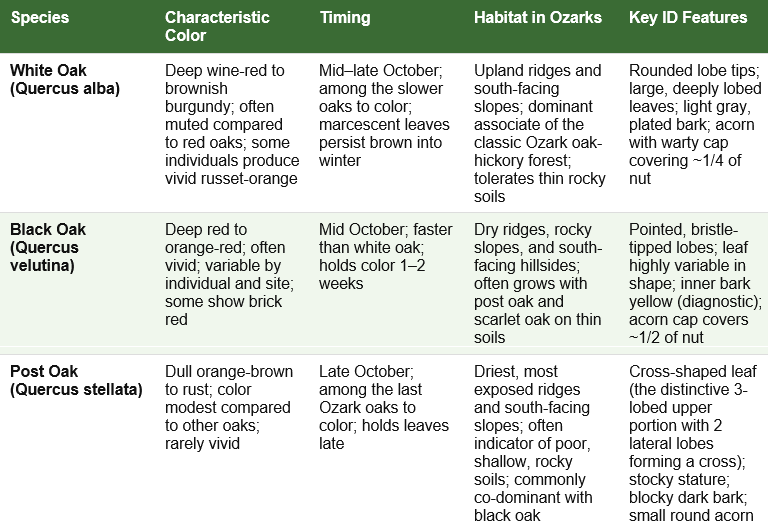
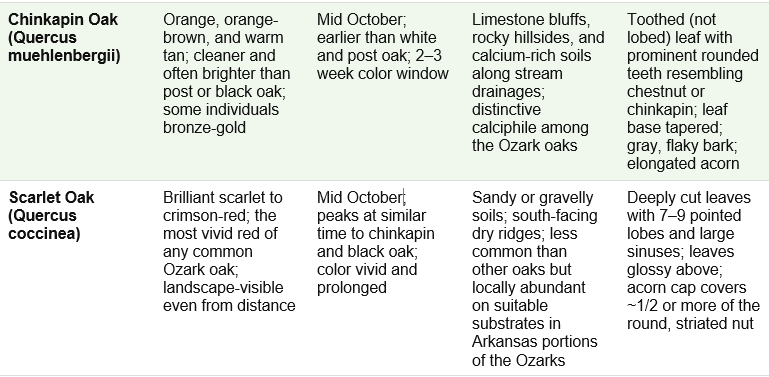
The oaks are the dominant canopy trees of the Ozark uplands, and no group of trees contributes more to the character of the region's autumn display. But oak autumn color is not a monolithic phenomenon — each of the major Ozark oak species produces a different color, at a different time, in a different habitat, and for different biochemical reasons. Learning to distinguish oaks in autumn by color is one of the most practically useful identification skills available to the Ozark naturalist, because the color differences are consistent, predictable, and visible at landscape scale.
Oaks fall into two major groups with relevance to autumn color: the white oak group (white oak, chinkapin oak, and their relatives), whose leaf lobes end in rounded tips and whose acorns mature in a single growing season; and the red/black oak group (black oak, scarlet oak, and their relatives), whose leaf lobes end in pointed, bristle-tipped teeth and whose acorns require two years to mature. This distinction is ecologically and biochemically significant: red/black oaks tend to produce stronger anthocyanin-based reds than white oaks, whose color shifts toward the bronze, tan, and rust end of the spectrum. The species accounts below apply this distinction to the five most common Ozark oaks.
PART 3 - Hickories in Autumn
Gold Against the Sky — Uniform, Early, and Unmistakable
If the oaks are the slow burn of the Ozark autumn — variable, prolonged, complex in their color — the hickories are its clarion note: an abrupt, uniform yellow-gold that is complete before most of the oaks have begun to turn. The hickories are the yellow in the oak-hickory forest's autumn palette, and their color is produced almost entirely by carotenoid pigments — specifically xanthophylls — rather than by anthocyanins. This biochemical choice means that hickories, unlike black gum or scarlet oak, do not produce red or orange: they go yellow, then gold, then drop, often within ten days of beginning to turn.
The uniformity of hickory color change is one of its most diagnostic features. An individual hickory turns all its leaves at essentially the same time; there is little of the patchwork coloring that characterizes oaks, where individual branches at different sun exposures may be at different stages simultaneously. This uniformity reflects the tight hormonal coordination of senescence across the compound leaf — because all leaflets of a hickory's compound leaf are under the control of a single hormonal signal from the rachis, they tend to shut down in unison. A hickory tree in peak color is almost uniformly yellow across its entire crown, making it distinctively visible against the darker greens of surrounding trees or the reds of co-occurring oaks.
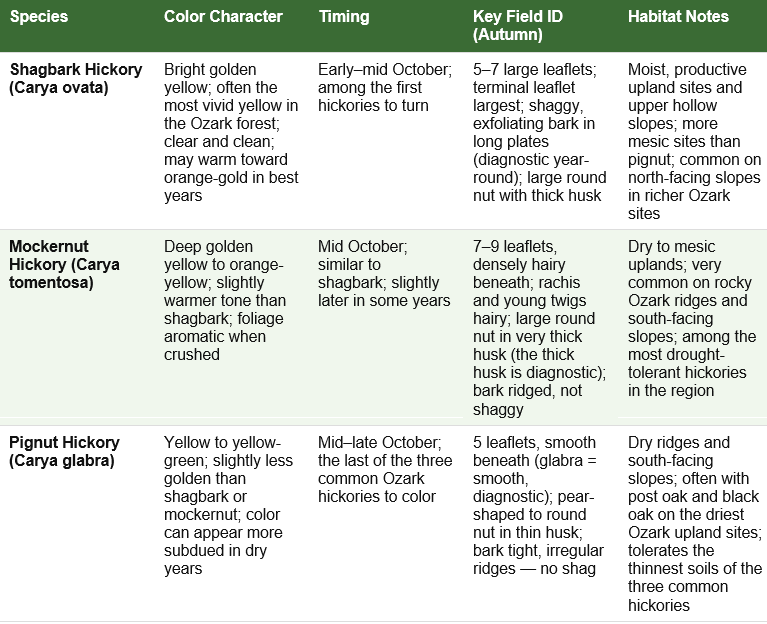
A practical field note on hickory identification in autumn: the compound leaf structure that makes hickories unmistakable as a genus is also the key to autumn confirmation — no other common Ozark tree produces a golden-yellow compound leaf at this time of year. The number and texture of the leaflets (smooth vs. hairy beneath), the husk characteristics of any fallen nuts, and the bark (shaggy vs. tight) separate the three common species. Pecan (Carya illinoinensis) occurs in river-bottom sites in the southern and eastern Ozark margin and produces a similar yellow with 11–15 slender leaflets — its compound leaf length (often 40–50 cm) distinguishes it from the shorter-leaved upland hickories.
PART 4 - Sumacs in Autumn
The First Flames — Scarlet Before the Oaks Have Noticed
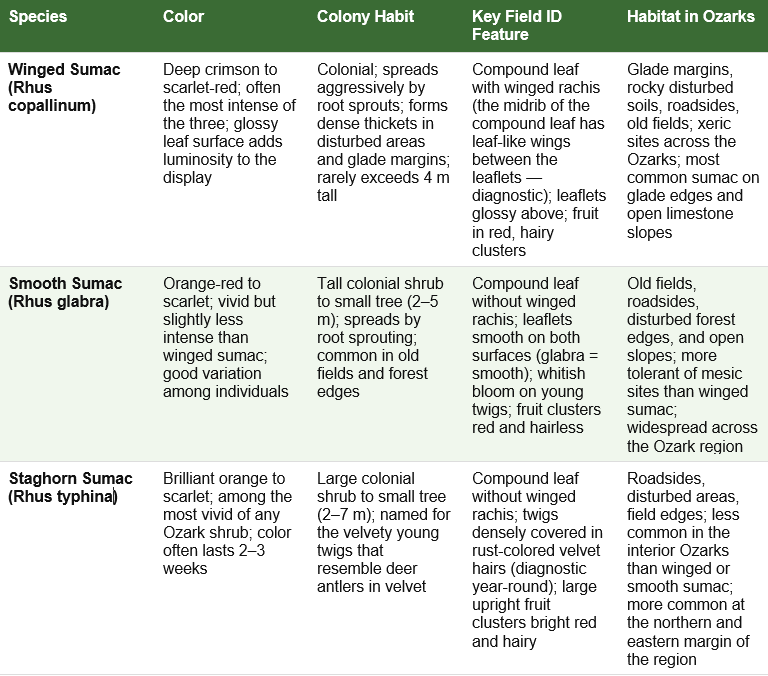
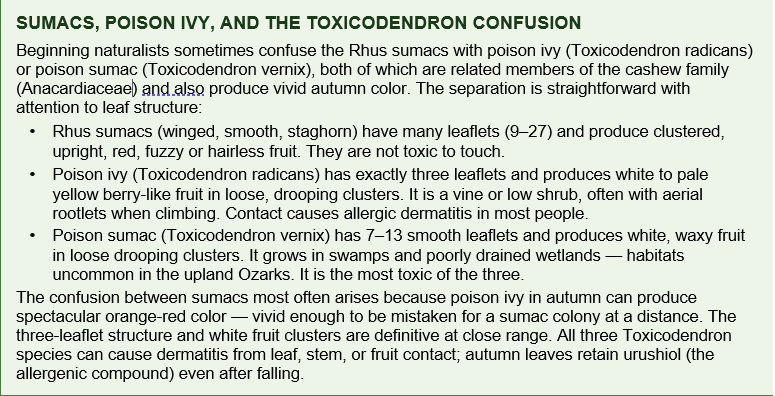
The sumacs are the Ozark autumn's opening act. While the oaks are still fully green and the hickories are just beginning to hint at yellow in late September, the sumac colonies on glade margins, roadsides, and disturbed slopes are already burning — vivid scarlet, deep crimson, and orange-red, their compound leaves turning as early as the second week of September in some years. Sumacs are not the region's tallest or most architecturally significant plants, but in the early autumn weeks before the canopy trees join the display, they are the Ozark landscape's most conspicuous color feature.
The biochemistry driving sumac's early and intense color is the same anthocyanin synthesis that characterizes the most vivid autumn-coloring trees — but sumacs synthesize anthocyanins earlier and more abundantly than most trees. The ecological logic is consistent with the sumac's stress-adapted ecology: growing on thin, dry, often disturbed soils in glade margins and road cuts where growing seasons are limited by soil moisture and temperature extremes, sumacs have evolved to shut down early and decisively. The same xeric-adapted physiology that makes them drought-tolerant during summer also drives their early senescence — they are not adapted to push the growing season into October the way a bottomland white oak does.
PART 5 - Maples, Sycamore & Black Gum
The Outliers and the Spectacular — Three Genera that Complete the Palette
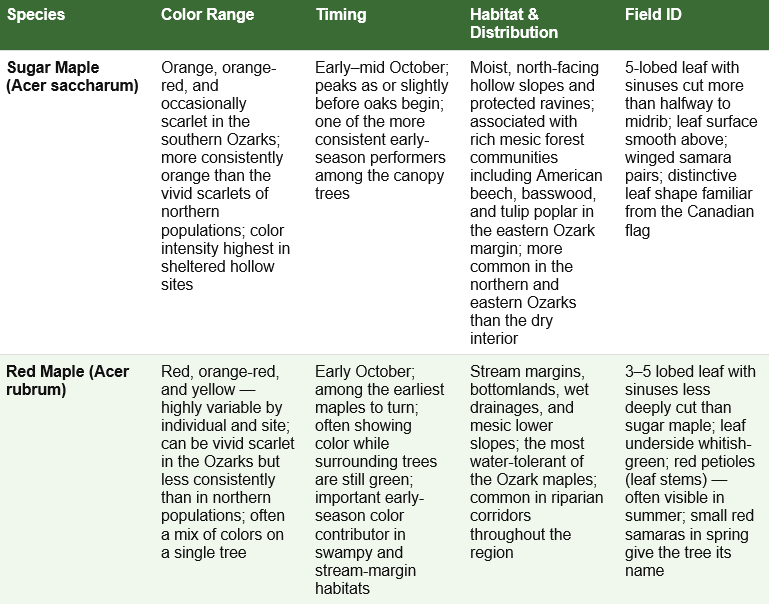
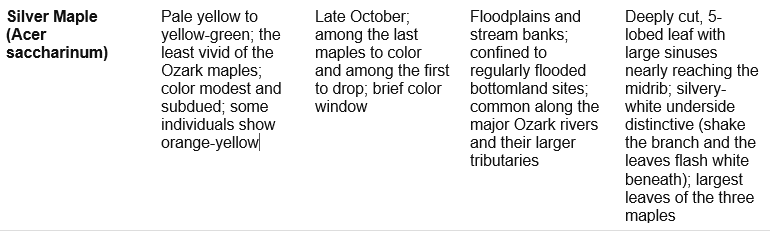
The Ozarks are not classic maple country in the way that the northern hardwood forests of New England or the upper Great Lakes are — the dominant overstory in the Ozark uplands is oak-hickory, not maple-beech, and the intense, uniform sugar-maple scarlets that define popular images of eastern autumn color are a regional phenomenon of moister, cooler climates to the north. But the Ozarks do have maples — three species, in three distinct habitats, producing three distinct color characters — and they contribute meaningfully to the autumn display, especially in the mesic hollows and north-facing slopes where they are concentrated. Two additional genera complete the non-oak-hickory Ozark autumn palette: sycamore, the largest native tree in the region, whose autumn color is among its least impressive attributes; and black gum, whose color is among the most reliably spectacular of any tree in the Ozark flora.
Understanding these three genera completes the color vocabulary needed to read the autumn landscape in full — not just the dominant oak-hickory matrix but the hollow communities, the stream corridors, and the rocky slopes where these species are concentrated.
Maples (Acer spp.) — Three Species, Three Ecological Contexts
Sycamore (Platanus occidentalis) — The Modest Giant
The American sycamore is the largest native tree in the Ozarks by trunk diameter and one of the most ecologically distinctive: its mottled white, cream, and pale green bark — produced by the outer bark flaking away in irregular plates to reveal the smooth inner bark beneath — makes it immediately identifiable in any season and creates one of the most striking winter-landscape features of the Ozark river corridor. Sycamores are confined to stream banks, river channels, and floodplains, where they grow to massive size; in the Ozarks, individuals with trunk diameters exceeding one meter are not unusual along the major rivers.
In autumn, sycamore is among the more understated performers in the Ozark tree community. The large, maple-like leaves — which can reach 20–30 cm across — turn pale yellow-brown to tan, with occasional individuals showing a muted orange-tan. The color is neither vivid nor prolonged; the ecological significance of the sycamore in the autumn landscape is less its foliar display than its role in leaf-pack formation in the streams it borders. Sycamore leaves are large, thick, and slow to decompose; when they fall into the stream channels they border, they become the physical substrate for the aquatic macroinvertebrate communities described in Lesson 5.2 — a contribution to stream ecology that persists through winter long after the color has gone.
Black Gum (Nyssa sylvatica) — The Most Vivid Tree in the Ozark Autumn
Black gum is, in the considered judgment of many Ozark naturalists, the single most reliably spectacular autumn-coloring tree in the region. It begins turning — individual branches, then the whole crown — while surrounding trees are still in full summer green, producing isolated torches of scarlet, deep red, and wine-purple in the forest before the season has officially announced itself. Its color is intense by any standard: the anthocyanin synthesis in Nyssa sylvatica is among the most abundant of any temperate tree species, producing pigment concentrations that drive leaf color deep into the crimson and burgundy range rather than the orange-red of oaks or the yellow-gold of hickories.
Black gum is not a large or architecturally imposing tree — it is typically a medium-sized understory or co-dominant species, rarely reaching the canopy heights of the dominant oaks and hickories. But its autumn color is disproportionately visible precisely because it begins before anything else. In late September and early October, the black gum's burning crown stands out against the surrounding green with a clarity that makes it the easiest tree to locate by color alone in the Ozark forest. It is also among the more reliable trees for identifying by habitat: black gum is strongly associated with creek-head hollows, rocky north-facing slopes, and moist acidic soils — the same microsites where you find trailing arbutus in spring and Christmas fern year-round. Once you know the habitat signature, the autumn color confirms the identification at fifty meters.
Black gum field ID summary: Simple, elliptical to obovate leaves (5–12 cm), glossy above, untoothed margin (no lobes, no teeth — entirely smooth-edged). Twigs with a distinctive zigzag pattern. Bark dark gray-black, deeply ridged and blocky on mature trees (sometimes compared to alligator skin). Fruit: small, dark blue-black drupes in clusters of 2–3, ripe in October, eaten by migrating birds. Habitat: moist rocky slopes, hollow heads, stream margins, north-facing ravines. Associates: umbrella magnolia, American beech, mountain laurel (in the eastern Ozark margin), and Christmas fern.
Reflection Questions
Record your responses in your field journal before proceeding to the activity. These questions require integration across all five parts of this lesson and connection to the color chemistry introduced in Lesson 2.1.