5.2 Leaf Pack Ecology
The Critical Role of Fallen Leaves as the Base of Stream Food Webs
Coarse and Fine Particulate Organic Matter •Microbial Conditioning and the Aquatic Hyphomycetes •Functional Feeding Groups and Shredder Ecology • The Leaf Processing Continuum • Leaf Packs as Physical Habitat • The River Continuum Concept in Ozark Streams
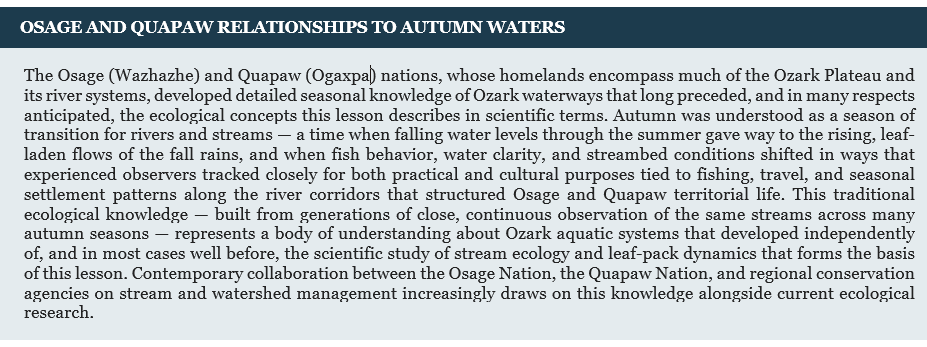
Wade into an Ozark headwater stream on an October afternoon and you will find, in nearly every slack-water eddy and behind every fallen branch, a loose brown raft of leaves — a leaf pack, though no one built it. A week of hard freezes upslope has stripped the sycamores and river birches along the bank, and the current has done the rest, gathering the fallen leaves into drifts against root wads, gravel bars, and the downstream face of every obstruction the stream offers. Pick one apart and the ecology of the entire autumn stream unfolds in your hands. The outer leaves are still recognizably leaves, tea-brown and slick with a film of bacteria and fungal filaments that began colonizing them within hours of submersion. Deeper in the pack, the leaves are riddled and skeletonized, their tissue reduced to a lace of veins by weeks of fungal digestion and the grinding mandibles of stonefly and caddisfly larvae that have taken up residence between the layers. A cranefly larva as thick as a pencil lead retreats from the light. A cased caddisfly, its portable shelter built from bound leaf fragments, clings to the pack's edge. This unremarkable tangle of drifting leaves is, pound for pound, one of the most important structures in the entire stream ecosystem — the primary energy entry point for a food web that, in a forested headwater stream, receives almost none of its energy from sunlight and photosynthesis at all. To understand how a fallen leaf becomes a fed macroinvertebrate, a fed macroinvertebrate becomes a fed fish, and a fed fish becomes the entire downstream economy of the river, is to understand the central energetic logic of the Ozark stream in autumn.
HOW TO USE THIS LESSON
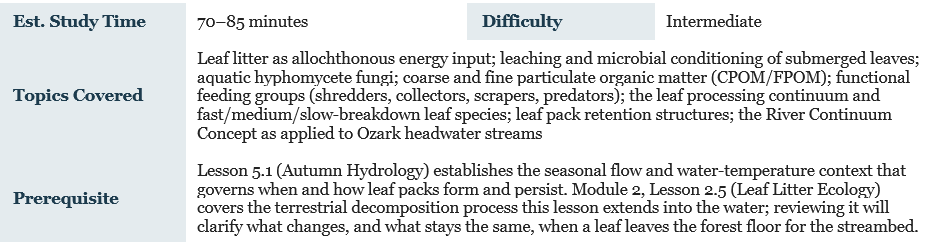
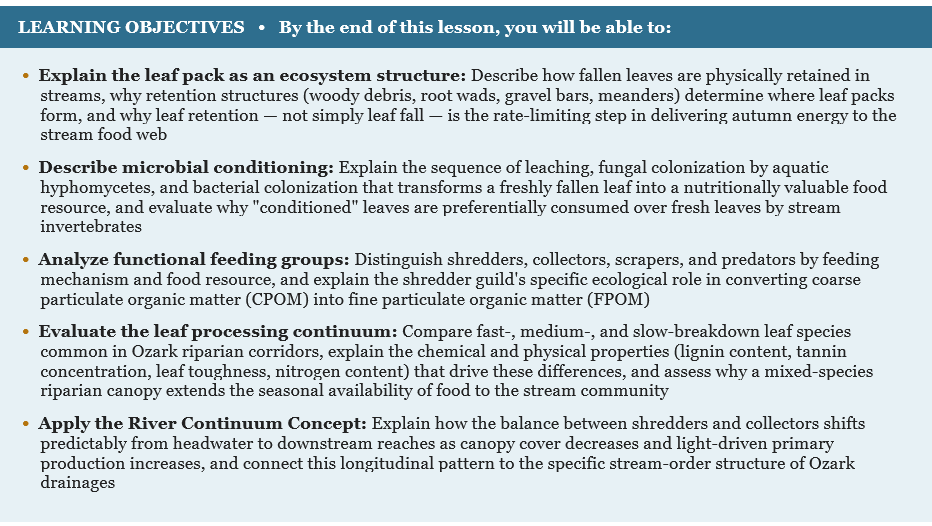
Lesson 5.2 builds directly on the hydrological foundation established in Lesson 5.1: the autumn rains and rising stream levels that lesson described are also the mechanism that delivers leaf litter into the water and distributes it to the retention structures where leaf packs form. This lesson is organized in four parts. Part 1 covers the physical entry of a leaf into the stream — how leaf packs form, where they are retained, and the immediate chemical changes (leaching) that begin within hours of submersion. Part 2 addresses microbial conditioning, the process by which aquatic fungi and bacteria transform a chemically unpalatable fresh leaf into a food resource stream invertebrates can use. Part 3 introduces the functional feeding groups — particularly the shredder guild — that consume conditioned leaf material and, in doing so, convert coarse organic matter into the fine particles that support the rest of the invertebrate community. Part 4 places the leaf pack in its full seasonal and spatial context: the leaf processing continuum of fast-, medium-, and slow-breakdown species that extends the autumn food pulse across months, and the River Continuum Concept, which explains why this lesson's headwater-focused ecology gives way, downstream, to the algae-based food webs more familiar from summer stream observation.
PART 1 - From Canopy to Current
How a Fallen Leaf Enters the Stream, Where It Is Retained, and What Happens in the First Hours Underwater
Lesson 5.1 described the hydrological turn of the Ozark autumn: cooling water temperatures, the return of consistent rainfall after the summer's low-flow stress, and the seasonal rise in stream discharge that follows the first sustained cold fronts. That same hydrological turn is the delivery mechanism for the subject of this lesson. As deciduous trees across the watershed complete the color change and abscission process examined in Module 2, an enormous pulse of organic material — leaves, twigs, bud scales, and fragments of bark — moves from the terrestrial canopy into the stream channel, carried by wind, gravity, and the first heavy autumn rains that wash accumulated leaf litter from the surrounding slopes into the water. In a well-forested Ozark headwater catchment, this single autumn pulse can account for well over half of the total annual organic energy input to the stream — a delivery event concentrated into a matter of weeks that the aquatic food web must be structurally prepared to capture, process, and use across the following months.
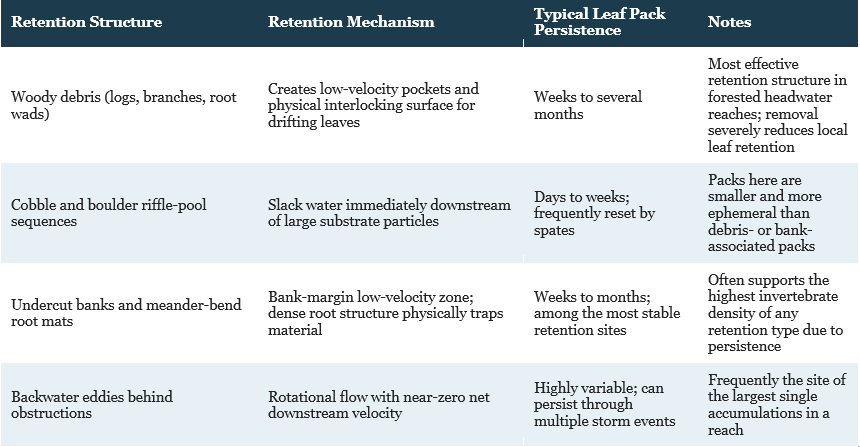
Falling into the water, however, is only the first step, and it is not the step that determines whether a leaf becomes available to the stream community. A leaf that drifts freely downstream without encountering an obstruction will simply be exported from the reach entirely, carried toward larger water where it contributes little to the local food web. The critical process is retention: the physical capture of leaf material by structures in the streambed that slow the current enough for leaves to settle, accumulate, and interlock into the dense aggregations known as leaf packs. In Ozark headwater and mid-order streams, four structures do most of this retention work. Woody debris — fallen branches, logs, and root wads — is the single most effective retention structure in forested reaches, its irregular surface creating the low-velocity pockets where drifting leaves collect and interlock. Boulder and cobble substrate creates similar low-velocity zones on a smaller scale, particularly in riffle-pool sequences where leaves accumulate in the slack water immediately downstream of larger rocks. Undercut banks and root wads along outside meander bends trap leaves against the bank margin, often building the largest and longest-persisting packs in a given reach. And backwater eddies — the rotating, low-velocity water that forms behind any obstruction to the main current — provide the calmest retention environment of all, allowing leaf packs to build to substantial size without being scoured away by each subsequent rain event.
The ecological significance of retention structure is not a minor technical detail — it is the reason that stream channelization, the removal of woody debris (once a standard stream "cleanup" practice), and the loss of riparian vegetation have such disproportionate effects on stream food-web productivity. A stream with abundant retention structure captures and holds a large fraction of its autumn leaf input, processing that material locally and supporting a productive resident invertebrate and fish community. A channelized stream with a smooth, debris-free bed and an eroded, unstable bank retains almost none of its leaf input; the leaves that fall into it are exported downstream, largely unprocessed, and the local food web is correspondingly impoverished. Ozark streams draining intact, forested watersheds — much of the Mark Twain National Forest and Ozark National Scenic Riverways drainage network — retain leaf material efficiently and support leaf-pack communities of considerable density and diversity; streams draining cleared, channelized, or heavily grazed watersheds retain far less, with measurable downstream consequences for invertebrate and fish productivity.
The First Hours: Leaching
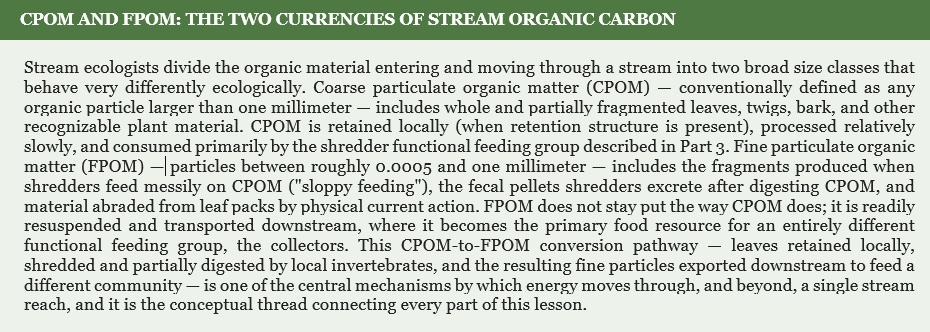
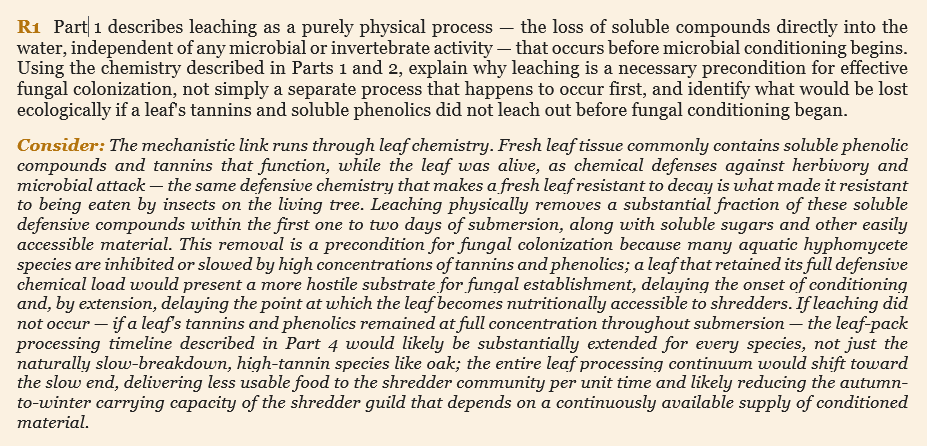
The moment a leaf is submerged, it begins to change chemically through a process independent of any microbe or invertebrate: leaching, the physical loss of soluble compounds — sugars, amino acids, potassium and other soluble minerals, and soluble phenolic compounds — directly into the surrounding water. Leaching is rapid and substantial: a freshly submerged leaf can lose ten to thirty percent of its original dry mass within the first twenty-four to forty-eight hours, entirely through the simple physical diffusion of soluble material out of damaged and senescent leaf cells into the surrounding water, with no biological consumption involved at all. This leachate is not ecologically inert — the dissolved organic carbon and nutrients released into the water column during the leaching pulse are themselves a resource, taken up by stream bacteria and contributing to the base of the dissolved-organic-matter food web that operates in parallel with the particulate food web this lesson focuses on. But from the perspective of the leaf itself, leaching is a necessary precondition for what comes next: the loss of soluble sugars and simple compounds strips away much of the leaf's most easily accessible energy, but it also removes some of the soluble phenolic and tannin compounds that make fresh leaf tissue chemically unpalatable and physically resistant to microbial attack, opening the leaf's remaining structural tissue — cellulose, hemicellulose, and lignin — to the fungal colonization that Part 2 describes.
Leaf Pack Retention Structures in Ozark Streams
PART 2 - Microbial Conditioning
Aquatic Hyphomycete Fungi, Bacterial Colonization, and the Transformation of an Inedible Leaf into a Food Resource
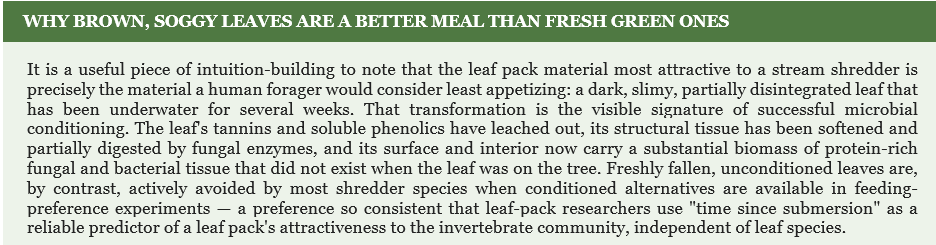
A freshly fallen, freshly submerged leaf is, from the perspective of a stream invertebrate, a poor meal. Its tissue is structurally tough, its nitrogen content is low relative to the carbon-rich cellulose and lignin that make up most of its dry mass, and it often retains defensive tannins and phenolic compounds that deter herbivory — the same chemical defenses that made the leaf unpalatable to insects while it was alive on the tree. Almost no stream macroinvertebrate can extract meaningful nutrition from a fresh, unconditioned leaf. What transforms the leaf from an indigestible structural material into a valuable food resource is microbial conditioning: the colonization and partial decomposition of leaf tissue by fungi and bacteria, a process that begins within hours of submersion and continues for the several weeks to months it takes a given leaf species to be fully processed.
Aquatic Hyphomycetes: The Primary Conditioning Agents
The dominant conditioning organisms in most temperate streams, including Ozark streams, are a specialized ecological group of fungi called aquatic hyphomycetes — a functional grouping (not a single taxonomic group) of fungal species adapted specifically to life on submerged decaying plant material in flowing water. Aquatic hyphomycetes colonize a leaf's surface and interior within days of submersion, and their filamentous hyphae penetrate the leaf's structural tissue, secreting extracellular enzymes that break down cellulose, hemicellulose, and — more slowly — the lignin that gives leaf tissue its structural rigidity and resistance to decay. This enzymatic breakdown accomplishes two things simultaneously that matter enormously to the invertebrates that will eventually feed on the leaf: it softens the leaf's physical structure, making it easier to fragment and ingest, and it converts some of the leaf's structural carbon into fungal biomass — protein-rich, nitrogen-rich fungal tissue that is dramatically more nutritious than the plant material it grew from. A leaf's carbon-to-nitrogen ratio, which begins very high (nitrogen-poor) in fresh leaf tissue, falls substantially over the weeks of fungal conditioning as fungal biomass accumulates within and on the leaf surface — and this falling C:N ratio is one of the most reliable chemical signatures of a leaf's transition from indigestible to nutritionally valuable.
Bacteria colonize submerged leaves alongside the aquatic hyphomycetes, though their ecological role is somewhat different: bacteria are particularly important on the fine particulate material — the shredded fragments and fecal pellets — that shredder feeding produces, where they continue processing organic matter that the fungi have already structurally opened up. The distinction matters for the functional feeding groups described in Part 3: many shredders show a measurable feeding preference for fungally conditioned leaf material specifically, in some cases selectively grazing the fungal hyphae and associated microbial biofilm from a leaf's surface as much as consuming the leaf tissue itself — a foraging strategy sometimes described as "eating the fungus, incidentally consuming the leaf."
PART 3 - Functional Feeding Groups
Shredders, Collectors, Scrapers, and Predators — the Macroinvertebrate Community That Processes the Leaf Pack
Stream ecologists classify macroinvertebrates not primarily by taxonomy but by functional feeding group — a classification based on how an organism acquires its food and what type of food resource it depends on, because these functional categories predict an organism's ecological role far more reliably than its taxonomic identity does. Four functional feeding groups dominate the macroinvertebrate communities of Ozark streams, and a leaf pack in October and November is, more than any other single stream habitat, the place where the first and most distinctively autumn-associated of these groups reaches its highest density: the shredders.
Shredders: The Leaf Pack Specialists
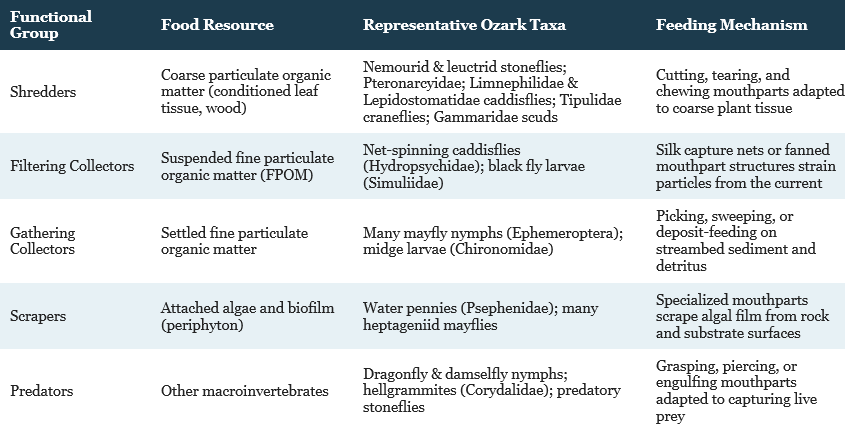
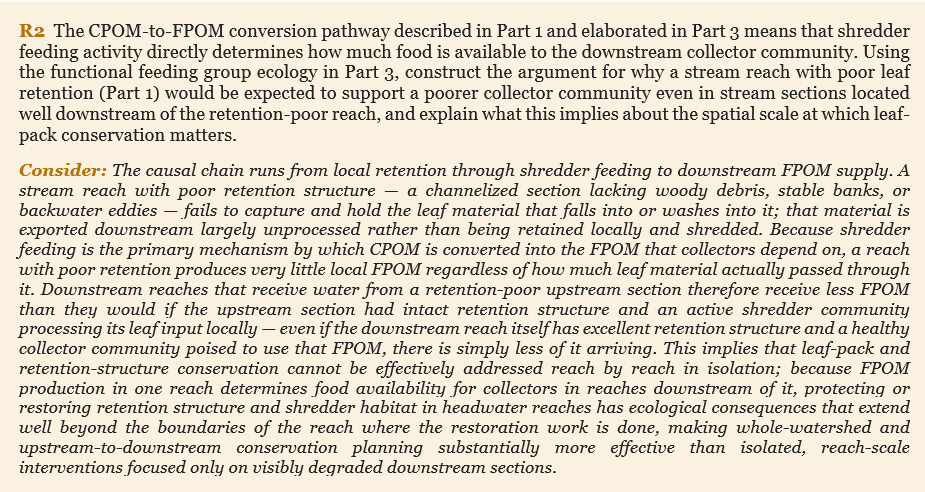
Shredders are macroinvertebrates equipped with mouthparts specifically adapted to cut, tear, and chew coarse particulate organic matter — primarily conditioned leaf tissue, though some shredder taxa also process wood and other coarse plant material. Their feeding accomplishes the critical CPOM-to-FPOM conversion introduced in Part 1: as a shredder feeds, a substantial fraction of the leaf material it handles is not actually ingested but is instead fragmented and released into the current as fine particles — a phenomenon researchers call "sloppy feeding" — while the material the shredder does ingest is processed through its gut and released as fecal pellets, another form of fine particulate matter. A single actively feeding shredder population can process a remarkable fraction of a leaf pack's standing crop over the autumn and winter months, and the fine particulate byproduct of that processing becomes the primary food resource for the collector functional group described below.
In Ozark headwater and mid-order streams, the shredder guild is dominated by immature aquatic insects from three orders. Stonefly (Plecoptera) shredders — particularly nemourid and leuctrid "rolled-winged" and "needle" stoneflies, along with the giant stoneflies of the family Pteronarcyidae in larger streams — are cold-water specialists whose activity often peaks in the cooler months of late fall and winter, precisely the period when leaf packs are freshest and most abundant. Caddisfly (Trichoptera) shredders, especially the case-building families Limnephilidae (northern caddisflies) and Lepidostomatidae, construct portable shelters from bound leaf and mineral fragments and graze on the surrounding leaf pack material from within the relative protection of their case. Cranefly (Diptera, family Tipulidae) larvae, often among the largest invertebrates found within a leaf pack, are generalist shredders whose soft, elongate bodies and robust mandibles allow them to process substantial quantities of conditioned leaf tissue. A smaller but locally important shredder contribution comes from crustaceans — scuds (amphipods of the family Gammaridae) and aquatic sowbugs (isopods of the family Asellidae) — which are particularly associated with spring-fed and groundwater-influenced Ozark streams where their populations can reach high densities.
Collectors, Scrapers, and Predators: The Rest of the Guild
Collectors feed on fine particulate organic matter rather than the coarse leaf material shredders specialize in, and they are subdivided by feeding mechanism into filtering collectors, which use specialized structures — the silk-lined capture nets of net-spinning caddisflies (family Hydropsychidae) are the most conspicuous Ozark example — to strain suspended FPOM directly from the water column, and gathering collectors, which pick or sweep settled FPOM from the streambed surface, a strategy used by many mayfly nymphs and midge larvae. Because leaf pack shredding is the primary local source of FPOM in a forested headwater reach during autumn, collector abundance and distribution in this season tracks shredder activity closely — collectors are often most abundant immediately downstream of active leaf packs, feeding on the particulate plume the shredders generate. Scrapers, which use specialized mouthparts to graze algae and biofilm from the surface of rocks and other substrate, are a comparatively minor component of the autumn headwater community described in this lesson; their importance increases substantially downstream and in more open-canopy reaches, a pattern Part 4's discussion of the River Continuum Concept explains directly. Predators — including dragonfly and damselfly nymphs, predatory stonefly species, and hellgrammites (dobsonfly larvae) — occupy the top of the leaf-pack invertebrate food web, feeding on the shredders, collectors, and scrapers whose populations the leaf pack's organic matter ultimately supports.
Functional Feeding Groups of the Ozark Autumn Leaf Pack Community
PART 4 - The Leaf Processing Continuum
Fast, Medium, and Slow-Breakdown Leaf Species, and the River Continuum Concept in Ozark Streams
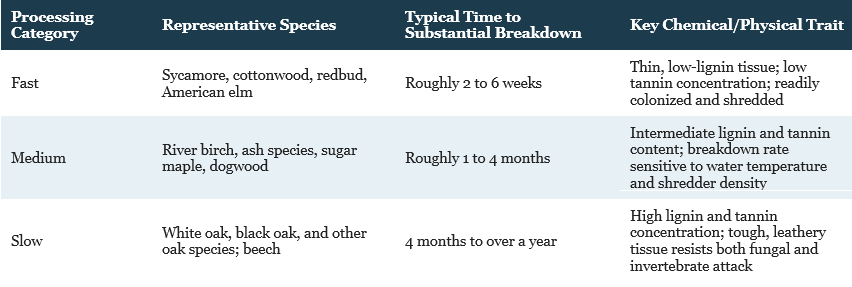
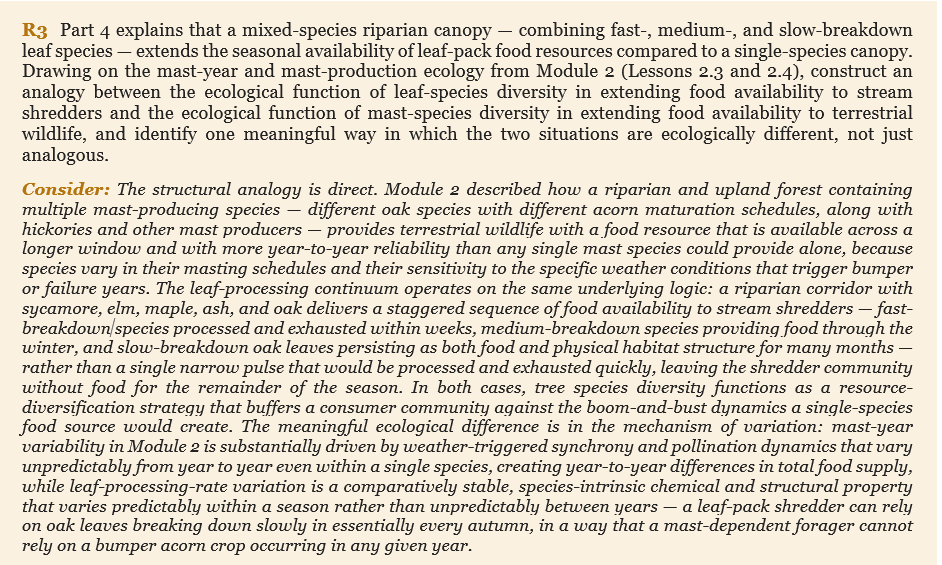
Not all leaves break down at the same rate, and this variation is not incidental — it is the mechanism by which a mixed-species riparian forest extends the availability of leaf-pack food resources across the entire fall and winter rather than concentrating it into a single brief pulse that the invertebrate community could not fully exploit. Stream ecologists group leaf species into three broad processing categories — fast, medium, and slow — based on the physical and chemical properties that govern how readily fungi can colonize the tissue and how readily shredders can consume it: leaf toughness and lignin content (tougher, more lignified tissue resists both fungal enzymes and invertebrate mandibles), tannin and other phenolic concentration (higher concentrations deter both microbial colonization and direct invertebrate feeding), and initial nitrogen content (higher-nitrogen leaves require less microbial nitrogen enrichment before they become nutritionally adequate for shredders). Species with thin, low-lignin, low-tannin leaves — sycamore and cottonwood among the most familiar Ozark riparian examples — can be reduced to skeletonized fragments and fully processed within a matter of weeks. Species with thick, heavily lignified, tannin-rich leaves — the oaks in particular — can persist as recognizable leaf material for many months, in some cases remaining in the streambed until the following summer.
This staggered breakdown schedule has a direct, testable ecological consequence: it means that the Ozark riparian forest's genuine tree diversity — the oak-hickory dominance with a substantial admixture of sycamore, river birch, elm, ash, redbud, and dogwood that Module 2 examined for its foliage color and mast production — also functions as a food-supply diversification strategy for the stream community, whether or not any individual tree species evolved leaf chemistry with that stream-level consequence in mind. A stream lined with a single leaf species would deliver its entire annual leaf-litter energy budget in one narrow pulse, fully processed and exhausted within a few months; a stream lined with a mix of fast-, medium-, and slow-breakdown species delivers a staggered, extended supply that the shredder community can draw on from October well into the following spring, with slow-breakdown oak leaves in particular providing a persistent food and physical-habitat resource through the winter months when few other organic inputs are entering the system.
Leaf Processing Rates of Common Ozark Riparian Tree Species
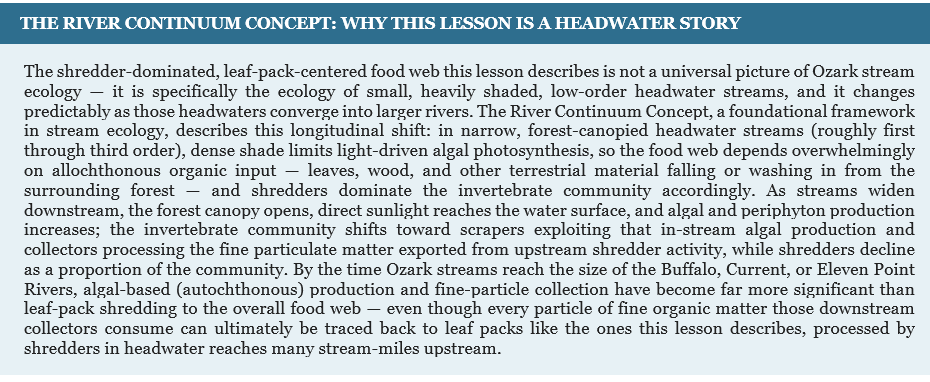
This longitudinal pattern also explains why leaf pack ecology is specifically an autumn headwater lesson within this course, and why Lesson 5.3's discussion of fish feeding behavior operates on a partially separate energetic logic: fish in headwater reaches benefit from leaf-pack ecology primarily indirectly, by consuming the invertebrate populations the leaf packs support, while fish in larger downstream reaches draw on a food web increasingly structured by in-stream algal production and the fine organic matter exported from upstream. Understanding where a given stretch of stream sits on this continuum — a small spring branch, a mid-sized Ozark stream, or a major river — is the single most useful piece of context for predicting what kind of food web, and what kind of leaf pack ecology, you will find there.
Reflection Questions
Record your responses in your field journal before proceeding to the field journal activity. These questions require integration across all four parts of this lesson and across earlier module content.
Field Journal Prompt — Leaf Pack Survey
This field component develops direct observational familiarity with leaf pack structure, retention, and the invertebrate community it supports. Complete all four components at an accessible Ozark stream site — a headwater branch, a mid-sized creek, or any wadeable stream with visible leaf accumulation. A small aquarium net or kitchen strainer, a white sorting tray or shallow pan, and a small hand lens will substantially improve your ability to locate and identify leaf pack invertebrates; none are required, but all are recommended. Observe standard stream-wading safety precautions: avoid entering water above knee depth or with visibly fast current, be cautious of slippery substrate, and avoid streams within 24 hours of significant rainfall when flows may be elevated and unpredictable.
1. Retention structure survey.
Walk a 100- to 200-meter stretch of your chosen stream and locate at least four distinct leaf packs, recording for each: the type of retention structure holding it (woody debris, cobble/boulder, undercut bank, backwater eddy, or other), an estimate of pack size (small — a double handful; medium — roughly a five-gallon-bucket volume; large — larger than that), and a qualitative assessment of how "conditioned" the pack appears (fresh and largely intact leaves versus dark, softened, partially skeletonized material). Which retention structure type produced the largest or most numerous packs at your site? Does this match the pattern described in Part 1?
2. Leaf species and processing-stage inventory.
From one of the leaf packs you located, carefully remove a small sample (a double handful is sufficient — return the remainder to the stream when finished) and sort the leaves into as many identifiable species as you can distinguish, using the tree identification skills from Module 2. For each species present, note its condition using the fast/medium/slow processing framework from Part 4: is it still largely intact (early-stage), softened and partially fragmented (mid-stage), or reduced to a skeletonized network of veins (late-stage)? Does the condition of each species in your sample match its expected processing category — are sycamore or elm leaves, if present, further along than any oak leaves in the same pack?
3. Macroinvertebrate survey.
Using a net, strainer, or simply careful hand-searching, examine the interior of a leaf pack for macroinvertebrates, transferring any you find to a shallow pan of stream water for observation before returning them to the stream. For each organism found, record a description sufficient to attempt identification to functional feeding group using the table in Part 3 (body shape, presence or absence of a case, approximate size, number and position of legs) and note where within the pack it was found (surface, interior, attached to a specific leaf). Estimate the total number of individuals found in your sample and the number of distinct types you were able to distinguish. Based on what you found, does your sample appear shredder-dominated, as Part 3 predicts for an autumn headwater leaf pack?
4. Synthesis and continuum reflection.
Write a minimum of one full page addressing the following: Based on your retention-structure survey, is your stream site retaining leaf litter effectively, or would you characterize it as a poor-retention reach based on the criteria in Part 1? Where does your site sit, in your best estimate, on the River Continuum Concept spectrum described in Part 4 — a narrow, heavily shaded headwater; a moderate mid-order stream; or a wide, more open downstream reach — and does the canopy cover and invertebrate community you observed match what Part 4 predicts for that position? What single change to your site (removal of a specific retention structure, canopy loss, or the reverse — adding retention structure or restoring canopy) would you predict to have the largest effect on its leaf-pack ecology, and why?
