Blue Flag
See also: Iris (genus)
Videos
How to Identify Blue Flag Iris
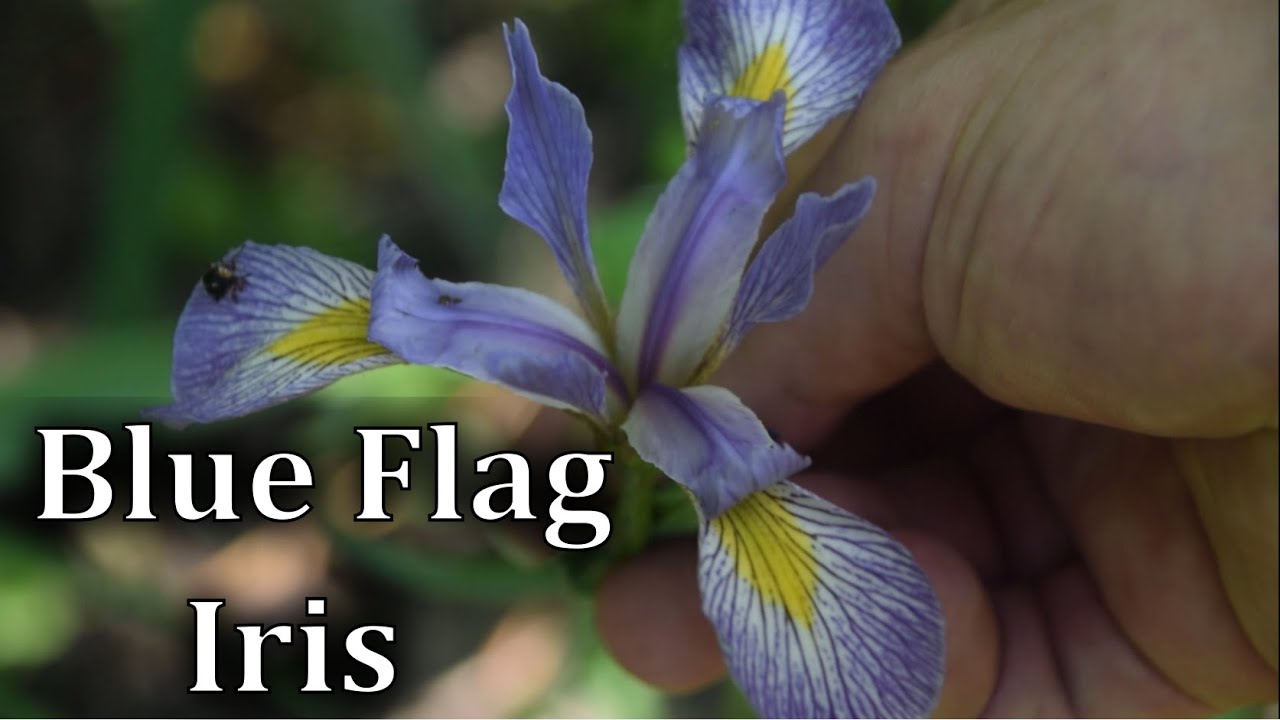
Iris versicolor is a great remedy for thyroid and blood sugar fluctuations due to leaky gut. Specific indication: thyroid and blood sugar fluctuations after eating. Disorders of salivation, bile flow, hence digestion and bowels, liver stress from metabolism up and down, mild depression, some addiction tendencies. - Mathew Wood
This powerful liver cleansing herb is best used in small doses or as part of a combination. It is considered helpful for chronic skin diseases and gallbladder problems involving a lack of bile flow. It helps with hypoglycemia associated with migraines, sugar cravings, and red-colored skin.
Qualities: Cooling and drying
Properties: Bitter, cholagogue, emetic and lymphatic
Specific Indications: Felter: Enlarged, soft, yielding lymphatic tissue. Gastrointestinal irritation, burning in the epigastrium, acid eructations.
From Herbs2000:
Contemporary practitioners of herbal medicine primarily use blue flag to detoxify the body. The use of formulations prepared with blue flag enhances urine flow as well as production of bile. In addition, they also have a gentle laxative action. These combined properties of cleansing the body make blue flag a valuable remedy for persistent skin disorders, for instance acne and eczema, particularly wherein constipation or gallbladder problems are responsible for the skin problems. Blue flag is also recommended for treating biliousness (excessive bile secretion) and indigestion. When taken in small doses, blue flag provides relief from vomiting and nausea. Nevertheless, when taken in large doses, blue flag itself induces vomiting. Traditionally, blue flag has been used to treat chronic gland problems. In addition, many also consider blue flag to facilitate weight loss.
Depending on the Native American practices, physicians of the 19th century who depended on herbs and were known as Eclectic physicians as well as herbalists employed blue flag to treat several medical conditions. It may be noted that when not used as a specific immune stimulator, blue flag was employed as a laxative as well as to detoxify the intestinal tract. Freshly obtained and chopped blue flag rhizomes are applied to sores of impetigo (a widespread bacterial skin contagion in children), which has been often recommended by herbalists. Conventional herbalists have employed blue flag to cure improper digestion marked by malabsorption of fat.
In earlier times, blue flag was amongst the most preferred medicinal plants among diverse Indian tribes in North America. Blue flag also has a gentle purgative action. People using this herb ought to be cautious while use. However, there are reports that this herb also has toxic effects. Freshly obtained rhizome of blue flag is fairly pungent and when it is taken internally it may result in purging and colic. However, the dried out root of the herb is far less caustic/ pungent. Blue flag should never be given to women during pregnancy.
The rhizome of blue flag possesses anti-inflammatory, alternative, cholagogue (any medicine that promotes bile secretion), cathartic (any substance that acts as a purgative), diuretic, diaphoretic (any medical substance that induces sweating), and emetic as well as sialagogue (any medication that promotes flow of saliva) properties. When the root of blue flag is taken internally, it works as a potent laxative or emetic that also has a strong action on the liver and encourages secretion of surplus body fluids. The root is also a tonic for the circulatory as well as the lymphatic systems. As the rhizome of blue flag possesses detoxifying action, it is very effective in treating skin disorders, such as acne, psoriasis and herpes. This attribute of the herb also makes it an important remedy for swollen glands, arthritis, pelvic inflammatory ailment and so on.
The root of blue flag is also applied externally to cure wounds and alleviate rheumatic joint pains. The rhizomes are gathered during the later part of summer or in early autumn and are generally dried up for use when necessary. Earlier, the roots of blue flag were boiled in water and subsequently smashed to prepare a poultice that was employed to alleviate the pain and swelling attributed to bruises and sores.
A number of indigenous Indian tribes of North America employed blue flag roots in the form of protection against rattlesnakes. They were of the belief that as long as the root of the herb was handled from time to time to make certain that its aroma seeped into the individual as well as his/ her clothes, rattlesnakes would never bite them. A number of the native tribes also chewed the root of blue flag and subsequently held rattlesnakes with their teeth and were never bitten till the time the scent remained.
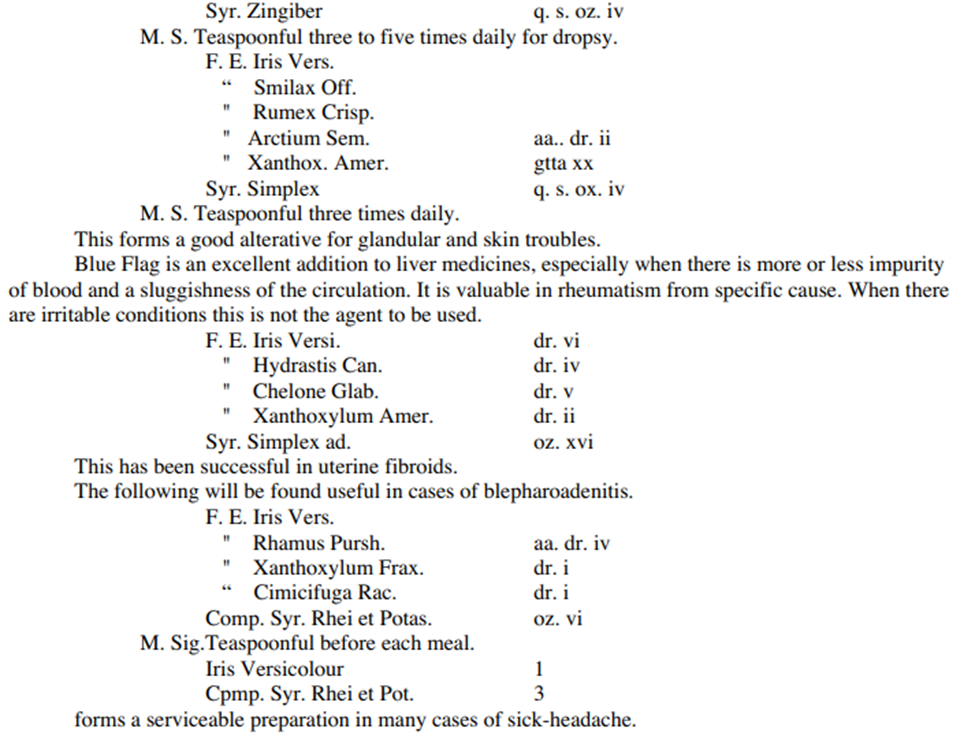
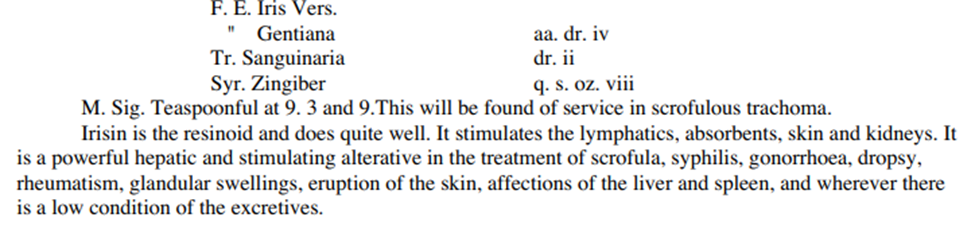
Physio-Medical Therapeutics, Materia Medica and Pharmacy BY T. J. LYLE, A.M.M. 1897
The root is a positive alterative. Its influence extends to the whole glandular system and the lymphatics. In hot infusion it stimulates a good free outward circulation. Cold preparations quite freely influence the liver, gall ducts and bowels. Large doses are quite cathartic, and are somewhat nauseating. Its influence is best as an alterative and when combined with other alteratives.
It is a most desirable agent in secondary syphilis, scrofula, skin diseases, mercurial cachexia, dropsy, chronic rheumatism and chronic liver troubles. Its best influence is seen in chronic, torpid conditions. The Fluid Extract may be used for all the general purposes of the root. It gives good results in chronic constipation, and it is said to give good results in goiter.

The Physiomedical Dispensatory by William Cook, M.D., 1869
The root of this plant is medicinal. When fresh, it is acrid and stimulating; but when dried at a moderate temperature, it loses this property, and then possesses little taste, though retaining its virtues. Age impairs it, and it requires to be kept in air-tight jars. Water extracts much of its virtues; alcohol, and diluted alcohol, act on it more effectually, extracting an oily and a resinous material.
Properties and Uses: This root is relaxing and stimulating, the stimulating property predominating. It acts upon the whole series of secernent organs, exciting the glandular system, and arousing the secretion of saliva, bile, urine, etc. Full doses act upon the liver and bowels quite decidedly and promptly, procuring rather thin discharges, and exhausting the frame if continued too freely. Small doses act with sufficient force to secure the usual glandular effects of a general stimulating alterant. Combined with diuretics, or the aqueous infusion used alone, it manifests a rather distinct impression upon the kidneys. It is rarely used alone as a cathartic, being too active for ordinary purposes; but is commonly added in small proportions to alterative compounds designed for secondary syphilis, mercurial cachexy, low grades of scrofula, leprous and chronic skin affections, and similar cases of marked depression and secernent inefficiency. It has, for the same reason, been commended in low forms of dropsy and chronic rheumatism; and may also be used in chronic liver complaints and jaundice. It is usually given in very limited quantities with such relaxants as suit the case in hand–the iris itself bearing toward the glandular system much the same stimulating relations that capsicum bears to the arterial system. It is not a suitable agent to administer in sensitive and irritable conditions of the frame, but is suited to languid and unimpressible states. Its field of action is thus quite limited, but in that field it is powerful and reliable. The dose ranges from two to five grains, three times a day, as a landular stimulant; and ten to twelve grains as a cathartic. Roots (powdered) of different ages, may vary much in strength; and an inferior article would call for the use of larger doses. Dr. Bigelow and Prof. Rafinesque were among the first to direct the attention of the profession to tills article. It is usually combined with such articles as sarsaparilla, arctium, scrofularia, and rumex. Prof. Rafinesque says that one part of iris and three parts of eryngium yuccaefolium, (about the same as eryngium aquaticum,) are very efficient in curing dropsy, when used in doses not sufficient to more than regulate the bowels. It is an ingredient in the Compound Sirup of Stillingia. As heat impairs its virtues, it is customary to add the tincture when the sirup has been completed.
Pharmaceutical Preparations:
I. Tincture. Finely crushed roots of blue flag, three ounces; alcohol of eighty percent, one pint. Macerate for two weeks, express and filter. This is used in doses of from ten to twenty drops three times a day, as an alterant; and forty to sixty drops as a cathartic. It is usually added to alterant sirups–four to eight ounces of the tincture to each gallon.
When intended to be added to sirups, it should be prepared on fifty percent alcohol; as the resinoid will separate from a stronger alcoholic tincture, when added to water.
II. Extract. A hydro-alcoholic extract is made from the coarsely-powdered roots, after the manner of extracts of this class. This is a rather powerful preparation, seldom used; but may be used in pills in obstinate cases. It is pretty sure to excite rather persistent ptyalism; and by its action on the rectum may arouse the uterine function. Alterative dose, half a grain; cathartic dose, two to four grains.
III. Fluid Extract. Mix one pound of finely-crushed blue flag with twelve fluid ounces of absolute alcohol and four ounces of ether; transfer to a percolator, and add a similar quantity of the menstrua; after it has ceased dripping, add diluted alcohol till a quart has passed. Evaporate this spontaneously to ten fluid ounces, in the mean time adding diluted alcohol till twenty-four fluid ounces have passed. Evaporate this to ten fluid ounces, and mix the two products–using a little absolute alcohol to dissolve any resinous material that may fall. Alterative dose, three to five drops; cathartic dose, twenty to twenty-five drops.
IV. Iridin. This is virtually an oleo-resinous extract, obtained by treating the root with ether and absolute alcohol till exhausted, and then evaporating. It can not be reduced to a solid form. It is a very concentrated article, and not much used. Cathartic dose, one-fourth of a grain every three, hours till it operates. Some druggists prepare iridin by the precipitation of a concentrated alcoholic tincture, as in podophyllin. On the addition of water, it falls as an oleo-resinous mass; which slowly oxidizes by long exposure to the air, and then may be brought to the powdered form by the admixture of a small part of the powdered root or of magnesia. The dose of this preparation is about one grain.