Lipid Nanoparticles
The three LNP-based drugs exhibit numerous similarities in their formulation, thereby behaving comparably as nanoparticles in vivo. Notably, all LNPs consist of four types of lipids: an ionizable lipid, a phospholipid, cholesterol, and a PEG-lipid (refer to Table LNP Lipids). Each of the three ionizable lipids possesses tertiary amine groups with a pKa ranging from 6.0 to 6.7. These lipids undergo a charge transition from neutral to cationic in response to the neutral pH in the blood and the acidic pH in endosomes. The three PEG-lipids feature dialkyl chains comprising only 14 carbons, which facilitates their rapid dissociation from the LNPs' surface once they enter the bloodstream. Essentially, the primary role of PEG-lipids is to prevent LNP aggregation during storage.
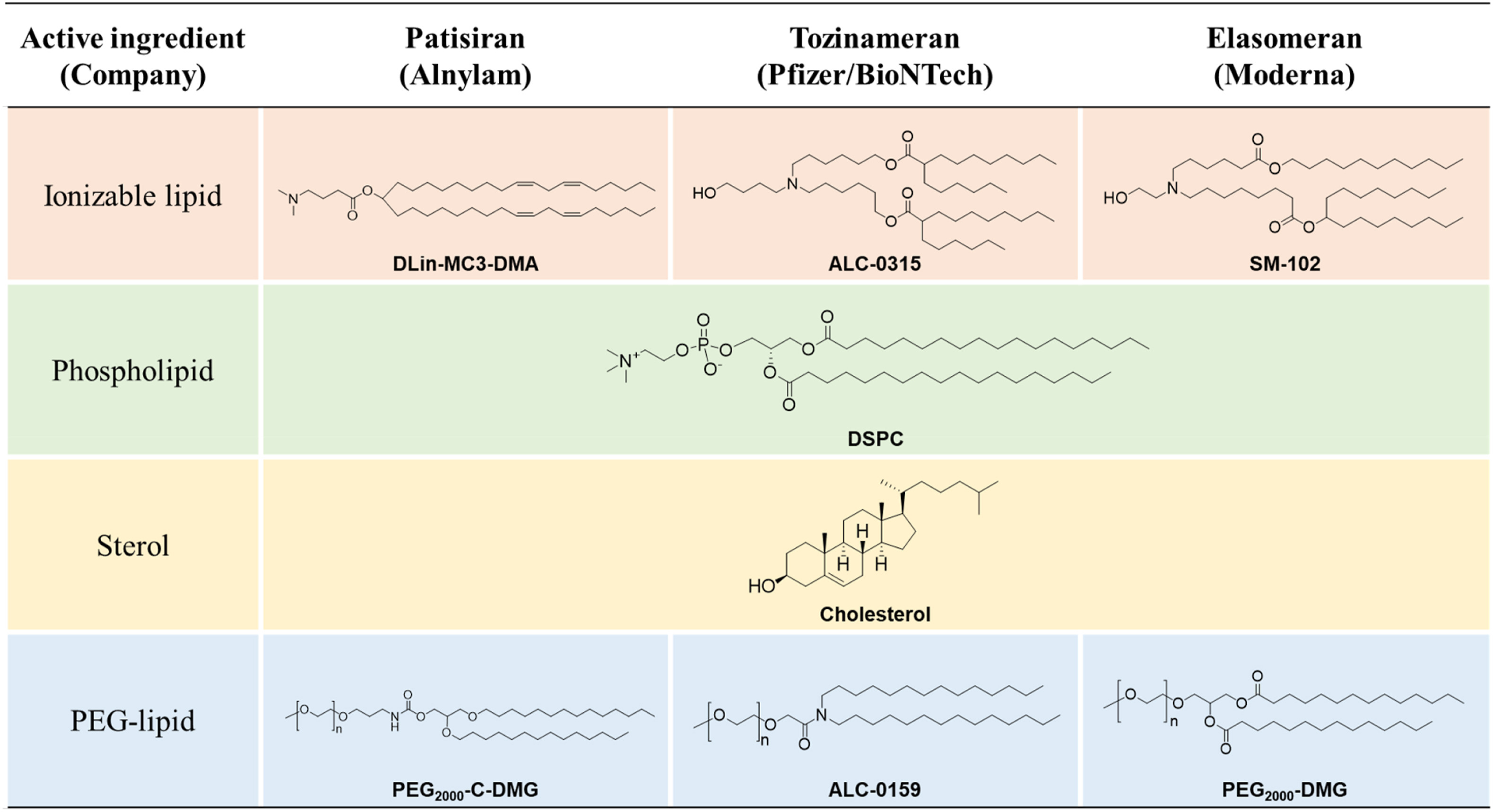
 Table LNP Lipids: The chemical structures of the lipids used in LNPs. Table from Ref 2021 Suzuki.
All three LNPs were composed of the four lipids in similar molar ratios. The primary differences lie in the storage conditions of the drug products. A recent review estimated that mRNAs, rather than LNPs, primarily contribute to the low storage stability of drug products [2021 Schoenmaker]. To slow down mRNA hydrolysis, mRNA vaccines necessitate storage temperatures between -15°C and -25°C (Moderna) and between -60°C and -90°C (Pfizer-BioNTech). Meanwhile, significant advancements have been made in enhancing the thermal stability of mRNA vaccines.
In the early stages of RNA technology, lipid formulations employed permanently charged cationic lipids, resulting in higher RNA encapsulation efficiency compared to neutral systems due to charge interactions between lipids and RNA. However, these formulations suffered from poor tolerability due to the introduction of a highly charged system into the bloodstream. A breakthrough in the development of pharmacologically acceptable lipid formulations occurred with the advent of ionizable cationic lipids. These pH-titratable lipids carry a positive charge at acidic pH but remain mostly uncharged at the pH of blood. This characteristic provides LNPs with the advantages of positive charge (facilitating RNA complexation and interaction with the endosomal membrane during the fusion process for RNA release into the cell cytosol) while avoiding the drawbacks of rapid elimination and poor tolerability.
The assembly of LNPs is achieved by rapidly mixing the four lipids in ethanol with RNA molecules in an aqueous buffer (near pH 4) using a microfluidic or T-junction mixer (refer to Figure LNP Formulation) [2020 Samaridou ].
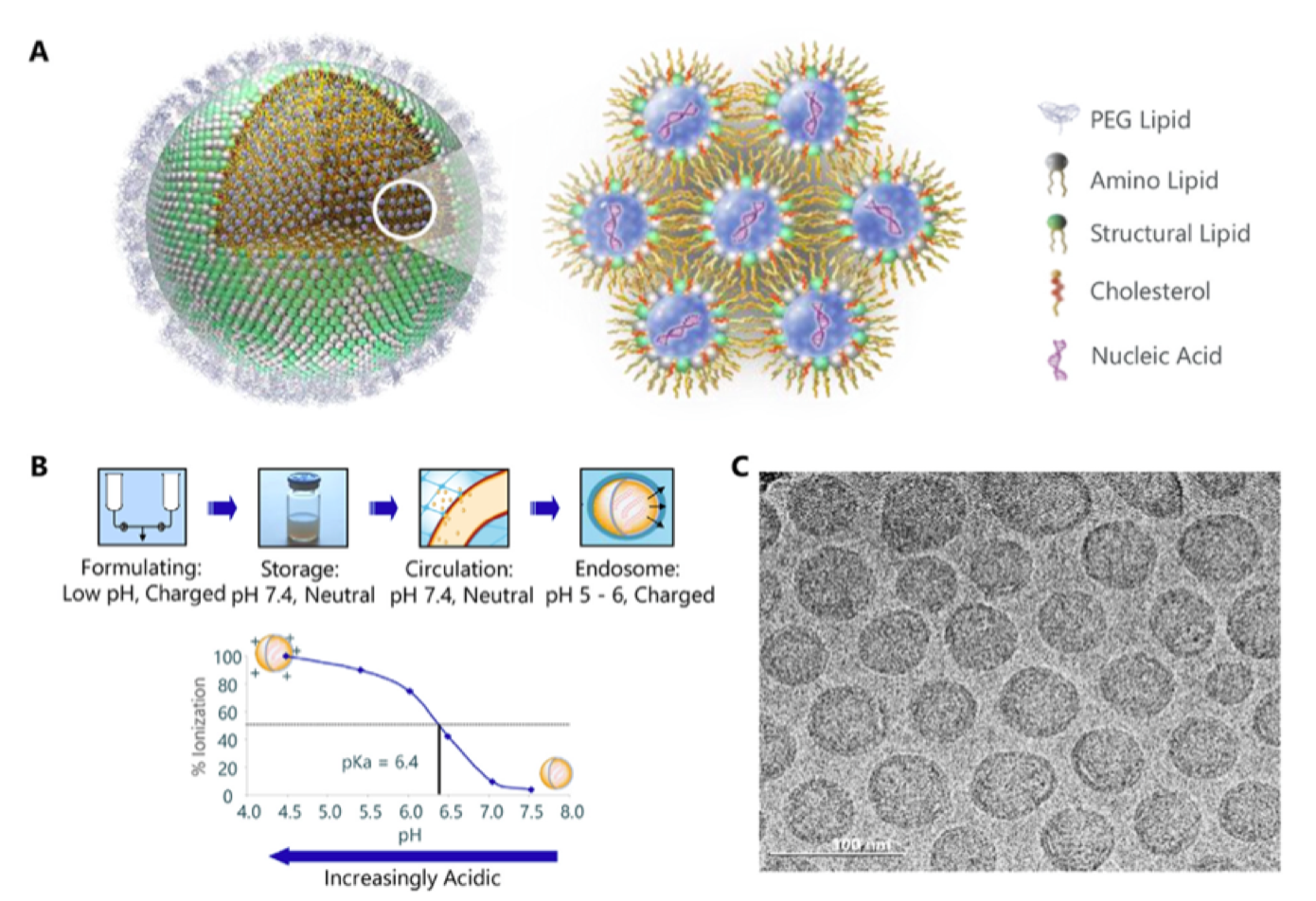

Figure LNP Formulation: (A) Schematic representation of lipid nanoparticle (LNP) structure. (B) Principle and importance of pKa in the action mechanism of ionizable lipids. (C) Cryogenic electron micrograph of LNPs at a magnification of 110,000 x. Scale Bar = 100 nm. Picture from 2020 Samaridou.
| Question | Answer |
|---|---|
| What makes the formulation of an LNP both simple and complex? | 4 lipids can be mixed together but endless combinations exist. |