Tumor Lifecycle
Tumor Lifecycle
There are several notable differences between murine and human tumors (see Figure Tumor Lifecycle). Human tumors can have various causes, but their lifecycle typically begins when a cell or small group of cells in a specific tissue accumulate the right set of mutations to start growing uncontrollably. The growth of these cell colonies goes through a process of elimination, equilibrium, and escape, which can often span years before the tumor cells gather the necessary mutations to grow without limits. As these tumors expand, they can manipulate the surrounding cells and structures to form a complex organ. The resulting tumor has faced significant challenges from the immune system and has developed a high level of genetic diversity, making it harder to treat.
In contrast, murine tumors are more influenced by time constraints rather than immune responses, as research limitations typically require a tumor to develop within a few weeks instead of years. In most tumor inoculation procedures, a large number of cultured cancer cells are injected into a mouse either orthotopically or subcutaneously. These cells usually grow without much interference from the immune system and form a detectable tumor within one to two weeks. Within this short timeframe and without immune editing, these tumors do not exhibit the genetic diversity seen in clinical tumors and have not had enough time to develop the secondary structural features that support many tissues. Angiogenesis, the formation of new blood vessels, occurs rapidly, resulting in a disorganized, hyperpermeable blood vessel structure that is amenable to Enhanced Permeation and Retention drug uptake.
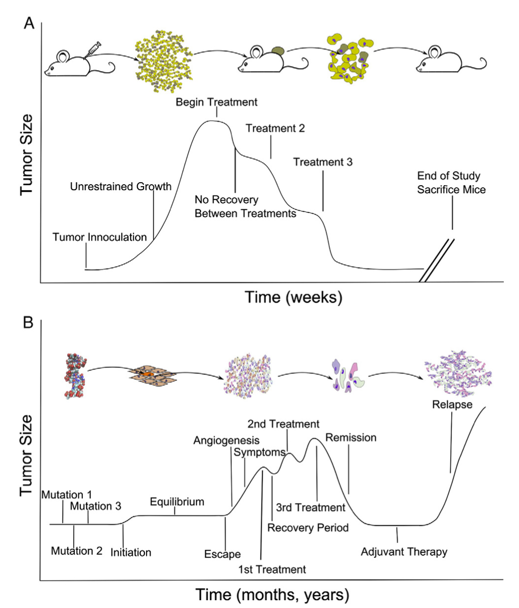
Figure Tumor Lifecycle: Mouse Model Tumors: A preclinical mouse model tumor reaches full size (up to 10% of body weight) within weeks of injection. These tumors are mostly uniform and are subjected to an aggressive treatment schedule with minimal recovery time. Human Tumors: Human tumors accumulate mutations over time until the right combination triggers tumor formation. They may undergo months or years of immune surveillance before entering a growth phase, growing to a small fraction of body weight. Human tumors are more diverse and resistant compared to animal model tumors. Treatment in humans necessitates longer recovery periods between treatments to allow tumor recovery.
Timing of Therapy
Human and mouse metabolisms differ, which may enhance the impact of EPR in lab models. Typically, human patients undergo chemotherapy every 2 to 4 weeks to allow recovery from toxic effects. During these breaks, cancer cells can rebound, becoming resistant as sensitive cells are killed off. In contrast, mice receive more frequent doses, sometimes every three days, preventing tumors from regaining strength. The short lifespan of mice limits long-term cancer monitoring. Most studies end with mice being euthanized, making it challenging to observe cancer recurrence over time. Even studies that keep mice post-remission cannot match the cancer-free survival times seen in human patients.