Liposome Formulation
Liposome Formulation
Over the past decades, many ways to formulate liposomes have been worked out. The fact that lipids are insoluble in water complicates matter. So typically, one has to start with solvents such as ethanol or chloroform that dissolve lipids.
Depicted in Figure Formulation is the workflow of a liposome extrusion: Here, the individual components of the future liposomes are ideally mixed in chloroform. In a glass flask the chloroform is evaporated and a thin film of lipids remains on the glass wall. Microscopically, the thin film represents dozens of layers of flat lipid membranes.
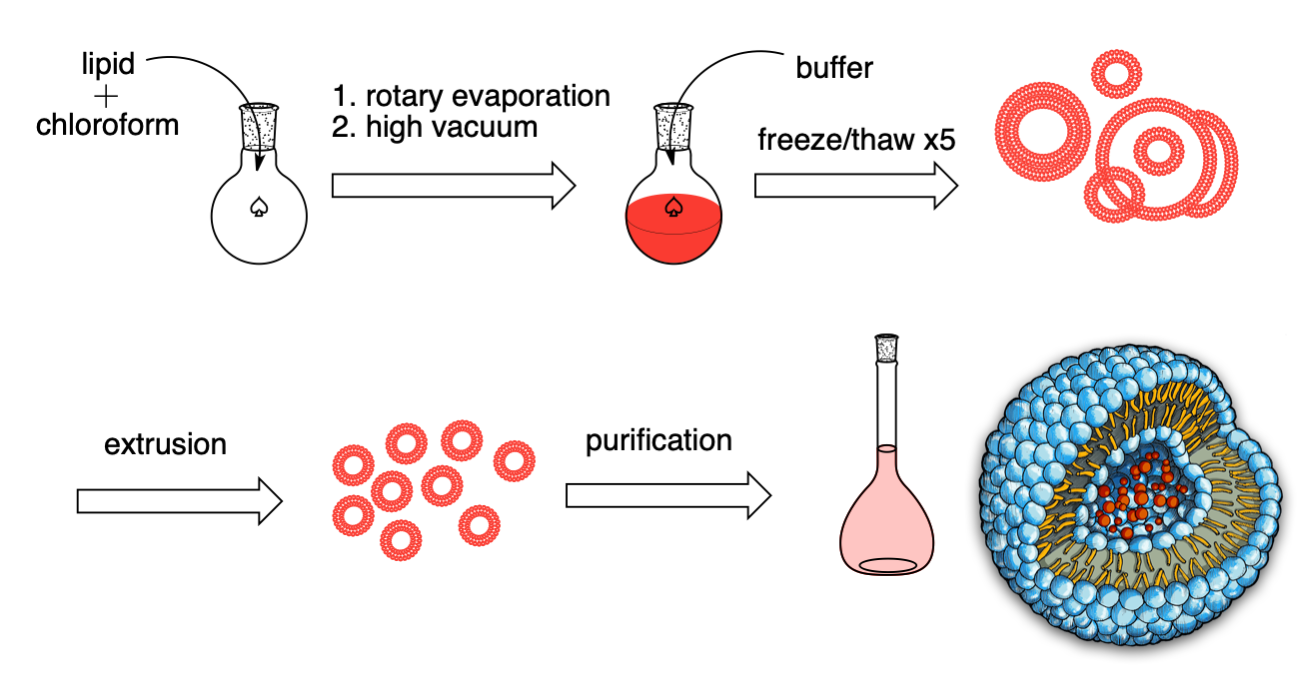

Figure Formulation: Workflow of liposome formulation by thin-film hydration and extrusion.
Now, an aqueous buffer solution is added on top of the film. This hydrates the headgroups of the lipid molecules, leading to a detachment of individual layers of membranes from the glass vessel wall. If the line tension of the membrane is stronger than the bending modulus of the membrane, the membrane will fold itself into a closed sphere. At this point, any cargo molecules that are in the aqueous buffer will partially be encapsulated in the lumen of the liposomes.
An extrusion step, essentially a filtration, will size large liposomes to approximately the diameter of the filter. After this, a dialysis or gel filtration is needed in order to remove any cargo molecules that are still floating around outside of the liposome.
Of course, many variants of this formulation process exists, e.g., it is possible to load a drug into the liposomes after the liposomes are formed. This uses a pH gradient. Furthermore, the use of chlorinated solvents is not possible on large scale due to regulatory issues. The most typical way of forming liposomes today is an injection of an ethanolic lipid solution into an aqueous buffer.
| Question | Answer |
|---|---|
| What is the ”formulation” of a liposome? | The process of forming a liposome loaded with a drug starting from the individual components. |