Mapuche

Ancient flag of the Mapuche on the Arauco War.
At the time of the arrival of Europeans, the Mapuche organized and constructed a network of forts and defensive buildings. Ancient Mapuche also built ceremonial constructions such as some earthwork mounds discovered near Purén.[70] Mapuche quickly adopted iron metal-working (Picunches already worked copper[71]) Mapuche learned horse riding and the use of cavalry in war from the Spaniards, along with the cultivation of wheat and sheep.
In the 300-year co-existence between the Spanish colonies and the relatively well-delineated autonomous Mapuche regions, the Mapuche also developed a strong tradition of trading with Spaniards, Argentines, and Chileans. Such trade lies at the heart of the Mapuche silver-working tradition, for Mapuche wrought their jewelry from the large and widely dispersed quantity of Spanish, Argentine, and Chilean silver coins. Mapuche also made headdresses with coins, which were called trarilonko, etc.
Central to Mapuche cosmology is the idea of a creator called ngenechen, who is embodied in four components: an older man (fucha/futra/cha chau), an older woman (kude/kuse), a young man, and a young woman. They believe in worlds known as the Wenu Mapu and Minche Mapu. Also, Mapuche cosmology is informed by complex notions of spirits that coexist with humans and animals in the natural world, and daily circumstances can dictate spiritual practices.[73]
The most well-known Mapuche ritual ceremony is the Ngillatun, which loosely translates as "to pray" or "general prayer". These ceremonies are often major communal events that are of extreme spiritual and social importance. Many other ceremonies are practiced, and not all are for public or communal participation but are sometimes limited to family.
The main groups of deities and/or spirits in Mapuche mythology are the Pillan and Wangulen (ancestral spirits), the Ngen (spirits in nature), and the wekufe (evil spirits).
Central to Mapuche belief is the role of the machi (shaman). It is usually filled by a woman, following an apprenticeship with an older machi, and has many of the characteristics typical of shamans. The machi performs ceremonies for curing diseases, warding off evil, influencing weather, harvests, social interactions, and dreamwork. Machis often have extensive knowledge of regional medicinal herbs. As biodiversity in the Chilean countryside has declined due to commercial agriculture and forestry, the dissemination of such knowledge has also declined, but the Mapuche people are reviving it in their communities. Machis have an extensive knowledge of sacred stones and sacred animals.
[ ](https://en.wikipedia.org/wiki/File:Hija_del_Cacique_Quilpr%C3%A1n,_en_1868.jpg)The daughter of lonko Quilapán
Like many cultures, the Mapuche have a deluge myth (epeu) of a major flood in which the world is destroyed and recreated. The myth involves two opposing forces: Kai Kai (water, which brings death through floods) and Tren Tren (dry earth, which brings sunshine). In the deluge almost all humanity is drowned; the few not drowned survive through cannibalism. At last, only one couple is left. A machi tells them that they must give their only child to the waters, which they do, and this restores order to the world.
Part of the Mapuche ritual is prayer and animal sacrifice, required to maintain the cosmic balance. This belief has continued to current times. In 1960, for example, a machi sacrificed a young boy, throwing him into the water after an earthquake and a tsunami.[74][75][76]
The Mapuche have incorporated the remembered history of their long independence and resistance from 1540 (Spanish and then Chileans and Argentines) and of the treaty with the Chilean and Argentine governments in the 1870s. Memories, stories, and beliefs, often very local and particularized, are a significant part of the Mapuche traditional culture. To varying degrees, this history of resistance continues to this day amongst the Mapuche. At the same time, a large majority of Mapuche in Chile identify with the state as Chilean, similar to a large majority in Argentina identifying as Argentines.[citation ^needed]
Contemporary attitudes
Since some four years ago a History of the Civilization in Araucanía has been published in the said Anales in which our indigenous ancestors are treated like savages, cruel, depraved, lacking morals, lacking warrior skills ...
—Nicolás Palacios, La raza chilena, p. 62.
Contemporary attitudes towards Mapuches on the part of non-Indigenous people in Chile are highly individual and heterogeneous. Nevertheless, a considerable part of the non-Indigenous people in Chile have a prejudiced and discriminatory attitude towards Mapuche. In a 2003 study, it was found that among the sample, 41% of people over 60 years old, 35% of people of low socioeconomic standing, 35% of the supporters of right-wing parties, 36% of Protestants, and 26% of Catholics were prejudiced against Indigenous peoples in Chile. In contrast, only 8% of those who attended university, 16% of supporters of left-wing parties, and 19% of people aged 18–29 were prejudiced.[116] Specific prejudices about the Mapuche are that the Mapuches are lazy and alcoholic; to some lesser degree, Mapuche are sometimes judged antiquated and dirty.[117]
In the 20th century, many Mapuche women migrated to large cities to work as domestic workers (Spanish: nanas mapuches). In Santiago, many of these women settled in Cerro Navia and La Pintana.[118] Sociologist Éric Fassin has called the occurrence of Mapuche domestic workers a continuation of colonial relations of servitude.[119]
Historian Gonzalo Vial claimed that the Republic of Chile owes a "historical debt" to the Mapuche. The Coordinadora Arauco-Malleco claims to have the goal of a "national liberation" of Mapuche, with their regaining sovereignty over their lands.[106] Reportedly there is a tendency among female Mapuche activists to reject feminism as they consider their struggle to go beyond gender.[118]
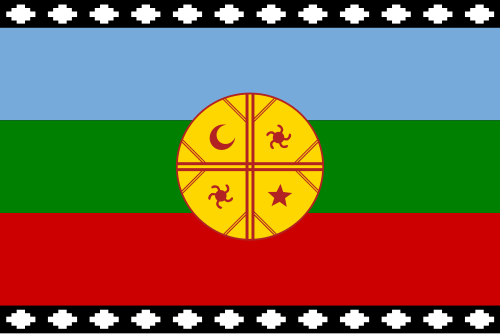
Wenufoye flag created in 1992 by the Indigenist organization "Consejo de Todas las Tierras".

Flag of Argentinian Tehuelche-Mapuche
See also
See PDF for complete Wikipedia article, downloaded:
Sunday, October 18, 2026 09:24AM
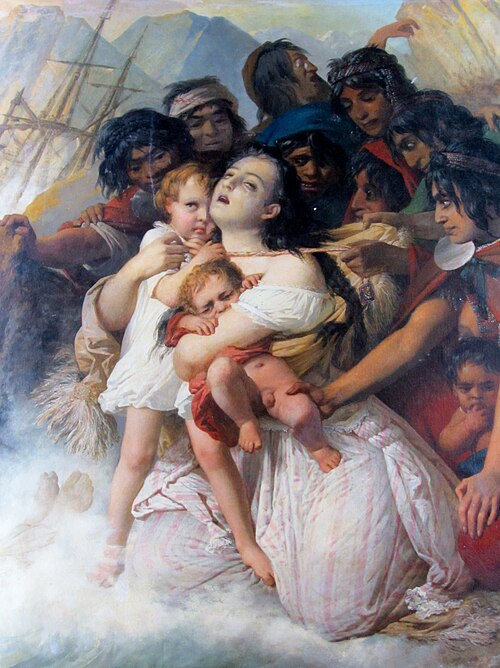
Painting by Raymond Monvoisin showing Elisa Bravo who was said to have survived the 1849 wreck of Joven Daniel to be then kidnapped by Mapuches.