METHOD OF REFUTATION
Tuesday, November 18, 2025 11:53AM
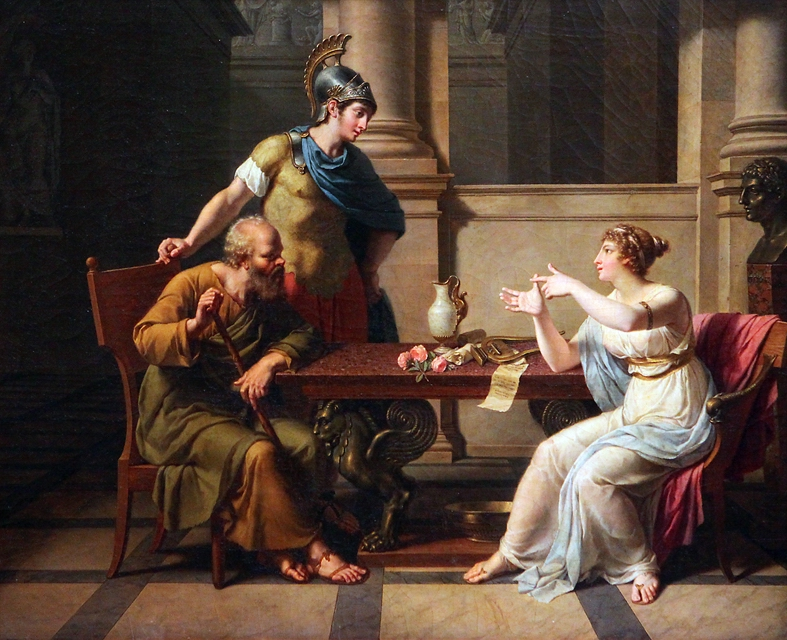
The Debate of Socrates and Aspasia by Nicolas-André Monsiau. Socrates's discussions were not limited to a small elite group; he engaged in dialogues with foreigners and with people from all social classes and of all genders.[75]
A fundamental characteristic of Plato's Socrates is the Socratic method, or the method of refutation (elenchus).[76] It is most prominent in the early works of Plato, such as Apology, Crito, Gorgias, Republic I, and others.[77] The typical elenchus proceeds as follows. Socrates initiates a discussion about a topic with a supposed expert on the subject, usually in the company of some young men and boys, and by dialogue proves the expert's beliefs and arguments to be contradictory.[78] Socrates initiates the dialogue by asking his interlocutor for a definition of the subject. As he asks more questions, the interlocutor's answers eventually contradict the first definition. The conclusion is that the expert did not really know the definition in the first place.[79] The interlocutor may come up with a different definition. That new definition, in turn, comes under the scrutiny of Socratic questioning. With each round of question and answer, Socrates and his interlocutor hope to approach the truth. More often, they continue to reveal their ignorance.[80] Since the interlocutors' definitions most commonly represent the mainstream opinion on a matter, the discussion places doubt on the common opinion.[81]
Socrates also tests his own opinions through the Socratic method. Thus Socrates does not teach a fixed philosophical doctrine. Rather, he acknowledges his own ignorance while searching for truth with his pupils and interlocutors.[81]
Scholars have questioned the validity and the exact nature of the Socratic method, or indeed if there even was a Socratic method.[82] In 1982, the scholar of ancient philosophy Gregory Vlastos claimed that the Socratic method could not be used to establish the truth or falsehood of a proposition. Rather, Vlastos argued, it was a way to show that an interlocutor's beliefs were inconsistent.[83] There have been two main lines of thought regarding this view, depending on whether it is accepted that Socrates is seeking to prove a claim wrong.[84] According to the first line of thought, known as the constructivist approach, Socrates indeed seeks to refute a claim by this method, and the method helps in reaching affirmative statements.[85] The non-constructivist approach holds that Socrates merely wants to establish the inconsistency between the premises and the conclusion of the initial argument.[86]
Socratic priority of definition
Socrates starts his discussions by prioritizing the search for definitions.[87] In most cases, Socrates initiates his discourse with an expert on a subject by seeking a definition—by asking, for example, what virtue, goodness, justice, or courage is.[88] To establish a definition, Socrates first gathers clear examples of a virtue and then seeks to establish what they had in common.[89] According to Guthrie, Socrates lived in an era when sophists had challenged the meaning of various virtues, questioning their substance; Socrates's quest for a definition was an attempt to clear the atmosphere from their radical skepticism.[90]
Some scholars have argued that Socrates does not endorse the priority of definition as a principle, because they have identified cases where he does not do so.[91] Some have argued that this priority of definition comes from Plato rather than Socrates.[92] Philosopher Peter Geach, accepting that Socrates endorses the priority of definition, finds the technique fallacious. Αccording to Geach, one may know a proposition even if one cannot define the terms in which the proposition is stated.[93]
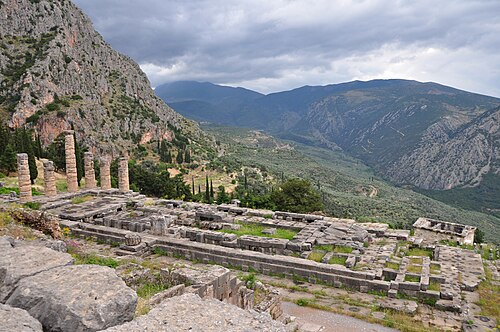
Ruins of the Temple of Apollo at Delphi, where Pythia was sited. The Delphic aphorism Know thyself was important to Socrates, as evident in many Socratic dialogues by Plato, especially Apology.[94]
Plato's Socrates often claims that he is aware of his own lack of knowledge, especially when discussing ethical concepts such as arete (i.e., goodness, courage) since he does not know the nature of such concepts.[95] For example, during his trial, with his life at stake, Socrates says: "I thought Evenus a happy man, if he really possesses this art (technē), and teaches for so moderate a fee. Certainly I would pride and preen myself if I knew (epistamai) these things, but I do not know (epistamai) them, gentlemen".[96] In some of Plato's dialogues, Socrates appears to credit himself with some knowledge, and can even seem strongly opinionated for a man who professes his own ignorance.[97]
There are varying explanations of the Socratic inconsistency (other than that Socrates is simply being inconsistent).[98] One explanation is that Socrates is being either ironic or modest for pedagogical purposes: he aims to let his interlocutor to think for himself rather than guide him to a prefixed answer to his philosophical questions.[99] Another explanation is that Socrates holds different interpretations of the meaning of "knowledge". Knowledge, for him, might mean systematic understanding of an ethical subject, on which Socrates firmly rejects any kind of mastery; or might refer to lower-level cognition, which Socrates may accept that he possesses.[100] In any case, there is a consensus that Socrates accepts that acknowledging one's lack of knowledge is the first step towards wisdom.[101]
Socrates is known for disavowing knowledge, a claim encapsulated in the saying "I know that I know nothing". This is often attributed to Socrates on the basis of a statement in Plato's Apology, though the same view is repeatedly found elsewhere in Plato's early writings on Socrates.[102] In other statements, though, he implies or even claims that he does have knowledge. For example, in Plato's Apology Socrates says: "...but that to do injustice and disobey my superior, god or man, this I know to be evil and base..." (Apology, 29b6–7).[103] In his debate with Callicles, he says: "...I know well that if you will agree with me on those things which my soul believes, those things will be the very truth..."[103]
Whether Socrates genuinely thought he lacked knowledge or merely feigned a belief in his own ignorance remains a matter of debate. A common interpretation is that he was indeed feigning modesty. According to Norman Gulley, Socrates did this to entice his interlocutors to speak with him. On the other hand, Terence Irwin claims that Socrates's words should be taken literally.[104]
Gregory Vlastos argues that there is enough evidence to refute both claims. In his view, for Socrates, there are two separate meanings of "knowledge": Knowledge-C and Knowledge-E (C stands for "certain", and E stands for elenchus, i.e. the Socratic method). Knowledge-C is something unquestionable whereas Knowledge-E is the knowledge derived from Socrates's elenchus.[105] Thus, Socrates speaks the truth when he says he knows-C something, and he is also truthful when saying he knows-E, for example, that it is evil for someone to disobey his superiors, as he claims in Apology.[106] Not all scholars have agreed with this semantic dualism. James H. Lesher has argued that Socrates claimed in various dialogues that one word is linked to one meaning (i.e. in Hippias Major, Meno, and Laches).[107] Lesher suggests that although Socrates claimed that he had no knowledge about the nature of virtues, he thought that in some cases, people can know some ethical propositions.[108]