Who is Aspasia?
Tuesday, November 18, 2025 12:03PM
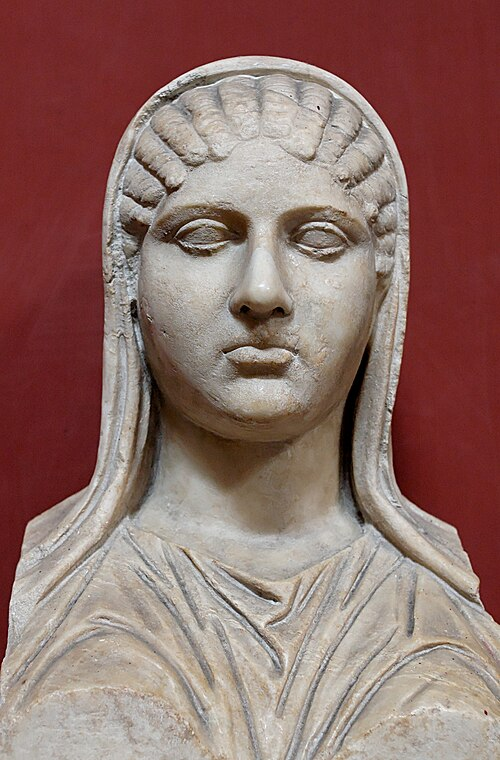
Marble portrait herm identified by an inscription as Aspasia, possibly copied from her grave.[1]
Aspasia (/æˈspeɪʒ(i)ə, -ziə, -ʃə/;[2] Ancient Greek: Ἀσπασία Greek: [aspasíaː]; c. 470 – after 428 BC[a]) was a metic woman in Classical Athens. Born in Miletus, she moved to Athens and began a relationship with the statesman Pericles, with whom she had a son named Pericles the Younger. Though Aspasia is one of the best-attested women from the Greco-Roman world, and the most important woman in the history of fifth-century Athens, almost nothing is certain about her life.
Aspasia was portrayed in ancient philosophy as a teacher and rhetorician. She has continued to be a subject of both visual and literary artists until the present. From the twentieth century, she has been portrayed as both a sexualised and sexually liberated woman, and as a feminist role model fighting for women's rights in ancient Athens.
In the classical period, two primary schools of thought developed around Aspasia. One tradition, concentrates on her intellect and rhetorical skill.[43] Some scholars have also proposed that the portrayal of several female characters in Athenian tragedy commented on Aspasia, including Euripides' Medea[44] and Phaedra,[45] and Sophocles' Jocasta.[46]
Outside of Aristophanes, mentions of Aspasia are known from the surviving fragments of Cratinus and Eupolis.[52] In the fourth century, four philosophers are known to have written Socratic dialogues which feature Aspasia: Antisthenes, Plato, Aeschines and Xenophon.[59] In the dialogues by Plato, Xenophon, and Aeschines, Aspasia is portrayed as an educated, skilled rhetorician, and a source of advice for marital concerns.[60] Armand D'Angour has argued that Diotima, to whom Socrates attributes his understanding of love in Symposium, is based on her.[61]
In the Hellenistic and Roman periods, some authors followed Aspasia's more positive portrayal in Socratic literature, situating her in a tradition of wise women. Didymus Chalcenterus wrote about exceptional women in history in his Symposiaka, downplaying her sexuality but noting her influence on Socrates' philosophy and Pericles' rhetoric.[58] Both Athenaeus and Maximus of Tyre report that Socrates advised Callias to have Aspasia teach his son.[62] In Rome, Cicero and Quintillian used the conversation between Aspasia and Xenophon in Aeschines' dialogue as a good example of inductio.[63]
Modern reception
Aspasia's earliest post-classical portrayal is in the letters of Héloïse to Abelard.[64] Héloïse cites Aspasia's conversation with Xenophon and his wife in Aeschines' dialogue, which she probably knew through Cicero's reference to it, and proposes Aspasia as an example for how she should live her own life.[65]
In the late medieval and early modern periods, Aspasia appeared in several catalogues, a fashionable genre at the time. She was included in three "medallion books", with an imagined portrait and a brief biography. The first of these was Guillaume Rouille's Promptuarium Iconum, which derives its depiction of Aspasia from Plutarch and focuses on her relationship with Pericles;[66] in Giovanni Angelo Canini's Iconografia, Aspasia is depicted wearing a helmet and shield.[67] Aspasia also featured in two catalogues of women in this period as a teacher and philosopher: in Arcangela Tarabotti's Tirannia Paterna, which portrays her as a teacher of rhetoric, and Gilles Ménage's Historia Mulierum Philosopharum, in which Aspasia is described as teaching rhetoric to Pericles and Socrates, and philosophy to Socrates.[68]
By the eighteenth century, Aspasia was widely enough known to be included in dictionaries and encyclopedias, where depictions of her were largely based on Plutarch.[67] In 1736, Jean Leconte de Bièvre published the Histoire de deux Aspasies, also based on Plutarch's depiction, which portrayed Aspasia as an educated woman and Pericles' teacher as well as his wife.[69] The eighteenth century also saw the first known image of Aspasia to be created by a woman, Marie Bouliard's Aspasie.[70] The painting depicts Aspasia with one breast bared, looking into a handheld mirror and with a scroll in her other hand. Though the bare breast references the eroticised traditions surrounding Aspasia, Madeleine Henry argues that the portrait differs from more pornographic depictions of women, with Aspasia looking into the mirror rather than out at the viewer, and holding a scroll rather than a cosmetic object such as a comb.[71]
In the nineteenth century, Plutarch's narrative dominated the interpretation of Aspasia in both novels and paintings.[72] In the visual arts, the sexualised side of Aspasia was represented by Jean-Léon Gérôme's painting Socrates Seeking Alcibiades in the House of Aspasia, depicts Aspasia as a period depicted an Aspasia active in public life, and interacting with the most renowned men of the period. I
In Henry Holiday's painting of Aspasia on the Pnyx, she is shown with another woman at the site of the Athenian assembly, the center of male public space in the city,[75] while in two paintings by Nicolas-André Monsiau she is shown at the centre of discussions with celebrated Athenian intellectuals and politicians.[76] In Socrates and Aspasia, she converses with Socrates and Pericles; in Aspasia in Conversation with the Most Illustrious Men of Athens, Euripides, Sophocles, Plato, and Xenophon are also among those included.[77] In both of these paintings, Aspasia is speaking and commanding the attention of these men.[78] Melissa Ianetta argues that Germaine de Staël's novel Corinne models its heroine after Aspasia, placing her in the same tradition of feminine rhetorical skill.[79]
An alternative nineteenth-century representation of Aspasia positioned her as a respectable wife. The authors Walter Savage Landor and Elizabeth Lynn Linton portrayed Aspasia as a good Victorian wife to Pericles in their novels Pericles and Aspasia and Amymone: A Romance of the Days of Pericles.[80] Lawrence Alma-Tadema's painting Phidias and the Frieze of the Parthenon also shows Aspasia as a respectable companion to men.[81] By contrast, Robert Hamerling's novel Aspasia showed her as a proto-feminist with far more agency than these romanticised accounts.[82]
The twentieth century saw on the one hand increasing interest in Aspasia separately from her relationships with men, and on the other more prurient concern with her sexuality.[83] The former strand of Aspasia's reception saw the Latvian author, feminist, and politician Elza Rozenberga, who took the pseudonym Aspazija, model her campaigning for women's rights after what she saw as Aspasia's example.[84]
DOWNLOADED: Tuesday, November 18, 2025 12:05PM
FROM WIKIPEDIA: Aspasia
edited by rk