Socratic daimonion
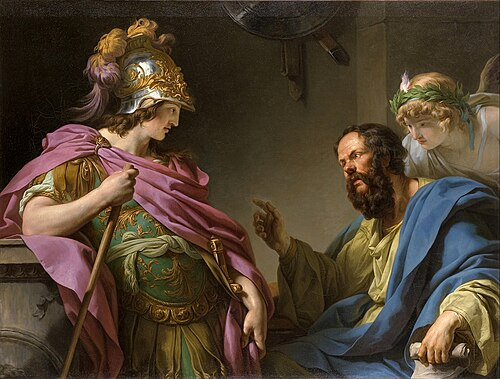
Alcibiades Receiving Instruction from Socrates, a 1776 painting by François-André Vincent, depicting Socrates's daimon[146]
In several texts (e.g., Plato's Euthyphro 3b5; Apology 31c–d; Xenophon's Memorabilia 1.1.2) Socrates claims he hears a daimōnic sign—an inner voice heard usually when he was about to make a mistake. Socrates gave a brief description of this daimonion at his trial (Apology 31c–d): "...The reason for this is something you have heard me frequently mention in different places—namely, the fact that I experience something divine and daimonic, as Meletus has inscribed in his indictment, by way of mockery. It started in my childhood, the occurrence of a particular voice. Whenever it occurs, it always deters me from the course of action I was intending to engage in, but it never gives me positive advice. It is this that has opposed my practicing politics, and I think its doing so has been absolutely fine."[147] Modern scholarship has variously interpreted this Socratic daimōnion as a rational source of knowledge, an impulse, a dream or even a paranormal experience felt by an ascetic Socrates.[148]
Virtue and knowledge
Socrates's theory of virtue states that all virtues are essentially one, since they are a form of knowledge.[149] For Socrates, the reason a person is not good is because they lack knowledge. Since knowledge is united, virtues are united as well. Another famous dictum—"no one errs willingly"—also derives from this theory.[150] In Protagoras, Socrates argues for the unity of virtues using the example of courage: if someone knows what the relevant danger is, they can undertake a risk.[149] Aristotle comments: " ... Socrates the elder thought that the end of life was knowledge of virtue, and he used to seek for the definition of justice, courage, and each of the parts of virtue, and this was a reasonable approach, since he thought that all virtues were sciences, and that as soon as one knew [for example] justice, he would be just..."[151]
Love
Some texts suggest that Socrates had love affairs with Alcibiades and other young persons; others suggest that Socrates's friendship with young boys sought only to improve them and were not sexual. In Gorgias, Socrates claims he was a dual lover of Alcibiades and philosophy, and his flirtatiousness is evident in Protagoras, Meno (76a–c) and Phaedrus (227c–d). However, the exact nature of his relationship with Alcibiades is not clear; Socrates was known for his self-restraint, while Alcibiades admits in the Symposium that he had tried to seduce Socrates but failed.[152]
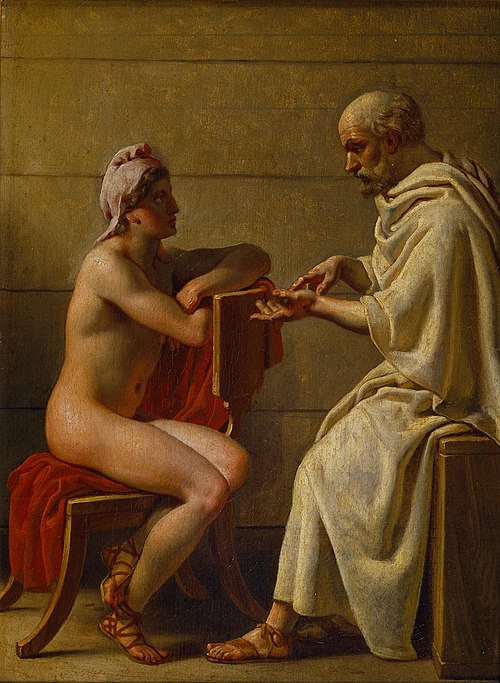
Socrates and Alcibiades, by Christoffer Wilhelm Eckersberg, 1813–1816
The Socratic theory of love is mostly deduced from Lysis, where Socrates discusses love[153] at a wrestling school in the company of Lysis and his friends. They start their dialogue by investigating parental love and how it manifests with respect to the freedom and boundaries that parents set for their children. Socrates concludes that if Lysis is utterly useless, nobody will love him—not even his parents. While most scholars believe this text was intended to be humorous, it has also been suggested that Lysis shows Socrates held an egoistic view of love, according to which we only love people who are useful to us in some way.[154] Other scholars disagree with this view, arguing that Socrates's doctrine leaves room for non-egoistic love for a spouse; still others deny that Socrates suggests any egoistic motivation at all.[155] In Symposium, Socrates argues that children offer the false impression of immortality to their parents, and this misconception yields a form of unity among them.[156] Scholars also note that for Socrates, love is rational.[157]
Socrates, who claims to know only that he does not know, makes an exception (in Plato's Symposium), where he says he will tell the truth about Love, which he learned from a 'clever woman'. Classicist Armand D'Angour has made the case that Socrates was in his youth close to Aspasia, and that Diotima, to whom Socrates attributes his understanding of love in Symposium, is based on her;[158] however, it is also possible that Diotima really existed.
Socratic philosophy of politics
While Socrates was involved in public political and cultural debates, it is hard to define his exact political philosophy. In Plato's Gorgias, he tells Callicles: "I believe that I'm one of a few Athenians—so as not to say I'm the only one, but the only one among our contemporaries—to take up the true political craft and practice the true politics. This is because the speeches I make on each occasion do not aim at gratification but at what's best."[159] His claim illustrates his aversion for the established democratic assemblies and procedures such as voting—since Socrates saw politicians and rhetoricians as using tricks to mislead the public.[160] He never ran for office or suggested any legislation.[161] Rather, he aimed to help the city flourish by "improving" its citizens.[160] As a citizen, he abided by the law. He obeyed the rules and carried out his military duty by fighting wars abroad. His dialogues, however, make little mention of contemporary political decisions, such as the Sicilian Expedition.[161]
Socrates spent his time conversing with citizens, among them powerful members of Athenian society, scrutinizing their beliefs and bringing the contradictions of their ideas to light. Socrates believed he was doing them a favor since, for him, politics was about shaping the moral landscape of the city through philosophy rather than electoral procedures.[162] There is a debate over where Socrates stood in the polarized Athenian political climate, which was divided between oligarchs and democrats. While there is no clear textual evidence, one widely held theory holds that Socrates leaned towards democracy: he disobeyed the one order that the oligarchic government of the Thirty Tyrants gave him; he respected the laws and political system of Athens (which were formulated by democrats); and, according to this argument, his affinity for the ideals of democratic Athens was a reason why he did not want to escape prison and the death penalty. On the other hand, there is some evidence that Socrates leaned towards oligarchy: most of his friends supported oligarchy, he was contemptuous of the opinion of the many and was critical of the democratic process, and Protagoras shows some anti-democratic elements.[163] A less mainstream argument suggests that Socrates favoured democratic republicanism, a theory that prioritizes active participation in public life and concern for the city.[164]
Yet another suggestion is that Socrates endorsed views in line with liberalism, a political ideology formed in the Age of Enlightenment. This argument is mostly based on Crito and Apology, where Socrates talks about the mutually beneficial relationship between the city and its citizens. According to Socrates, citizens are morally autonomous and free to leave the city if they wish—but, by staying within the city, they also accept the laws and the city's authority over them.[165] On the other hand, Socrates has been seen as the first proponent of civil disobedience. Socrates's strong objection to injustice, along with his refusal to serve the Thirty Tyrants' order to arrest Leon, are suggestive of this line. As he says in Critias, "One ought never act unjustly, even to repay a wrong that has been done to oneself."[166] Ιn the broader picture, Socrates's advice would be for citizens to follow the orders of the state, unless, after much reflection, they deem them to be unjust.[167]
downloaded: Tuesday, November 18, 2025 12:33PM
from: Socrates#Socratic_irony