Jung on Mandalas
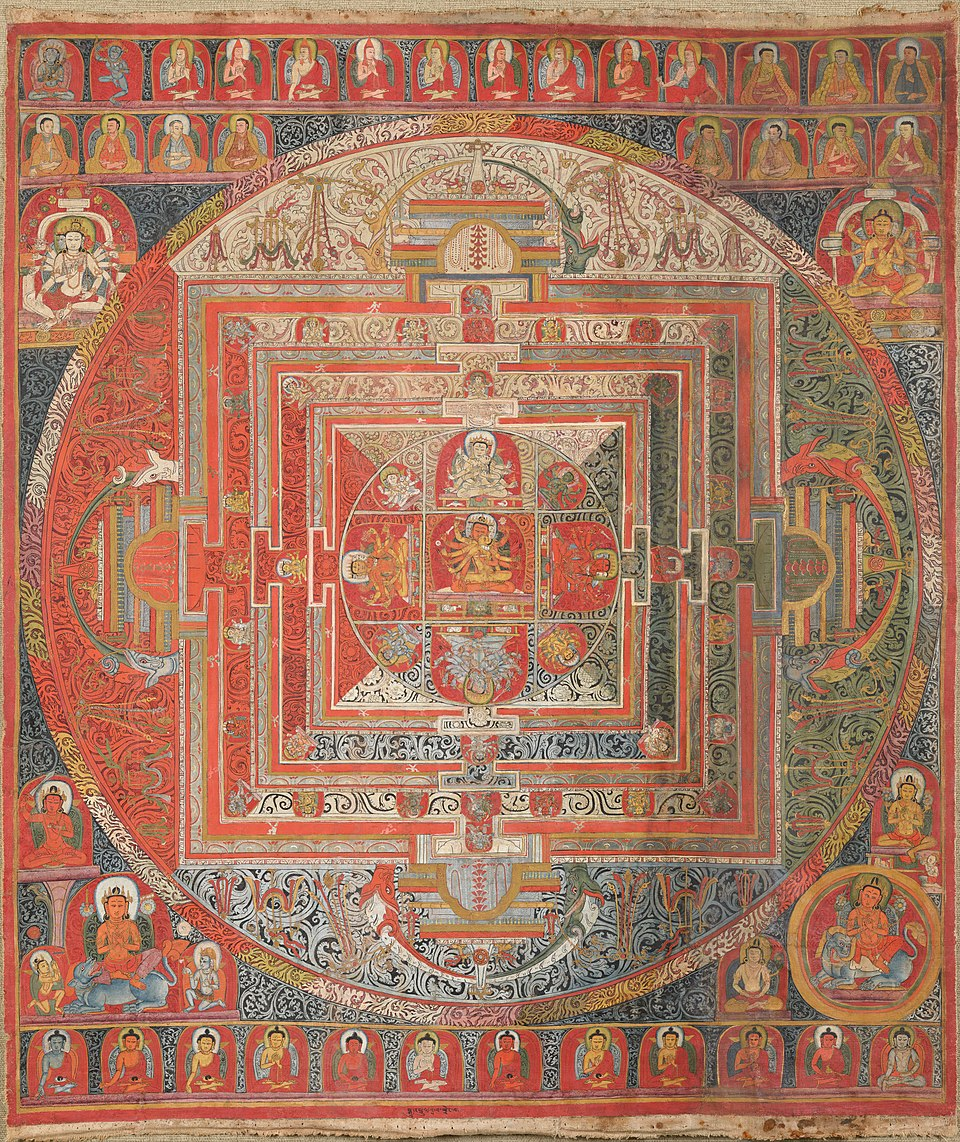
Western psychological interpretations
The re-introduction of mandalas into modern Western thought is largely credited to psychologist Carl Gustav Jung. In his exploration of the unconscious through art, Jung observed the common appearance of a circle motif across religions and cultures. He hypothesized that the circle drawings reflected the mind's inner state at the moment of creation and were a kind of symbolic archetype in the collective unconscious. Familiarity with the philosophical writings of India prompted Jung to adopt the word "mandala" to describe these drawings created by himself and his patients. In his autobiography, Jung wrote:
I sketched every morning in a notebook a small circular drawing, [...] which seemed to correspond to my inner situation at the time. [...] Only gradually did I discover what the mandala really is: [...] the Self, the wholeness of the personality, which if all goes well is harmonious.
— Carl Jung, Memories, Dreams, Reflections, pp. 195–196. p.232 Vintage books revised edition (Doubleday)
When I began drawing the mandalas, however, I saw that everything, all the paths I had been following, all the steps I had taken, were leading back to a single point—namely, to the mid-point. It became increasingly plain to me that the mandala is the center. It is the exponent of all paths. It is the path to the center, to individuation....I saw that here the goal had been revealed. One could not go beyond the center. The center is the goal, and everything is directed toward that center. Through this dream, I understood that the self is the principle and archetype of orientation and meaning. Therein lies its healing function. For me, this insight signified an approach to the center and therefore to the goal.
— Carl Jung, Memories, Dreams, Reflections, pp. 233–235 Vintage Books revised edition (Doubleday)
Jung claimed that the urge to make mandalas emerges during moments of intense personal growth. He further hypothesized their appearance indicated a "profound re-balancing process" is underway in the psyche; the result of the process would be a more complex and better integrated personality.
The mandala serves a conservative purpose – namely, to restore a previously existing order. But it also serves the creative purpose of giving expression and form to something that does not yet exist, something new and unique. [...] The process is that of the ascending spiral, which grows upward while simultaneously returning again and again to the same point.
— Marie-Louise von Franz, In Man and His Symbols (C. G. Jung, Ed.), p. 225,
American art therapist Joan Kellogg later created the MARI card test, a free response measure, based on Jung's work.[30]
Transpersonal psychologist David Fontana proposed that the symbolic nature of a mandala may help one "to access progressively deeper levels of the unconscious, ultimately assisting the meditator to experience a mystical sense of oneness with the ultimate unity from which the cosmos in all its manifold forms arises."[31]
Thursday, December 11, 2025 01:23PM