HUMMINGBIRD
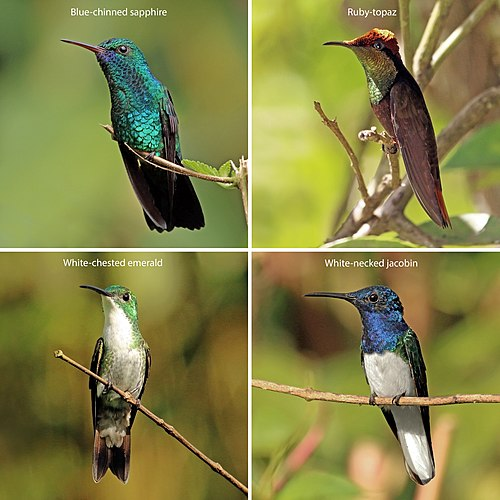
Hummingbirds are birds native to the Americas and comprise the biological family Trochilidae. With approximately 375 species and 113 genera,[1][2] they occur from Alaska to Tierra del Fuego, but most species are found in Central and South America.[3][4] As of 2025, 21 hummingbird species are listed as endangered or critically endangered, with about 191 species declining in population.[1][3][5]
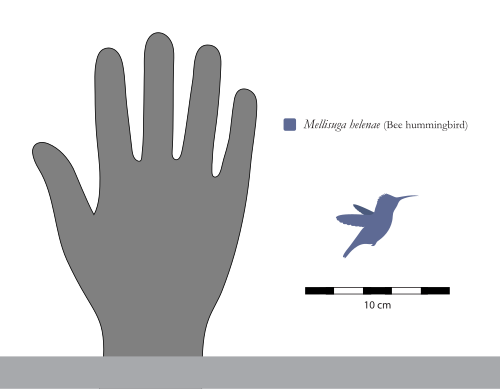
Hummingbirds have varied specialized characteristics to enable rapid, maneuverable flight: exceptional metabolic capacity, adaptations to high altitude, sensitive visual and communication abilities, and long-distance migration in some species. Among all birds, male hummingbirds have the widest diversity of plumage color, particularly in blues, greens, and purples.[6] Hummingbirds are the smallest mature birds, measuring 7.5–13 cm (3–5 in) in length. The smallest is the 5 cm (2.0 in) bee hummingbird, which weighs less than 2.0 g (0.07 oz), and the largest is the 23 cm (9 in) giant hummingbird, weighing 18–24 grams (0.63–0.85 oz). Noted for long beaks, hummingbirds are specialized for feeding on flower nectar, but all species also consume small insects.
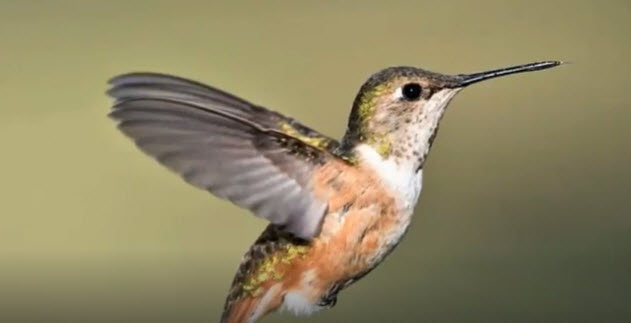
Hummingbirds are known by that name because of the humming sound created by their beating wings, which flap at high frequencies audible to other birds and humans. They hover at rapid wing-flapping rates, which vary from around 12 beats per second in the largest species to 99 per second in small hummingbirds.
Hummingbirds have the highest mass-specific metabolic rate of any homeothermic animal.[7][8] To conserve energy when food is scarce and at night when not foraging, they can enter torpor, a state similar to hibernation, and slow their metabolic rate to 1⁄15 of its normal rate.[8][9] While most hummingbirds do not migrate, the rufous hummingbird has one of the longest migrations among birds, traveling twice per year between Alaska and Mexico, a distance of about 3,900 miles (6,300 km).
Hummingbirds split from their sister group, the swifts and treeswifts, around 42 million years ago.[10] The oldest known fossil hummingbird is Eurotrochilus, from the Rupelian Stage of Early Oligocene Europe.[11]
Hummingbirds are the smallest known and smallest living avian theropod dinosaurs.[12][13][14] The iridescent colors and highly specialized feathers of many species (mainly in males) give some hummingbirds exotic common names, such as sun gem, fairy, woodstar, sapphire or sylph.[15]
Morphology
Across the estimated 375 species,[1] hummingbird weights range from as small as 2.0 grams (0.071 oz) to as large as 20 grams (0.71 oz).[15][16] They have characteristic long, narrow beaks (bills) which may be straight (of varying lengths) or highly curved.[15][16] The bee hummingbird – only 6 centimetres (2.4 in) long and weighing about 2 grams (0.071 oz) – is the world's smallest bird and smallest warm-blooded vertebrate.[15][17]
Hummingbirds have compact bodies with relatively long, bladelike wings having anatomical structure enabling helicopter-like flight in any direction, including the ability to hover.[15][16] Particularly while hovering, the wing beats produce the humming sounds, which function to alert other birds.[15] In some species, the tail feathers produce sounds used by males during courtship flying.[15][16] One species of hummingbird – the little woodstar (Chaetocercus bombus) – has a wing-beat frequency of 99 per second during hovering.[18] Such extreme flight demands are supported by a high metabolic rate dependent on foraging for sugars from flower nectar.[8][16]
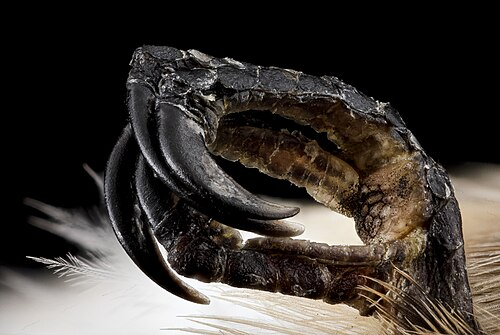
Hummingbird legs are short with feet having three toes pointing forward and one backward – the hallux.[19][20] The toes of hummingbirds are formed as claws with ridged inner surfaces to aid gripping onto flower stems or petals.[20] Hummingbirds do not walk on the ground or hop like most birds, but rather shuffle laterally and use their feet to grip while perching, preening feathers, or nest-building (by females), and during fights to grab feathers of opponents.[19][20]
Hummingbirds apply their legs as pistons for generating thrust upon taking flight, although the shortness of their legs provides about 20% less propulsion than assessed in other birds.[21] During flight, hummingbird feet are tucked up under the body, enabling optimal aerodynamics and maneuverability.[20]
Of those species that have been measured during flight, the top flight speeds of hummingbirds exceed 15 m/s (54 km/h; 34 mph).[17] During courtship, some male species dive from 30 metres (100 ft) of height above a female at speeds around 23 m/s (83 km/h; 51 mph).[22][23]
The sexes differ in feather coloration, with males having distinct brilliance and ornamentation of head, neck, wing, and breast feathers.[15][16] The most typical feather ornament in males is the gorget – a bib-like iridescent neck-feather patch that changes brilliance with the viewing angle to attract females and warn male competitors away from territory.[15]
Hummingbirds begin mating when they are a year old.[24] Sex occurs over 3–5 seconds when the male joins its cloaca with the female's, passing sperm to fertilize the female's eggs.[24]
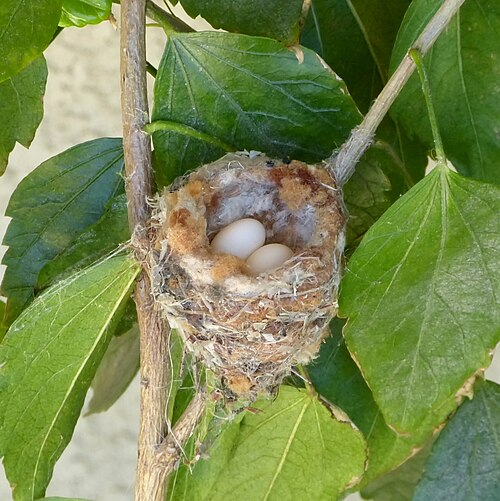
Hummingbird females build a nest resembling a small cup about 1.5 inches (3.8 cm) in diameter, commonly attached to a tree branch using spider webs, lichens, moss, and loose strings of plant fibers (image).[15][16] Typically, two pea-sized white eggs (image) – the smallest of any bird – are incubated over 2–3 weeks in breeding season.[15][16] Fed by regurgitation only from the mother, the chicks fledge about 3 weeks after hatching.[16][25]
The average lifespan of a ruby-throated hummingbird is estimated to be 3–5 years, with most deaths occurring in yearlings,[25] although one banded ruby-throated hummingbird lived for 9 years and 2 months.[26] Bee hummingbirds live 7–10 years.[17]
Although most hummingbird species live in remote habitats where their population numbers are difficult to assess, population studies in the United States and Canada indicate that the ruby-throated hummingbird numbers are around 34 million, rufous hummingbirds are around 19 million, black-chinned, Anna's, and broad-tailed hummingbirds are about 8 million each, calliopes at 4 million, and Costa's and Allen's hummingbirds are around 2 million each.[4] Several species exist only in the thousands or hundreds.[4]
According to the International Union for Conservation of Nature Red List of Threatened Species in 2025, 8 hummingbird species are classified as critically endangered, 13 are endangered, 13 are vulnerable, and 21 species are near-threatened.[1] Two species – the Brace's emerald (Riccordia bracei) and Caribbean emerald (Riccordia elegans) – have been declared extinct.[1]
Of the 15 species of North American hummingbirds that inhabit the United States and Canada,[4] several have changed their range of distribution, while others showed declines in numbers since the 1970s,[4][5] including in 2023 with dozens of hummingbird species in decline. As of the 21st century, rufous, Costa's, calliope, broad-tailed, and Allen's hummingbirds are in significant decline, some losing as much as 67% of their numbers since 1970 at nearly double the rate of population loss over the previous 50 years.[4][5][27] The ruby-throated hummingbird population – the most populous North American hummingbird – decreased by 17% over the early 21st century.[5] Habitat loss, glass collisions, cat predation, pesticides, and possibly climate change affecting food availability, migration signals, and breeding are factors that may contribute to declining hummingbird numbers.[4][27] By contrast, Anna's hummingbirds had large population growth at an accelerating rate since 2010,[5] and expanded their range northward to reside year-round in cold winter climates.[28]
Superficially similar species
Some species of sunbirds — an Old World group restricted in distribution to Eurasia, Africa, and Australia — resemble hummingbirds in appearance and behavior,[29] but are not related to hummingbirds, as their resemblance is due to convergent evolution.[30]
The hummingbird moth has flying and feeding characteristics similar to those of a hummingbird.[31] Hummingbirds may be mistaken for hummingbird hawk-moths, which are large, flying insects with hovering capabilities, and exist only in Eurasia.[29]
Tuesday, September 30, 2025 12:09PM