BESS TRUMAN
Thursday, October 16, 2025 11:12AM
from: Wikipedia
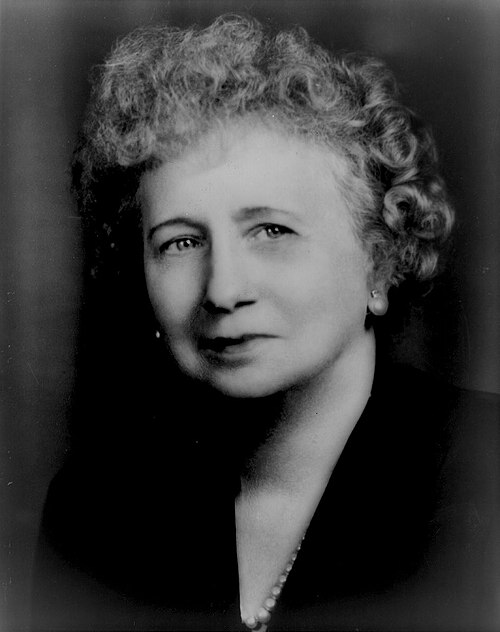
Portrait, c. 1940s
Elizabeth Virginia Truman (née Wallace; February 13, 1885 – October 18, 1982) was First Lady of the United States from 1945 to 1953 as the wife of President Harry S. Truman. She had previously served as Second Lady of the United States from January to April 1945. At 97 years, 247 days, she was the longest-lived first and second lady.
She was born in Independence, Missouri, where she kept a home her entire life. She had known Harry since they were children, though she did not return his affections until adulthood. She was strongly affected by the suicide of her father when she was 18, which shaped her opinions about privacy from the public eye and the responsibilities of a spouse. Bess and Harry married in 1919, and Bess spent the following years managing the Truman household and working in her husband's offices as his political career advanced. She was apprehensive about Harry running for vice president in 1944, and she was deeply upset when he ascended to the presidency the following year.
As first lady, Bess avoided social obligations and media attention whenever possible, and she made regular excursions to her home in Independence. She chose not to continue in the regular press conferences carried out by her predecessor Eleanor Roosevelt, believing that her responsibility as a wife was to keep her opinions private. Her influence on her husband's presidency came about in their private conversations, as he would consult her about most major decisions during his presidency. She was also prominent in his reelection campaign, making regular appearances for crowds as he toured the United States. She was greatly relieved when Harry chose not to run for another term in 1952. After her tenure as first lady, Bess lived in retirement at her home in Independence until her death in 1982.
Truman was generally popular among her contemporaries, but her lifelong devotion to privacy has allowed for limited historical analysis. She refused to provide information about herself or her beliefs to journalists during her lifetime, and she destroyed many of her letters after leaving the White House. There is no consensus among historians on her performance as first lady or to what extent she influenced her husband's presidency.
Marriage and Family
Harry S. Truman met Bess soon after his family moved to Independence in 1890, and the two attended school together until graduation.[4]: 251 Many factors kept them from forming a closer bond in school, including their differences in social class and religion, Harry's time-consuming job at a drugstore, and Harry's inability to participate in athletics with Bess due to his thick glasses.[6]: 7 They sometimes studied Latin together, and he often volunteered to carry her books, but they did not become close friends.[8]: 313
Bess had many suitors in the years after high school, but none won her love.[6]: 11 In 1910, long after their time in school, Harry volunteered to return a cake plate to the Wallaces as an excuse to speak to Bess. They reconnected and began a courtship.[2]: 477 Harry was insecure about his lack of money, and he attempted to impress Bess by purchasing tickets to shows and building her a tennis court. Bess' mother disapproved of the relationship.[11]: 209–210
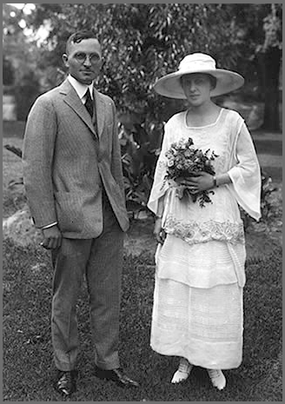
Bess and Harry married on June 28, 1919, at Trinity Episcopal Church in Independence.[13] The newlyweds honeymooned in Chicago and Detroit[2]: 478 and then moved into Bess's childhood home so she could care for her mother.[7]: 146 During their marriage, Bess tried in vain to teach her husband the etiquette with which she had been raised.[4]: 252 Their only child, Margaret, was born in 1924. Bess's two previous pregnancies had ended in miscarriages. Bess became the primary authority figure in Margaret's life, while Harry would spoil her.[4]: 253
Bess held several jobs working with her husband, which provided more income for the Truman family. She was accounts manager at Truman-Jacobsen Haberdashery from 1919 to 1922, when the business went bankrupt. After Harry was elected county judge in the eastern district of Jackson County, she worked as his aide from 1922 to 1924 and from 1926 to 1934.[9] Corruption and violence were prominent in Jackson County politics at the time, and working with her husband in his early political career caused her great distress, including when they feared a plot to kidnap their young daughter. In addition to helping Harry in his political work, Bess also managed the family's household and finances. As part of her social life, Bess helped found the Junior Service League of Independence and a chapter of the Daughters of the American Revolution.[2]: 479
When Harry was elected as a senator from Missouri in 1934, Bess stayed in Missouri with her mother for the first year. After visiting Harry, she decided to stay, and the family moved to Washington, D.C.[7]: 147 While Congress was in session during the first half of each year, they would live in rented apartments in Washington. When the session ended, they would return to Independence for the rest of the year.[2]: 479 While her husband was in the Senate, Bess became a member of the Congressional Club, the P.E.O. Sisterhood, the H Street United Service Organization, and the Red Cross work of the group informally known as the "Senate Wives".[14] She joined her husband's staff as a clerk, answering personal mail and editing committee reports when he became chairman of the Senate Special Committee to Investigate the National Defense Program.[15] She developed relationships with the wives of senators and cabinet members,[4]: 254 though she did not attend meetings of senators' wives, as she found them boring.[11]: 205 During her husband's political career, she helped him write his speeches, though she refused to give any of her own.[11]: 207
In 1944, Harry was offered the Democratic nomination for Vice President of the United States. He had not sought the position, and it was a surprise to the Trumans when it was offered.[2]: 480 When the position had previously been suggested to him, he had dismissed the idea out of concern for Bess and Margaret.[8]: 317 When Harry accepted the role of vice president to President Franklin D. Roosevelt, Bess was not entirely pleased. She wanted to return to their life in Missouri, and she also feared that Roosevelt would die, which would make her husband the president.[9] Bess's position on Harry's staff was controversial during the campaign, but he retained her during the campaign and during his vice presidency.[2]: 480 After the Democratic ticket won the election and Harry was sworn in as vice president, Bess became Second Lady of the United States. She found herself saddled with the associated social responsibilities, attending many events as a representative of the Roosevelts, often multiple times in one day.[8]: 318 Bess served as second lady for 82 days before President Roosevelt died and her husband ascended to the presidency.[2]: 480
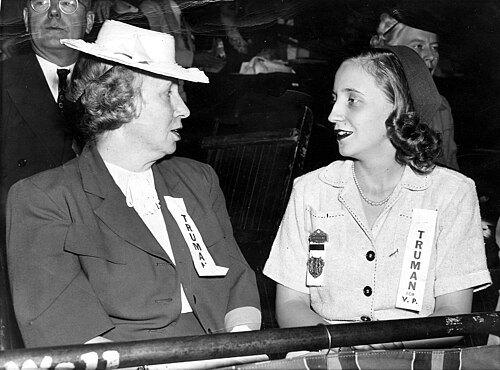
Bess and Margaret Truman at the 1944 Democratic National Convention
President Roosevelt died on April 12, 1945, immediately making Harry Truman the president of the United States and Bess Truman the first lady of the United States. Bess reportedly wept when she first heard the news. After making arrangements for her mother, Bess' first act as first lady was to give her condolences to the widowed Eleanor Roosevelt shortly before attending her husband's inauguration. They moved into Blair House on April 16, allowing Eleanor time to vacate the White House, and they occupied the White House on May 7.[4]: 255 Bess had only limited social responsibilities during her first months as first lady, as the nation was in the midst of World War II and in mourning of President Roosevelt.[16]: 26 She stayed in the White House until the end of the month before making her first return trip to Independence.[4]: 256
After the end of World War II, Bess was responsible for restoring the White House social season, and she organized the White House's receptions and events. She was inspired by the history of the White House and that of the Monroe administration in particular.[2]: 482 She chose to host a more limited social season in response to postwar food shortages, replacing large dinners with informal luncheons.[17]: 64 She emphasized courteousness and respect for all of her guests, including political opponents and others that she disliked.[8]: 319 Bess received about one hundred letters each day, and she spent much time replying to each one.[11]: 212 She also maintained some social obligations in Washington society, including regular attendance of luncheons in her honor.[2]: 482
Bess felt great anxiety at public events and wished to avoid being the center of attention. She underwent a humiliating experience a few weeks into her tenure as first lady when she was asked to christen airplanes by striking champagne bottles against them.[11]: 206 The first bottle had not been scored to allow for an easy break, causing Bess to ineffectually strike the bottle against the plane's hull several times amid a crowd of spectators and reporters.[11]: 206 Harry would tease her about this event, and she would eventually join the family in laughing at the footage.[7]: 149
Bess found the White House's lack of privacy distasteful. As her husband put it later, she was "not especially interested" in the "formalities and pomp or the artificiality" that surrounded the presidential family. Though she steadfastly fulfilled the social obligations of her position, she did only what she thought was necessary.[18] She resisted any changes to her lifestyle, often handling bookkeeping, dusting, and other chores on her own, though she did enjoy having domestic servants.[8]: 319 She dressed simply, preferring conservative gowns and suits rather than more elaborate dresses.[16]: 40 When the White House was rebuilt during Harry's second term, the family lived in Blair House and kept their social life to a minimum.[18] The responsibility of finding new venues for larger events fell to Bess.[4]: 257
Privately, Bess was an unofficial advisor to her husband. She never told him what to do as president, but she often offered her opinion on matters he was unsure of. Bess would also assist Harry with his speeches, including his speech on the Truman Doctrine. In addition to speeches, Bess reviewed and commented on Harry's work at the end of every day, and played an influential role in his 1948 campaign.[9] Harry would later say that he asked her input on major issues, including the Marshall Plan and entry into the Korean War.[11]: 208 Many of Bess' ideas became government initiatives, including the use of theatrical companies abroad to improve foreign relations and the involvement of the National Institutes of Health in an effort to combat disease.[4]: 256 She was also the one to suggest appointing Charlie Ross as the White House Press Secretary.[16]: 101
Bess was involved with a controversy while she was first lady in attending a reception for the Daughters of the American Revolution. The organization had refused to allow Hazel Scott, a black pianist, to perform at DAR Constitution Hall, and Bess' attendance was seen as an endorsement of this stance. Scott's husband, Representative Adam Clayton Powell, was banned from the White House after calling Bess the "Last Lady of the Land". Bess caused a similar controversy when she attended a play at George Washington University despite an ongoing protest of the ban on black audience members. Bess felt that a first lady's actions should not address political issues, and she considered her personal time to be entirely separate from her political role.[11]: 214 She was upset with being compared to segregationists, furthering her resolve to avoid the public for the rest of her husband's presidency.[2]: 482
As First Lady, Bess served as Honorary President of the Girl Scouts, the Woman's National Democratic Club, and the Washington Animal Rescue League. She was Honorary Chairman of the American Red Cross.[15] She worked with various organizations, but she never adopted a group or cause to focus on, as many First Ladies do.[9] She was active in her husband's reelection campaign in 1948, traveling the country with Harry in a whistle-stop train tour in which he introduced her to crowds as his "Boss".[2]: 484 Her presence, along with that of her daughter, contributed to Harry's image as a family man.[17]: 65 She also sat in on and contributed to meetings among his advisors. Four years later, when Harry was uncertain about another reelection campaign, Bess' desire to return home was a major factor in his decision not to run.[8]: 322–323 When Harry announced that he would not run for reelection in 1952, one of Bess' friends described her as trying not to show how gleeful she was.[2]: 485 After her retirement, however, she would say that she enjoyed the culture and political happenings of Washington.[4]: 258
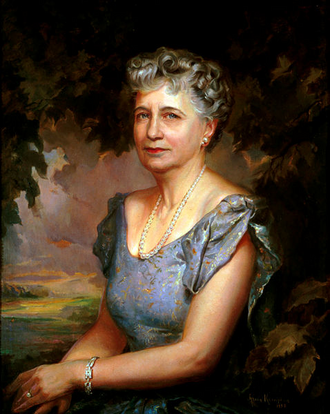
Portrait of Bess Truman by Greta Kempton
LEGACY
Truman kept a low profile during her tenure as first lady, and commentators often emphasized how little was known about her. Many contemporary reports about her contained inaccuracies and misrepresentations based on the very little that reporters could glean. Her refusal to discuss her political beliefs led the public to believe that she had no strong opinions of her own.[11]: 211 Bess destroyed many of her own letters after leaving the White House with the intention of making historical analysis of her life more difficult. Most of her surviving correspondences are those that were preserved by her daughter.[2]: 487 She made only one television appearance, also on the initiative of her daughter.[3] Much of the historic record about Bess is derived from a biography written by her daughter and letters written to her by Harry. For this reason, historical analysis of Bess Truman varies considerably.[2]: 490 Siena Research Institute polling ranked her as the 11th best out of 37 first ladies in 1993, but its subsequent edition in 2003 ranked her as 20th best out of 38.[26]
She was often contrasted with her predecessor, Eleanor Roosevelt. While Roosevelt was active in politics and an influential public figure, Bess' influence was largely felt behind the scenes at the White House.[11]: 206 She would chide her husband when he lost his temper, to the point where her "you didn't have to say that" became an inside joke among the White House staff. Bess was popular among the staff, with whom she enjoyed friendly relations in contrast to her shy personality in public.[11]: 213 Her input may have influenced her husband's decision making, but the extent of her role is lost to history.[2]: 490
See also
Thursday, October 16, 2025 11:21AM