How much Sleep?
Too little sleep can age you faster. But could “too much” sleep do the same? A new study suggests the answer is complicated. Researchers mapped self-reported sleep duration against 23 biological aging clocks across the brain and body. The result was a U-shaped curve, with both short and long sleep being associated with older-looking biology, while the lowest biological aging appeared between 6.4 and 7.8 hours of sleep per night. But short and long sleep were associated with faster aging for different reasons. Short sleep—typically less than 6 hours—was linked to accelerated aging across multiple organs and a broad pattern of chronic disease risk. Long sleep—typically more than 8 hours—looked different. It was also associated with older-looking biology and higher disease risk, but the signal appeared more concentrated around brain aging, depression risk, and neuropsychiatric vulnerability. In that sense, long sleep may not always be a cause of disease. It may be a clue that something else is already going on. In today's newsletter, we'll explore how sleep behaves like a whole-body aging signal that the brain, immune system, liver, endocrine system, adipose tissue, and pancreas all register in different ways, and how you should interpret this new "sleep sweet spot" for your own health. | Too little sleep can age you faster. But could “too much” sleep do the same? A new study suggests the answer is complicated. Researchers mapped self-reported sleep duration against 23 biological aging clocks across the brain and body. The result was a U-shaped curve, with both short and long sleep being associated with older-looking biology, while the lowest biological aging appeared between 6.4 and 7.8 hours of sleep per night. But short and long sleep were associated with faster aging for different reasons. Short sleep—typically less than 6 hours—was linked to accelerated aging across multiple organs and a broad pattern of chronic disease risk. Long sleep—typically more than 8 hours—looked different. It was also associated with older-looking biology and higher disease risk, but the signal appeared more concentrated around brain aging, depression risk, and neuropsychiatric vulnerability. In that sense, long sleep may not always be a cause of disease. It may be a clue that something else is already going on. In today's newsletter, we'll explore how sleep behaves like a whole-body aging signal that the brain, immune system, liver, endocrine system, adipose tissue, and pancreas all register in different ways, and how you should interpret this new "sleep sweet spot" for your own health. | Too little sleep can age you faster. But could “too much” sleep do the same? A new study suggests the answer is complicated. Researchers mapped self-reported sleep duration against 23 biological aging clocks across the brain and body. The result was a U-shaped curve, with both short and long sleep being associated with older-looking biology, while the lowest biological aging appeared between 6.4 and 7.8 hours of sleep per night. But short and long sleep were associated with faster aging for different reasons. Short sleep—typically less than 6 hours—was linked to accelerated aging across multiple organs and a broad pattern of chronic disease risk. Long sleep—typically more than 8 hours—looked different. It was also associated with older-looking biology and higher disease risk, but the signal appeared more concentrated around brain aging, depression risk, and neuropsychiatric vulnerability. In that sense, long sleep may not always be a cause of disease. It may be a clue that something else is already going on. In today's newsletter, we'll explore how sleep behaves like a whole-body aging signal that the brain, immune system, liver, endocrine system, adipose tissue, and pancreas all register in different ways, and how you should interpret this new "sleep sweet spot" for your own health. | Too little sleep can age you faster. But could “too much” sleep do the same? A new study suggests the answer is complicated. Researchers mapped self-reported sleep duration against 23 biological aging clocks across the brain and body. The result was a U-shaped curve, with both short and long sleep being associated with older-looking biology, while the lowest biological aging appeared between 6.4 and 7.8 hours of sleep per night. But short and long sleep were associated with faster aging for different reasons. Short sleep—typically less than 6 hours—was linked to accelerated aging across multiple organs and a broad pattern of chronic disease risk. Long sleep—typically more than 8 hours—looked different. It was also associated with older-looking biology and higher disease risk, but the signal appeared more concentrated around brain aging, depression risk, and neuropsychiatric vulnerability. In that sense, long sleep may not always be a cause of disease. It may be a clue that something else is already going on. In today's newsletter, we'll explore how sleep behaves like a whole-body aging signal that the brain, immune system, liver, endocrine system, adipose tissue, and pancreas all register in different ways, and how you should interpret this new "sleep sweet spot" for your own health. | Too little sleep can age you faster. But could “too much” sleep do the same? A new study suggests the answer is complicated. Researchers mapped self-reported sleep duration against 23 biological aging clocks across the brain and body. The result was a U-shaped curve, with both short and long sleep being associated with older-looking biology, while the lowest biological aging appeared between 6.4 and 7.8 hours of sleep per night. But short and long sleep were associated with faster aging for different reasons. Short sleep—typically less than 6 hours—was linked to accelerated aging across multiple organs and a broad pattern of chronic disease risk. Long sleep—typically more than 8 hours—looked different. It was also associated with older-looking biology and higher disease risk, but the signal appeared more concentrated around brain aging, depression risk, and neuropsychiatric vulnerability. In that sense, long sleep may not always be a cause of disease. It may be a clue that something else is already going on. In today's newsletter, we'll explore how sleep behaves like a whole-body aging signal that the brain, immune system, liver, endocrine system, adipose tissue, and pancreas all register in different ways, and how you should interpret this new "sleep sweet spot" for your own health. |
|---|---|---|---|---|
| These weekly science deep dives are made possible by FoundMyFitness Premium Members. If this kind of evidence-focused work is useful to you, I share a few related sleep segments near the end of the email! | These weekly science deep dives are made possible by FoundMyFitness Premium Members. If this kind of evidence-focused work is useful to you, I share a few related sleep segments near the end of the email! | These weekly science deep dives are made possible by FoundMyFitness Premium Members. If this kind of evidence-focused work is useful to you, I share a few related sleep segments near the end of the email! | These weekly science deep dives are made possible by FoundMyFitness Premium Members. If this kind of evidence-focused work is useful to you, I share a few related sleep segments near the end of the email! | These weekly science deep dives are made possible by FoundMyFitness Premium Members. If this kind of evidence-focused work is useful to you, I share a few related sleep segments near the end of the email! |
Sleep duration is a multi-organ aging signalThe study included data from the UK Biobank and MULTI Consortium to compare self-reported sleep duration with 23 biological aging clocks built from three layers of biology:
Researchers used these organ-based clocks to estimate whether a person's brain, liver, immune system, pancreas, fat tissue, or other organ system looked biologically older or younger than expected for their chronological ("real") age. They called this difference the biological age gap or BAG—a higher BAG means you're aging faster than expected and a lower BAG means you appear younger or less biologically aged. The relationship between sleep and biological aging was U-shaped—both short and long sleep (less than 6 or more than 8 hours per night, respectively) were associated with older-looking organs. The lowest biological age gaps tended to fall in the middle, and the sleep duration associated with the lowest biological age fell between 6.4 and 7.8 hours per night. But there was no one perfect sleep duration for every tissue. The optimal amount varied by organ system, clock type, and sex.
I think we should take some time to ponder what this variation means and why it's important. It suggests that different organs may have different relationships with sleep, or, if we're being a bit more cautious, that different methods of measuring biological aging (for example, using MRI or blood-based proteins) capture different aspects of sleep-related physiology. A brain protein clock and a brain MRI clock are both "brain aging" clocks, but they're different layers of biology. One is reading proteins enriched in the brain while the other is measuring gray matter volume and other structural features. So the fact that their optimal sleep "needs" differ reflects the different time scales of aging—proteins likely capture the immediate, acute effects while MRI captures longer-standing sleep habits that impact the brain over time. | Sleep duration is a multi-organ aging signalThe study included data from the UK Biobank and MULTI Consortium to compare self-reported sleep duration with 23 biological aging clocks built from three layers of biology:
Researchers used these organ-based clocks to estimate whether a person's brain, liver, immune system, pancreas, fat tissue, or other organ system looked biologically older or younger than expected for their chronological ("real") age. They called this difference the biological age gap or BAG—a higher BAG means you're aging faster than expected and a lower BAG means you appear younger or less biologically aged. The relationship between sleep and biological aging was U-shaped—both short and long sleep (less than 6 or more than 8 hours per night, respectively) were associated with older-looking organs. The lowest biological age gaps tended to fall in the middle, and the sleep duration associated with the lowest biological age fell between 6.4 and 7.8 hours per night. But there was no one perfect sleep duration for every tissue. The optimal amount varied by organ system, clock type, and sex.
I think we should take some time to ponder what this variation means and why it's important. It suggests that different organs may have different relationships with sleep, or, if we're being a bit more cautious, that different methods of measuring biological aging (for example, using MRI or blood-based proteins) capture different aspects of sleep-related physiology. A brain protein clock and a brain MRI clock are both "brain aging" clocks, but they're different layers of biology. One is reading proteins enriched in the brain while the other is measuring gray matter volume and other structural features. So the fact that their optimal sleep "needs" differ reflects the different time scales of aging—proteins likely capture the immediate, acute effects while MRI captures longer-standing sleep habits that impact the brain over time. |
 | | |||
 | | | | |
 |
 | | | | |
 |
| U-shaped patterns between sleep duration and biological aging clocks. | U-shaped patterns between sleep duration and biological aging clocks. | U-shaped patterns between sleep duration and biological aging clocks. | U-shaped patterns between sleep duration and biological aging clocks. | U-shaped patterns between sleep duration and biological aging clocks. |
| | Short sleep raises chronic disease riskIn addition to measuring biological age across organs, the researchers also asked whether sleep patterns translated into disease risk and, using a genetic analysis, if abnormal sleep duration and disease risk share some of the same inherited architecture. Again, both short and long sleep sat on the higher biological aging sides of the curve but didn't appear to reflect the same underlying biology.
What's the interpretation here? Short sleep may be a broader systemic stress signal linked to cardiometabolic dysfunction, inflammation, pulmonary disease, musculoskeletal pain, psychiatric disease, and digestive disorders. Long sleep may be more complex: a marker of neuropsychiatric vulnerability, poor sleep quality, compensation, fatigue, or underlying disease burden. It's a matter of being an upstream stressor versus a downstream signal. | |||
| | | | | |
Short sleep raises chronic disease riskIn addition to measuring biological age across organs, the researchers also asked whether sleep patterns translated into disease risk and, using a genetic analysis, if abnormal sleep duration and disease risk share some of the same inherited architecture. Again, both short and long sleep sat on the higher biological aging sides of the curve but didn't appear to reflect the same underlying biology.
What's the interpretation here? Short sleep may be a broader systemic stress signal linked to cardiometabolic dysfunction, inflammation, pulmonary disease, musculoskeletal pain, psychiatric disease, and digestive disorders. Long sleep may be more complex: a marker of neuropsychiatric vulnerability, poor sleep quality, compensation, fatigue, or underlying disease burden. It's a matter of being an upstream stressor versus a downstream signal. | Short sleep raises chronic disease riskIn addition to measuring biological age across organs, the researchers also asked whether sleep patterns translated into disease risk and, using a genetic analysis, if abnormal sleep duration and disease risk share some of the same inherited architecture. Again, both short and long sleep sat on the higher biological aging sides of the curve but didn't appear to reflect the same underlying biology.
What's the interpretation here? Short sleep may be a broader systemic stress signal linked to cardiometabolic dysfunction, inflammation, pulmonary disease, musculoskeletal pain, psychiatric disease, and digestive disorders. Long sleep may be more complex: a marker of neuropsychiatric vulnerability, poor sleep quality, compensation, fatigue, or underlying disease burden. It's a matter of being an upstream stressor versus a downstream signal. | Short sleep raises chronic disease riskIn addition to measuring biological age across organs, the researchers also asked whether sleep patterns translated into disease risk and, using a genetic analysis, if abnormal sleep duration and disease risk share some of the same inherited architecture. Again, both short and long sleep sat on the higher biological aging sides of the curve but didn't appear to reflect the same underlying biology.
What's the interpretation here? Short sleep may be a broader systemic stress signal linked to cardiometabolic dysfunction, inflammation, pulmonary disease, musculoskeletal pain, psychiatric disease, and digestive disorders. Long sleep may be more complex: a marker of neuropsychiatric vulnerability, poor sleep quality, compensation, fatigue, or underlying disease burden. It's a matter of being an upstream stressor versus a downstream signal. | Short sleep raises chronic disease riskIn addition to measuring biological age across organs, the researchers also asked whether sleep patterns translated into disease risk and, using a genetic analysis, if abnormal sleep duration and disease risk share some of the same inherited architecture. Again, both short and long sleep sat on the higher biological aging sides of the curve but didn't appear to reflect the same underlying biology.
What's the interpretation here? Short sleep may be a broader systemic stress signal linked to cardiometabolic dysfunction, inflammation, pulmonary disease, musculoskeletal pain, psychiatric disease, and digestive disorders. Long sleep may be more complex: a marker of neuropsychiatric vulnerability, poor sleep quality, compensation, fatigue, or underlying disease burden. It's a matter of being an upstream stressor versus a downstream signal. | Short sleep raises chronic disease riskIn addition to measuring biological age across organs, the researchers also asked whether sleep patterns translated into disease risk and, using a genetic analysis, if abnormal sleep duration and disease risk share some of the same inherited architecture. Again, both short and long sleep sat on the higher biological aging sides of the curve but didn't appear to reflect the same underlying biology.
What's the interpretation here? Short sleep may be a broader systemic stress signal linked to cardiometabolic dysfunction, inflammation, pulmonary disease, musculoskeletal pain, psychiatric disease, and digestive disorders. Long sleep may be more complex: a marker of neuropsychiatric vulnerability, poor sleep quality, compensation, fatigue, or underlying disease burden. It's a matter of being an upstream stressor versus a downstream signal. |
 | ||||
 | | | | |
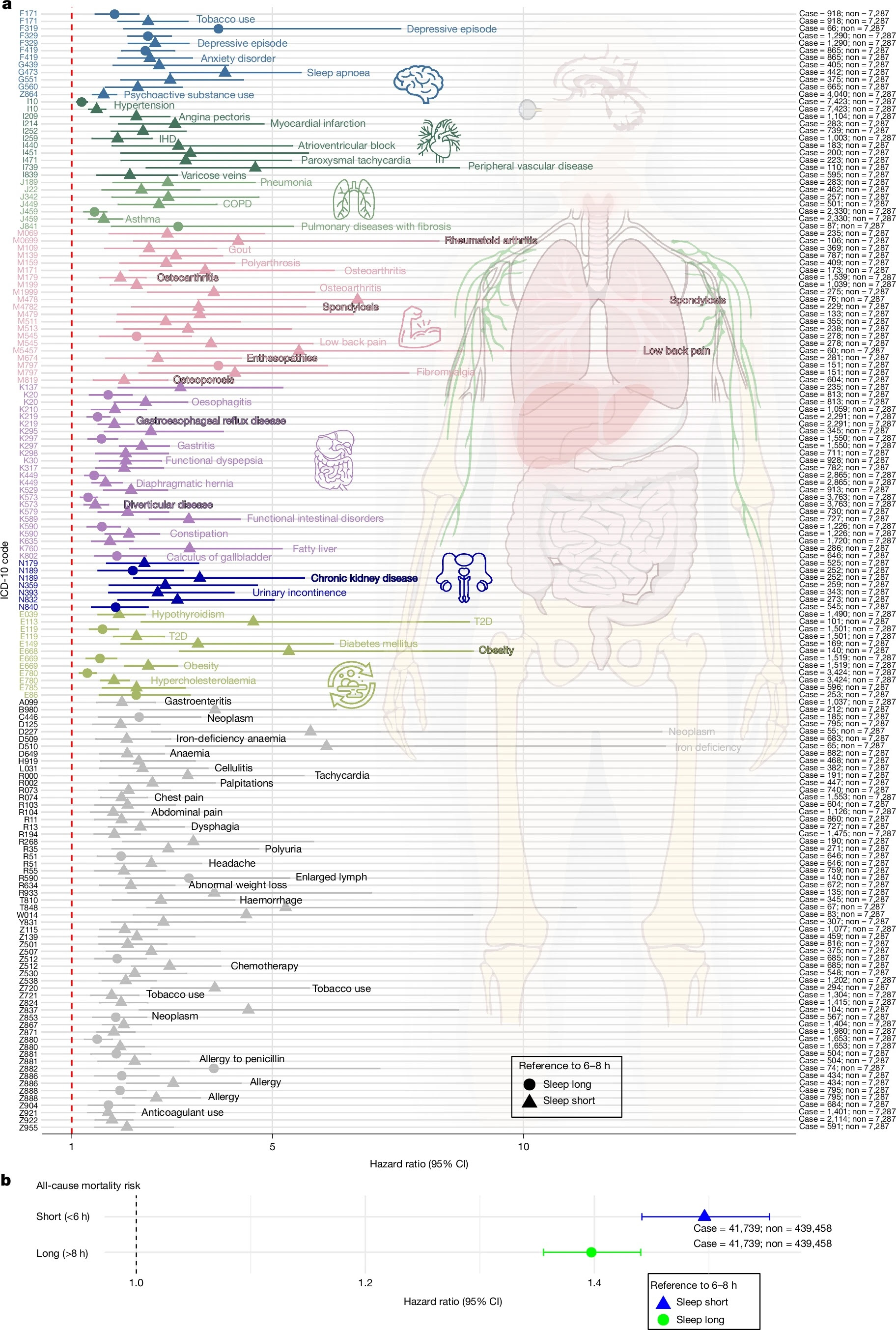 | | | | |
| Clinical evidence for a systemic involvement of abnormal sleep duration patterns compared with normal sleep duration. | Clinical evidence for a systemic involvement of abnormal sleep duration patterns compared with normal sleep duration. | Clinical evidence for a systemic involvement of abnormal sleep duration patterns compared with normal sleep duration. | Clinical evidence for a systemic involvement of abnormal sleep duration patterns compared with normal sleep duration. | Clinical evidence for a systemic involvement of abnormal sleep duration patterns compared with normal sleep duration. |
| | What might explain the biology?The U-shaped curve is tempting to read literally as "too little sleep is bad, too much sleep is bad, and somewhere in the middle is ideal." But biologically, the two ends of the curve may not be mirror images. Short sleep is easier to understand as a direct stressorWhen sleep is chronically restricted, the body loses time for a coordinated set of repair, metabolic, immune, and brain-maintenance programs. Even mild sleep restriction can quickly worsen glucose regulation, shift appetite hormones, activate immune and inflammatory pathways, stress fat cells, and give the brain less opportunity for deep sleep-dependent processes such as glymphatic clearance (our brain's process of clearing waste). All of this gives insufficient sleep multiple routes into disease. This helps explain why short sleep was not linked to just one category of disease in the study. Its associations stretched across multiple organ systems including cardiometabolic, pulmonary, gastrointestinal, musculoskeletal, psychiatric, and neurological. Long sleep acts more like a warning signalSleeping "too much" may appear after chronic inflammation, depression, neurodegeneration, metabolic dysfunction, pain, infection, medication effects, or sleep apnea have increased the body’s need for rest (or reduced the quality of the sleep being obtained). More sleep is not always better if sleep quality is poor. Someone with sleep apnea, for example, may spend nine hours in bed and still wake up exhausted because the sleep they are getting is fragmented and physiologically stressful (sleep expert Dr. Michael Grandner explained this elegantly on episode #107 of the FoundMyFitness podcast). This distinction is important because the study found that short and long sleep related to disease through different-looking pathways. Short sleep showed broader systemic associations, while long sleep showed a more focused pattern around neuropsychiatric and brain-related traits, which is exactly what we might expect if long sleep often reflects some sort of cognitive vulnerability, fatigue, altered brain-body regulation, or an underlying disease process rather than a simple lifestyle behavior like “sleeping too much.” One of my favorite parts of the paper is that the authors tried to illustrate this idea with a case study: late-life depression. This was a fitting choice because late-life depression sits at the intersection of sleep, aging, brain health, and systemic disease. It is not just a “mood disorder” in the narrow sense. Depression in older adults can involve brain atrophy, vascular disease, inflammation, metabolic dysfunction, adipose tissue biology, neuroendocrine stress, and reduced resilience across multiple organ systems. These are many of the same pathways sleep plausibly affects. The researchers asked whether short and long sleep were linked to late-life depression through the same route. They were not.
This analysis helps explain why our conclusion should not immediately be that long sleep is equally as harmful as short sleep. Both matter. But they ask different questions. With short sleep, the question is: Why is the body not getting enough recovery? With long sleep, the question may be: What is the body trying to recover from? | |||
| | | | | |
What might explain the biology?The U-shaped curve is tempting to read literally as "too little sleep is bad, too much sleep is bad, and somewhere in the middle is ideal." But biologically, the two ends of the curve may not be mirror images. Short sleep is easier to understand as a direct stressorWhen sleep is chronically restricted, the body loses time for a coordinated set of repair, metabolic, immune, and brain-maintenance programs. Even mild sleep restriction can quickly worsen glucose regulation, shift appetite hormones, activate immune and inflammatory pathways, stress fat cells, and give the brain less opportunity for deep sleep-dependent processes such as glymphatic clearance (our brain's process of clearing waste). All of this gives insufficient sleep multiple routes into disease. This helps explain why short sleep was not linked to just one category of disease in the study. Its associations stretched across multiple organ systems including cardiometabolic, pulmonary, gastrointestinal, musculoskeletal, psychiatric, and neurological. Long sleep acts more like a warning signalSleeping "too much" may appear after chronic inflammation, depression, neurodegeneration, metabolic dysfunction, pain, infection, medication effects, or sleep apnea have increased the body’s need for rest (or reduced the quality of the sleep being obtained). More sleep is not always better if sleep quality is poor. Someone with sleep apnea, for example, may spend nine hours in bed and still wake up exhausted because the sleep they are getting is fragmented and physiologically stressful (sleep expert Dr. Michael Grandner explained this elegantly on episode #107 of the FoundMyFitness podcast). This distinction is important because the study found that short and long sleep related to disease through different-looking pathways. Short sleep showed broader systemic associations, while long sleep showed a more focused pattern around neuropsychiatric and brain-related traits, which is exactly what we might expect if long sleep often reflects some sort of cognitive vulnerability, fatigue, altered brain-body regulation, or an underlying disease process rather than a simple lifestyle behavior like “sleeping too much.” One of my favorite parts of the paper is that the authors tried to illustrate this idea with a case study: late-life depression. This was a fitting choice because late-life depression sits at the intersection of sleep, aging, brain health, and systemic disease. It is not just a “mood disorder” in the narrow sense. Depression in older adults can involve brain atrophy, vascular disease, inflammation, metabolic dysfunction, adipose tissue biology, neuroendocrine stress, and reduced resilience across multiple organ systems. These are many of the same pathways sleep plausibly affects. The researchers asked whether short and long sleep were linked to late-life depression through the same route. They were not.
This analysis helps explain why our conclusion should not immediately be that long sleep is equally as harmful as short sleep. Both matter. But they ask different questions. With short sleep, the question is: Why is the body not getting enough recovery? With long sleep, the question may be: What is the body trying to recover from? | What might explain the biology?The U-shaped curve is tempting to read literally as "too little sleep is bad, too much sleep is bad, and somewhere in the middle is ideal." But biologically, the two ends of the curve may not be mirror images. Short sleep is easier to understand as a direct stressorWhen sleep is chronically restricted, the body loses time for a coordinated set of repair, metabolic, immune, and brain-maintenance programs. Even mild sleep restriction can quickly worsen glucose regulation, shift appetite hormones, activate immune and inflammatory pathways, stress fat cells, and give the brain less opportunity for deep sleep-dependent processes such as glymphatic clearance (our brain's process of clearing waste). All of this gives insufficient sleep multiple routes into disease. This helps explain why short sleep was not linked to just one category of disease in the study. Its associations stretched across multiple organ systems including cardiometabolic, pulmonary, gastrointestinal, musculoskeletal, psychiatric, and neurological. Long sleep acts more like a warning signalSleeping "too much" may appear after chronic inflammation, depression, neurodegeneration, metabolic dysfunction, pain, infection, medication effects, or sleep apnea have increased the body’s need for rest (or reduced the quality of the sleep being obtained). More sleep is not always better if sleep quality is poor. Someone with sleep apnea, for example, may spend nine hours in bed and still wake up exhausted because the sleep they are getting is fragmented and physiologically stressful (sleep expert Dr. Michael Grandner explained this elegantly on episode #107 of the FoundMyFitness podcast). This distinction is important because the study found that short and long sleep related to disease through different-looking pathways. Short sleep showed broader systemic associations, while long sleep showed a more focused pattern around neuropsychiatric and brain-related traits, which is exactly what we might expect if long sleep often reflects some sort of cognitive vulnerability, fatigue, altered brain-body regulation, or an underlying disease process rather than a simple lifestyle behavior like “sleeping too much.” One of my favorite parts of the paper is that the authors tried to illustrate this idea with a case study: late-life depression. This was a fitting choice because late-life depression sits at the intersection of sleep, aging, brain health, and systemic disease. It is not just a “mood disorder” in the narrow sense. Depression in older adults can involve brain atrophy, vascular disease, inflammation, metabolic dysfunction, adipose tissue biology, neuroendocrine stress, and reduced resilience across multiple organ systems. These are many of the same pathways sleep plausibly affects. The researchers asked whether short and long sleep were linked to late-life depression through the same route. They were not.
This analysis helps explain why our conclusion should not immediately be that long sleep is equally as harmful as short sleep. Both matter. But they ask different questions. With short sleep, the question is: Why is the body not getting enough recovery? With long sleep, the question may be: What is the body trying to recover from? | What might explain the biology?The U-shaped curve is tempting to read literally as "too little sleep is bad, too much sleep is bad, and somewhere in the middle is ideal." But biologically, the two ends of the curve may not be mirror images. Short sleep is easier to understand as a direct stressorWhen sleep is chronically restricted, the body loses time for a coordinated set of repair, metabolic, immune, and brain-maintenance programs. Even mild sleep restriction can quickly worsen glucose regulation, shift appetite hormones, activate immune and inflammatory pathways, stress fat cells, and give the brain less opportunity for deep sleep-dependent processes such as glymphatic clearance (our brain's process of clearing waste). All of this gives insufficient sleep multiple routes into disease. This helps explain why short sleep was not linked to just one category of disease in the study. Its associations stretched across multiple organ systems including cardiometabolic, pulmonary, gastrointestinal, musculoskeletal, psychiatric, and neurological. Long sleep acts more like a warning signalSleeping "too much" may appear after chronic inflammation, depression, neurodegeneration, metabolic dysfunction, pain, infection, medication effects, or sleep apnea have increased the body’s need for rest (or reduced the quality of the sleep being obtained). More sleep is not always better if sleep quality is poor. Someone with sleep apnea, for example, may spend nine hours in bed and still wake up exhausted because the sleep they are getting is fragmented and physiologically stressful (sleep expert Dr. Michael Grandner explained this elegantly on episode #107 of the FoundMyFitness podcast). This distinction is important because the study found that short and long sleep related to disease through different-looking pathways. Short sleep showed broader systemic associations, while long sleep showed a more focused pattern around neuropsychiatric and brain-related traits, which is exactly what we might expect if long sleep often reflects some sort of cognitive vulnerability, fatigue, altered brain-body regulation, or an underlying disease process rather than a simple lifestyle behavior like “sleeping too much.” One of my favorite parts of the paper is that the authors tried to illustrate this idea with a case study: late-life depression. This was a fitting choice because late-life depression sits at the intersection of sleep, aging, brain health, and systemic disease. It is not just a “mood disorder” in the narrow sense. Depression in older adults can involve brain atrophy, vascular disease, inflammation, metabolic dysfunction, adipose tissue biology, neuroendocrine stress, and reduced resilience across multiple organ systems. These are many of the same pathways sleep plausibly affects. The researchers asked whether short and long sleep were linked to late-life depression through the same route. They were not.
This analysis helps explain why our conclusion should not immediately be that long sleep is equally as harmful as short sleep. Both matter. But they ask different questions. With short sleep, the question is: Why is the body not getting enough recovery? With long sleep, the question may be: What is the body trying to recover from? | What might explain the biology?The U-shaped curve is tempting to read literally as "too little sleep is bad, too much sleep is bad, and somewhere in the middle is ideal." But biologically, the two ends of the curve may not be mirror images. Short sleep is easier to understand as a direct stressorWhen sleep is chronically restricted, the body loses time for a coordinated set of repair, metabolic, immune, and brain-maintenance programs. Even mild sleep restriction can quickly worsen glucose regulation, shift appetite hormones, activate immune and inflammatory pathways, stress fat cells, and give the brain less opportunity for deep sleep-dependent processes such as glymphatic clearance (our brain's process of clearing waste). All of this gives insufficient sleep multiple routes into disease. This helps explain why short sleep was not linked to just one category of disease in the study. Its associations stretched across multiple organ systems including cardiometabolic, pulmonary, gastrointestinal, musculoskeletal, psychiatric, and neurological. Long sleep acts more like a warning signalSleeping "too much" may appear after chronic inflammation, depression, neurodegeneration, metabolic dysfunction, pain, infection, medication effects, or sleep apnea have increased the body’s need for rest (or reduced the quality of the sleep being obtained). More sleep is not always better if sleep quality is poor. Someone with sleep apnea, for example, may spend nine hours in bed and still wake up exhausted because the sleep they are getting is fragmented and physiologically stressful (sleep expert Dr. Michael Grandner explained this elegantly on episode #107 of the FoundMyFitness podcast). This distinction is important because the study found that short and long sleep related to disease through different-looking pathways. Short sleep showed broader systemic associations, while long sleep showed a more focused pattern around neuropsychiatric and brain-related traits, which is exactly what we might expect if long sleep often reflects some sort of cognitive vulnerability, fatigue, altered brain-body regulation, or an underlying disease process rather than a simple lifestyle behavior like “sleeping too much.” One of my favorite parts of the paper is that the authors tried to illustrate this idea with a case study: late-life depression. This was a fitting choice because late-life depression sits at the intersection of sleep, aging, brain health, and systemic disease. It is not just a “mood disorder” in the narrow sense. Depression in older adults can involve brain atrophy, vascular disease, inflammation, metabolic dysfunction, adipose tissue biology, neuroendocrine stress, and reduced resilience across multiple organ systems. These are many of the same pathways sleep plausibly affects. The researchers asked whether short and long sleep were linked to late-life depression through the same route. They were not.
This analysis helps explain why our conclusion should not immediately be that long sleep is equally as harmful as short sleep. Both matter. But they ask different questions. With short sleep, the question is: Why is the body not getting enough recovery? With long sleep, the question may be: What is the body trying to recover from? | What might explain the biology?The U-shaped curve is tempting to read literally as "too little sleep is bad, too much sleep is bad, and somewhere in the middle is ideal." But biologically, the two ends of the curve may not be mirror images. Short sleep is easier to understand as a direct stressorWhen sleep is chronically restricted, the body loses time for a coordinated set of repair, metabolic, immune, and brain-maintenance programs. Even mild sleep restriction can quickly worsen glucose regulation, shift appetite hormones, activate immune and inflammatory pathways, stress fat cells, and give the brain less opportunity for deep sleep-dependent processes such as glymphatic clearance (our brain's process of clearing waste). All of this gives insufficient sleep multiple routes into disease. This helps explain why short sleep was not linked to just one category of disease in the study. Its associations stretched across multiple organ systems including cardiometabolic, pulmonary, gastrointestinal, musculoskeletal, psychiatric, and neurological. Long sleep acts more like a warning signalSleeping "too much" may appear after chronic inflammation, depression, neurodegeneration, metabolic dysfunction, pain, infection, medication effects, or sleep apnea have increased the body’s need for rest (or reduced the quality of the sleep being obtained). More sleep is not always better if sleep quality is poor. Someone with sleep apnea, for example, may spend nine hours in bed and still wake up exhausted because the sleep they are getting is fragmented and physiologically stressful (sleep expert Dr. Michael Grandner explained this elegantly on episode #107 of the FoundMyFitness podcast). This distinction is important because the study found that short and long sleep related to disease through different-looking pathways. Short sleep showed broader systemic associations, while long sleep showed a more focused pattern around neuropsychiatric and brain-related traits, which is exactly what we might expect if long sleep often reflects some sort of cognitive vulnerability, fatigue, altered brain-body regulation, or an underlying disease process rather than a simple lifestyle behavior like “sleeping too much.” One of my favorite parts of the paper is that the authors tried to illustrate this idea with a case study: late-life depression. This was a fitting choice because late-life depression sits at the intersection of sleep, aging, brain health, and systemic disease. It is not just a “mood disorder” in the narrow sense. Depression in older adults can involve brain atrophy, vascular disease, inflammation, metabolic dysfunction, adipose tissue biology, neuroendocrine stress, and reduced resilience across multiple organ systems. These are many of the same pathways sleep plausibly affects. The researchers asked whether short and long sleep were linked to late-life depression through the same route. They were not.
This analysis helps explain why our conclusion should not immediately be that long sleep is equally as harmful as short sleep. Both matter. But they ask different questions. With short sleep, the question is: Why is the body not getting enough recovery? With long sleep, the question may be: What is the body trying to recover from? |
 | | | | |
| | Final thoughtsThe universal prescription to get 8 hours of sleep was always too blunt. I don't say this because eight hours is “wrong,” but because it implies a level of precision and universality that sleep biology just does not have. People differ in their sleep needs based on age, genetics, training load, illness, stress, hormones, circadian timing, and life stage. This study takes that idea a step further, suggesting that even within the same person, different organs and tissues may not relate to sleep duration in exactly the same way. The brain protein clock, brain MRI clock, endocrine metabolite clock, adipose clock, pancreas clock, immune clock, and liver clock did not all reach their lowest biological age gaps at the same reported sleep duration. That does not mean we should micromanage sleep down to the decimal point. But it does suggest that sleep is not a single lever acting uniformly across the body. It is a whole-body biological state, and different tissues may register sleep loss (or sleep disruption) differently. That is what makes this study so interesting to me. It does not give us a perfect sleep number. It gives us a better way to think about sleep as part of a broader biological dashboard (although having a reference range is nice). And fortunately, sleep is one of those topics where the practical takeaways are fairly clear. If you are habitually sleeping less than six hours, the advice is simple: protect your sleep opportunity. Short sleep has a cleaner biological story. It can act like a direct physiological stressor, pushing the body toward poorer glucose regulation, altered appetite hormones, higher sympathetic tone, immune dysregulation, inflammation, and poor recovery. So if your sleep is chronically short, create the conditions that allow sleep to happen. That means light in the morning, darkness at night, regular movement, earlier meals, a cool room, less evening stimulation, and a calmer relationship with sleep itself. If you are sleeping six to eight hours and feel good, do not micromanage. This study is not a reason to change what is already working. The sleep durations associated with the “youngest” clocks bottomed out across a range, not a single number. Your practical target should be consistent, restorative sleep, not trying to force yourself into some perfect sleep window. This is where function matters. Do you wake up feeling reasonably restored? Is your energy stable? Can you train, think, regulate your mood, and move through the day without feeling like you are dragging yourself through it? Then your sleep is probably doing its job. If you are sleeping more than eight hours, the takeaway is different: do not force yourself to sleep less. This is one of the most important points in today's newsletter. Long sleep was associated with older-looking biology and higher disease risk in this study, but that does not mean long sleep is necessarily causing those outcomes. In many cases, long sleep may be a lagging indicator—a signal that something else is already going on. So (please!) do not set an alarm to artificially restrict sleep just to fit the “optimal” range. Do not interpret long sleep as laziness or a moral failure. And do not rely on stimulants to override persistent fatigue without asking why the fatigue is there in the first place. Your goal should be to understand why so much sleep is needed, or why so much sleep still does not feel restorative. So if I had to summarize the practical framework, it would be this: If sleep is short, protect it. If sleep is long and restorative, do not panic. If sleep is long and still not restorative, investigate. And if there is one final piece of advice I would add, it is this: do not turn sleep into another source of stress. One of my favorite takeaways from my conversation with sleep expert Dr. Michael Grandner was that "the enemy of sleep is effort." That is not true for all health habits. Effort helps with exercise, nutrition, and many parts of behavior change. But sleep is different. You cannot force yourself into deep sleep through willpower. In fact, trying harder often makes sleep worse. Sometimes you will miss the sweet spot. That is okay. Consistency is what counts. | |||
| | | | | |
Final thoughtsThe universal prescription to get 8 hours of sleep was always too blunt. I don't say this because eight hours is “wrong,” but because it implies a level of precision and universality that sleep biology just does not have. People differ in their sleep needs based on age, genetics, training load, illness, stress, hormones, circadian timing, and life stage. This study takes that idea a step further, suggesting that even within the same person, different organs and tissues may not relate to sleep duration in exactly the same way. The brain protein clock, brain MRI clock, endocrine metabolite clock, adipose clock, pancreas clock, immune clock, and liver clock did not all reach their lowest biological age gaps at the same reported sleep duration. That does not mean we should micromanage sleep down to the decimal point. But it does suggest that sleep is not a single lever acting uniformly across the body. It is a whole-body biological state, and different tissues may register sleep loss (or sleep disruption) differently. That is what makes this study so interesting to me. It does not give us a perfect sleep number. It gives us a better way to think about sleep as part of a broader biological dashboard (although having a reference range is nice). And fortunately, sleep is one of those topics where the practical takeaways are fairly clear. If you are habitually sleeping less than six hours, the advice is simple: protect your sleep opportunity. Short sleep has a cleaner biological story. It can act like a direct physiological stressor, pushing the body toward poorer glucose regulation, altered appetite hormones, higher sympathetic tone, immune dysregulation, inflammation, and poor recovery. So if your sleep is chronically short, create the conditions that allow sleep to happen. That means light in the morning, darkness at night, regular movement, earlier meals, a cool room, less evening stimulation, and a calmer relationship with sleep itself. If you are sleeping six to eight hours and feel good, do not micromanage. This study is not a reason to change what is already working. The sleep durations associated with the “youngest” clocks bottomed out across a range, not a single number. Your practical target should be consistent, restorative sleep, not trying to force yourself into some perfect sleep window. This is where function matters. Do you wake up feeling reasonably restored? Is your energy stable? Can you train, think, regulate your mood, and move through the day without feeling like you are dragging yourself through it? Then your sleep is probably doing its job. If you are sleeping more than eight hours, the takeaway is different: do not force yourself to sleep less. This is one of the most important points in today's newsletter. Long sleep was associated with older-looking biology and higher disease risk in this study, but that does not mean long sleep is necessarily causing those outcomes. In many cases, long sleep may be a lagging indicator—a signal that something else is already going on. So (please!) do not set an alarm to artificially restrict sleep just to fit the “optimal” range. Do not interpret long sleep as laziness or a moral failure. And do not rely on stimulants to override persistent fatigue without asking why the fatigue is there in the first place. Your goal should be to understand why so much sleep is needed, or why so much sleep still does not feel restorative. So if I had to summarize the practical framework, it would be this: If sleep is short, protect it. If sleep is long and restorative, do not panic. If sleep is long and still not restorative, investigate. And if there is one final piece of advice I would add, it is this: do not turn sleep into another source of stress. One of my favorite takeaways from my conversation with sleep expert Dr. Michael Grandner was that "the enemy of sleep is effort." That is not true for all health habits. Effort helps with exercise, nutrition, and many parts of behavior change. But sleep is different. You cannot force yourself into deep sleep through willpower. In fact, trying harder often makes sleep worse. Sometimes you will miss the sweet spot. That is okay. Consistency is what counts. | Final thoughtsThe universal prescription to get 8 hours of sleep was always too blunt. I don't say this because eight hours is “wrong,” but because it implies a level of precision and universality that sleep biology just does not have. People differ in their sleep needs based on age, genetics, training load, illness, stress, hormones, circadian timing, and life stage. This study takes that idea a step further, suggesting that even within the same person, different organs and tissues may not relate to sleep duration in exactly the same way. The brain protein clock, brain MRI clock, endocrine metabolite clock, adipose clock, pancreas clock, immune clock, and liver clock did not all reach their lowest biological age gaps at the same reported sleep duration. That does not mean we should micromanage sleep down to the decimal point. But it does suggest that sleep is not a single lever acting uniformly across the body. It is a whole-body biological state, and different tissues may register sleep loss (or sleep disruption) differently. That is what makes this study so interesting to me. It does not give us a perfect sleep number. It gives us a better way to think about sleep as part of a broader biological dashboard (although having a reference range is nice). And fortunately, sleep is one of those topics where the practical takeaways are fairly clear. If you are habitually sleeping less than six hours, the advice is simple: protect your sleep opportunity. Short sleep has a cleaner biological story. It can act like a direct physiological stressor, pushing the body toward poorer glucose regulation, altered appetite hormones, higher sympathetic tone, immune dysregulation, inflammation, and poor recovery. So if your sleep is chronically short, create the conditions that allow sleep to happen. That means light in the morning, darkness at night, regular movement, earlier meals, a cool room, less evening stimulation, and a calmer relationship with sleep itself. If you are sleeping six to eight hours and feel good, do not micromanage. This study is not a reason to change what is already working. The sleep durations associated with the “youngest” clocks bottomed out across a range, not a single number. Your practical target should be consistent, restorative sleep, not trying to force yourself into some perfect sleep window. This is where function matters. Do you wake up feeling reasonably restored? Is your energy stable? Can you train, think, regulate your mood, and move through the day without feeling like you are dragging yourself through it? Then your sleep is probably doing its job. If you are sleeping more than eight hours, the takeaway is different: do not force yourself to sleep less. This is one of the most important points in today's newsletter. Long sleep was associated with older-looking biology and higher disease risk in this study, but that does not mean long sleep is necessarily causing those outcomes. In many cases, long sleep may be a lagging indicator—a signal that something else is already going on. So (please!) do not set an alarm to artificially restrict sleep just to fit the “optimal” range. Do not interpret long sleep as laziness or a moral failure. And do not rely on stimulants to override persistent fatigue without asking why the fatigue is there in the first place. Your goal should be to understand why so much sleep is needed, or why so much sleep still does not feel restorative. So if I had to summarize the practical framework, it would be this: If sleep is short, protect it. If sleep is long and restorative, do not panic. If sleep is long and still not restorative, investigate. And if there is one final piece of advice I would add, it is this: do not turn sleep into another source of stress. One of my favorite takeaways from my conversation with sleep expert Dr. Michael Grandner was that "the enemy of sleep is effort." That is not true for all health habits. Effort helps with exercise, nutrition, and many parts of behavior change. But sleep is different. You cannot force yourself into deep sleep through willpower. In fact, trying harder often makes sleep worse. Sometimes you will miss the sweet spot. That is okay. Consistency is what counts. | Final thoughtsThe universal prescription to get 8 hours of sleep was always too blunt. I don't say this because eight hours is “wrong,” but because it implies a level of precision and universality that sleep biology just does not have. People differ in their sleep needs based on age, genetics, training load, illness, stress, hormones, circadian timing, and life stage. This study takes that idea a step further, suggesting that even within the same person, different organs and tissues may not relate to sleep duration in exactly the same way. The brain protein clock, brain MRI clock, endocrine metabolite clock, adipose clock, pancreas clock, immune clock, and liver clock did not all reach their lowest biological age gaps at the same reported sleep duration. That does not mean we should micromanage sleep down to the decimal point. But it does suggest that sleep is not a single lever acting uniformly across the body. It is a whole-body biological state, and different tissues may register sleep loss (or sleep disruption) differently. That is what makes this study so interesting to me. It does not give us a perfect sleep number. It gives us a better way to think about sleep as part of a broader biological dashboard (although having a reference range is nice). And fortunately, sleep is one of those topics where the practical takeaways are fairly clear. If you are habitually sleeping less than six hours, the advice is simple: protect your sleep opportunity. Short sleep has a cleaner biological story. It can act like a direct physiological stressor, pushing the body toward poorer glucose regulation, altered appetite hormones, higher sympathetic tone, immune dysregulation, inflammation, and poor recovery. So if your sleep is chronically short, create the conditions that allow sleep to happen. That means light in the morning, darkness at night, regular movement, earlier meals, a cool room, less evening stimulation, and a calmer relationship with sleep itself. If you are sleeping six to eight hours and feel good, do not micromanage. This study is not a reason to change what is already working. The sleep durations associated with the “youngest” clocks bottomed out across a range, not a single number. Your practical target should be consistent, restorative sleep, not trying to force yourself into some perfect sleep window. This is where function matters. Do you wake up feeling reasonably restored? Is your energy stable? Can you train, think, regulate your mood, and move through the day without feeling like you are dragging yourself through it? Then your sleep is probably doing its job. If you are sleeping more than eight hours, the takeaway is different: do not force yourself to sleep less. This is one of the most important points in today's newsletter. Long sleep was associated with older-looking biology and higher disease risk in this study, but that does not mean long sleep is necessarily causing those outcomes. In many cases, long sleep may be a lagging indicator—a signal that something else is already going on. So (please!) do not set an alarm to artificially restrict sleep just to fit the “optimal” range. Do not interpret long sleep as laziness or a moral failure. And do not rely on stimulants to override persistent fatigue without asking why the fatigue is there in the first place. Your goal should be to understand why so much sleep is needed, or why so much sleep still does not feel restorative. So if I had to summarize the practical framework, it would be this: If sleep is short, protect it. If sleep is long and restorative, do not panic. If sleep is long and still not restorative, investigate. And if there is one final piece of advice I would add, it is this: do not turn sleep into another source of stress. One of my favorite takeaways from my conversation with sleep expert Dr. Michael Grandner was that "the enemy of sleep is effort." That is not true for all health habits. Effort helps with exercise, nutrition, and many parts of behavior change. But sleep is different. You cannot force yourself into deep sleep through willpower. In fact, trying harder often makes sleep worse. Sometimes you will miss the sweet spot. That is okay. Consistency is what counts. | Final thoughtsThe universal prescription to get 8 hours of sleep was always too blunt. I don't say this because eight hours is “wrong,” but because it implies a level of precision and universality that sleep biology just does not have. People differ in their sleep needs based on age, genetics, training load, illness, stress, hormones, circadian timing, and life stage. This study takes that idea a step further, suggesting that even within the same person, different organs and tissues may not relate to sleep duration in exactly the same way. The brain protein clock, brain MRI clock, endocrine metabolite clock, adipose clock, pancreas clock, immune clock, and liver clock did not all reach their lowest biological age gaps at the same reported sleep duration. That does not mean we should micromanage sleep down to the decimal point. But it does suggest that sleep is not a single lever acting uniformly across the body. It is a whole-body biological state, and different tissues may register sleep loss (or sleep disruption) differently. That is what makes this study so interesting to me. It does not give us a perfect sleep number. It gives us a better way to think about sleep as part of a broader biological dashboard (although having a reference range is nice). And fortunately, sleep is one of those topics where the practical takeaways are fairly clear. If you are habitually sleeping less than six hours, the advice is simple: protect your sleep opportunity. Short sleep has a cleaner biological story. It can act like a direct physiological stressor, pushing the body toward poorer glucose regulation, altered appetite hormones, higher sympathetic tone, immune dysregulation, inflammation, and poor recovery. So if your sleep is chronically short, create the conditions that allow sleep to happen. That means light in the morning, darkness at night, regular movement, earlier meals, a cool room, less evening stimulation, and a calmer relationship with sleep itself. If you are sleeping six to eight hours and feel good, do not micromanage. This study is not a reason to change what is already working. The sleep durations associated with the “youngest” clocks bottomed out across a range, not a single number. Your practical target should be consistent, restorative sleep, not trying to force yourself into some perfect sleep window. This is where function matters. Do you wake up feeling reasonably restored? Is your energy stable? Can you train, think, regulate your mood, and move through the day without feeling like you are dragging yourself through it? Then your sleep is probably doing its job. If you are sleeping more than eight hours, the takeaway is different: do not force yourself to sleep less. This is one of the most important points in today's newsletter. Long sleep was associated with older-looking biology and higher disease risk in this study, but that does not mean long sleep is necessarily causing those outcomes. In many cases, long sleep may be a lagging indicator—a signal that something else is already going on. So (please!) do not set an alarm to artificially restrict sleep just to fit the “optimal” range. Do not interpret long sleep as laziness or a moral failure. And do not rely on stimulants to override persistent fatigue without asking why the fatigue is there in the first place. Your goal should be to understand why so much sleep is needed, or why so much sleep still does not feel restorative. So if I had to summarize the practical framework, it would be this: If sleep is short, protect it. If sleep is long and restorative, do not panic. If sleep is long and still not restorative, investigate. And if there is one final piece of advice I would add, it is this: do not turn sleep into another source of stress. One of my favorite takeaways from my conversation with sleep expert Dr. Michael Grandner was that "the enemy of sleep is effort." That is not true for all health habits. Effort helps with exercise, nutrition, and many parts of behavior change. But sleep is different. You cannot force yourself into deep sleep through willpower. In fact, trying harder often makes sleep worse. Sometimes you will miss the sweet spot. That is okay. Consistency is what counts. | Final thoughtsThe universal prescription to get 8 hours of sleep was always too blunt. I don't say this because eight hours is “wrong,” but because it implies a level of precision and universality that sleep biology just does not have. People differ in their sleep needs based on age, genetics, training load, illness, stress, hormones, circadian timing, and life stage. This study takes that idea a step further, suggesting that even within the same person, different organs and tissues may not relate to sleep duration in exactly the same way. The brain protein clock, brain MRI clock, endocrine metabolite clock, adipose clock, pancreas clock, immune clock, and liver clock did not all reach their lowest biological age gaps at the same reported sleep duration. That does not mean we should micromanage sleep down to the decimal point. But it does suggest that sleep is not a single lever acting uniformly across the body. It is a whole-body biological state, and different tissues may register sleep loss (or sleep disruption) differently. That is what makes this study so interesting to me. It does not give us a perfect sleep number. It gives us a better way to think about sleep as part of a broader biological dashboard (although having a reference range is nice). And fortunately, sleep is one of those topics where the practical takeaways are fairly clear. If you are habitually sleeping less than six hours, the advice is simple: protect your sleep opportunity. Short sleep has a cleaner biological story. It can act like a direct physiological stressor, pushing the body toward poorer glucose regulation, altered appetite hormones, higher sympathetic tone, immune dysregulation, inflammation, and poor recovery. So if your sleep is chronically short, create the conditions that allow sleep to happen. That means light in the morning, darkness at night, regular movement, earlier meals, a cool room, less evening stimulation, and a calmer relationship with sleep itself. If you are sleeping six to eight hours and feel good, do not micromanage. This study is not a reason to change what is already working. The sleep durations associated with the “youngest” clocks bottomed out across a range, not a single number. Your practical target should be consistent, restorative sleep, not trying to force yourself into some perfect sleep window. This is where function matters. Do you wake up feeling reasonably restored? Is your energy stable? Can you train, think, regulate your mood, and move through the day without feeling like you are dragging yourself through it? Then your sleep is probably doing its job. If you are sleeping more than eight hours, the takeaway is different: do not force yourself to sleep less. This is one of the most important points in today's newsletter. Long sleep was associated with older-looking biology and higher disease risk in this study, but that does not mean long sleep is necessarily causing those outcomes. In many cases, long sleep may be a lagging indicator—a signal that something else is already going on. So (please!) do not set an alarm to artificially restrict sleep just to fit the “optimal” range. Do not interpret long sleep as laziness or a moral failure. And do not rely on stimulants to override persistent fatigue without asking why the fatigue is there in the first place. Your goal should be to understand why so much sleep is needed, or why so much sleep still does not feel restorative. So if I had to summarize the practical framework, it would be this: If sleep is short, protect it. If sleep is long and restorative, do not panic. If sleep is long and still not restorative, investigate. And if there is one final piece of advice I would add, it is this: do not turn sleep into another source of stress. One of my favorite takeaways from my conversation with sleep expert Dr. Michael Grandner was that "the enemy of sleep is effort." That is not true for all health habits. Effort helps with exercise, nutrition, and many parts of behavior change. But sleep is different. You cannot force yourself into deep sleep through willpower. In fact, trying harder often makes sleep worse. Sometimes you will miss the sweet spot. That is okay. Consistency is what counts. |
| | Go Deeper on Sleep, Metabolism, and Biological Aging Today's newsletter focused on a large study linking self-reported sleep duration with biological-age profiles across multiple organs and molecular layers. The key point is not that everyone needs one exact sleep number. It's that sleep needs are unique. This is where we can start to get practical about how much sleep is enough for glucose regulation, what short sleep does acutely, how to think about sleep quality and regularity, and which behaviors may help improve deep sleep without turning sleep into another perfectionistic metric. The timestamp links below are from Premium Member episodes. Q&A #53 Q&A #54
Q&A #61 | |||
| | | | | |
Go Deeper on Sleep, Metabolism, and Biological Aging Today's newsletter focused on a large study linking self-reported sleep duration with biological-age profiles across multiple organs and molecular layers. The key point is not that everyone needs one exact sleep number. It's that sleep needs are unique. This is where we can start to get practical about how much sleep is enough for glucose regulation, what short sleep does acutely, how to think about sleep quality and regularity, and which behaviors may help improve deep sleep without turning sleep into another perfectionistic metric. The timestamp links below are from Premium Member episodes. Q&A #53 Q&A #54
Q&A #61 | Go Deeper on Sleep, Metabolism, and Biological Aging Today's newsletter focused on a large study linking self-reported sleep duration with biological-age profiles across multiple organs and molecular layers. The key point is not that everyone needs one exact sleep number. It's that sleep needs are unique. This is where we can start to get practical about how much sleep is enough for glucose regulation, what short sleep does acutely, how to think about sleep quality and regularity, and which behaviors may help improve deep sleep without turning sleep into another perfectionistic metric. The timestamp links below are from Premium Member episodes. Q&A #53 Q&A #54
Q&A #61 | Go Deeper on Sleep, Metabolism, and Biological Aging Today's newsletter focused on a large study linking self-reported sleep duration with biological-age profiles across multiple organs and molecular layers. The key point is not that everyone needs one exact sleep number. It's that sleep needs are unique. This is where we can start to get practical about how much sleep is enough for glucose regulation, what short sleep does acutely, how to think about sleep quality and regularity, and which behaviors may help improve deep sleep without turning sleep into another perfectionistic metric. The timestamp links below are from Premium Member episodes. Q&A #53 Q&A #54
Q&A #61 | Go Deeper on Sleep, Metabolism, and Biological Aging Today's newsletter focused on a large study linking self-reported sleep duration with biological-age profiles across multiple organs and molecular layers. The key point is not that everyone needs one exact sleep number. It's that sleep needs are unique. This is where we can start to get practical about how much sleep is enough for glucose regulation, what short sleep does acutely, how to think about sleep quality and regularity, and which behaviors may help improve deep sleep without turning sleep into another perfectionistic metric. The timestamp links below are from Premium Member episodes. Q&A #53 Q&A #54
Q&A #61 | Go Deeper on Sleep, Metabolism, and Biological Aging Today's newsletter focused on a large study linking self-reported sleep duration with biological-age profiles across multiple organs and molecular layers. The key point is not that everyone needs one exact sleep number. It's that sleep needs are unique. This is where we can start to get practical about how much sleep is enough for glucose regulation, what short sleep does acutely, how to think about sleep quality and regularity, and which behaviors may help improve deep sleep without turning sleep into another perfectionistic metric. The timestamp links below are from Premium Member episodes. Q&A #53 Q&A #54
Q&A #61 |