Complete guide to light therapy dosing
Complete guide to light therapy dosing
Light therapy, Photobiomodulation, LLLT, phototherapy, infrared therapy, red light therapy and so on, are different names for similar things – applying light in the 600nm-1000nm range to the body. Many people swear by light therapy from LEDs, while others will use low level lasers. Whatever the light source, some people notice tremendous results, while others might not notice much at all.
The most common reason for this discrepancy is a lack of knowledge about dose. To be successful with light therapy, you first need to know how strong your light is (at different distances), and then how long to use it for.
Contents
What is the strength of my light?
How to calculate dose
More to learn
Summary
References
Medical & Healthcare Disclaimer
The information contained in this article is not intended or implicitly suggested to be an alternative for professional diagnoses, or profesionally recommended treatments & medical advice. Absolutely all of the content, including the article text itself, images, comments and other information, contained on this web page is for non-specific information purposes only. We strongly suggest that one should never ignore professional health/medical advice and we strongly suggest that one must not delay seeking a professionally recommended medical treatment because of information attained via reading this article/website. The products sold or recommended on this web site are absolutely not for the diagnosis, prevention, monitoring, treatment or alleviation of any specific disease, injury or disability.
How can I know the strength of my light?
The power density of light from any LED or laser therapy device can be tested with a ‘solar power meter’ – a product that is usually sensitive to light in the 400nm – 1100nm range – giving a reading in mW/cm² or W/m² (100W/m² = 10mW/cm²).
Power density? This is a measurement of how concentrated the light is at a given point (a.k.a. energy density, light power density, etc.). Specifically how many light photons are passing through a given area of space.
With a solar power meter and a ruler, you can measure your light power density by distance. Below are the light power density readings of three of our products at different distances:
Infrared light DeviceRed Light DeviceRed/IR combo Distance (cm) Power Density (mw/cm²) Power Density (mw/cm²) Power Density (mw/cm²) 0 1200 1100 1000 5 500 450 600 10 200 180 450 15 100 90 200 20 70 65 100 25 45 40 85 30 35 30 70 35 20 18 55 40 18 15 40
(Power densities over about 200mw/cm² are not typically indicated for skin treatment as they are too powerful, however they can still be used for short periods to target deeper tissue. Power densities in the 500-1000+ range offer excellent penetration, useful for muscles, joints, brain tissue, etc.)
You can test any LED or laser to find out the power density at a given point. Full spectrum lights such as incandescents & heat lamps cannot be tested this way unfortunately because much of the output is not in the relevant range for light therapy, so the readings will be inflated. Lasers and LEDs give accurate readings because they only output wavelengths +/-20 of their stated wavelength. ‘Solar’ power meters are obviously intended for measuring sunlight, so not perfectly calibrated for measuring single wavelength LED light – the readings will be a ballpark figure but accurate enough. More accurate (and expensive) LED light meters do exist.
Optimal strength range
Once you have the readings of your device, you can determine the ‘light therapy range’ or the distance from which it needs to be applied to give an appropriate power density. This tends to be in the 10 – 200mW/cm² range. Vary the strength by varying the distance you apply light from.
Here is the therapy range of our Red Light Device for example:
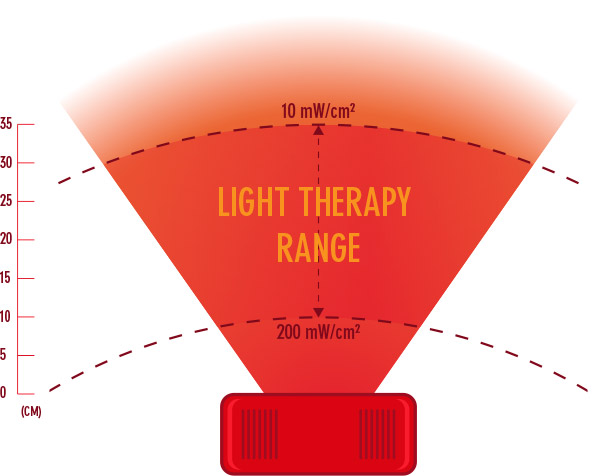 RLM Red Light Device showing range between 10cm & 35cm
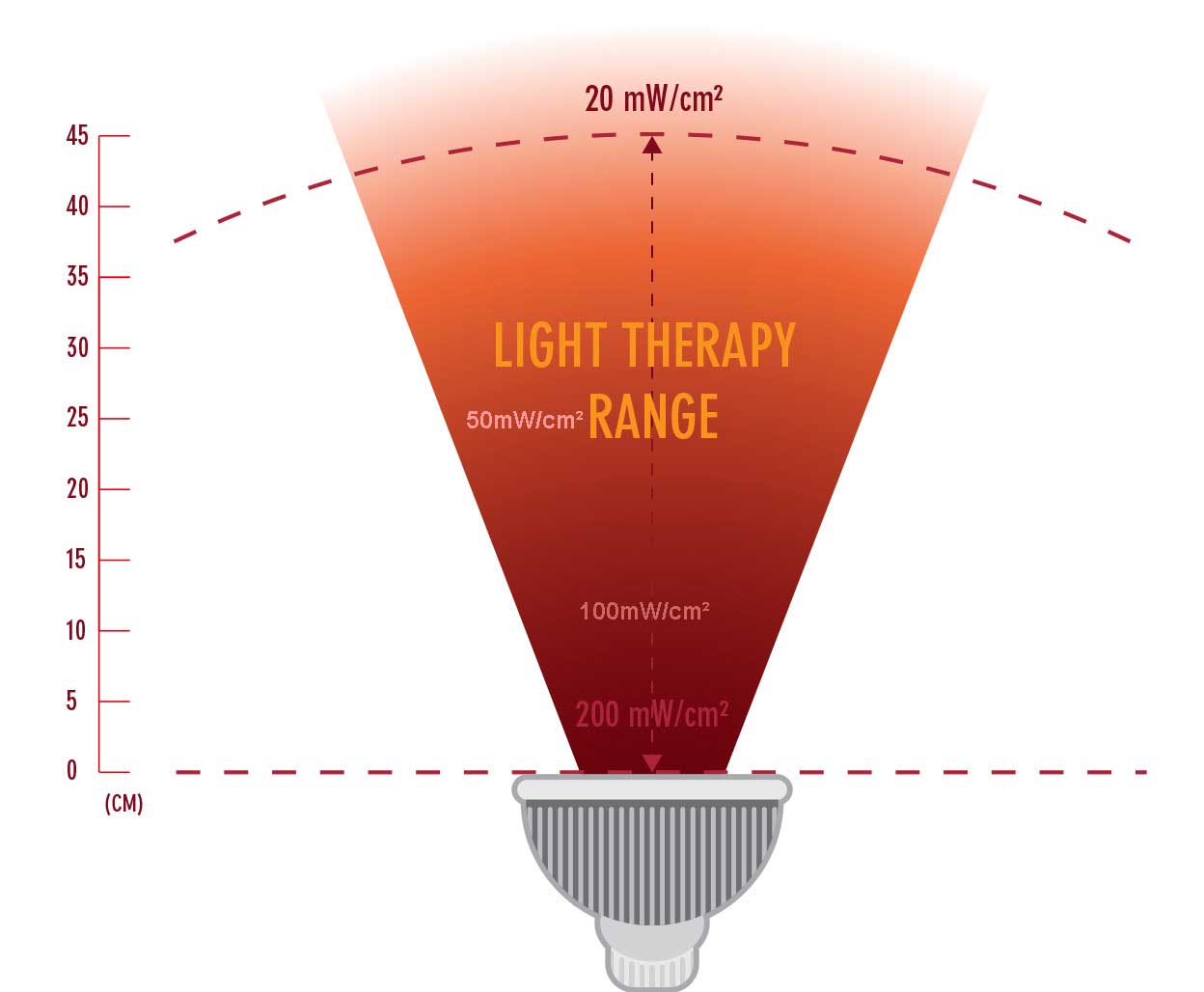 Therapy range of the infrared mini 830 device
How to calculate light therapy dose
Light therapy dose is calculated with this formula:
Power Density x Time = Dose
Fortunately, most recent studies use standardised units to describe their protocol:
- Power Density in mW/cm² (milliwatts per centimeter squared)
- Time in s (seconds)
- Dose in J/cm² (Joules per centimeter squared)
For light therapy at home, power density is therefore the main thing you need to know – if you don’t know it, you won’t be able to know how long to apply your device for to achieve a certain dose. It is simply a measure of how strong the light intensity is (or how many photons are in an area of space).
With angled output LEDs, the light is spreading out as it moves, covering a wider and wider area. This means relative light intensity at any given point gets weaker as distance from source increases. Differences in beam angles on LEDs also affects the power density. For example a 3w/10° LED will project light power density further than a 3w/120° LED, which will project weaker light over a larger area.
Light therapy studies tend to use power densities of ~10mW/cm² up to a max ~200mW/cm².
Dose is simply telling you how long that power density was applied for. Higher light intensity means less application time is required:
5mW/cm² applied for 200 seconds gives 1J/cm².
20mW/cm² applied for 50 seconds gives 1J/cm².
100mW/cm² applied for 10 seconds gives 1J/cm².
These units of mW/cm² and seconds give a result in mJ/cm² – just multiply that by 0.001 to get in J/cm². The full formula, taking into account standard units is therefore:
Dose = Power Density x Time x 0.001
What dose should I aim for?
Now that you can calculate what dose you are getting, you need to know what dose is actually effective. Most review articles and educational material tends to claim a dose in the range of 0.1J/cm² to 6J/cm² is optimal for cells, with less doing nothing and much more cancelling out the benefits.
However, some studies find positive results in much higher ranges, such as 20J/cm², 70J/cm², and even as high as 700J/cm². It’s possible that a deeper systemic effect is seen at the higher doses, depending on how much energy is applied in total to the body. It could also be that the higher dose is effective because the light penetrates deeper. Getting a dose of 1J/cm² in the top layer of skin will only take seconds. Getting a dose of 1J/cm² in deep muscle tissue could take 1000 times as long, requiring 1000J/cm²+ on the skin above.
Distance of the light source is crucially important here, as it determines the light power density hitting the skin. For example, using the Red Light Device at 25cm instead of 10cm would increase the application time required but cover a larger area of skin. There’s nothing wrong with using it from further away, just be sure to compensate by increasing application time.
Calculating how long a session
Now you should know your light’s power density (varying by distance) and the dose you want. Use the formula below to calculate how many seconds you need to apply your light for:
Time = Dose ÷ (Power density x 0.001)
Time in seconds, dose in J/cm² and power density in mW/cm²
Is there more to light therapy dosing?
While the information laid out here is adequate to measure dose and calculate application time for general use, light therapy dosing is a much more complicated matter, scientifically.
- J/cm² is how everyone measures dose now, however, the body is 3 dimensional. Dose can also be measured in J/cm³, which is how much energy is applied to a volume of cells, rather than just applied the surface area of skin.
- Is J/cm² (or ³) even a good way to measure dose? A 1 J/cm² dose can be applied to 5cm² of skin, while the same 1 J/cm² dose could be applied to 50cm² of skin. The dose per area of skin is the same (1J & 1J) in each case, but the total energy applied (5J vs 50J) is vastly different, potentially leading to different systemic outcomes.
- Different strengths of light can have different effects. We know that the following strength and time combinations give the same total dose, but the results wouldn’t necessarily be the same in studies:
- 2mW/cm² x 500secs = 1J/cm²
- 500mW/cm² x 2secs = 1J/cm²
- Session frequency. How often should sessions of ideal doses be applied? This may be different for different issues. Somewhere between 2x per week and 14x per week is shown effective in studies.
Summary
Using the right dose is key to get the most out of light therapy. Higher doses are required to stimulate deeper tissue than for the skin. To calculate dose for yourself, with any device, you need to:
- Figure out your light’s power density (in mW/cm²) by measuring it at different distances with a solar power meter.
- If you have one of our products, use the table above.
- Calculate dose with the formula: Power Density x Time = Dose
- Look for dosing protocols (strength, session time, dose, frequency) that have been proven effective in relevant light therapy studies.
- For general use and maintenance, between 1 and 60J/cm² may be appropriate
References
- Is light-emitting diode phototherapy (LED-LLLT) really effective? WS Kim et al. 2011.
- Low-level laser (light) therapy (LLLT) in skin: stimulating, healing, restoring. P Avci et al. 2013 .
- The growth of human scalp hair mediated by visible red light laser and LED sources in males. RJ Lanzafame. 2013.
- The growth of human scalp hair in females using visible red light laser and LED sources. RJ Lanzafame. 2014
- Low-level laser therapy in chronic autoimmune thyroiditis: a pilot study. DB Höfling et al. 2010.
- Low-level laser in the treatment of patients with hypothyroidism induced by chronic autoimmune thyroiditis: a randomized, placebo-controlled clinical trial. DB Höfling et al. 2013.
- Efficiency of low-level laser therapy in reducing pain induced by orthodontic forces. AA Bicakci. 2012.
- In Vitro effect of low-level laser therapy on typical oral microbial biofilms. FG Basso et al. 2011
- 830 nm light-emitting diode low level light therapy (LED-LLLT) enhances wound healing: a preliminary study. PK Min et al. 2013.
- Combination blue (415 nm) and red (633 nm) LED phototherapy in the treatment of mild to severe acne vulgaris. DJ Goldberg et al. 2006.
- Psychological benefits 2 and 4 weeks after a single treatment with near infrared light to the forehead: a pilot study of 10 patients with major depression and anxiety. F Schiffer et al. 2009.
- The effect of low-level laser therapy during orthodontic movement: a preliminary study. M Youssef et al. 2008.
- Does Phototherapy Enhance Skeletal Muscle Contractile Function and Postexercise Recovery? A Systematic Review. Borsa et al. 2013.
- Meta-Analysis of Pain Relief Effects by Laser Irradiation on Joint Areas. Ho Jang et al. 2012.