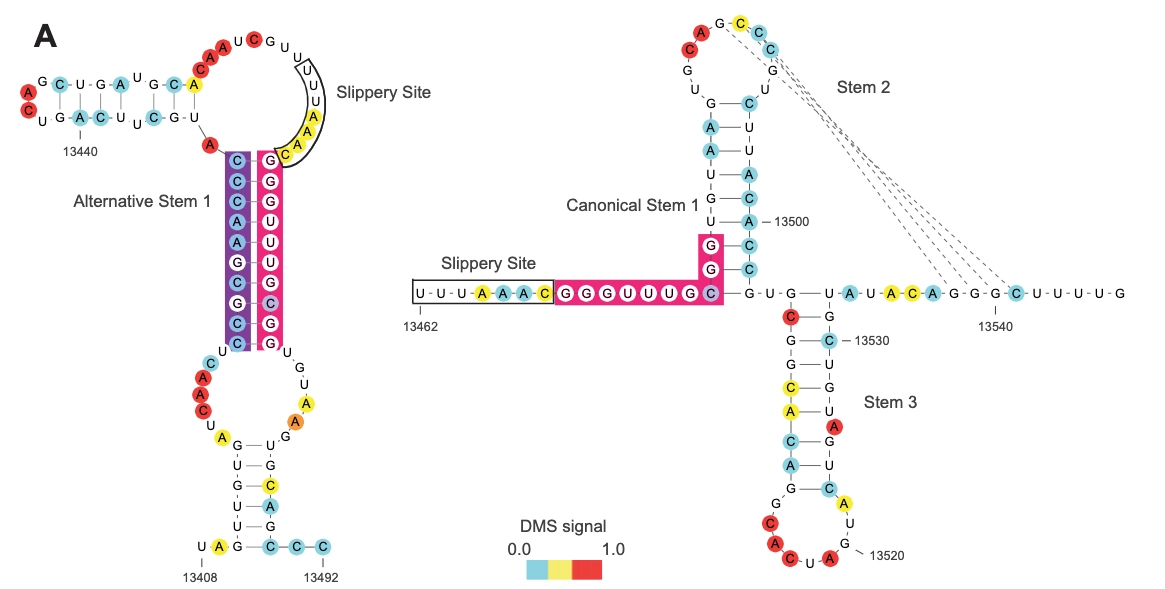
Frame shifting region
ribosomal frameshifting pseudoknot (PRF)
(pmid: 32676598 Pyle 2020)
- sits at the boundary between Orf1a andOrf1ab (Plant and Dinman, 2008).
- The PRF, found in all coronaviruses, induces a -1 ribosomal frameshift that allows for bypassing of the Orf1a stop codon and production of the orf1ab polyprotein, which includes the viral replicase(Plant et al., 2005).
- Reporter assays using a truncated PRF construct showed that programmed frameshifting occurs ~25% of the time in SARS-CoV(Kelly et al., 2020), and that it is crucialfor sgRNA synthesis (Plant et al., 2013). Extensive mutational analysis has revealed a three-stemmed pseudoknot structure for the SARS-CoV PRF (Plant et al., 2005). However, neither the mechanism of frameshifting regulation nor the three-stem pseudoknot PRF conformation has been validated in cells.
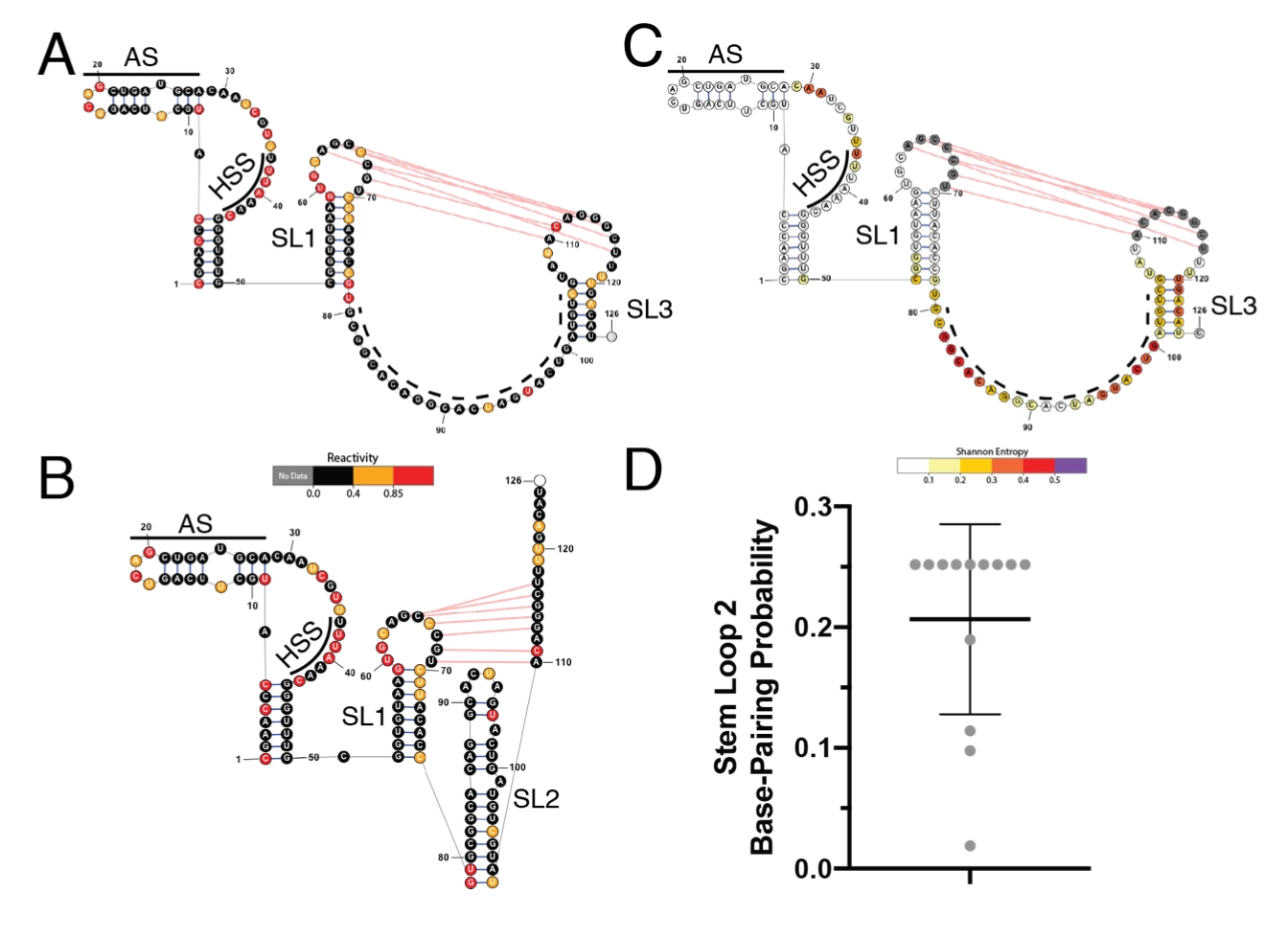
unexpected structure at Frameshift Element (FSE)
(Lan 2020 doi: 10.1101/2020.06.29.178343) FSE has emerged as a major drug target for small molecule binding that could influence the rate of frameshifting and be used as a treatment against SARS-CoV-2. To date, there is little experimental data on the structure of SARS-CoV-2 FSE and the prevailing model is a 3-stem pseudoknot forming downstream of the slippery site, which is thought to pause the ribosome and allow frameshifting to occur (Plant and Dinman, 2008).
- Our in-cell model does not include the expected pseudoknot formation downstream of the slippery sequence. Instead, half of the canonical stem 1 (Figure 4A, purple) finds an alternative pairing partner (pink) driven by 10 complementary bases upstream of the slippery site (Figure 4A, pink). We call this pairing Alternative Stem 1 (AS1).