RNA structure in the virion
PMID: 34168138 2021
virion RNA in situ conformation sequencing - vRIC-seq
- “unentangled globule” conformation.
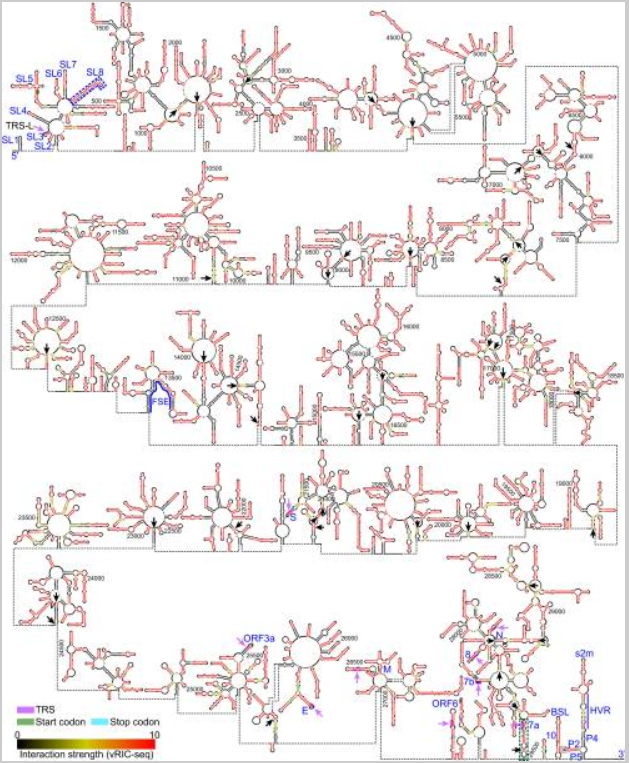
- many long-range duplexes and higher-order junctions, both of which are under purifying selections and contribute to the sequential package of the SARS-CoV-2 genome.
- the D614G and the other two accompanying mutations may remodel duplexes into more stable forms.
- the structure-guided design of small interfering RNAs can obliterate the SARS-CoV-2 in Vero cells.
- about 63.8% (19,064 nt) of the SARS-CoV-2 genome were base-paired
- PubMed Central Image Viewer. structure
- comparing vRIC with SHAPE in cells: single-stranded regions revealed by vRIC-seq tended to have stronger SHAPE signals than base-paired regions (P < 2.2e−16, Fig. 4b). Unexpectedly, 76% of the duplexes identified by vRIC-seq in virion might also present in host cells by comparing with the SHAPE-derived structural model (Fig. 4c). In addition, over 88% of the in-virion duplexes that happened within 2 kb were also present in host cells, evidenced by COMRADES identified chimeric reads (Fig. 4d). However, the pairwise interactions over 2 kb showed evident remodeling in the host cells (Fig. 4d).

vRIC-seq:
- RIC-seq utilizes a pCp-biotin to label proximally interacting chimeric RNAs and high-throughput sequencing to retrieve their spatial proximity information.
- can detect short- and long-range duplexes, multiple-way junctions, and loop-loop contacts without base pairing potentials.
- SARS-CoV-2 virions are typically 80 nm in diameter and can’t be pelleted down as human cells by standard centrifugation1. This feature makes virions not compliant with our current RIC-seq protocol that includes extensive washing and standard centrifugation at every enzymatic step30. To overcome the major challenges, we designed a way to trap SARS-CoV-2 virions on Concanavalin A (ConA) beads that bind specifically to glycoproteins present on the surface of virions. By optimizing virion capture, crosslinking, and enzymatic conditions, we further developed a virion RNA in situ conformation sequencing technology, named vRIC-seq, for global mapping of viral RNA genome structures in intact virions.