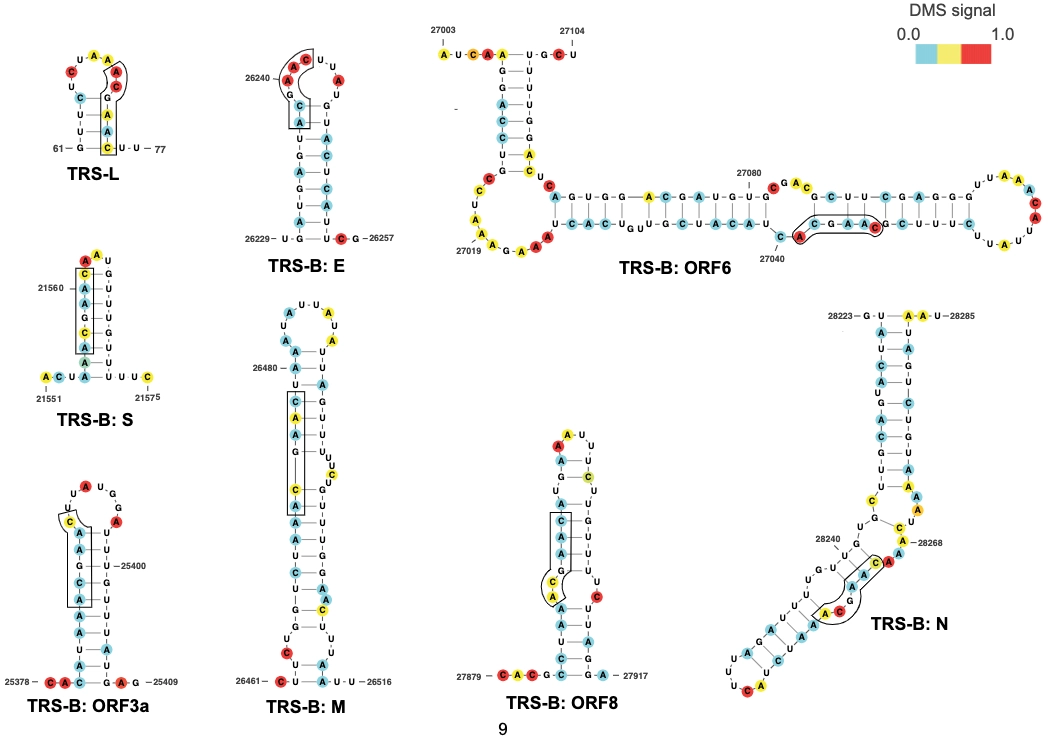
Transcription regulating sequences - TRS
Transcription-Regulating Sequences (TRSs) lie within stem loops
(Lan 2020 doi: 10.1101/2020.06.29.178343) As the transcription-regulating sequences (TRSs) are necessary for the synthesis of sgRNAs, we analyzed our structural models of the leader TRS (TRS-L) and the nine body TRSs (TRS-B). The leader TRS (TRS-L) is the central component of the 5’ UTR involved in discontinuous transcription (Sola et al., 2015).
- stem of SL3 contains two bases with medium reactivity (Figure 2B), which suggests that SL3 transitions between folded and unfolded states
- Of the nine body TRSs, we find that seven (all but the TRSs of ORF7a and ORF7b) lie within a stem loop. Of these, all but one TRS (N) place the core sequence on the 5’ side of the stem. Four body TRSs (M, ORF6, ORF8, and N) are predicted to lie in stem loops with two or three bulges, with the core sequence spanning one of the internal bulges. The other three structured body TRSs (S, ORF3a, and E) lie in stem loops without bulges, with the final paired base in the 5’ side of the stem contained in the core sequence. Strikingly, the entire core sequence is paired in two body TRSs (S and M), and partially exposed in a loop or bulge in the other five (Figure 2B).