Overview to RNA-SHAPE experiments in CoV2
SHAPE-map of CoV2 in cells
(PMID: 33444546 Pyle 2021)
- secondary structure of the SARS-CoV-2 RNA genome probed in infected cells.
- networks of well-folded RNA structures throughout Orf1ab
- new aspects of SARS-CoV-2 genome architecture that distinguish it from other single-stranded, positive-sense RNA viruses.
- we pinpoint individual regions of well-folded RNA structure that merit downstream functional analysis.
- analyzed using the ShapeMapper pipeline(Smola et al., 2015b).
- secondary structure prediction withthe SuperFoldpipeline(Smola et al., 2015b)
5' end shape corrasponds very well with the Iserman LLPS data (pmid: 32587965)
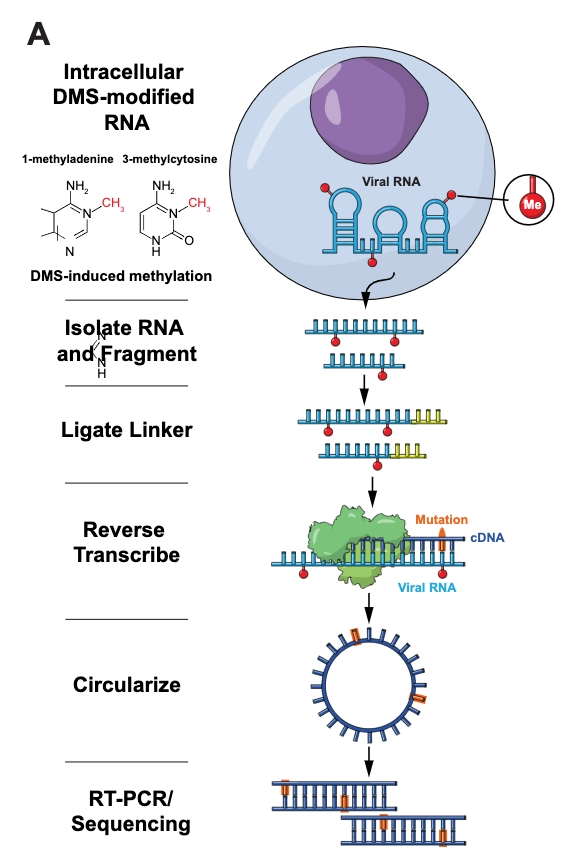
DMS on CoV2
(Lan 2020 doi: 10.1101/2020.06.29.178343) full-length in-vivoDMS-MaPseq on SARS-CoV2 infected cells. DMS rapidly and specifically modifies unpaired adenines and cytosines in vivo at their Watson-Crick faces.
- Combined, a total of ~1.58 million paired reads mapped to the coronavirus genome (Figure 1C), representing ~40% of total cellular RNA (post ribosomal RNA depletion).
- regions of potential interest in the SARS-CoV-2 genome, we identified all structured and accessible regions, which we define as stretches of at least 10 consecutive paired bases or 14 consecutive unpaired bases, respectively (Figure 2A).
- Structured regions could be functional elements of the genome that are potential targets of therapeutics. We identify 215 structured regions covering a total of 2,359 bases (8.5% of the genome).
in vitro SHAPE
(Iserman 2020 pmid: 32587965) + N binding ; LLPS
(Manfredonia 2020 doi: 10.1101/2020.06.15.151647) SHAPE-MaP analysis on ex vivo extracted and refolded SARS-CoV-2
- druggable pockets predicted
- 8% of the structures conserved among corona -> special function?