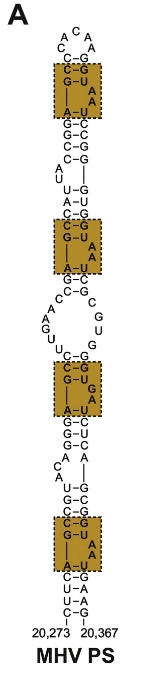
MHV - PS
Intro - MHV PS
(pmid: 31505321) mapped the minimal functional PS to a 69-nt segment of rep1b (Fosmire et al., 1992) - but larger forms more efficient in packaging.
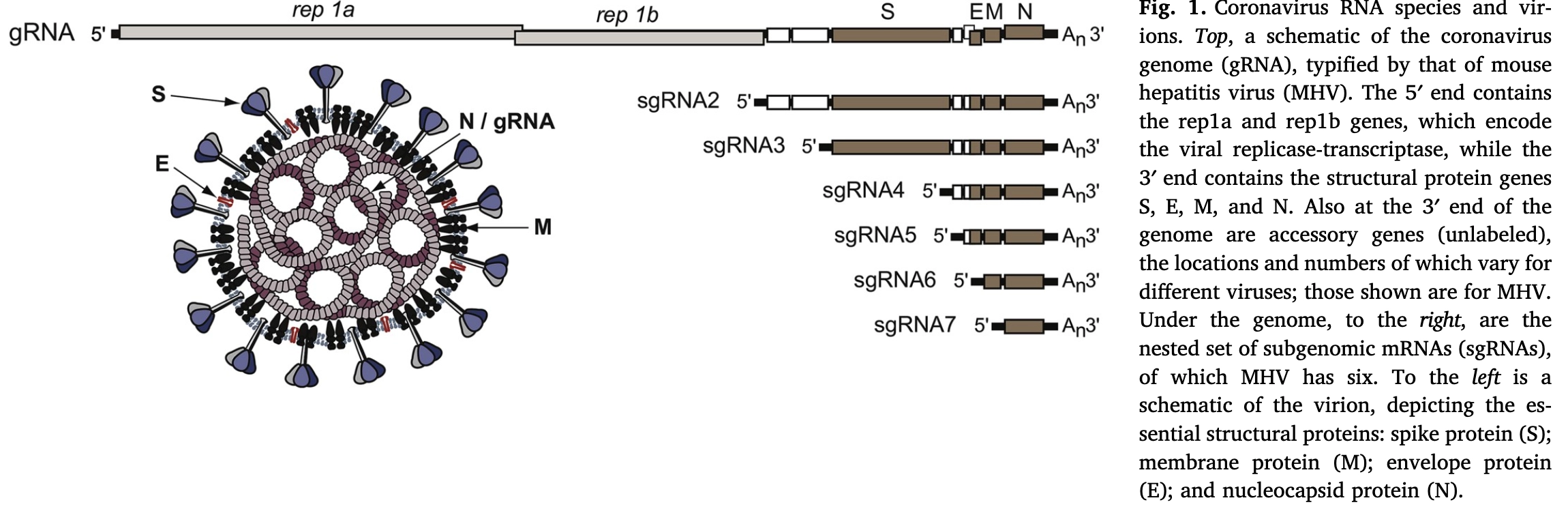
20 kb downstream from the 5′ end of the genome, distant from cis-acting RNA elements required for viral RNA replication. As would be expected, it only appears in gRNA and not in the nested set of sgRNAs.
bovine coronavirus (BCoV), another lineage A betacoronavirus, recognizes the PS of MHV, and reciprocally, MHV recognizes the PS of BCoV
- model for the MHV PS - analysis of the folding of the homologous region from all lineage A betacoronavirus genomes (Chen et al., 2007). This structure, a 95-nt bulged stem-loop, contains four copies of an AGC/GUAAU motif, each displaying an AA (or GA bulge) on its 3′ side (Fig. 2A). These repeat units are spaced at regular intervals, with a two-fold quasi-symmetry centered around an internal loop. It was noted by Chen et al. (2007) that their model has a different RNA fold than the previously reported 69-nt substructure of Fosmire et al. (1992), and it is not in complete accord with that earlier study. The 95-nt bulged stem-loop structure was shown to be in good agreement with in vitro chemical and enzymatic probing experiments. It is also strongly supported by phylogenetic criteria (Fig. 2B). The terminal loop and the repeat units are absolutely conserved in every currently known lineage A betacoronavirus. All other stem segments are preserved by covariation of base pairs. In contrast, wider divergence is allowed in the central internal loop, where numerous nucleotide substitutions or small insertions occur. Notably, the PS of equine coronavirus (EqCoV), a close relative of BCoV, contains a deletion that precisely encompasses the central bulge and one of the repeat units (Fig. 2B).
(pmid: 31505321) Initial characterization of a coronavirus PS was carried out with the prototype lineage A betacoronavirus, mouse hepatitis virus (MHV)
- studied by defective-interfering (DI) RNAs > localization of the MHV PS to a portion of the replicase gene (Makino et al., 1990; van der Most et al., 1991).
- mapped the PS to a 190-nt segment of rep1b (Fosmire et al., 1992). This locus is some 20 kb downstream from the 5′ end of the genome, distant from cis-acting RNA elements required for viral RNA replication - only appears in gRNA and not in the nested set of sgRNAs.
- 69-nt substructure within the 190-nt segment as the minimal functional PS (Fosmire et al., 1992). > larger forms of the PS were more efficient for packaging of DI RNAs or heterologous RNAs into virions of helper virus (Cologna and Hogue, 2000) or into virus-like particles (VLPs) formed from expressed structural proteins (Bos et al., 1996; Narayanan and Makino, 2001).
- BCoV, another lineage A betacoronavirus, recognizes the PS of MHV, and reciprocally, MHV recognizes the PS of BCoV (Cologna and Hogue, 2000).
- The betacoronavirus lineage A PS falls in a region of rep1b that codes for the nsp15 subunit of the replicase-transcriptase (Deng and Baker, 2018). The PS RNA encodes a segment of nsp15 that is absent from the nsp15 sequences of betacoronavirus lineages B, C, and D, as well as those of alpha, gamma-, and deltacoronaviruses
Sequence/Structure of the MHV PS
(pmid: 31505321) HV PS was constructed through analysis of the folding of the homologous region from all lineage A betacoronavirus genomes (Chen et al., 2007). This structure, a 95-nt bulged stem-loop, contains four copies of an AGC/GUAAU motif, each displaying an AA (or GA bulge) on its 3′ side (Fig. 2A).
repeat units are spaced at regular intervals, with a two-fold quasi-symmetry centered around an internal loop. It was noted by Chen et al. (2007) that their model has a different RNA fold than the previously reported 69-nt substructure of Fosmire et al. (1992), and it is not in complete accord with that earlier study. The 95-nt bulged stem-loop structure was shown to be in good agreement with in vitro chemical and enzymatic probing experiments. It is also strongly supported by phylogenetic criteria (Fig. 2B). The terminal loop and the repeat units are absolutely conserved in every currently known lineage A betacoronavirus. All other stem segments are preserved by covariation of base pairs. In contrast, wider divergence is allowed in the central internal loop, where numerous nucleotide substitutions or small insertions occur. Notably, the PS of equine coronavirus (EqCoV), a close relative of BCoV, contains a deletion that precisely encompasses the central bulge and one of the repeat units (Fig. 2B).