TMPRSS2 - S protein processing
The paper that make us think over the Furin project
(Hoffman Pöhlmann 2020 Cell - pmid: 32142651) SARS-CoV can use the endosomal cysteine proteases cathepsin B and L (CatB/L) (Simmons et al., 2005) and the serine protease TMPRSS2 (Glowacka et al., 2011; Matsuyama et al., 2010; Shulla et al., 2011) for S protein priming in cell lines, and inhibition of both proteases is required for robust blockade of viral entry (Kawase et al., 2012). However, only TMPRSS2 activity is essential for viral spread and pathogenesis in the infected host whereas CatB/L activity is dispensable (Iwata-Yoshikawa et al., 2019; Shirato et al., 2016; Shirato et al., 2018; Zhou et al., 2015).
Take home after reviewing other literatur: Lots was known before; binding affinities of Camostat are low; Nafamostat not tested; new Furin site not taken into account; more than one protease required; virus is evolving at second cleavage site
TMPRSS2 is known since 2010 to be the processing enzyme of protein S
(Shulla Gallagher 2010 JVir pmid: 21068237)(Matsuyama Taguchi 2010 JVir)
(Glowacka Pöhlmann 2011 JVir pmid: 21325420)
other proteases being involved
(Glowacka Pöhlmann 2011 JVir pmid: 21325420) - cathepsins B and L
(Hoffman Pöhlmann 2020 Cell - pmid: 32142651) One can speculate that furin-mediated precleavage at the S1/S2 site in infected cells might promote subsequent TMPRSS2-dependent entry into target cells, as reported for MERS-CoV (Kleine-Weber et al., 2018; Park et al., 2016).
why did I go for Furin - see: S protein - SARS-CoV-2
TMPRSS2 structural analysis
3/2020 There is just a poster, but no structure available. (Oliveira Barbosa 2018 Biophys J)
TMPRSS2 Inhibitors
Camostat
(Kawase Matsuyama 2012 JVir pmid: 22496216) - inhibiting SARS-CoV - Camostat + CatB/L inhibitor - long known!! -they used HeLa cells stably expressing ACE2 - They just tried the Serine Protease Inhibitors: inhibitory effects of chemicals on TMPRSS2 were examined by observing their ability to suppress cell entry by pseudotyped virus. HeLa-ACE2 or HeLa-ACE2-TMPRSS2 cells were treated with benzamidine, aprotinin, gabexate, camostat, and TLCK for 30 min and then inoculated with pseudotyped viruses in the continued presence of these inhibitors.
High concentrations of Camostat required: Camostat-mediated suppression ofSARS-S entry never exceeded 65%, even in the presence of a high concentration of the drug (100microM - first effects with 10microM in cell culture), indicating that, despite the presence of TMPRSS2, 35% of the viruses utilized endosomal cathepsins for cell entry. In contrast, in the absence of TMPRSS2, camostat had insignificant effects on pseudotyped virus entry.
Is there something known about the Camostat specificity? I did not find!! No data for affinity and specificity!!
Camostat mesylate: Sigma
Wikipedia: Camostat is a serine protease inhibitor. Serine protease enzymes have a variety of functions in the body, and so camostat has a diverse range of uses. It is used in the treatment of some forms of cancer and is also effective against some viral infections, as well as inhibiting fibrosis in liver or kidney disease or pancreatitis.[1][2][3][4][5] It is approved in Japan for the treatment of pancreatitis.[6][7]
It is an inhibitor of the enzyme Transmembrane protease, serine 2 (TMPRSS2). Inhibition of TMPRSS2 partially blocked infection by SARS-CoV and Human coronavirus NL63 in HeLa cells.[8] Another in vitro study showed that Camostat reduces significantly the infection of Calu-3 lung cells by SARS-CoV-2, the virus responsible for COVID-19.[9]
International Drug name: Camostat
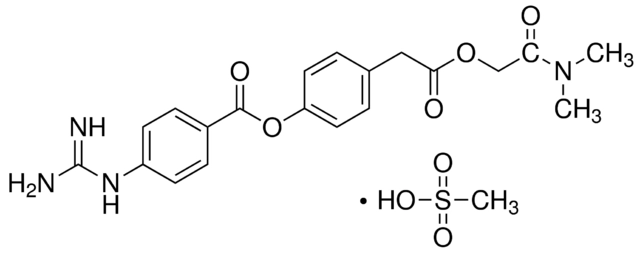
(Meyer Steinmetzer 2013 BiochJ pmid: 23527573) - inhibiting influenza
(Hoffman Pöhlmann 2020 Cell - pmid: 32142651) camostat mesylate partially blocked SARS-2-S-driven entry into Caco-2 (Figure S3 B) and Vero-TMPRSS2 cells (Figure 4A). Full inhibition was attained when camostat mesylate and E-64d, an inhibitor of CatB/L, were added (Figure 4A; Figure S3B), indicating that SARS-2-S can use both CatB/L as well as TMPRSS2 for priming in these cell lines.
exerted no unwanted cytotoxic effects.
TMPRSS2 is dispensable for development and homeostasis (Kim et al., 2006) and thus constitutes an attractive drug target. In this context, it is noteworthy that the serine protease inhibitor camostat mesylate, which blocks TMPRSS2 activity (Kawase et al., 2012; Zhou et al., 2015), has been approved in Japan for human use, but for an unrelated indication. This compound or related ones with potentially increased antiviral activity (Yamamoto et al., 2016) could thus be considered for off-label treatment of SARS-CoV-2-infected patients.
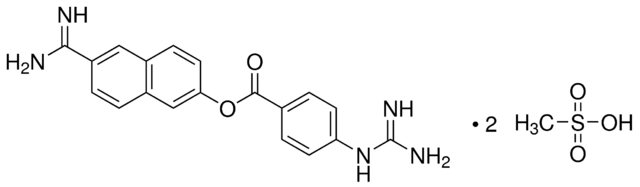
Nafamostat
(Yamamoto Matsuda 2016 Antimicrob Agents and Chemotherapy pmid: 27550352) TMPRSS2 fusion assay - 1000 compounds screened. assay has the potential to facilitate the discovery of new inhibitors of membrane fusion of MERS-CoV as well as other viruses that rely on the activity of TMPRSS2.
inhibits at 1 microM - two other compounds of the 1000 FDA approved show effects in the assay. 10 times more active than camostat! Nafamostat is currently indicated for systemic use in the treatment of pancreatitis and disseminated intravascular coagulation. The anticoagulatory activity as implicated in the latter indication may cause unwanted side effects when it is applied to MERS. The feasibility of clinical application of nafamostat is beyond the scope of our current study; however, either nafamostat or its derivatives have potential to be used in the treatment of MERS.
medical indication: pancreatitis
wikipedia: anticoagulant; used during hemodialysis to prevent the proteolysis of fibrinogen into fibrin.
tryptase inhibitor, which is implicated in leaking blood vessels of dengue haemorrhagic fever and end stage dengue shock syndrome. It is available in generic form already used for the treatment of certain bleeding complications in some countries, but risks of complications (incl anaphylaxis) must be weighed in non-emergency care.
Sigma: Nafamostat
TMPRSS2 in other diseases
overexpressed in patients with prostate cancer. This protease induces tumorigenesis through the proteolytic conversion of proHGF, activation of c-Met signaling and engagement of the PI3K-Akt-mTOR pathway. The enzyme participates in viral infection by performing cleavage and activation of glycoproteins.