Austronesian peoples
The Austronesian peoples, sometimes referred to as Austronesian-speaking peoples,[47] are a large collection of peoples who speak Austronesian languages, having settled in:
- Taiwan, maritime Southeast Asia,
- parts of mainland Southeast Asia,
- Micronesia,
- coastal New Guinea,
- Island Melanesia,
- Polynesia, and
- Madagascar.[48][49]
- They also include indigenous ethnic minorities in
- Vietnam,
- Cambodia,
- Myanmar,
- Thailand and
- Hainan.[48][50][51]
- The nations and territories predominantly populated by Austronesian-speaking peoples are sometimes known collectively as Austronesia.[52]
The group originated from a prehistoric seaborne migration, known as the Austronesian expansion, from Taiwan, circa 3000 to 1500 BCE.
Austronesians reached the Batanes Islands in the northernmost Philippines by around 2200 BCE.
They used sails some time before 2000 BCE.[53]: 144 In conjunction with their use of other maritime technologies:
- notably catamarans,
- outrigger boats,
- lashed-lug boats, and
- the crab claw sail),
- this enabled phases of rapid dispersal into the islands of
- the Indo-Pacific,
- culminating in the settlement of New Zealand c.1250 CE.[54]
- During the initial part of the migrations,
- they encountered and assimilated (or were assimilated
- by) the Paleolithic populations that had migrated earlier into
- Maritime Southeast Asia and
- New Guinea.
- They reached as far as Easter Island to the east,
- Madagascar to the west,[55] and
- New Zealand to the south.
- At the furthest extent, they might have also reached the Americas.[56][57][58]
Aside from language, Austronesian peoples widely share cultural characteristics, including such traditions and traditional technologies as:
- lashed-lug shipbuilding,
- tattooing,
- stilt houses,
- jade carving,
- wetland agriculture, and
- various rock art motifs.
- They also share domesticated plants and animals
- that were carried along with the migrations,
- including rice,
- bananas,
- coconuts,
- breadfruit,
- Dioscorea yams,
- taro,
- paper mulberry,
- chickens,
- pigs, and
- dogs.
History of research
See also: Malay race
The linguistic connections
- Madagascar,
- Polynesia, and
- Southeast Asia,
- particularly the similarities between
- Malagasy,
- Malay, and
- Polynesian numerals,
- were recognized early in the colonial era by European authors.[59]
The first formal publication on these relationships was in 1708 by Dutch Orientalist Adriaan Reland,
who recognized a "common language" from Madagascar to western Polynesia, although Dutch explorer Cornelis de Houtman observed linguistic links between Madagascar and the Malay Archipelago a century earlier, in 1603.[50]
German naturalist Johann Reinhold Forster,
who traveled with James Cook on his second voyage, also recognized the similarities of Polynesian languages to those of Island Southeast Asia.
In his book Observations Made during a Voyage round the World (1778), he posited that the ultimate origins of the Polynesians might have been the lowland regions of the Philippines and proposed that they arrived to the islands via long-distance voyaging.[60]
 Skulls representing Johann Friedrich Blumenbach's "five races" in De Generis Humani Varietate Nativa (1795).
see PDF.
The Tahitian skull labeled "O-taheitae" represented what he called the "Malay race".
The Spanish philologist Lorenzo Hervás later devoted a large part of his Idea dell'universo (1778–1787) to the establishment of a language family linking:
- the Malay Peninsula,
- the Maldives,
- Madagascar,
- Indonesia (Sunda Islands and
- Moluccas),
- the Philippines, and
- the Pacific Islands eastward to Easter Island.
Multiple other authors corroborated this classification (except for the erroneous inclusion of Maldivian), and the language family came to be known as "Malayo-Polynesian", first coined by the German linguist Franz Bopp in 1841 (German: malayisch-polynesisch).[59][61]
The connections between Southeast Asia, Madagascar, and the Pacific Islands were also noted by other European explorers, including the Orientalist William Marsden and the naturalist Johann Reinhold Forster.[62]
Johann Friedrich Blumenbach added Austronesians as the fifth category to his "varieties" of humans in the second edition of De Generis Humani Varietate Nativa (1781).
He initially grouped them by geography and thus called Austronesians the "people from the southern world".
In the third edition, published in 1795, he named Austronesians the "Malay race", or the "brown race", after correspondence with Joseph Banks, who was part of the first voyage of James Cook.[62][63]
:{Blumenbach used the term "Malay" due to his belief that most Austronesians spoke the "Malay idiom" (i.e., the Austronesian languages:{:{), though he inadvertently caused the later confusion of his racial category with the Malay ethnic group.[64]}:
The other varieties Blumenbach identified were:
- the "Caucasians" (white),
- "Mongolians" (yellow),
- "Ethiopians" (black), and
- "Americans" (red).
Blumenbach's definition of the "Malay" race is largely identical to the modern distribution of the Austronesian peoples, including not only Islander Southeast Asians but also the people of Madagascar and the Pacific Islands.
Although Blumenbach's work was later used in scientific racism, Blumenbach was a monogenist and did not believe the human "varieties" were inherently inferior to each other.
Rather, he believed that the Malay race was a combination of the "Ethiopian" and "Caucasian" varieties.[62][63]}:}:
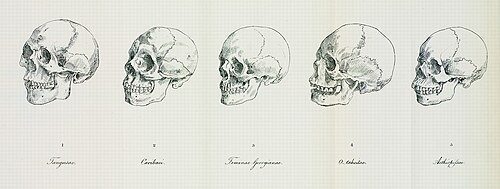
Skulls representing Johann Friedrich Blumenbach's "five races" in De Generis Humani Varietate Nativa (1795). The Tahitian skull labeled "O-taheitae" represented what he called the "Malay race".
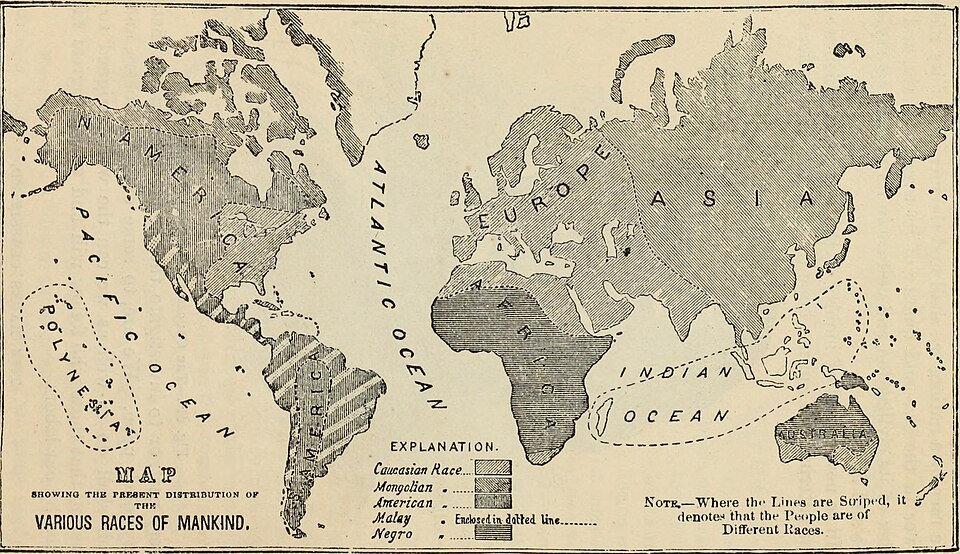
The New Physiognomy map (1889), printed by the Fowler & Wells Company, depicting Johann Friedrich Blumenbach's five human races. The region inhabited by the "Malay race" is shown enclosed in dotted lines. Like in most 19th-century sources, Islander Melanesians are excluded. Taiwan, which was annexed by the Qing dynasty in the 17th century, is also excluded.
Malay variety. Tawny-coloured; hair black, soft, curly, thick and plentiful; head moderately narrowed; forehead slightly swelling; nose full, rather wide, as it were diffuse, end thick; mouth large, upper jaw somewhat prominent with parts of the face when seen in profile, sufficiently prominent and distinct from each other. This last variety includes the islanders of the Pacific Ocean, together with the inhabitants of the Marianas, the Philippine, the Molucca and the Sunda Islands, and of the Malayan peninsula. I wish to call it the Malay, because the majority of the men of this variety, especially those who inhabit the Indian islands close to the Malacca peninsula, as well as the Sandwich, the Society, and the Friendly Islanders, and also the Malambi of Madagascar down to the inhabitants of Easter Island, use the Malay idiom.
—Johann Friedrich Blumenbach,The anthropological treatises of Johann Friedrich Blumenbach, translated by Thomas Bendyshe, 1865.[65]
By the 19th century, however, a classification of Austronesians as being a subset of the "Mongolian" race was favored, as was polygenism.
The Australo-Melanesian populations of Southeast Asia and Melanesia (whom Blumenbach initially classified as a "subrace" of the "Malay" race) were also now being treated as a separate "Ethiopian" race by authors like Georges Cuvier, Conrad Malte-Brun (who first coined the term "Oceania" as Océanique), Julien-Joseph Virey, and René Lesson.[62][66]
The British naturalist James Cowles Prichard originally followed Blumenbach by treating Papuans and Indigenous Australians as being descendants of the same stock as Austronesians.
But by his third edition of Researches into the Physical History of Man (1836–1847), his work had become more racialized due to the influence of polygenism.
He classified the peoples of Austronesia into two groups: the "Malayo-Polynesians" (roughly equivalent to the Austronesian peoples) and the "Kelænonesians" (roughly equivalent to the Australo-Melanesians).
He further subdivided the latter into the "Alfourous" (also "Haraforas" or "Alfoërs", the Native Australians), and the "Pelagian or Oceanic Negroes" (the Melanesians and western Polynesians).
Despite this, he acknowledges that "Malayo-Polynesians" and "Pelagian Negroes" had "remarkable characters in common", particularly in terms of language and craniometry.[62][59][61]
In linguistics, the Malayo-Polynesian language family also initially excluded Melanesia and Micronesia, due to the perceived physical differences between the inhabitants of these regions from Malayo-Polynesian speakers.
However, there was growing evidence of their linguistic relationship to Malayo-Polynesian languages, notably from studies on the Melanesian languages by Georg von der Gabelentz, Robert Henry Codrington, and Sidney Herbert Ray.
Codrington coined and used the term "Ocean" language family rather than "Malayo-Polynesian" in 1891, in opposition to the exclusion of Melanesian and Micronesian languages.
This was adopted by Ray, who defined the "Oceanic" language family as encompassing the languages of Southeast Asia and Madagascar, Micronesia, Melanesia, and Polynesia.[50][67][68][69]
In 1899, the Austrian linguist and ethnologist Wilhelm Schmidt coined the term "Austronesian" (German: austronesisch, from Latin auster, "south wind"; and Greek νῆσος,) to refer to the language family.[70] Schmidt had the same motivations as Codrington: he proposed the term as a replacement to "Malayo-Polynesian", because he also opposed the implied exclusion of the languages of Melanesia and Micronesia in the latter name.[59][61]
It became the accepted name for the language family, with Oceanic and Malayo-Polynesian languages being retained as names for subgroups.[50]
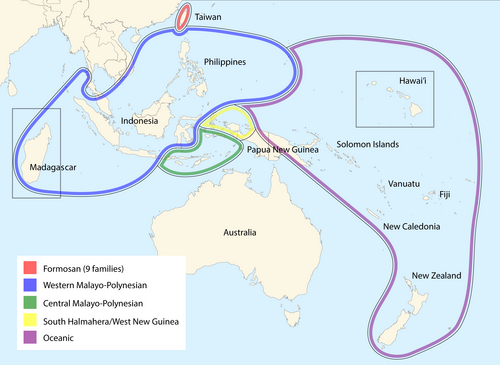
Distribution of the Austronesian languages (Blust, 1999)[71]
The term "Austronesian", or more accurately "Austronesian-speaking peoples", came to refer to people who speak the languages of the Austronesian language family.
Some authors, however, object to the use of the term to refer to people, as they question whether there really is any biological or cultural shared ancestry between all Austronesian-speaking groups.[47][72]
This is especially true for authors who reject the prevailing "Out of Taiwan" hypothesis and instead offer scenarios where the Austronesian languages spread among preexisting static populations through borrowing or convergence, with little or no population movements.[48][73]
Despite these objections, the general consensus is that the archeological, cultural, genetic, and especially linguistic evidence all separately indicate varying degrees of shared ancestry among Austronesian-speaking peoples that justifies their treatment as a "phylogenetic unit".
rk NOTE: Was this during a "RESET" in which the Archons were taking inventory of their stock,
oops, I mean PREY?
Wikipedia article continued:
This has led to the use of the term "Austronesian" in academic literature to refer not only to the Austronesian languages but also the Austronesian-speaking peoples, their societies, and the geographic area of Austronesia.[72][48][73][77][78]
Some Austronesian-speaking groups are not direct descendants of Austronesians and acquired their languages through language shift,
rk NOTE: Can you say: TOWER OF BABEL?
Wikipedia article continued:
but this is believed to have happened only in a few instances, since the Austronesian expansion was too rapid for language shifts to have occurred fast enough.[79]
In parts of Island Melanesia, migrations and paternal admixture from Papuan groups after the Austronesian expansion (estimated to have started at around 500 BCE) also resulted in gradual population turnover.
These secondary migrations were incremental and happened gradually enough that the culture and language of these groups remained Austronesian, even though in modern times, they are genetically more Papuan.[80]
In the vast majority of cases, the language and material culture of Austronesian-speaking groups descend directly through generational continuity, especially in islands that were previously uninhabited.[79]
Serious research into the Austronesian languages and its speakers has been ongoing since the 19th century.
Modern scholarship on Austronesian dispersion models is generally credited to two influential papers in the late 20th century:
The Colonization of the Pacific: A Genetic Trail* (Hill & Serjeantson, eds., 1989) and
The Austronesian Dispersal and the Origin of Languages (Bellwood, 1991).[81][82]
- The topic is particularly interesting to scientists for the remarkably unique characteristics of the Austronesian speakers: their extent, diversity, and rapid dispersal.[83][84]
Regardless, certain disagreements still exist among researchers with regards to:
- chronology,
- origin,
- dispersal,
- adaptations to the island environments,
- interactions with preexisting populations in areas they settled, and
- cultural developments over time.
- The mainstream accepted hypothesis is the "Out of Taiwan" model first proposed by Peter Bellwood.
- But there are multiple rival models that create a sort of "pseudo-competition" among their supporters due to narrow focus on data from limited geographic areas or disciplines.[83][84][85]
- The most notable of which is the "Out of Sundaland" (or "Out of Island Southeast Asia") model.
Geographic distribution
See also: Austronesian expansion, Micronesian navigation, and Polynesian navigation
- Austronesians were the first humans with seafaring vessels that could cross large distances on the open ocean;
- this technology allowed them to colonize a large part of the Indo-Pacific region.[86][failed ^verification][87]
- Prior to the 16th-century colonial era,
- the Austronesian language family was the most widespread in the world,
- spanning half the planet from Easter Island in the eastern Pacific Ocean to
- Madagascar in the western Indian Ocean.[48]
Languages of the Austronesian family are today spoken by about 386 million people (4.9% of the global population), making it the fifth-largest language family by number of speakers.
Major Austronesian languages include Malay (around 250–270 million in Indonesia alone in its own literary standard, named Indonesian), Javanese, and Filipino (Tagalog). The family contains 1,257 languages, the second-largest number of any language family.[91]
The geographic region that encompasses native Austronesian-speaking populations is sometimes referred to as "Austronesia".[77]
Other geographic names for various subregions include:
- Malay Peninsula,
- Greater Sunda Islands,
- Lesser Sunda Islands,
- Island Melanesia,
- Island Southeast Asia,
- Malay Archipelago,
- Maritime Southeast Asia,
- Melanesia,
- Micronesia,
- Near Oceania,
- Oceania,
- Pacific Islands,
- Remote Oceania,
- Polynesia, and
- Wallacea.
- In Indonesia, the nationalistic term Nusantara,
- from Old Javanese,
- is also popularly used for the Indonesian islands.[77][92]
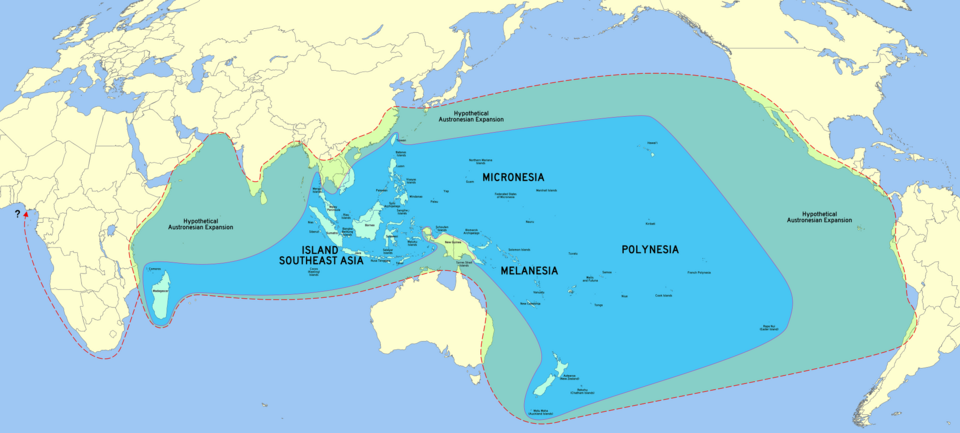
Extent of contemporary Austronesia and possible further migrations and contact (Blench, 2009)[93]
rk NOTE: Who is paying these "researchers"
for this SHITE?
Austronesian regions are almost exclusively islands in the Pacific and Indian oceans, with predominantly tropical or subtropical climates with considerable seasonal rainfall.[50][94]
Inhabitants of these regions include:
- Taiwanese indigenous peoples,
- most ethnic groups in Brunei,
- East Timor,
- Indonesia,
- Madagascar,
- Malaysia,
- Micronesia,
- the Philippines, and
- Polynesia.
- Also included are the Malays of Singapore;
- the Polynesians of New Zealand,
- Hawaii, and
- Chile;
- the Torres Strait Islanders of Australia;
- the non-Papuan peoples of Melanesia and
- coastal New Guinea;
- the Shibushi speakers of Mayotte, and
- the Malagasy and
- Shibushi speakers of Réunion.
- Austronesians are also found in the regions of Southern Thailand;
- the Cham areas in Vietnam,
- Cambodia, and
- Hainan; and
- the Mergui Archipelago of Myanmar.[48][50][51]
Additionally, modern-era migration has brought Austronesian-speaking people to
- the United States,
- Canada,
- Australia,
- the UK,
- mainland Europe,
- Cocos (Keeling) Islands,
- South Africa,
- Sri Lanka,
- Suriname,
- Hong Kong,
- Macau, and
- West Asian countries.[95]
Some authors also propose further settlements and contacts in the past in areas that are not inhabited by Austronesian speakers today. rk NOTE: Is Epstein looking for a new place to hide himself and the rest of the BABY-EATERS?
Wikipedia article continued:
These range from likely hypotheses to very controversial claims with minimal evidence.
In 2009, Roger Blench compiled an expanded map of Austronesia that encompassed these claims based on a variety of evidence, such as
- historical accounts,
- loanwords,
- introduced plants and animals,
- genetics,
- archeological sites, and
- material culture.
- They include areas like
- the Pacific coast of the Americas,
- Japan,
- the Yaeyama Islands,
- the Australian coast,
- Sri Lanka and
- coastal South Asia,
- the Persian Gulf,
- some Indian Ocean islands,
- East Africa,
- South Africa, and
- West Africa.[93]
List of Austronesian peoples
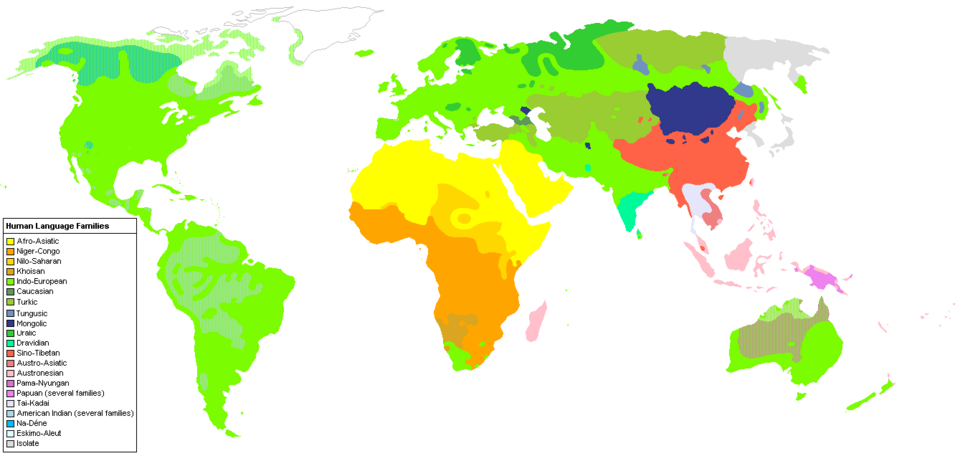
Map showing the distribution of the Austronesian language family (light rose pink). It roughly corresponds to the distribution of all Austronesian peoples.
Austronesian peoples include the following groupings by name and geographic location (incomplete):[citation ^needed]
- Formosan: Taiwan (e.g., Amis, Atayal, Bunun, Paiwan, collectively known as Taiwanese indigenous peoples)
- Malayo-Polynesian:
- Borneo groups (e.g., Kadazan-Dusun, Murut, Iban, Bidayuh, Dayak, Lun Bawang/Lundayeh)
- Chamic group: Cambodia, Hainan, Cham areas of Vietnam (remnants of the Champa kingdom, which covered central and southern Vietnam) as well as Aceh, in northern Sumatra (e.g., Acehnese, Chams, Jarai, Utsuls)
- Moken
- Central Luzon group: (e.g., Kapampangan, Sambal)
- Igorot (Cordillerans): Cordilleras (e.g., Balangao, Ibaloi, Ifugao, Itneg, Kankanaey)
- Lumad: Mindanao (e.g., Kamayo, Mandaya, Mansaka, Kalagan, Manobo, Tasaday, T'boli)
- Malagasy: Madagascar (e.g., Betsileo, Merina, Sihanaka, Bezanozano)
- Melanesians: Melanesia (e.g., Fijians, Kanak, Ni-Vanuatu, Solomon Islands)
- Micronesians: Micronesia (e.g., Carolinian, Chamorro, Palauans)
- Moro: Bangsamoro (Mindanao & Sulu Archipelago, e.g., Maguindanao, Iranun, Maranao, Tausug, Yakan, Sama-Bajau)
- Northern Luzon lowlanders (e.g., Ilocano, Pangasinan, Ibanag, Itawes)
- Polynesians: Polynesia (e.g., Māori, Native Hawaiians, Cook Islands, Samoans, Tongans)
- Southern Luzon lowlanders (e.g., Tagalog, Bicolano)
- Sunda–Sulawesi language and ethnic groups, including Sundanese, Banjar, Javanese, Balinese, Toraja, Minangkabau, Batak, Malay (geographically includes Malaysia, Brunei, Pattani, Singapore, Cocos (Keeling) Islands, parts of Sri Lanka, southern Myanmar, and much of western and central Indonesia)
- Visayans: Visayas and neighboring islands (e.g., Aklanon, Boholano, Cebuano, Hiligaynon, Masbateño, Waray)
Genetic studies
See also: Genetic studies on Filipinos
Migration routes of major Y-chromosome DNA haplogroups in East and Southeast Asia.[265]
See PDF.
Genetic studies have been conducted on Austronesian peoples.[266]
Haplogroup O1a, marked by the M119 SNP, is frequently detected in native Taiwanese and northern Filipinos, as well as some people in Indonesia, Malaysia, and non-Austronesian populations in southern China.[267]
A 2007 analysis of the DNA recovered from human remains in archaeological sites of prehistoric peoples along the Yangtze River in China also shows high frequencies of Haplogroup O1 in the Neolithic Liangzhu culture, linking them to Austronesian and Tai-Kadai peoples.
The Liangzhu culture existed in coastal areas around the mouth of the Yangtze. Haplogroup O1 was absent in other archaeological sites inland. The authors of the study suggest that this may be evidence of two different human migration routes during the peopling of Eastern Asia; one coastal and the other inland, with little gene flow between them.[132]
The 'core Austronesian' population derives more ancestry from Late Neolithic Fujian-related sources (66.9%–74.3%), similar to present Kra-Dai groups and southeastern Han Chinese.[268
^
Strong affinities also exist between present Austronesians and Qihe3 from Early Neolithic Fujian. Qihe3 clusters with Boshan from Early Neolithic Shandong and is genetically indistinguishable from Liangdao-2.
However, Qihe3 could be modeled as a mixture of local ancestries from southeastern China with some input from northeastern China. In contrast, Late Neolithic Fujianese populations, like Xitoucun and Tanshishan, have higher affinities with Dushan-related populations, who have slightly more affinities for present Austroasiatic-speaking groups.
Likewise, the Taiwan Hanben population is closely related to Dushan-related populations and are related to the Taiwan Gongguan population, Longli Bouyei and Qiandongnan Dong, who are representatives of the ancestral Kra-Dai population, Kinh Vietnamese etc.[269][270]
Another study states affirms the southeastern Chinese origins of the 'proto-Austronesian' population although there's evidence that they mixed with contemporary populations from Shandong.[271]
Using the Atayal as proxies for the ancestral Austronesian population, they can also be modeled as a mixture of North Indian-related (6%) and Naxi/Miao-related groups (94%).[272][273]
An important breakthrough in studies in Austronesian genetics was the identification of the "Polynesian motif" (haplogroup B4a1a1) in 1989, a specific nine-base-pair deletion mutation in mitochondrial DNA. Several studies have shown that it is shared by Polynesians and Island Southeast Asians,[274] with a sub-branch also identified in Madagascar, indicating shared maternal ancestry among Austronesians.[275]
Austronesian-speaking regions also have high-to-moderate frequencies of haplogroup O1 of the Y-DNA (including Madagascar), indicating shared paternal ancestry, with the exception of Polynesia where the Papuan-derived haplogroup C2a1 predominates (although lower frequencies of Austronesian haplogroup O-M122 also exist).
This indicates that the Lapita people, the direct ancestors of Polynesians, were likely matrilocal, assimilating Papuan men from outside the community by marriage in Near Oceania, prior to the Polynesian expansion into Remote Oceania.[274][275][276][60]
Moodley et al. (2009) identified two distinct populations of the gut bacteria Helicobacter pylori that accompanied human migrations into Island Southeast Asia and Oceania, called hpSahul and hspMāori.
The study sampled Native Australians, Native Taiwanese, highlanders in New Guinea, and Melanesians and Polynesians in New Caledonia, which were then compared with other H. pylori haplotypes from Europeans, Asians, Pacific Islanders, and others. They found that hpSahul diverged from mainland Asian H. pylori populations approximately 31,000 to 37,000 years ago and have remained isolated for 23,000 to 32,000 years, confirming the Australo-Melanesian substratum in Island Southeast Asia and New Guinea. hspMāori, on the other hand, is a subpopulation of hpEastAsia, previously isolated from Polynesians (Māori, Tongans, Samoans) in New Zealand, and three individuals from the Philippines and Japan. The study found hspMāori from Native Taiwanese, Melanesians, Polynesians, and two inhabitants from the Torres Strait Islands, all of which are Austronesian sources.
As expected, hspMāori showed greatest genetic diversity in Taiwan, while all non-Taiwanese hspMāori populations belonged to a single lineage they called the "Pacific clade".
They also calculated the isolation-with-migration model (IMa), which showed that the divergence of the Pacific clade of hspMāori was unidirectional from Taiwan to the Pacific. This is consistent with the Out-of-Taiwan model of Austronesian expansion.[277]
A 2014 study states that Austronesian populations from Island Southeast Asia and Oceania, such as Fiji and Polynesia, have 30-90% Taiwan-related ancestry. Populations from western Island Southeast Asia have ~10–60% H'tin-related ancestry, with the rest being Taiwan-related and Negrito-related. In contrast, there is no Taiwan-related ancestry in admixed Mainland Southeast Asian populations that don't traditionally speak Austronesian languages.[278]
On 16 January 2020, the personal genomics company 23andMe added the category "Filipino & Austronesian" after customers with no known Filipino ancestors were getting false positives for 5% or more "Filipino" ancestry in their ancestry composition report (the proportion was as high as 75% in Samoa, 71% in Tonga, 68% in Guam, 18% in Hawaii, and 34% in Madagascar). The company's scientists surmised that this was due to the shared Austronesian genetic heritage being incorrectly identified as Filipino ancestry.[279]
According to a 2021 study, Cordillerans are the least admixed Austronesian group among the Austronesians of East Asia, especially Kankanaey, Bontoc, Balangao, Tuwali, Ayangan, Kalanguya, and Ibaloi groups.
Compared to Austronesians like Ami and Atayal, they do not exhibit admixture with Austroasiatic-related and Northeast Asian-related groups.
All Filipino subgroups likewise show closer affinities to Cordillerans than Ami and Atayal.
Nonetheless, Ami, Atayal and Cordillerans all share strong affinities with Malaysians, Indonesians, Oceanians and even ancient individuals from peninsular Malaysia and Oceanian Lapita.
Cordillerans are also closely related to the ~7,000 to 8,000-y-old Liangdao-2 individual and did not receive the northern East Asian ancestry that was introduced in this individual.
Compared to other Filipino subgroups, Central Cordillerans show no admixture with indigenous Negritos despite extensive interaction with their neighbors. However, there's evidence of northern East Asian ancestry being introduced to the Batanes Islands and coastal regions of Luzon after the initial Cordilleran settlement of the Philippines from Taiwan.
Likewise, there's evidence of low-lying European ancestry in individuals from
- Bolinao,
- Cebuano,
- Ibaloi,
- Itabayaten,
- Ilocano,
- Ivatan,
- Kapampangan,
- Pangasinan, and
- Yogad groups,
- along with some urbanized lowlanders,
- Bicolanos and
- Spanish Creole-speaking Chavacanos,
- dating back to the Spanish colonial period.[153]
A 2023 study, however, states that present Kankanaey groups have about ~33% northern East Asian ancestry, similar to what's found in Taiwan Highland/Taiwan Orchid Island groups, who have ~28–37% northern East Asian ancestry.
These findings suggest considerable northern East Asian influence in Taiwan prior to the Out-of-Taiwan expansions.
For example, other early Out-of-Taiwan (i.e. Lapita) groups have more northern East Asian ancestry than Into-Taiwan groups (21–29% vs. ~0–8%).[280]
Austronesian-related populations also partially contributed to the genomes of Jōmon peoples[281] and Koreans.[282]
However, the affinities between Austronesians and Jōmon more likely reflect shared descent[283][284] or genetic input from the Jōmon into Austronesians themselves.[285][286][287]
Other studies show no significant gene flow from Austronesians to the Jōmon,[285] including Ryukyuan Jōmon.[288][289][290][291]
SEE PDF for complete Wikipedia article including HISTORY
downloaded:
Wednesday, September 16, 2026 09:04AM
Austronesian peoples - Wikipedia
Highlights, questions, and comments are mine:
Rosann Kohnke, M.A./M.W. Counseling Psychology Masters Level Therapist; PhiThetaKappa Honor Society since 1994; Standing Dream Weaver of Norkota, MAGA, Whistleblower, MKUltra Survivor, Trump and Putin supporter, EWARANON and DAVID ICKE Supporter,Shamanka, Sovereign, Digital Soldier for the Republic of the United States of America and Human Trafficking Escapee. rk.
Wednesday, September 16, 2026 04:40PM