Human genetics
Dear Reader: Everywhere you see the word "sex" be aware that the appriate word is GENDER. rk
FYI: Human Males = xy and Human Females = xx
"Human Genetics" redirects here. For the journal, see Human Genetics (journal).
For a non-technical introduction to the topic, see Introduction to genetics.
Human genetics is the study of inheritance as it occurs in human beings.
Human genetics encompasses a variety of overlapping fields including:
- classical genetics,
- cytogenetics,
- molecular genetics,
- biochemical genetics,
- genomics,
- population genetics,
- developmental genetics,
- clinical genetics, and
- genetic counseling.
Genes are the common factor of the qualities of most human-inherited traits.
Study of human genetics can:
- answer questions about human nature,
- can help understand diseases and
- the development of effective treatment and
- help us to understand the genetics of human life.
This article describes only basic features of human genetics;
- for the genetics of disorders please see:
- medical genetics.
- For information on the genetics of
- DNA repair defects related to accelerated aging and/or increased risk of cancer please see:
- DNA repair-deficiency disorder.
Genetic differences and inheritance patterns
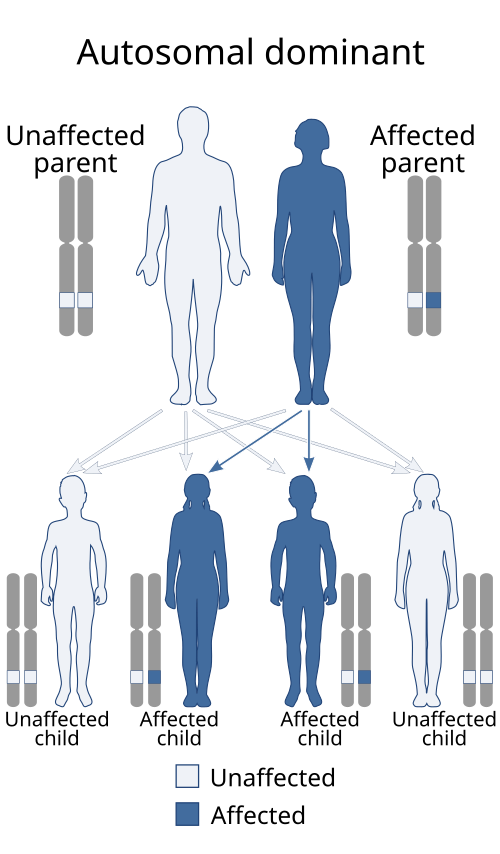
Autosomal dominant pattern, a 50/50 chance
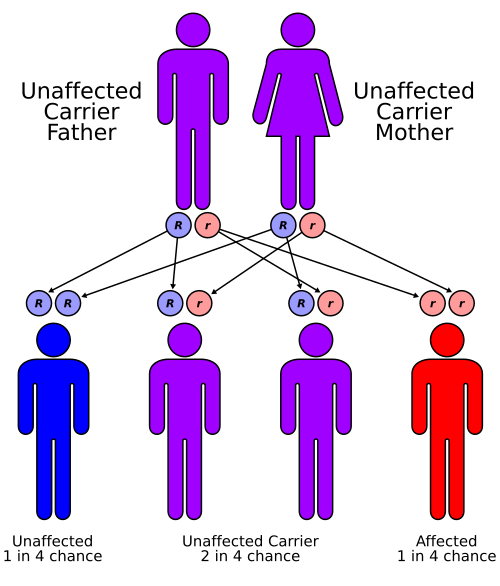
Autosomal recessive inheritance, a 25% chance, and (purple) a 50% carrier chance.
Inheritance of traits for humans are based upon Gregor Mendel's model of inheritance.
rk NOTE: Mendel...is that an abbreviated form of
that German NAZI: Mendele?
Mendel deduced that inheritance depends upon discrete units of inheritance, called factors or genes.[1]
Autosomal dominant inheritance
Autosomal traits are associated with a single gene on an autosome (non-sex chromosome)—they are called "dominant"
because a single copy—inherited from either parent—is enough to cause this trait to appear.
This often means that one of the parents must also have the same trait, unless it has arisen due to an unlikely new mutation.
Examples of autosomal dominant traits and disorders are
Autosomal recessive inheritance
Autosomal recessive traits is one pattern of inheritance for
- a trait,
- disease, or
- disorder
to be passed on through families.
For a recessive trait or disease to be displayed two copies of the trait or disorder needs to be presented.
The trait or gene will be located on a non-sex chromosome.
Because it takes two copies of a trait to display a trait, many people can unknowingly be carriers of a disease.
From an evolutionary perspective, a recessive disease or trait can remain hidden for several generations before displaying the phenotype.
Examples of autosomal recessive disorders are:
X-linked and Y-linked inheritance
X-linked genes are found on the sex X chromosome.
X-linked genes just like autosomal genes have both dominant and recessive types.
Recessive X-linked disorders are rarely seen in females and usually only affect males.
This is because males inherit their X chromosome and all X-linked genes will be inherited from the maternal side.
Fathers only pass on their Y chromosome to their sons, so no X-linked traits will be inherited from father to son.
Men cannot be carriers for recessive X linked traits, as they only have one X chromosome, so any X linked trait
inherited from the mother will show up.
Females express X-linked disorders when they are homozygous for the disorder and become carriers when they are heterozygous.
X-linked dominant inheritance will show the same phenotype as a heterozygote and homozygote.
Just like X-linked inheritance, there will be a lack of male-to-male inheritance, which makes it distinguishable from autosomal traits.
One example of an X-linked trait is
which is caused by a mutation in ribosomal protein gene.
This mutation results in:
- skeletal,
- craniofacial abnormalities,
- intellectual disability, and
- short stature.
X chromosomes in females undergo a process known as X inactivation.
X inactivation is when one of the two X chromosomes in females is almost completely inactivated.
It is important that this process occurs otherwise a woman would produce twice the amount of normal X chromosome proteins.
Empathic Insight: Does that mean that human "meat" is "protein" to the "reptilians"? rk.
The mechanism for X inactivation will occur during the embryonic stage.
rk NOTE: Do doctors give pregnant women SHOTS and call the VITAMINS for pregnant women only?
For people with disorders like trisomy X, where the genotype has three X chromosomes, X-inactivation will inactivate all X chromosomes until there is only one X chromosome active.
Males with Klinefelter syndrome,
who have an extra X chromosome,
will also undergo X inactivation to have only one completely active X chromosome.
rk NOTE: Is this some kind of Project 2030 "PLAN"?
SEE: 426). What is AGENDA 2030?:
https://bra.in/3jb3ak
IN USA has questions MindMap.
Y-linked inheritance occurs when a gene, trait, or disorder is transferred through the Y chromosome.
Since Y chromosomes can only be found in males, Y linked traits are only passed on from father to son.
The testis determining factor, which is located on the Y chromosome, determines the maleness of individuals.
Besides the maleness inherited in the Y-chromosome there are no other found Y-linked characteristics.
Pedigrees analysis
to be continued
Thursday, September 03, 2026 09:52AM
See PDF for complete Wikipedia article downloaded:
Thursday, September 03, 2026 09:49AM
My questions and comments are built into this highlighted post.
SINCERELY, Rosann Kohnke, M.A./M.W. Counseling Psychology Masters Level Therapist; PhiThetaKappa Honor Society since 1994; Standing Dream Weaver of Norkota, MAGA, Whistleblower, MKUltra Survivor, Trump and Putin supporter, EWARANON and DAVID ICKE Supporter,Shamanka, Sovereign, Digital Soldier for the Republic of the United States of America and Human Trafficking Escapee. rk.
updated:
Thursday, September 03, 2026 03:50PM