RAINBOW GOLD PROJECT
SNOWLINE GOLD ANNOUNCES 100% OWNED RAINBOW GOLD PROJECT, CENTRAL YUKON
- Geochemical anomaly suggests the presence of a deep-seated intrusion-related gold system, potentially analogous to Victoria Gold’s Eagle or Kinross’ Fort Knox deposits
- Ground magnetics reveal alteration signature across 3 x 2 kilometre area
- Prospecting grab samples to 7.98 g/t Au, shear zones to 4.1 g/t Au
Vancouver, B.C., April 13, 2021 SNOWLINE GOLD CORP. (CSE: SGD) (the “Company” or “Snowline”) is pleased to provide additional detail on its 100% owned, 125 hectare Rainbow Gold Project, located within the Tintina Gold Belt. The Rainbow project covers a gold and pathfinder element soil anomaly associated with surface alteration caused by a recently discovered intrusion, thought to belong to the mid-Cretaceous Tombstone Plutonic Suite. Other Tombstone-related gold deposits within the Tintina Gold Belt include Fort Knox (11 million ounces Au), and Eagle (4.8 million ounces Au).
“The Rainbow Gold Project is another key element in Snowline’s Yukon-focused asset portfolio. The sampling and geophysics to date indicate we may be on top of a prospective intrusion like the types associated with other large deposits in the Tintina Gold Belt” said Nikolas Matysek, Chief Executive Officer of Snowline. “Historical work has established a clear deposit thesis that we will move to validate this season.”
Snowline is reviewing the complete project portfolio it acquired from a private vendor and is focused on planning and prioritizing its exploration to maximize shareholder value. Specifically, it is examining multiple options for its non-core assets, including targeted exploration and joint venture arrangements.
Project Geology
Grid soil geochemistry completed over the property revealed a 1 km by 300 m zone of high gold values (to 1.27 g/t) accompanied by anomalous bismuth, tellurium and tungsten flanked by zones of anomalous arsenic, antimony and silver (see Figure 1). This geochemical anomaly corresponds to the eroded edge of a 3×2 kilometre magnetic anomaly. Prospecting returned shear-hosted sulphide-bearing outcrop samples grading 4.1 g/t Au and locally-derived angular quartz float samples running 7.98 g/t Au. The magnetic anomaly reveals the potential size of the alteration system, and stream geochemistry anomalies that are 2.5 kilometres from the soil anomaly suggests that mineralizing fluids may have travelled at a similar scale.
A program of drone surveying, geochemical sampling and structural mapping is planned to establish suitable drill targets on the Rainbow property.
Figure 1: Intense, zoned, multi-element soil anomaly associated with eroded exposures of a hornfelsed zone around newly-discovered intrusive rocks at Rainbow. High spatial correlation between gold and bismuth, with anomalous antimony and arsenic peripheral to the gold zone is similar to zoning observed in known reduced intrusion related gold systems such as Kinross Gold’s Ft. Knox deposit in Alaska.
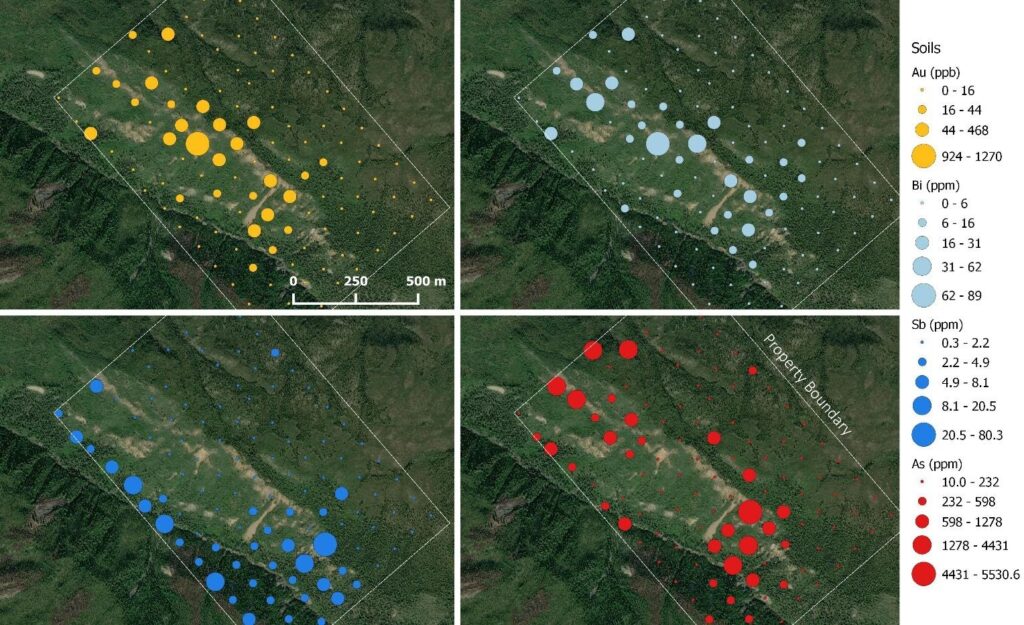 Figure 1: Intense, zoned, multi-element soil anomaly associated with eroded exposures of a hornfelsed zone around newly-discovered intrusive rocks at Rainbow. High spatial correlation between gold and bismuth, with anomalous antimony and arsenic peripheral to the gold zone is similar to zoning observed in known reduced intrusion related gold systems such as Kinross Gold’s Ft. Knox deposit in Alaska.
Qualified Person
The scientific and technical information contained in this news release has been reviewed and approved by Scott Berdahl, P. Geo., Chief Operating Officer of Snowline and a Qualified Person for the purpose of NI 43-101.