CORNUCOPIA
| LOCATION | Elko County, Nevada, near the town of Tuscarora |
|---|---|
| TARGET: | Volcanic hosted, low-sulfidation, epithermal Ag-Au quartz veins |
| COMMODITY: | Gold and Silver |
Project Highlights
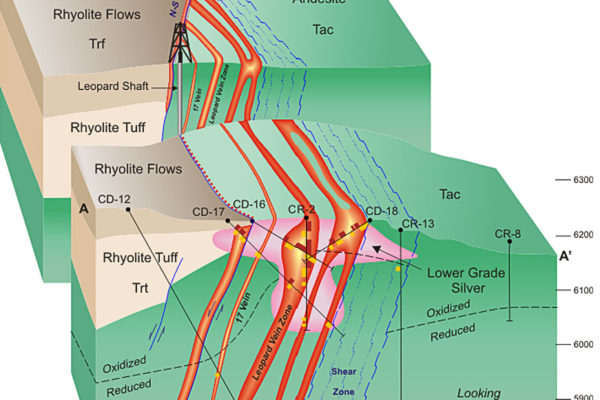
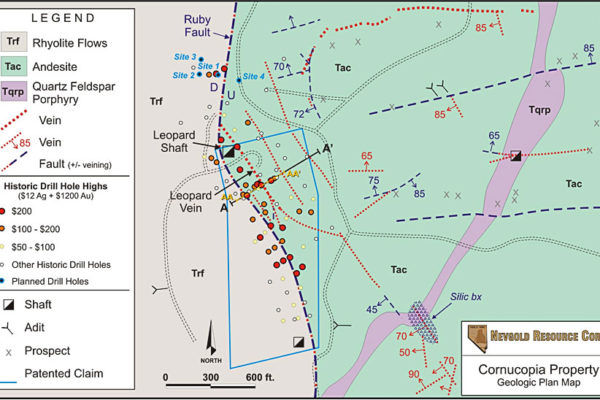
- Silver Predator holds a package of compiled historical exploration data generated by three companies: 1) Homestake Mining Corporation drilled 18 rotary and core holes totaling 4,559 feet in 1979, 2) Western States Mining Company drilled 58 rotary holes totaling 11,800 feet from 1980 to 1981, and 3) Bonanza Silver Corporation drilled 14 reverse circulation holes totaling 9,175 feet in 2000. SPD believes that the historic drill results are reliable and relevant. This historic drill data, combined with mine production records and surface geologic mapping, delineates a northwest trending, 2000 by 500 foot corridor of silver dominant precious metals mineralization parallel to the structural fabric of the Leopard vein system.
- In general, the drill pattern consists of vertical holes at a nominal grid spacing of 70 to 100 feet. The mineralized corridor is best represented by Homestake’s drilling on a fence of three angle core holes (CD-16 to -18) and one vertical rotary hole (CR-2) that returned a series of near-surface silver intercepts as summarized below.
Drill Hole | From (ft) | To (ft) | Length (ft) | True Width (ft)* | Silver oz/ton | Silver g/t |
|---|---|---|---|---|---|---|
| CD-16 | 62 | 131 | 69 | 64.8 | 2.42 | 83.1 |
| CD-17 | 23 | 53 | 30 | 27.2 | 8.23 | 282.0 |
| Including | 23 | 43 | 20 | 18.1 | 11.92 | 408.7 |
| CD-17 | 164.5 | 173 | 8.5 | 7.7 | 1.81 | 62.1 |
| CD-18 | 18 | 91 | 73 | 30.8 | 6.60 | 226.1 |
| Including | 56 | 66 | 70 | 4.2 | 38.00 | 1302.9 |
| CD-2 | 0 | 100 | 100 | 34.2 | 7.31 | 250.5 |
| Including | 45 | 90 | 45 | 15.4 | 13.84 | 474.5 |
*True widths are approximate and based upon interpretation of the mineralizing controls as currently understood.
- Although Cornucopia has been known as a high-grade silver-gold district, there is a significant envelope of lower grade oxide mineralization as outlined by over 2900 feet (11%) of the drilled intervals that assayed greater than 0.5 oz/ton silver (max 71.5 oz/ton Ag). In addition, the property has upside gold exploration potential as given by drill intercepts totaling 900 feet (3.5%) that assayed greater than 0.01 oz/ton gold ( max 0.660 oz/ton Au). Importantly, the silver-gold mineralization is characterized by examples of drill intercepts that start at the surface as listed in the following table (also see CR-2, 0-100 feet in preceding table).
Drill Hole | From (ft) | To (ft) | Length (ft) | True Width (ft)* | Silver oz/ton | Silver g/t |
|---|---|---|---|---|---|---|
| CD-4 | 0 | 165 | 165 | 56.4 | 1.77 | 60.8 |
| Including | 120 | 145 | 25 | 8.6 | 4.78 | 163.7 |
| CD-6 | 0 | 30 | 30 | 10.3 | 1.82 | 62.3 |
| L4S-OE | 0 | 195 | 195 | 66.7 | 1.32 | 45.1 |
| L5S-OE | 0 | 90 | 90 | 30.8 | 0.99 | 34.0 |
| L6S-OE | 0 | 70 | 70 | 23.9 | 1.17 | 40.2 |
*True widths are approximate and based upon interpretation of the mineralizing controls as currently understood.
- Homestake and Western States focused their efforts on near-surface mineralization in the area of historic underground mining activity, whereas Bonanza Silver’s drilling was primarily peripheral to the zones of known mineralization. As a result, the property has not undergone significant exploration in the primary resource target area in nearly 30 years and no concerted effort has ever been made to explore hi-grade underground targets at depth or under Miocene cover to the northwest. This presents SPD with an exceptional exploration opportunity in a mining district known for its documented history of high-grade silver and gold.
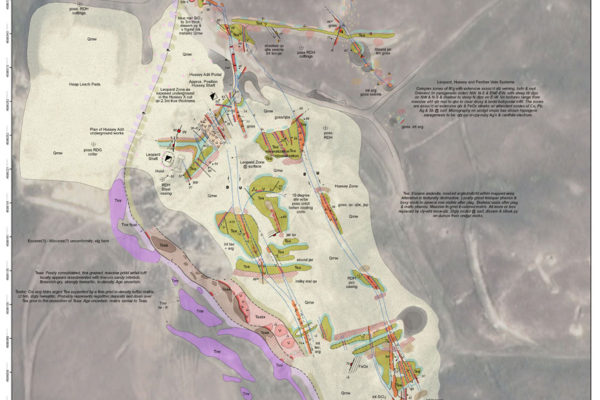
- In November 2011, Thomas H. Chadwick (CPG) completed an updated, detailed geologic map of the heart of the Cornucopia District at 1:1200 scale.
Overview
Silver Predator’s Cornucopia claims lie within the historic Cornucopia silver (gold) mining district located in Elko County, Nevada. The consolidated land position consists of one patented and 28 unpatented lode claims oriented north-northwest along the Leopard vein system. These claims cover the areas of previous mining activity and historic, non-NI 43-101 compliant silver resources, as well as the remainder of the Cornucopia mining district.
Mineral Resources
There are no current Ni 43-101 compliant resources or reserves on the Cornucopia Property.
Geology and Mineralization
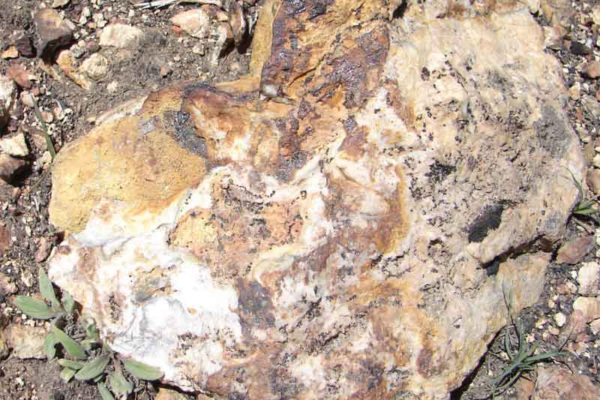
The mineralization in the Cornucopia District is hosted by Tertiary volcanic rocks and is considered to be of the low-sulfidation epithermal type, similar to the Midas mine (Newmont) and the Ivanhoe property (currently under development by Great Basin Gold) located 32 miles to the southwest. Silver (gold) mineralization occurs with quartz veining, silicification and argillic alteration. High-grade silver quartz veins of the Leopard mine display crustiform to colliform banding, and multiple periods of vein and wall rock brecciation. Silver and gold occur with pyrite, acanthite, ruby silver, tetrahedrite, stephanite and electrum.
Historical Exploration
The high-grade silver-gold veins were first discovered in the Cornucopia district in 1873. The Leopard vein was by far the most productive in the district and exhibited grades as high as 400 oz/ton silver and 1 oz/ton gold. Buchanan (1981) reported historical production of 762,000 ounces of silver and 13,400 ounces of gold from 31,000 tons of ore, yielding approximate average grades of 24.6 oz/ton silver and 0.43 oz/ton gold. From 1937 to 1940, approximately 10,000 tons of mine tailings were reworked (Smith, 1976).
Current Work
Silver Predator is currently compiling all historical data and the property is available for lease or option to purchase.
MAPS