TULLY PROPERTY
The Tully property is located in the north-central portion of the Timmins district. The property includes a 2.7 kilometre segment of the structural zone that separates mafic-ultramafic volcanic rocks of the Kidd-Munro assemblage (2.72–2.71 Ga) on the north from sedimentary rocks of the Porcupine assemblage (2.69 Ga) on the south. This structural zone is interpreted as a major early thrust, referred to as the Pipestone Fault, which splays off the Porcupine-Destor Fault and is thus highly prospective for gold mineralization.
The Tully property is underlain by a 500–1,500 metres thick panel of mafic–ultramafic rocks, likely representing basalt–komatiite flows of the Kidd-Munro assemblage, bounded on both sides by greywacke-mudstone turbidites, likely belonging to the Porcupine assemblage. The contacts of this panel are interpreted to represent thrust faults, along which these assemblages were imbricated during the early structural evolution of the Abitibi greenstone belt. Bedrock on the property is completely covered by a thick blanket of glacial drift; thus, the geology is entirely derived from drillhole and geophysical data.
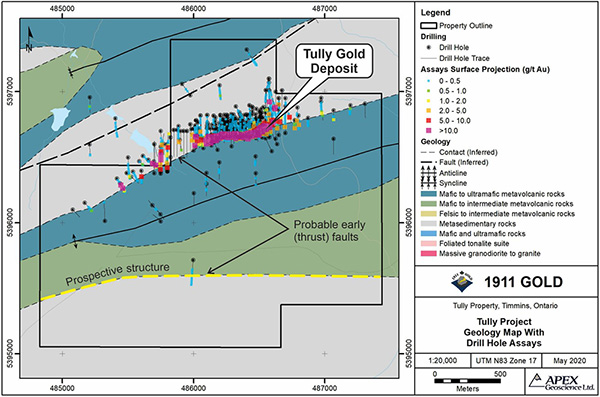
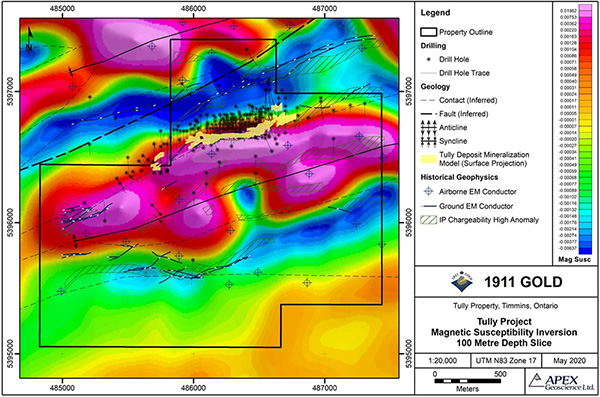
The north central portion of the Tully property includes the Tully (Timmins North) gold deposit, hosted by a layered schistose mafic unit – typically logged as ‘mafic tuff’ – along the north contact of the ultramafic panel. This host unit ranges up to 60 metres in thickness (typically 30 metres) and has been traced by drilling for over 1,600 metres along strike and up to 700 metres down-dip. It has a general strike of az. 250 and dips steeply north.
The Tully deposit consists of an array of shallowly inclined quartz-carbonate veins stacked ‘ladder-style’ within the mafic host unit and constrained by its hangingwall and footwall contacts. The higher-grade core of the deposit extends over 600 metres along strike and 400 metres down dip, and plunges moderately toward the east-northeast.
The drillhole database for the property contains 391 drillholes. More than 300 drillholes were completed in several drilling campaigns between 1969 and 2014 to delineate the Tully deposit, including 219 drillholes (totaling 66,468 metres) completed by SGX Resources Inc. between 2010 and 2014. The most recent published resource estimate for the deposit was produced in 2010, thus predating the SGX drilling. The prospective southern portion and contact of the mafic–ultramafic panel has been tested only at reconnaissance scale.
The Company has identified and secured relevant materials from the SGX drilling, including drillcore, coarse rejects, pulps, drill logs and assay sheets, to facilitate data verification and future mineral resource estimates.