BOUSQUET PROPERTY
The Bousquet Property is located on the historical Cadillac Break in the Abitibi Region of the Province of Québec, about 30 kilometers east of Rouyn-Noranda.. The Property consists of 97 claims covering 2,675 ha.
Download the Bousquet Project Presentation (PDF)
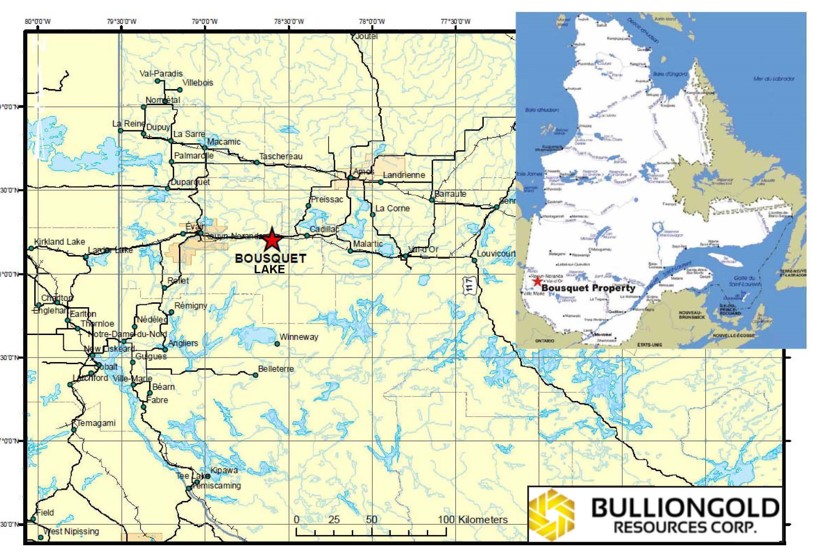
- 97 claims, 2,675 ha located at the heart of the globally recognized Abitibi mining camp (more than 30 mines)
- 100M oz. historical gold production on the Cadillac-Larder Lake Fault
- 7 KM along the Cadillac-Larder Lake Fault
- 7 known gold showings
- 4 km gold bearing corridor with multiple gold showings
- Favorable geology with presence of folds and faults
- Multiple magnetic targets
- Infrastructure and power grid nearby
- Multiple gold mills nearby
- Year long access through provincial road
Geology
The Bousquet Property is underlain by meta-sedimentary rocks of the Cadillac, Timiskaming and Pontiac Groups and from volcanic flows and intrusives of the Piche Group. The Cadillac-Larder Lake Break crosses the property for 7 km in the northern part of the Normar Block.

Prolific Gold Mining Camp
There are several gold mines found along or adjacent to the Cadillac-Larder Lake Break that cuts across the Bousquet Lake Property. Between 1926 and 2020, in excess of twenty (20) mines have produced over 25 million ounces of gold along the Cadillac Break within the Bousquet-Cadillac district. The Cadillac mining camp is characterized by three types of mineralization related to distinct gold-bearing geological settings: gold-bearing massive sulphide lenses (Bousquet 2 and La Ronde mines), gold-rich polymetallic veins (Doyon and Mouska mines) and auriferous veins associated with regional E-W trending faults (Lapa deposit).
 Over 100M OZ. Au produced since the last 100 years on the Cadillac-Larder Lake Fault
Gold Mineralization
A strong gold mineralized system was discovered in the southern portion of the Bousquet Lake Property. Three gold showings, Decoeur, Paquin East and Paquin West and Calder-Bousquet, were discovered in the early exploration work (1932-1945) on the property. These showings have probably been formed in the same mineralizing episode within regional E-W trending faults. On the Decoeur showing, grades of 8.40 g/t Au over 1.77 m, 4.35 g/t Au over 4.83 and 4.04 g/t Au over 1.52 m were intersected in historical drill holes. On the Paquin showings, 3.73 g/t Au over 5.49 m, 5.91 g/t Au over 3.02 m and 6.84 and 6.53 g/t Au over 2.44 m were intersected in historical drilling. An intercept of 8.09 g/t Au over 2.0 m was also intersected on the Calder-Bousquet gold occurrence.
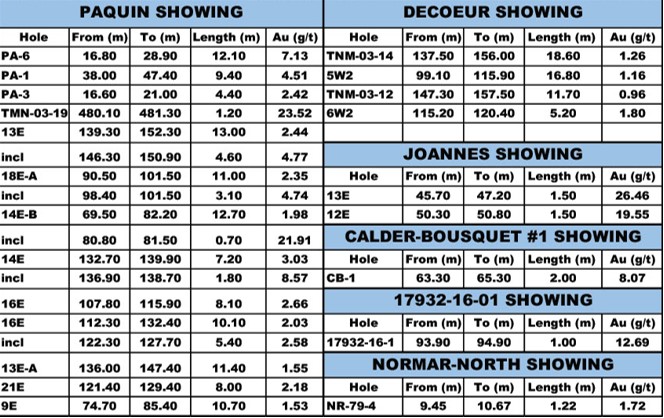
The gold mineralization is located in a fold zone above the 250m level. Strong possibilities exist that other folds from the same deformation exist laterally or at depth. The Blackfly group of claims has been little explored in the past due to the paucity of outcrops but the use of new geophysical methods can generate good and valid targets from the deposit models of this high quality location within one of the most prolific world class gold belt.
Gold mineralization was also found in a 2003 drill program in the felsic intrusion (called tonalite) within the Cadillac fault zone. The intrusive is found between two talc-chlorite schist units of the Piche Group. Hole TMN-03-31 intersected 4.75 g/t Au over 1.5 m in quartz veins, veinlets, and zones of silicification and hole TMN-03-08 intersected 1.42 g/t Au over 1.5 m and 0.71 g/t Au over 5.7 m gold also in the tonalite.

2021 Exploration Campaign
The company is planning an extensive exploration campaign for 2021 :
- Geological mapping and sampling
- Drilling campaign at depth around historical showings
- Drilling campaign on new targets along the Cadillac Fault (6.8 km)
For more information about the Bousquet Project, contact us.