HOOK LAKE PROJECT
Previously 'North Falcon'
[ ](https://skyharbourltd.com/_resources/projects/Falcon-Point-Project.jpg)
Project Summary:
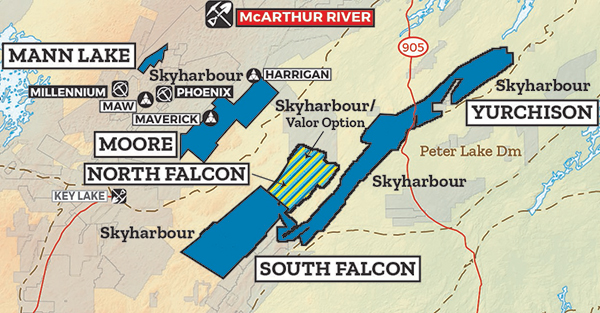
Uranium mineralization discovered to date at the Hook Lake (previously North Falcon Point) project is shallow and is hosted in two geological settings characterized by structurally controlled uranium mineralization which include the Hook Lake, West Way and Nob Hill zones. Recently, the Company announced a Definitive Agreement with ASX listed Valor Resources which provides Valor an earn-in option to acquire an 80% working interest in the Hook Lake Uranium Project. This definitive agreement with Valor at Hook Lake effectively utilizes our prospect generator model to advance the Company’s other projects with partner companies.
The project area is in close proximity to two all-weather northern highways and grid power. Historical exploration has consisted of airborne and ground geophysics, multi-phased diamond drill campaigns, detailed geochemical sampling and surveys, and ground-based prospecting culminating in an extensive geological database for the project area. Compilation and reinterpretation of previous exploration work results is already underway. It is anticipated that the initial phase of exploration work by Valor will include further bio-geochemical surveys, detailed UAV magnetics, ground gravity and resistivity surveys as well as detailed geological and structural mapping. Based on this work drill targets will be selected.
Highlights:
- 16 contiguous mineral claims – totalling 25,847 hectares
- Years of exploration have culminated in extensive geological database for the project area
- Hook Lake target area at north end of the Hook Lake property recently yielded high grade uranium grab samples of up to 68% U3O8 in massive pitchblende vein at surface
- Previous operators unable to definitively explain and locate
the source
- Recently announced (December 9, 2020) Definitive Agreement signed with Valor Resources to earn-in 80% of the project
- Valor will contribute cash and exploration expenditures consideration totaling CAD $3,975,000 over a three-year period ($475,000 will be in cash payments to Skyharbour as well as $3,500,000 in exploration expenditures)
- Valor has issued a total of 233,333,333 shares to Skyharbour
Hook Lake Target Area:
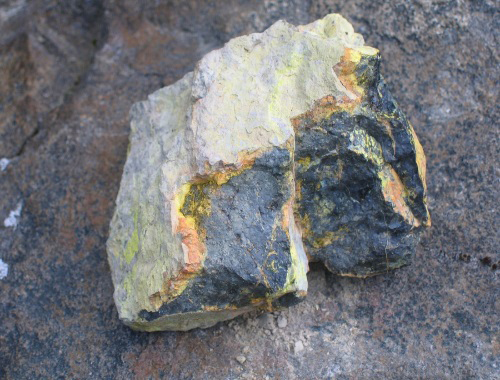
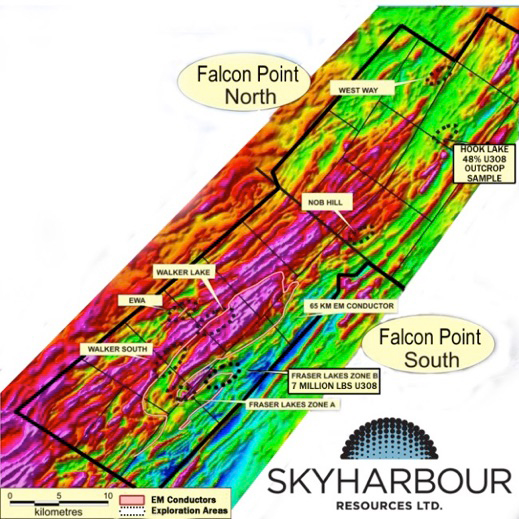
The Hook Lake area is located near the northern end of the property approximately 35 kilometres northeast of Skyharbour’s JNR Fraser Lakes Zone B deposit. In October 2015, on the northern side of the property at the Hook Lake target, Skyharbour reported that it had confirmed the presence of high grade uranium mineralization with up to 68.0% U3O8 in a grab sample from a trench. The trench is referred to as the Hook Lake U-Mo showing and was the focus of the Company’s Summer 2015 field program which consisted of detailed prospecting and vegetation sampling. Skyharbour randomly selected three grab samples from the Hook Lake showing to verify historic results and these grab samples returned 68.0% U3O8, 35.7% U3O8 and 29.8% U3O8. Previous operators were unable to definitively explain and locate the source of the high grade outcropping uranium mineralization. Furthermore, the bio-geochemical survey carried out over the trenches in 2015 responded positively with along-strike anomalies 2 km to the northeast.
[ ](https://skyharbourltd.com/_resources/projects/hook-lake-mineral.jpg)
In 2006, while carrying out work on the Falcon Point Project, previous operator JNR Resources rediscovered the mineralized trench which they referred to as the Hook Lake U-Mo showing. The mineralization occupies a 1.0 metre wide by 10.0 metre long diagonal jog within a south-southwest trending ductile-brittle shear zone that cuts felsic to mafic intrusive host rocks. This showing consists of a 0.5 to 1.0 metre wide pitchblende vein exposed over a short strike length. Two grab samples taken by JNR returned 48.0% U3O8 and 40.1% U3O8, while a soil sample taken over the vein returned 27.8% U3O8. The uranium mineralization is associated with up to 8.8% Pb, enriched rare earth element (REE) values, and anomalous Bo, Co and V values. A narrow radioactive shear located 5 metres south of the pitchblende vein also returned 460 ppm U as well as elevated Pb and REE values. The mineralization has similarities to the Eagle Point uranium deposit being structurally-controlled, vein-type, high grade, and likely part of the feeder system to more typical high grade, unconformity uranium deposits.
Other High-Priority Target Areas:
- Nob Hill - Fracture-controlled vein-type uranium mineralisation on surface outcrop with up to 0.130% - 0.141% U3O8 in grab samples; diamond drilling intersected anomalous uranium in several drill holes with values up to 422 ppm U over 0.5 m
- West Way - Vein type U mineralisation within a NE-trending shear zone; grab samples taken from the surface showing contained variable uranium values including up to 0.475% U3O8 and drilling of the structure intersected the altered shear zone at depth, along with anomalous Cu, Ni, Co, As, V, U, & Pb
- Grid T - Fracture-hosted secondary uranium mineralisation in sheared calc-silicates and marbles in a 100 m x 20 m zone of anomalous radioactivity with grab samples having up to 800 ppm U
- Alexander Lake Boulder Field - 30 biotite-quartz-k-feldspar pegmatite boulders NE of Alexander Lake; the best results include 360 ppm U, 1,400 ppm U and 1,600 ppm U respectively
- Thompson Lake Boulder Field - Numerous radioactive boulders and blocks of pegmatized meta-arkose, pegmatite, and granite; the best value obtained was 738 ppm U from a granite boulder
- NE Alexander Lake – Several calc-silicate, plagioclase-quartz granulite, quartzite, and meta-arkose boulders with up to 4,800 ppm U, 7,600 ppm Mo and 1,220 ppm Ni
[ ](https://skyharbourltd.com/_resources/projects/falcon-point-exploration-map.jpg)
Potential Future Work Programs:
A focused exploration program is recommended for the Falcon Point property. The primary objectives are to discover the source of the high grade mineralization at the Hook Lake target. In addition, further interpretation of geochemical and assay data in conjunction with geological and structural analysis will improve the effectiveness of targeting for future drill programs.