RIVER VALLEY PALLADIUMPROJECT
100% owned by New Age Metals
Located 100km NE of Sudbury, Ontario
2.9 MOz PdEq M&I, 1.1 MOz PdEq Inferred
Preliminary Economic Assessment study completed
RIVER VALLEY PROJECT PRESENTATION
PATH TO PRE-FEASIBILITY
SEE PRESENTATION

LOCATION & ACCESS
The River Valley Palladium Project is located approximately 100 km northeast of the City of Sudbury, in northern Ontario. The Project is road accessible and boasts strong established infrastructure and local community support. NI 43-101 compliant Mineral Resource Estimates and a Preliminary Economic Assessment study have been completed for the Project.
PROPERTY & OWNERSHIP
The River Valley Palladium project was acquired in 1998 by NAM (formally Pacific North West Capital, now New Age Metals). NAM discovered significant PGM occurrences on the Property and entered into a joint venture agreement with Anglo Platinum in 1999. NAM was the operator of the joint venture until 2010 as Anglo Platinum earned-in for 50% ownership, and continues to be the operator today.
In January 2011, NAM successfully acquired Anglo Platinum Limited’s 50% of the Project, to achieve 100% ownership. In 2016, NAM’s management negotiated the purchase of 100% of the River Valley Extension from Mustang Minerals. This acquisition increased the size of NAM’s land position to 15,800 acres and its portion of the River Valley Deposit from 12 km to 16 km in strike length.
The Project is currently covered by two Mining Leases. The Mining Leases cover an approximate area of 12,000 acres and include surface and mining rights. A buffer zone of approximately >5000 acres has been added to the existing River Valley Project.
The River Valley PGM Project is 100% owned
BY NEW AGE METALS
REGIONAL GEOLOGY
The River Valley Intrusion is the largest and easternmost body of the Paleoproterozoic age East Bull Lake Intrusive Suite. The East Bull Lake and Agnew Lake Intrusions are smaller and located to the west of Sudbury. Collectively, these intrusions are eroded remnants of layered sill complexes that formed from tholeiitic, plagioclase-rich magmas emplaced during a Paleoproterozoic rifting event in the Archean crust.

PROPERTY GEOLOGY
The River Valley Intrusion (RVI) is shallow-dipping and layered body that appears to be approximately 900 m thick. The dominant rock types are brecciated and massive leuco-gabbronorite and leucogabbro with gabbro and anorthosite. There is an increase in metamorphic grade from the northwest part of the intrusion (greenschist facies) to the southeast part (amphibolite facies). The RVI intrudes Archean age paragneiss and orthogneiss of the Grenville Province and, along the Grenville Front, is in thrust contact with quartzite of the Huronian Mississagi Formation.

MINERAL RESOURCE
The River Valley Intrusion (RVI) is shallow-dipping and layered body that appears to be approximately 900 m thick. The dominant rock types are brecciated and massive leuco-gabbronorite and leucogabbro with gabbro and anorthosite. There is an increase in metamorphic grade from the northwest part of the intrusion (greenschist facies) to the southeast part (amphibolite facies). The RVI intrudes Archean age paragneiss and orthogneiss of the Grenville Province and, along the Grenville Front, is in thrust contact with quartzite of the Huronian Mississagi Formation.

CLICK FOR RESULTS FROM THE AMENDED NI 43-101 MINERAL RESOURCE 2019 ESTIMATE
| Class | Tonnes ‘,000 | Pd (g/t) | Pt (g/t) | Rh (g/t) | Au (g/t) | Cu (%) | Ni (%) | Co (%) | PdEq (g/t) |
|---|---|---|---|---|---|---|---|---|---|
| Measured | 56,096.7 | 0.54 | 0.20 | 0.013 | 0.03 | 0.06 | 0.02 | 0.006 | 0.94 |
| Indicated | 43,158.5 | 0.49 | 0.19 | 0.003 | 0.03 | 0.05 | 0.02 | 0.006 | 0.84 |
| Measured + Indicated | 99,255.2 | 0.52 | 0.20 | 0.009 | 0.03 | 0.06 | 0.02 | 0.006 | 0.90 |
| Inferred | 52,306.0 | 0.31 | 0.31 | 0.012 | 0.04 | 0.04 | 0.02 | 0.001 | 0.63 |
| Class | PGM + Au (oz) | PdEq (oz) | PtEq (oz) |
|---|---|---|---|
| Measured | 1,394,000 | 1,701,000 | 1,701,000 |
| Indicated | 983,000 | 1,166,000 | 1,166,000 |
| Measured + Indicated | 2,377,000 | 2,867,000 | 2,867,000 |
| Inferred | 841,000 | 1,059,000 | 1,059,000 |
Notes:
- CIM definition standards were followed for the Mineral Resource Estimate.
- The 2018 Mineral Resource models used Ordinary Kriging grade estimation within a three-dimensional block model with mineralized zones defined by wireframed solids.
- A base cut-off grade of 0.35 g/t PdEq was used for reporting Mineral Resources in a constrained pit and 2.00 g/t PdEq was used for reporting the Mineral Resources under the pit.
- Palladium Equivalent (PdEq) calculated using (US$): $950/oz Pd, $950/oz Pt, $1,275/oz Au, $1500/oz Rh, $2.75/lb Cu, $5.25/lb Ni, $36/lb Co.
- Numbers may not add exactly due to rounding.
- Mineral Resources that are not Mineral Reserves do not have economic viability.
- The Inferred Mineral Resource in this estimate has a lower level of confidence than that applied to an Indicated Mineral Resource and must not be converted to a Mineral Reserve. It is reasonably expected that the majority of the Inferred Mineral Resource could be upgraded to an Indicated Mineral Resource with continued exploration.
PRELIMINARY ECONOMIC ASSESSMENT
The first Preliminary Economic Assessment (PEA) of the River Valley Palladium Project was completed in August 2019 by P&E Mining Consultants, DRA Americas Inc., and WSP Canada Inc. and the Technical Report is available on SEDAR. The study returned a positive result for an open pit mining scenario based on a two-year trailing average metal price of $US1,200/oz Pd. At that price, palladium accounts for approximately 65% of the payable metal.
CLICK FOR THE SUMMARY OF THE OUTPUTS FROM THE 2019 PEA
Production
| Throughput (tpd) | 20,000 |
|---|---|
| Average PdEq Output/Year (oz/yr) | 119,000 |
| Palladium Equivalent Grade (g/t) | 0.88 |
| Strip Ratio | 3.6:1 |
| Mine Life (yrs) | 14 |
Valuation (Base Case @ US$1200 Pd)
| Pre-Tax NPV (5%) | 261 |
|---|---|
| Pre-Tax IRR | 13 |
| After-Tax NPV (5%) | 138 |
| After-Tax IRR | 10 |
Valuation (+20% Pd Price Sensitivity)
| After-Tax NPV (5%) | 300 |
|---|---|
| After-Tax IRR | 15 |
CAPEX and OPEX
Initial Capital Costs (US$ Millions)
| Mining Pre-stripping | 17.3 |
|---|---|
| Process Plant | 401.3 |
| Site Infrastructure | 20 |
| Tailings Storage Facility | 8 |
| Owner Costs | 5 |
| Contingency | 43.4 |
| Total Initial Capital | 495 |
LOM Operating Cost (US$ per Tonne)
| Mining Cost per Tonne Mined Material | 2.28 |
|---|---|
| Mining Cost per Tonne Plant Feed | 10.17 |
| Processing Coat per tonne plant feed | 8.44 |
| G&A per Tonne Plant Feed | 0.86 |
| Total Cost per Tonne Plant Feed | 495 |
Cost
| Preproduction Capital (US$ M) | 495 |
|---|---|
| LOM Average Cash Cost (US$/oz) | 709 |
| LOM Average AISC (US$)/oz | 709 |
EXPLORATION & DEVELOPMENT PROGRAM
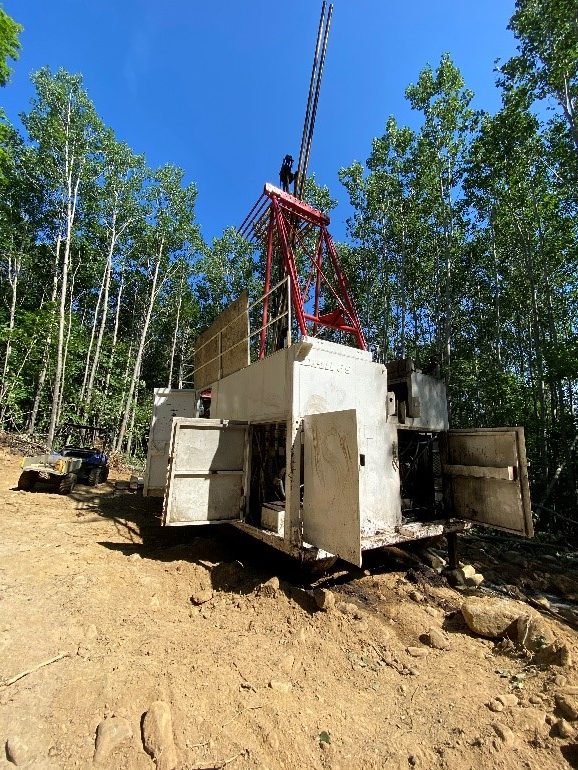
The PEA outlined a phased work program approach to advance River Valley to a Pre-Feasibility level project. This work program includes: 1) continued exploration drilling, particularly for mineralization in the intrusion footwall; 2) advanced metallurgical testing to improve process recoveries and more accurately estimate concentrate grades; 3) geotechnical logging of drill core to create a 3D geomechanical block model and estimate open pit wall angles; and 4) hydrogeological studies to generate a water management plan for the site. The Pre-Feasibility study could support the first Mineral Reserve Estimate for the River Valley Palladium Project.
In 2020, NAM systematically completed a phased exploration and project development program based on the PEA recommendations. The program included further exploration drilling and environmental and archaeological studies focused in the northern area of River Valley.
Plans for future exploration programs, subject to financing, include; drilling near the potential open pit mines to increase mine life and decrease strip ratio; drilling deep to test for presence of mineralization below the current depth of drilling (average 220 metres); re-assaying available drill core for the other platinum metals, particularly rhodium (the most valuable of the platinum metals); and expansion of the geophysical program to cover the entire 16 km long strike-length of the River Valley Palladium deposit and ultimately the entire River Valley Intrusion, which appears to be underlain by a gigantic high-positive gravity anomaly.
Technical information provided on this report has been reviewed and approved for technical content by Bill Stone, Consulting Geologist of New Age Metals, a Qualified Person under the provisions of National Instrument 43‐101