e to the pi i, a nontraditional take (old version)
3.12M subscribers
SUBSCRIBED
Wait! There's an improved version: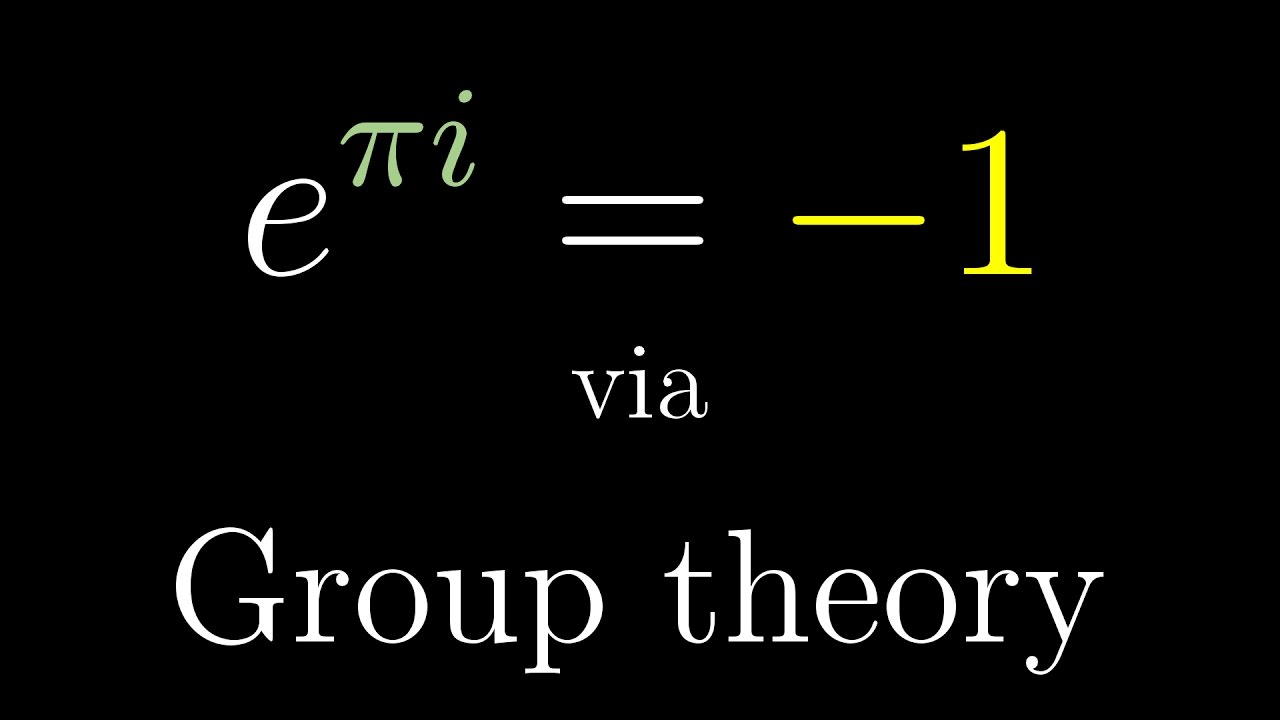 Also, for the calculus-savvy, you'll prefer this one:
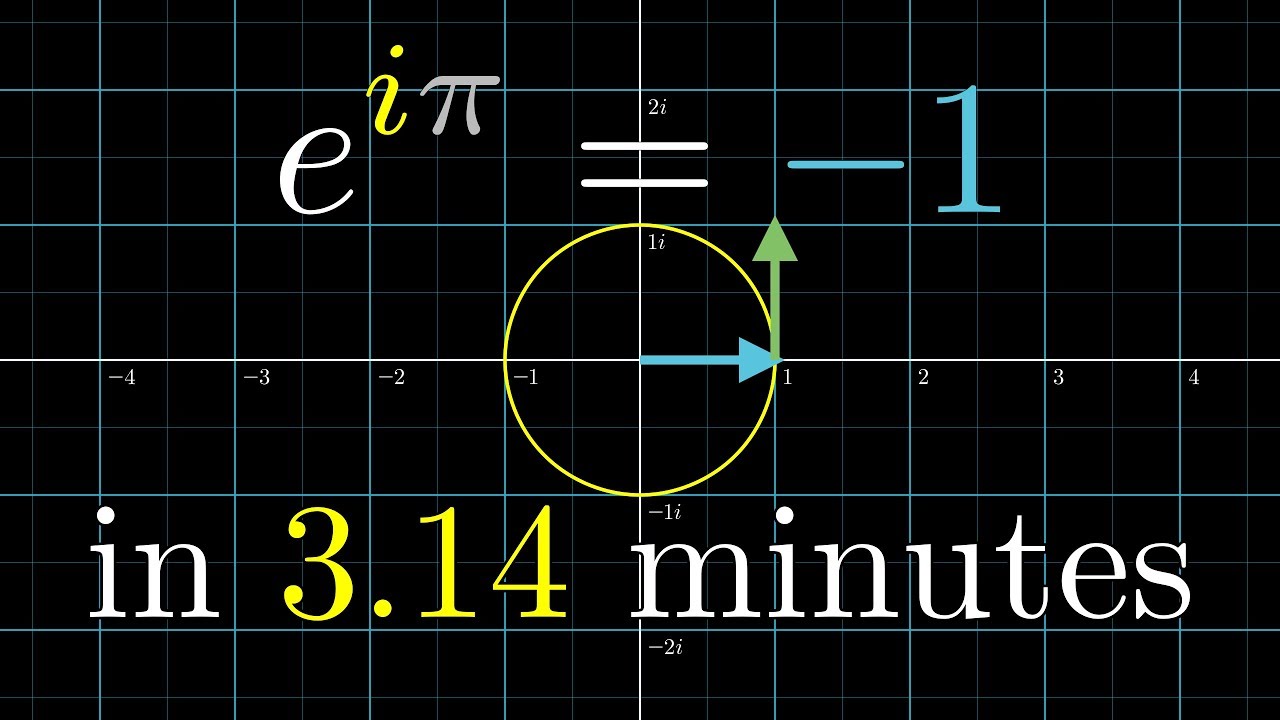 Home page: https://www.3blue1brown.com/The enigmatic equation e{pi i} = -1 is usually explained using Taylor's formula during a calculus class. This video offers a different perspective, which involves thinking about numbers as actions, and about ex as something which turns one action into another. For more information on viewing exponential functions in this new light, check out this article: http://goo.gl/LPyc4RMusic: "Wyoming 307" by Time For Three, http://www.tf3.com/
Caption author (Polish)
Caption author (Chinese (Taiwan))
Caption author (Korean)
Caption author (Russian)
Caption author (Ukrainian)
Caption author (Greek)
Caption author (German)
Caption author (Hebrew)
Caption author (Italian)
Caption authors (French)
SHOW LESS
00:08
e to the pi i equals negative 1
00:10
is one of the most famous equations in math, but it's also one of the most
00:13
confusing.
00:14
Those watching this video likely fall into one of three categories
00:17
1) you know what each term means, but the statement as a whole seems nonsensical,
00:21
2) you were lucky enough to see what this means and some long formulae explaining why it
00:25
works in a calculus class,
00:27
but it still feels like black magic, or 3) it's not entirely clear with the
00:31
terms themselves are.
00:33
Those in this last category might be in the best position to understand the explanation
00:37
I'm about to give
00:37
since it doesn't require any calculus or advanced math, but will instead require an
00:41
open-minded to reframing how we think about numbers.
00:44
Once we do this, it will become clear what the question means,
00:48
why it's true and most importantly why it makes intuitive sense.
00:51
First let's get one thing straight,
00:54
what we we write as e to the x is not repeated multiplication
00:58
that would only make sense when x is a number that we can count 1, 2, 3 and so on,
01:02
and even then you'd have to define the number the number e first. To understand what this
01:06
function actually does,
01:07
we first need to learn how to think about numbers as actions.
01:11
We are first taught to think about numbers as counting things, and addition and
01:14
multiplication are thought of with respect counting.
01:21
However is more thinking becomes tricky when we talk about fractional amounts,
01:25
very tricky when we talk about irrational amounts, and downright nonsensical
01:28
when we introduce things like the square root of -1.
01:31
Instead we should think of each number as simultaneously being three things
01:35
a point on an infinitely extending line, an action which slides that line along itself,
01:40
in which case we call it an "adder", and an action which stretches the line
01:44
in which case we call it a "multiplier". When you think about numbers as adders,
01:48
you could imagine adding it with all numbers as points on the line
01:52
all at once. But instead, forget that you already know anything about addition
01:55
so that we can reframe how you think about it.
01:57
Thing of adders purely as sliding the line with the following rule:
02:00
You slide until the point corresponding to zero ends up where the point corresponding
02:04
with the adder itself started
02:06
When you successively applied two adders, the effect will be the same as just applying some other adder.
02:10
This is how we define their sum. Likewise,
02:13
forget the you already know anything about multiplication, and think of a
02:16
multiplier purely as a way to stretch the line.
02:19
Now the rule is to fix zero in place, and bring the point corresponding with
02:24
one, to where the point corresponding with the multiplier itself started off,
02:28
keeping everything evenly spaced as you do so. Just as with adders
02:31
we can now redefine multiplication as the successive application
02:34
of two different actions. The life's ambition of e to the x
02:38
is to transform adders into multipliers, and to do so is naturally as possible.
02:43
For instance, if you take two adders, successfully apply them,
02:46
then pump the resulting sum through the function, it is the same as first putting
02:49
each adder through the function separately,
02:51
then successively applying the two multipliers you get. More succinctly,
02:55
e to the x plus y equals e to the x time e to the y.
02:58
If e to the x was thought it as repeated multiplication, this property
03:02
would be a consequence.
03:03
but really it goes the other way around. You should think this property is defining
03:07
e to the x, and the fact that the special case and counting numbers has
03:10
anything to do with repeated multiplication
03:12
is a consequence the property.
03:16
Multiple functions satisfy this property,
03:17
but when you try to define one explicitly, one stands out as being the most natural,
03:22
and we express it with this infinite sum. By the way,
03:26
the number e is just to find to be the value of this function at one.
03:29
The numbers is not nearly as special as the function as a whole, and the convention to
03:33
write this function as e to the x
03:35
is a vestige of its relationship with repeated multiplication.
03:38
The other less natural function satisfying this property
03:41
are the exponentials with different bases. Now the expression "e to the pi i"
03:45
at least seems to have some meaning,
03:47
but you shouldn't think about this infinite sum when trying to make sense of it.
03:50
You only need to think about turning adders into multipliers. You see,
03:56
we can also play this game a sliding and stretching in the 2d plane,
04:00
and this is what complex numbers are. Each numbers simultaneously a point on
04:04
the plane
04:05
an adder, which slides the plane so that the point for 0
04:08
lands on the point for the number, and multiplayer which fixes zero in place
04:12
and brings the point for one to the point for the number while keeping
04:16
everything evenly spaced.
04:17
This can now include rotating along with some stretching and shrinking.
04:21
All the actions of the real numbers still apply, sliding side to side and stretching,
04:25
but now we have a whole host of new actions.
04:30
For instance, take this point here. We call it "i". As an adder,
04:34
it slides the plane up, and as a multiplier, it turns it a quarter of the way around
04:39
Since multiplying it by itself gives -1, which is to say
04:43
applying this action twice is the same as the action of -1
04:46
as a multiplier,
04:49
it is the square root of -1. All adding is some combination of sliding sideways
04:54
and sliding up or down, and all multiplication is some combination of
04:58
stretching and rotating.
05:01
Since we already know that e to the x turns slide side to side into stretches,
05:04
the most natural thing you might expect his for to turn this new dimension of adders,
05:08
slides up and down, directly into the new dimension of multipliers,
05:12
rotations. In terms points on the plane, this would mean e to the x takes
05:16
points on this vertical line
05:18
which correspond to adders that slide the plane up and down, and puts them on the
05:21
circle with radius one
05:23
which corresponds with the multipliers that rotate the plane. The most natural way
05:27
you could imagine doing this
05:28
is to wrap the line around the circle without stretching your squishing it
05:32
which would mean it takes a length of two pi to go completely around the circle,
05:35
since by definition this is the ratio the circumference of a circle to its radius.
05:40
This means going up pi would translate to going exactly half way around the circle.
05:45
When in doubt, if there's a natural way to do things,
05:48
this is exactly what e to the x will do, and this case is no exception.
05:51
If you want to see a full justification for why e to the x behaves this way,
05:55
see this additional video here. So there you have it,
06:00
this function e to the x take the adder pi i to the multiplayer -1.
English