Gadsden flag
The Gadsden flag is a historical American flag with a yellow field depicting a timber rattlesnake[1][2] coiled and ready to strike. Beneath the rattlesnake are the words "Dont Tread on Me" [sic].[a] Some modern versions of the flag include an apostrophe in the word "don't". Originating in the American Revolution, the flag has in modern days become a symbol of American right-libertarianism, and later the Tea Party movement.
The flag is named after Christopher Gadsden, a South Carolinian delegate to the Continental Congress, and brigadier general in the Continental Army,[4][5][6] who designed the flag in 1775 during the American Revolution.[7] He gave the flag to Commodore Esek Hopkins, and it was unfurled on the main mast of Hopkins' flagship USS *Alfred* on December 20, 1775.[5][8] Two days later, Congress made Hopkins commander-in-chief of the Continental Navy.[9] He adopted the Gadsden banner as his personal flag, flying it from the mainmast of the flagship while he was aboard.[5] The Continental Marines also flew the flag during the early part of the war.[7]
The rattlesnake was a symbol of the unity of the Thirteen Colonies at the start of the Revolutionary War, and it had a long history as a political symbol in America. Benjamin Franklin used it for his Join, or Die woodcut in 1754.[5][10] Gadsden intended his flag to serve as a physical symbol of the American Revolution's ideals.[5]
The flag has been described as the "most popular symbol of the American Revolution".[5] Its design proclaims an assertive warning of vigilance and unity of purpose in the common defense.[11] This has led it to be associated with the ideas of individualism and liberty.[12][13][14][15][16][17] It is often used in the United States as a symbol of right-libertarianism, classical liberalism, and small government, as well as for distrust or defiance against authorities and government.[18][19][20]
Appearance and symbolism
Variations in appearance
Many variations of the Gadsden flag exist. The motto may or may not include an apostrophe in the word "Don't";[21]: 339 the typeface used for the motto may or may not feature serifs. The rattlesnake is sometimes shown as resting on a green ground; representations dating from 1885 and 1917 do not display anything below the rattlesnake. The rattlesnake usually faces to the left, and the early representations mentioned above face left. However, some versions of the flag show the snake facing to the right.
History of the rattlesnake symbol in America
[ ](https://en.wikipedia.org/wiki/File:Benjamin_Franklin_-_Join_or_Die.jpg)Benjamin Franklin's 1754 JOIN, or DIE. cartoon
The timber rattlesnake can be found in the area of the original Thirteen Colonies. Like the bald eagle, part of its significance is that it was unique to the Americas, serving as a means of showing a separate identity from the Old World. Its use as a symbol of the American colonies can be traced back to the publications of Benjamin Franklin. In 1751, he made the first reference to the rattlesnake in a satirical commentary published in The Pennsylvania Gazette. It became the policy of the British Parliament to send convicted criminals to Britain's North American colonies (primarily the Province of Georgia), so Franklin suggested that Americans thank Parliament by sending rattlesnakes to Britain.[22]
In 1754, during the French and Indian War, Franklin published JOIN, or DIE, a woodcut of a snake cut into eight sections. It represented the colonies, with New England joined as the head and South Carolina as the tail, following their order along the coast. This was the first political cartoon published in an American newspaper.[23]
In 1774, Paul Revere added Franklin's iconic cartoon to the nameplate of Isaiah Thomas's paper, the Massachusetts Spy, depicted there as fighting a British griffin.[24]
In December 1775, Benjamin Franklin published an essay in the Pennsylvania Journal under the pseudonym "American Guesser" in which he suggested that the rattlesnake was a good symbol for the American spirit and its valuation for vigilance, assertiveness, individualism, unity, and liberty:[25]
[T]here was painted a Rattle-Snake, with this modest motto under it, "Don't tread on me." [...] she has no eye-lids. She may therefore be esteemed an emblem of vigilance. She never begins an attack, nor, when once engaged, ever surrenders [...] The Rattle-Snake is solitary, and associates with her kind only when it is necessary for their preservation [...] 'Tis curious and amazing to observe how distinct and independent of each other the rattles of this animal are, and yet how firmly they are united together, so as never to be separated but by breaking them to pieces. [...] The power of fascination attributed to her, by a generous construction, may be understood to mean, that those who consider the liberty and blessings which America affords, and once come over to her, never afterwards leave her, but spend their lives with her.
The rattlesnake symbol was first officially adopted by the Continental Congress in 1778 when it approved the design for the seal of the War Office.[citation ^needed] At the top center of the seal is a rattlesnake holding a banner that says, "This we'll defend". This design of the War Office seal was carried forward—with some minor modifications—into the subsequent designs as well as the Department of the Army's seal, emblem and flag.[citation ^needed] As such, some variation of a rattlesnake symbol has been in continuous official use by the US Army for over 243 years.
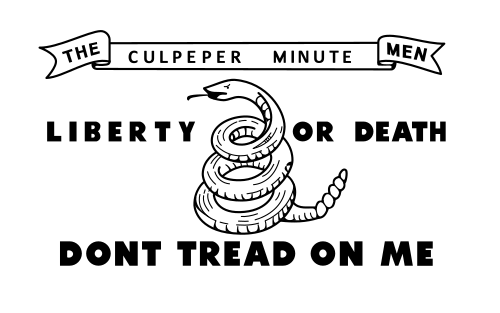
Other American flags that use a rattlesnake motif include The United Companies of the Train of Artillery of the Town of Providence, the First Navy Jack, and the Culpeper Minutemen flag, among others.
In the 21st century, the Gadsden Flag has been used by supporters of the Tea Party movement.
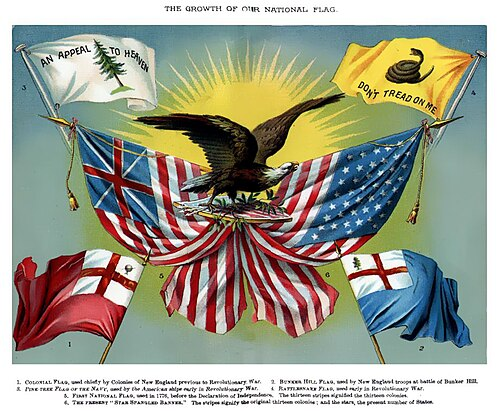
Gadsden's flag in an 1885 schoolbook
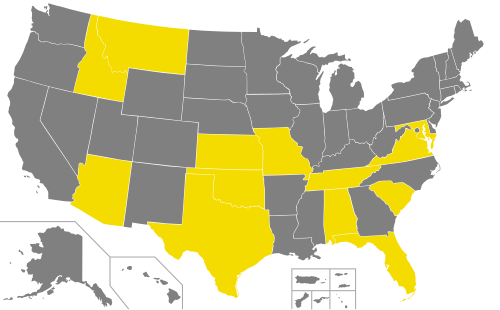
Map of states (colored yellow) that offer Gadsden flag specialty license plates
Gadsden flag flown in the area of demonstration during the January 6, 2021, storming of the U.S. Capitol.

updated:
Thursday, May 21, 2026 10:49AM