Aesculapian_snake
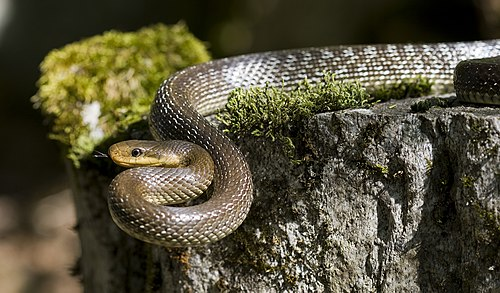
Adult Zamenis longissimus from the region of Ticino, Switzerland
The Aesculapian snake /ˌɛskjəˈleɪpiən/ (Zamenis longissimus, previously Elaphe longissima) is a species of nonvenomous snake native to Europe, a member of the subfamily Colubrinae of the family Colubridae. Growing up to 2 metres (6.6 ft) in length, it is among the largest European snakes, similar in size to the four-lined snake (Elaphe quatuorlineata) and the Montpellier snake (Malpolon monspessulanus). The Aesculapian snake has been of cultural and historical significance for its role in ancient Greek, Roman, and Illyrian mythology and derived symbolism.
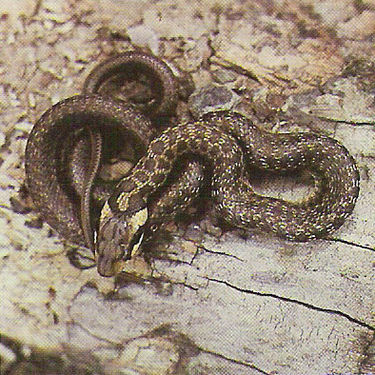
Juvenile with distinctive coloration
Zamenis longissimus hatches at around 30 cm (11.8 in). Adults are usually from 110 cm (43.3 in) to 160 cm (63 in) in total length (tail included), but can grow to 200 cm (79 in), with the record size being 225 cm (7.38 ft).[3] Expected body mass in adult Aesculapian snakes is from 350 to 890 g (0.77 to 1.96 lb).[4][5] It is dark, long, slender, and typically bronzy in colour, with smooth scales that give it a metallic sheen.
Juveniles can easily be confused with juvenile grass snakes (Natrix natrix) and barred grass snakes (Natrix helvetica), because juvenile Aesculapians also have a yellow collar on the neck that may persist for some time in younger adults. Juvenile Z. longissimus are light green or brownish-green with various darker patterns along the flanks and on the back. Two darker patches appear in the form of lines running on the top of the flanks. The head in juveniles also features several distinctive dark spots, one hoof-like on the back of the head in-between the yellow neck stripes, and two paired ones, with one horizontal stripe running from the eye and connecting to the neck marks, and one short vertical stripe connecting the eye with the fourth to fifth upper labial scales.
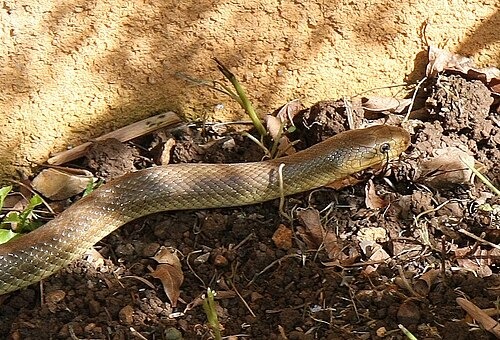
Lightly coloured adult
Adults are much more uniform, sometimes being olive-yellow, brownish-green, sometimes almost black. Often in adults, there may be a more or less regular pattern of white-edged dorsal scales appearing as white freckles all over the body up to moiré-like structures in places, enhancing the shiny metallic appearance. Sometimes, especially when pale in colour, two darker longitudinal lines along the flanks can be visible. The belly is plain yellow to off-white, while the round iris has amber to ochre colouration. Melanistic, erythristic, and albinotic natural forms are known, as is a dark grey form.
Although there is no noticeable sexual dimorphism in colouration, males grow significantly longer than females, presumably because of the more significant energy input of the latter into the reproductive cycle. Maximum weight for German populations has been 890 grams (1.96 lb) for males and 550 grams (1.21 lb) for females (Böhme 1993; Gomille 2002). Other distinctions, as in many snakes, include in males a relatively longer tail to total body length and a wider tail base.
Scale arrangement includes 23 dorsal scale rows at midbody (rarely 19 or 21), 211–250 ventral scales, a divided anal scale, and 60–91 paired subcaudal scales (Schultz 1996; Arnold 2002). Ventral scales are sharply angled where the underside meets the side of the body, which enhances the species' climbing ability.
Lifespan is estimated at 25 to 30 years.[3][6][7]
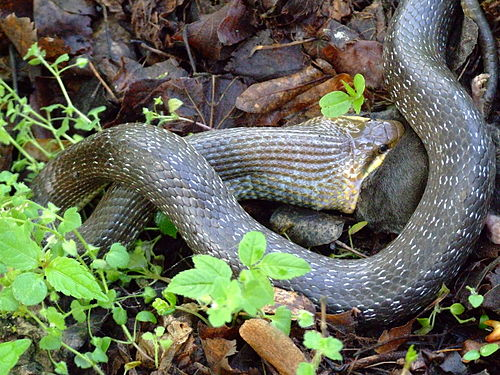
Swallowing a small mammal
The main food source of Zamenis longissimus is small mammals such as shrews, moles, and rodents up to the size of rats. A 130 cm (51 in) adult specimen has been reported to have overpowered a 200 g (7.1 oz) rat. It also eats birds as well as bird eggs and nestlings. It suffocates its prey by constriction, though harmless smaller mouthfuls may be eaten alive without constriction, or simply crushed on eating by jaws. Juveniles mainly eat lizards and arthropods, later small rodents. Other snakes and lizards are taken, but only found rarely in adult prey.
Predators include badgers and other mustelids, foxes, wild boar (mainly by digging up and decimating egg clutches and hatchlings), hedgehogs, and various birds of prey (though there are reports of adults successfully standing their ground against feathered attackers). Juveniles may be eaten by smooth snakes and other reptilivorous snakes. Also a threat mainly to juveniles and hatchlings are domestic animals such as cats, dogs, and chickens, and even rats may be dangerous to inactive adult specimens in hibernation. In areas of concurrent distribution, it is also preyed upon by introduced North American raccoons and east Asian raccoon dogs.[3][6][7][18]
Behaviour
Zamenis longissimus is active by day (diurnal). In the warmer months of the year, it comes out in late afternoon or early morning. It is a very good climber capable of ascending even vertical, branchless tree trunks. It has been observed at heights of 4 to 5 m (13 to 16 ft) and even 15 to 20 m (49 to 66 ft) in trees, and foraging in the roofs of buildings. Observed optimum temperature for activity in German populations is 20–22 °C (68–72 °F) (Heems 1988) and it is rarely recorded below 16 °C (61 °F) or above 25 °C (77 °F), other observations for Ukrainian populations (Skarbek et Ščerban 1980) put minimum activity temperature from 19 °C (66 °F) and optimum to 21–26 °C (70–79 °F). Above around 27 °C (81 °F) it tries to avoid exposure to direct sunlight and ceases activity with more extreme heat. It will exhibit a degree of activity even during hibernation, moving around to keep a body temperature near 5 °C (41 °F) and occasionally emerging to bask on sunny days.
The average home range for French populations has been calculated at 1.14 ha (2.8 acres), however males will travel longer distances of up to 2 km (1.2 mi) to find females during the mating season and females to find suitable hatching sites to lay eggs.
The Aesculapian snake is deemed secretive and not always easy to find even in areas of positive presence, or found in surprising contexts.[3][6][7][18] In contact with humans, it can be rather tame, possibly due to its cryptic coloration keeping it hidden within its natural environment. It usually disappears and hides, but if cornered it may sometimes stand its ground and try to intimidate its opponent, sometimes with a chewing-like movement of the mouth and occasionally biting.[6]
It has been speculated that the species may be more prevalent than thought due to spending a significant part of its time in tree canopy, but no reliable data exist as to what part that would be. In France it is said to be the only snake species that occurs inside dense, shadowy forests with minimum undergrowth, presumably because of using foliage for basking and foraging. In other parts of its geographic range it has been reported to only use the canopy on a more substantial basis in largely uninhabited areas, such as the natural beech forests of the East Slovak and Ukrainian Carpathians, with similar characteristics.[3][7]
The Aesculapian snake was first described by Josephus Nicolaus Laurenti in 1768 as Natrix longissima, later it was also known as Coluber longissimus and for the most part of its history as Elaphe longissima. The current scientific name of the species based on revisions of the large genus Elaphe is Zamenis longissimus. Zamenis is from Greek ζαμενής[19] "angry", "irritable", "fierce", longissimus comes from Latin and means "longest"; the snake is one of the longest over its range. The common name of the species, Aesculape in French and its equivalent in other languages, refers to the classical god of healing (Greek Asclepius and later Roman Aesculapius) whose temples the snake was encouraged around. It is surmised that the typical depiction of the god with his snake-entwined staff features the species. Later from these, modern symbols developed of the medical professions as used in a number of variations today. The species, along with four-lined snakes, is carried in an annual religious procession in Cocullo in central Italy, which is of separate origin and was later made part of the Catholic calendar.

The classical Rod of Aesculapius as a symbol of human medicine

The V-form as a symbol of veterinary medicine

The Aesculapian snake with the Bowl of Hygieia as a symbol of pharmacology
Conservation
Though the Aesculapian snake occupies a relatively broad range and is not endangered as a species, it is thought to be in general decline largely due to anthropic disturbances. The snake is especially vulnerable in fringe parts and northern areas of its distribution where, given the historic retreat as a result of climatic changes since the Holocene climatic optimum, local populations remain isolated both from each other and from the main distribution centers, with no exchange of genetic material and no reinforcement through migration as a result. In such areas active local protection is due. ^[citation ^needed]
The snake has been classified as Critically Endangered in the German Red List of endangered species.[citation ^needed] In most other countries including France, Switzerland, Austria, the Czech Republic, Slovakia, Hungary, Bulgaria, Poland, Ukraine and Russia it is also under protection status.[citation ^needed]
Among the key concerns is human-caused habitat destruction, with a series of respective recommendations concerning forestry and agriculture as to the protection through non-intervention of the species' core distribution centers, including targeted protection of potential hatching and hibernation places like old growth zones and fringe ecotones near woodland areas.[citation ^needed]
A significant threat also are roads both in terms of new construction and rising traffic, with a risk of further fragmentation of populations and loss of genetic exchange.[3]
DOWNLOADED FROM WIKIPEDIA
Wednesday, December 03, 2025 11:33AM