10_Hygiea
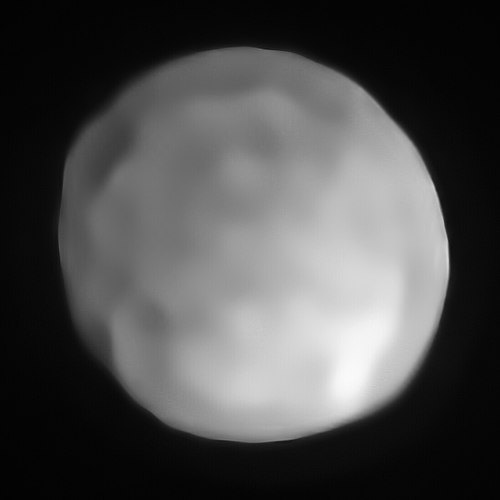
10 Hygiea is a large asteroid located in the outer main asteroid belt between the orbits of Mars and Jupiter. It was the tenth known asteroid, discovered on 12 April 1849 by Italian astronomer Annibale de Gasparis at the Astronomical Observatory of Capodimonte in Naples, Italy. It was named after Hygieia, the Greek goddess of health. It is the fourth-largest main-belt asteroid by both volume and mass, with a mean diameter of 433 km (269 mi) and a mass constituting 3% of the main asteroid belt's total mass.
Hygiea has a nearly spherical shape, with two known craters about 100 and 180 km (62 and 112 mi) in diameter. Because of its shape and large size, some researchers consider Hygiea a possible dwarf planet. Hygiea has a dark, carbonaceous surface consisting of hydrated and ammoniated silicate minerals, with carbonates and water ice. Hygiea's subsurface likely contains a large fraction of water ice. These characteristics make Hygiea very similar to the main-belt dwarf planet Ceres, which suggests the two objects have similar origins and evolutionary histories.[12]: 2
Hygiea is the parent body of the Hygiea family, an asteroid family comprising over 7,000 known asteroids that share similar orbital and compositional characteristics with Hygiea.[13] The Hygiea family is believed to have formed by a giant impact on Hygiea about 2 to 3 billion years ago.[14] This impact is thought to have shattered Hygiea, which led to its reaccumulation as a nearly spherical body.
Hygiea was discovered on the evening of 12 April 1849 by Italian astronomer Annibale de Gasparis at the Astronomical Observatory of Capodimonte in Naples, Italy.[15]: XV [16]: 10 On that night he was using the observatory's Reichenbach equatorial telescope[17][b] to observe a section of the sky in the 12th hour of right ascension, as part of his larger project of cataloguing stars along the ecliptic up to the 14th apparent magnitude.[15]: XV–XVI [16]: 10 While comparing his observations to the Berlin Academy's star chart,[16]: 10 [c] de Gasparis noticed a starlike object between magnitude 9 and 10 which was not recorded before.[20]: 126 [16]: 10 [d] Although poor weather prevented further observations for a few days, de Gasparis reobserved the object on 14 and 17 April and confirmed it had moved between these dates.[20]: 126 [19] Judging by how much the object had moved, de Gasparis concluded it must be another new planet[e] between the orbit of Mars and Jupiter.[20]: 126 De Gasparis announced his discovery to Erasmo Fabri Scarpellini,[23]: 28 secretary of the Correspondenza Scientifica bulletin at Rome, Italy,[20]: 126 who in turn passed on the news to Heinrich Christian Schumacher, who published it in the Astronomische Nachrichten journal on 11 May 1849.[19][22] Hygiea was the first asteroid discovered by de Gasparis and the tenth asteroid discovered in history.[22][24]: 80 He would later discover another six asteroids between 1850 and 1853 and two more during the 1860s.[22]
Name
De Gasparis invited Ernesto Capocci Belmonte, his friend and director of the Capodimonte Observatory, to assign a name to the asteroid as gratitude for his help and advice.[15]: XVI [16]: 10 Capocci suggested the name Igea—the Italian spelling of Hygieia, the Greek goddess of health and daughter of Asclepius.[17][16]: 10 De Gasparis added the adjective Borbonica to Capocci's suggested name, to honor King Ferdinand II of the Bourbons of Naples who ruled the Kingdom of the Two Sicilies and supported the work of the Capodimonte Observatory.[25][15]: XVI Together, de Gasparis and Capocci proposed the name Igea Borbonica ("Bourbon Hygieia") in a letter forwarded to Ferdinand II on 8 May 1849.[26][16]: 10 De Gasparis's commemoration of the Bourbons may have helped him and Capocci circumvent punishment for their participation in the liberal movements of 1848.[27]
The name Igea Borbonica was not mentioned in the first communications to the European scientific community.[16]: 10 When English astronomer John Herschel received the news of Hygiea's discovery from his Neapolitan colleagues,[16]: 10 he suggested that Parthenope would be an apt name for de Gasparis's discovery, as it comes from the siren who founded Naples in Greek mythology.[22][20]: 127 In a letter written to English mathematician Augustus De Morgan in April 1849, Herschel wrote:
No name has yet been mentioned. What do you think of Parthenope (being a Neapolitan?) I should think it will occur as a matter of course to Gasparis if he has any classical reading.
— John Herschel, in a letter to Augustus De Morgan (April 1849)[17][16]: 10–11
Herschel corresponded with other European scientists and astronomers to hear their thoughts on the name Parthenope for de Gasparis's discovery, although by the time he reached out to de Gasparis, Hygiea had already been named one month earlier.[17] When Schumacher, editor of Astronomische Nachrichten, learned of the name proposed by de Gasparis and Capocci, he complained in a letter addressed to Herschel on 26 June 1849 that it had the Italian spelling instead of the Latin form, as conventionally done for all the other planets.[17] Regardless, de Gasparis recognized Herschel's suggestion and expressed desire to realize Herschel's wish.[17][20]: 167 On 11 May 1850, de Gasparis discovered the asteroid 11 Parthenope and acknowledged Herschel for the name in his announcement.[22]
There are multiple variations on the Latin spelling of Hygiea, including Hygièa, Hygia, and Hygea.[17][28] The modern English form Hygiea is a less common variant of the name of the goddess, which in Greek is Ὑγίεια (Hygieia)[29] or Ὑγεῖα (Hygeia).[30] The name was often spelled Hygeia (and occasionally Hygea[31][24]: 80 ) by astronomers during the early 1850s, though by the 1860s, the spelling Hygiea became commonplace.[32] According to the English astronomer John Russell Hind, the adjective Borbonica had been dropped by 1852.[20]: 126 [33]: 68–70
Symbol and designation
As with the other previously discovered asteroids, Hygiea was given an astronomical symbol as a way of representing it. The symbol for Hygiea was proposed by de Gasparis in a letter addressed to Hind on 4 November 1850, in which he wrote, "The symbol of Hygeia [sic] is a serpent (like a Greek ζ) crowned with a star."[34] Visually, de Gasparis's symbol for Hygiea is depicted as: [ ](https://en.wikipedia.org/wiki/File:Hygiea_symbol_%28original,_fixed_width%29.svg "The traditional planetary symbol for 10 Hygiea") (U+1F779 in Unicode 17.0).[35]: 7 [36] The serpent, particularly when drinking from a bowl, is a traditional symbol of the goddess Hygieia (cf. U+1F54F 🕏).[37]
However, perhaps due to the late announcement of Hygiea's intended symbol, it was not used in following astronomical almanacs such as the Berliner Astronomisches Jahrbuch in 1850 and the Nautical Almanac and Astronomical Ephemeris in 1852, marking the first time an asteroid was listed without its symbol in these almanacs.[35]: 7 American astronomer Benjamin Apthorp Gould interpreted Hygiea's symbol as a rod of Asclepius, depicting it as a serpent coiled around a staff in a January 1852 publication of the Astronomical Journal: [ ](https://en.wikipedia.org/wiki/File:Rod_of_Asclepius_%28fixed_width%29.svg "rod of Asclepius") (U+2695 ⚕).[24]: 80 [35]: 7
Both symbols of Hygiea soon became obsolete, as the number of asteroids discovered had grown too much for each to have unique symbols.[38][24]: 80 In 1851 Johann Franz Encke proposed a different identification system, suggesting using a number corresponding to the order of discovery enclosed in a small circle[38][35]: 5 —for Hygiea it would be ⑩.[24]: 80 Astronomers began adopting Encke's circled number scheme in scientific publications, though as the number of asteroids discovered grew, astronomers eventually switched to enclosing the number in parentheses, which became the modern minor-planet designation scheme.[38][35]: 5 In the case of Hygiea, its modern minor planet designation would be (10) Hygiea[10] or 10 Hygiea.[1]
The Minor Planet Center uses the minor planet provisional designations A849 GA and A900 GA for Hygiea,[10] though these are only retrospective extensions of the new-style provisional designation scheme established in 1925.[39] While the provisional designation A849 GA refers to the discovery date of Hygiea, the designation A900 GA refers to the date when Hygiea was serendipitously observed and catalogued (as Arequipa 38[40]: 13 ) by the Harvard College Observatory's photographic sky survey at Arequipa, Peru in 1900.[41][10][f]
Hygiea has seen some minor astrological use, though its symbol was confused once again, with Asclepsius's rod replaced by Mercury's caduceus: [ ](https://en.wikipedia.org/wiki/File:Hygiea_symbol_%28fixed_width%29.svg "Astrological symbol for Hygiea"), though in a more elaborate form (U+2BDA ⯚) than the caduceus symbol of the planet Mercury.[35]: 6 [42]: 11 The caduceus has long been mistaken for the rod of Asclepius (see caduceus as a symbol of medicine).
While the first four asteroids discovered—Ceres (1801), Pallas (1802), Juno (1804), and Vesta (1807)—were considered planets during the first half of the 19th century (with some astronomers continuing to consider them as such until the end of the century), the discovery of Hygiea occurred when the classification of asteroids was already evolving.[38] Hygiea was referred to as a planet in the following years after its discovery,[17] though by 1852 astronomers have also called Hygiea a minor planet[20]: 127 or an asteroid.[24]: 80 These terms were introduced prior to Hygiea's discovery and became more used with the discovery of more asteroids beginning in the 1850s.[38] From the second half of the 19th century, asteroids began to be treated in a predominantly collective way, grouped according to orbital or spectral characteristics, with less attention to the individual object.[44]
In 2006, the International Astronomical Union's (IAU) committee for drafting a new definition of planet had considered classifying Hygiea among the planets or the newly-coined category of dwarf planets, if it were found that the asteroid is massive enough to be shaped predominantly by hydrostatic equilibrium.[45]: 238 [43]: 17 [46]: 50 This proposal for the definition of planet has since been revised and adopted to decree that a planet must orbit the Sun, have sufficient mass to attain a spherical shape by hydrostatic equilibrium, and clear its neighbourhood; objects that satisfy all but the last criterion are considered dwarf planets.[47][6]: 137–138 Since 2019, telescope images have resolved Hygiea's nearly spherical shape, suggesting that it may have reached hydrostatic equilibrium.[13] Because Hygiea already orbits the Sun and is located in the asteroid belt where it has not cleared its orbital neighborhood, Hygiea's nearly spherical shape could qualify it as a dwarf planet, according to Pierre Vernazza and collaborators who studied Hygiea with telescope imaging.[47][6]: 138–139 [13] If so, Hygiea could be the smallest dwarf planet known.[13][48] However, the IAU has not yet officially classified Hygiea as a dwarf planet.[12]: 1
DOWNLOADED FROM WIKIPEDIA
Friday, December 05, 2025 07:41AM
rk