Consciousness
Etymology
The words "conscious" and "consciousness" in the English language date to the 17th century, and the first recorded use of "conscious" as a simple adjective was applied figuratively to inanimate objects ("the conscious Groves", 1643).[6]: 175 It derived from the Latin conscius (con- "together" and scio "to know") which meant "knowing with" or "having joint or common knowledge with another", especially as in sharing a secret.[7] Thomas Hobbes in Leviathan (1651) wrote: "Where two, or more men, know of one and the same fact, they are said to be Conscious of it one to another".[8] There were also many occurrences in Latin writings of the phrase conscius sibi, which translates literally as "knowing with oneself", or in other words "sharing knowledge with oneself about something". This phrase has the figurative sense of "knowing that one knows", which is something like the modern English word "conscious", but it was rendered into English as "conscious to oneself" or "conscious unto oneself". For example, Archbishop Ussher wrote in 1613 of "being so conscious unto myself of my great weakness".[9]
The Latin conscientia, literally 'knowledge-with', first appears in Roman juridical texts by writers such as Cicero. It means a kind of shared knowledge with moral value, specifically what a witness knows of someone else's deeds.[10][11] Although René Descartes (1596–1650), writing in Latin, is generally taken to be the first philosopher to use conscientia in a way less like the traditional meaning and more like the way modern English speakers would use "conscience", his meaning is nowhere defined.[12] In Search after Truth (Regulæ ad directionem ingenii ut et inquisitio veritatis per lumen naturale, Amsterdam 1701) he wrote the word with a gloss: conscientiâ, vel interno testimonio (translatable as "conscience, or internal testimony").[13][14] It might mean the knowledge of the value of one's own thoughts.[12]
John Locke, a 17th-century British Age of Enlightenment philosopher
The origin of the modern concept of consciousness is often attributed to John Locke who defined the word in his Essay Concerning Human Understanding, published in 1690, as "the perception of what passes in a man's own mind".[15][16] The essay strongly influenced 18th-century British philosophy, and Locke's definition appeared in Samuel Johnson's celebrated Dictionary (1755).[17]
The French term conscience is defined roughly like English "consciousness" in the 1753 volume of Diderot and d'Alembert's Encyclopédie as "the opinion or internal feeling that we ourselves have from what we do".[18]
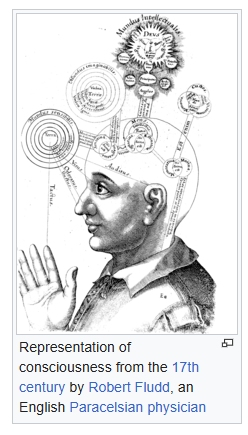
Consciousness, at its simplest, is awareness of internal and external existence.[1] However, its nature has led to millennia of analyses, explanations, and debate by philosophers, scientists, and theologians. Opinions differ about what exactly needs to be studied or even considered consciousness. In some explanations, it is synonymous with the mind, and at other times, an aspect of it. In the past, it was one's "inner life", the world of introspection, of private thought, imagination, and volition.[2] Today, it often includes any kind of cognition, experience, feeling, or perception. It may be awareness, awareness of awareness, metacognition, or self-awareness, either continuously changing or not.[3][4] The disparate range of research, notions and speculations raises a curiosity about whether the right questions are being asked.[5]
Examples of the range of descriptions, definitions or explanations are: ordered distinction between self and environment, simple wakefulness, one's sense of selfhood or soul explored by "looking within"; being a metaphorical "stream" of contents, or being a mental state, mental event, or mental process of the brain.
downloaded: December 16, 2024, 2:04 PM