ALU sequences
ALU name comes from a restriction enzyme--actually from Arthrobacter Luteus the source of the enzyme.-or works well there? Alus do not make Proteins but may be important in mutation creation. Recent findings suggest that Alu elements may have a broad evolutionary impact by affecting gene structures, protein sequences, splicing motifs and expression patterns. AKA "Jumping Genes" from their ability to move around and be duplicated. They can be well-used as markers by being inserted alongside a gene of interest.
An Alu element is a short stretch of DNA originally characterized by the action of the Arthrobacter luteus (Alu) restriction endonuclease. Alu elements are the most abundant transposable elements, containing over one million copies dispersed throughout the human genome.
Alu elements are primate-specific repeats and comprise 11% of the human genome. They have wide-ranging influences on gene expression. Their contribution to genome evolution, gene regulation and disease is reviewed.
Alu elements are classified as SINEs, or Short Interspersed Elements. All Alus are approximately 300 bp in length and derive their name from a single recognition site for the restriction enzyme AluI located near the middle of the Alu element. Human chromosomes contain about 1,000,000 Alu copies, which equal 10% of the total genome. Alu elements probably arose from a gene that encodes the RNA component of the signal recognition particle, which labels proteins for export from the cell. Alus are the most abundant SINEs.Short interspersed nuclear elements (SINEs) are non-autonomous, non-coding transposable elements (TEs) that are about 100 to 700 base pairs in length. They are a class of retrotransposons, DNA elements that amplify themselves throughout eukaryotic genomes, often through RNA intermediates.
An Alu element is a short stretch of DNA originally characterized by the action of the Alu (Arthrobacter luteus) restriction endonuclease. Alu elements of different kinds occur in large numbers in primate genomes. In fact, Alu elements are the most abundant transposable elements in the human genome. They are derived from the small cytoplasmic 7SL RNA, a component of the signal recognition particle. The event, when a copy of the 7SL RNA became a precursor of the Alu elements, took place in the genome of an ancestor of Supraprimates.
Alu elements are retrotransposonsand look like DNA copies made from RNA polymerase III-encoded RNAs. Alu elements do not encode for protein products and depend on LINE retrotransposons for their replication. Looks like they can be introns as well as within protein coding areas of exons but they do not code for proteins themselves??
The sequence of the DNA for the 299 nucleotide long 7SL RNA:
gccgggcgcg gtggcgcgtg cctgtagtcc cagctactcg ggaggctgAG GCTGgaGGAT CGcttgAGTC CAggagttct
gggctgtagt gcgctatgcc gatcgggtgt ccgcactaag ttcggcatca atatggtgac ctcccgggag cgggggacca
ccaggttgcc taaggagggg tgaaccggcc caggtcggaa acggagcagg tcaaaactcc cgtgctgatc agtagtggga
tcgcgcctgt gaatagccac tgcactccag cctgggcaac atagcgagac cccgtctct
The functional retinoic acid response element hexamer sites are in upper case and overlap the internal transcriptional promoter. The recognition sequence of the Alu endonuclease is 5' AG/CT 3'; that is, the enzyme cuts the DNA segment between the guanine and cytosine residues (in bold above).
Alu insertions have been implicated in several inherited human diseases and in various forms of cancer.
The study of Alu elements has also been important in elucidating human population genetics and the evolution of primates, including the evolution of humans.
Alu elements consist of a sequence averaging 260 base pairs that contains a site that is recognized by the restriction enzyme AluI. They appear to be reverse transcripts of 7S RNA, part of the signal recognition particle.
The Alu family is a family of repetitive elements in the human genome. Modern Alu elements are about 300 base pairs long and are therefore classified as short interspersed elements (SINEs) among the class of repetitive DNA elements. The typical structure is 5'Part A- A5TACA6 -Part B - PolyA Tail - 3', where Part A and Part B are similar nucleotide sequences. Expressed another way, it is believed modern Alu elements emerged from a head to tail fusion of two distinct FAMs (fossil antique monomers) over 100 mkya, hence its dimeric structure of two similar, but distinct monomers (left and right arms) joined by an A-rich linker.
The length of the polyA tail varies between Alu families.
There are over one million Alu elements interspersed throughout the human genome, and it is estimated that about 10.7% of the human genome consists of Alu sequences. However, less than 0.5% are polymorphic (i.e. they occur in more than one form or morph).
In 1988, Jerzy Jurka and Temple Smith discovered that Alu elements were split in two major subfamilies known as AluJ and AluS, and other Alu subfamilies were also independently discovered by several groups. Later on, a sub-subfamily of AluS which included active Alu elements was given the separate name AluY.
The discovery of Alu subfamilies led to the hypothesis of master/source genes, and provided the definitive link between transposable elements (active elements) and interspersed repetitive DNA (mutated copies of active elements).
They are different from CRISPRs but difficult to explain! Not Palindromes? but their sequences can be palindromic! Also do not have ORFs to create proteins. ALUs are short SINEs ??
Alu elements are found only in primates – the "monkey" branch of the evolutionary tree, which includes humans. So, all of the hundreds of thousands of Alu copies have accumulated in primates since their separation from other vertebrate groups about 65 million years ago. Once an Alu integrates into a new site, it accumulates new mutations at the same rate as surrounding DNA loci. Alu elements can be sorted into distinct lineages, or families, according to inherited patterns of new mutations. These studies suggest that the rate of Alu transposition has changed over time – from about one new jump in every live birth, early in primate evolution, to about one in every 200 newborns today. Taken together, this pattern suggests that, at any point in time, only one or several Alu "masters" are capable of transposing.
Once an Alu inserts at a chromosome locus, it can copy itself for transposition, but there is no evidence that it is ever excised or lost from a chromosome locus. So, each Alu insertion is stable through evolutionary time. Each is the "fossil" of a unique transposition event that occurred only once in primate evolution. Like genes, Alu insertions are inherited in a Mendelian fashion from parents to children. Thus, all primates showing an Alu insertion at a particular locus have inherited it from a common ancestor. This is called identity by descent.
Alu elements are a specific class of repetitive DNA that first appeared about 60 to 70 million years ago during primate evolution. They do not exist in genomes of other mammals. Alu elements are the most common form of mobile DNA in the human genome, and are able to transpose, or jump, to different positions in the genome sequence. When they jump into regions of the genome containing existing genes, these elements can become new exons -- pieces of messenger RNAs that carry the genetic information.
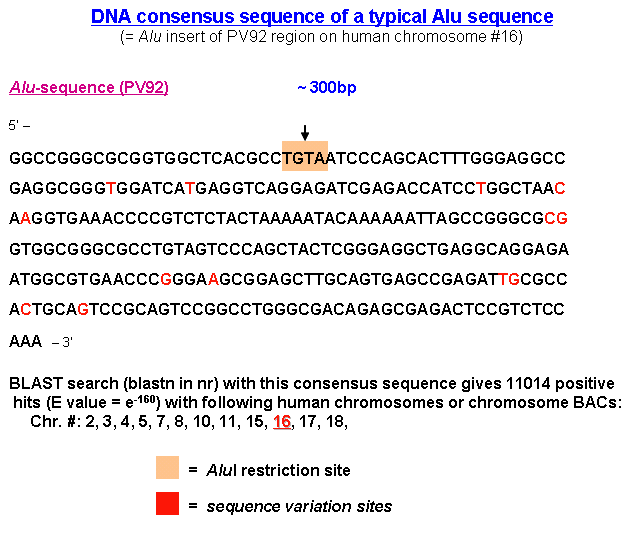

300 bp long Alu sequences like the one shown above are present at a ca. 1 million sites in the human genome and make up an estimated 10% of the total DNA of human genes