Operons
In genetics, an operon is a functioning unit of genomic DNA containing a cluster of genes under the control of a single promoter. The genes are transcribed together into an mRNA strand and either translated together in the cytoplasm, or undergo trans-splicing to create monocistronic mRNAs that are translated separately, i.e. several strands of mRNA that each encode a single gene product. The result of this is that the genes contained in the operon are either expressed together or not at all. Several genes must be co-transcribed to define an operon.
Originally, operons were thought to exist solely in prokaryotes, but since the discovery of the first operons in eukaryotes in the early 1990s, more evidence has arisen to suggest they are more common than previously assumed. In general, expression of prokaryotic operons leads to the generation of polycistronic mRNAs, while eukaryotic operons lead to monocistronic mRNAs.
Eukaryotes lack operons because gene regulation is so complex that you could not possibly fit genes that code for regulation points close enough to the genes they regulate. Operons depend upon having the structural gene closely downstream, while Eukaryotic genes do not have this luxury due to these complex control mechanisms. (Conjecture)
Operons are also found in viruses such as bacteriophages. For example, T7 phages have two operons. The first operon codes for various products, including a special T7 RNA polymerase which can bind to and transcribe the second operon. The second operon includes a lysis gene meant to cause the host cell to burst.

Based on the frequency distance distributions, we estimated a total of 630 to 700 operons in E. coli.
EcoCyc is a scientific database for the bacterium Escherichia coli K-12 MG1655. The EcoCyc project performs literature-based curation of the entire genome, and of transcriptional regulation, transporters, and metabolic pathways.
New to EcoCyc? Take the guided tour of the EcoCyc.org Web site, watch our free online instructional videos, or read our 2013 article: "EcoCyc: fusing model organism databases with systems biology"
Scientists first understood gene regulation when they studied E. coli, a type of bacteria that lives in our large intestine. This bacterium makes enzymes that help us digest our food, like the lactose in milk. E. coli, remember, is a prokaryote; an organism whose cells lack a nucleus. Prokaryotic DNA is clustered into groups of genes called operons. When scientists first studied the lac operon found in E. coli, they observed gene regulation through transcriptional repression and induction.
We've talked about repression and induction before. Repression describes a decrease in gene transcription, whereas induction is an increase in gene transcription. The lac operon of E. coli is induced in the presence of lactose, and it's repressed when lactose is gone. Sometimes we describe induction and repression as 'turning on' and 'turning off' the operon. We can think of the operon as being controlled by a switch. Lactose turns it on, and the absence of lactose turns it off.
But what is the true mechanism for transcriptional control? We know there's not really a switchboard down there, microscopically managing everything that happens in the bacterial DNA. So, what's the real story? How does repression and induction actually work? And what about lactose? It's only a sugar. Can it really have that much power over the expression of bacterial genes?
This lesson will walk you through the main parts of an operon, describing how each of the segments work. We'll take a closer look at the lac operon and how it responds to repressors and inducers. Then, we'll revisit repression and induction for a thorough understanding of how an operon controls transcription in the prokaryotic cell.
Anatomy of an Operon
RNA polymerase attaches to the sense strand of DNA to begin transcription
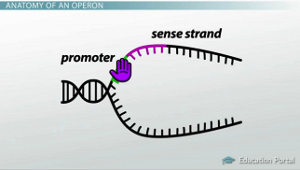
Promoter Sense Strand Diagram
Alright, so here's the lac operon from E. coli. Like all operons, it's a cluster of related genes that code for similar things. We call the individual genes structural genes. A structural gene is any gene that codes for a structural protein or an enzyme. Remember, enzymes are just one kind of protein. The structural genes in the lac operon code for three different enzymes. The first enzyme is called beta galactosidase. The second one is galactose permease, and the third is called thiogalactoside transacetylase. Whew! Let's just call them Betty, Gail, and Theo. All three of them are in charge of breaking down lactose in the intestine. Because Betty, Gail, and Theo are usually needed at the same time, then their genes are all transcribed at the same time. The Betty gene, the Gail gene, and the Theo gene are all side by side in the lac operon.
Now, let's look at what we have just in front of the structural genes. There's a short DNA segment here, and it's called the operator. This is the part of the operon that acts as a switch for transcription. It's just like an operator that works the switchboard for a telephone company. The operator controls whether or not transcription will occur. It does this by providing a binding site for the repressor, which blocks RNA polymerase from attaching to the promoter. Wait a second. RNA polymerase? Promoter? Haven't we seen those terms before?
Recall that genetic transcription begins when RNA polymerase locates the promoter on the sense strand of DNA. RNA polymerase starts building the mRNA strand right after the promoter. In a prokaryotic cell, transcription continues through the entire length of the operon. If we want all the structural genes to be transcribed and translated, then we need RNA polymerase to first attach to the promoter.
The promoter lives just in front of the operator, and the operator sits just in front of the structural genes. All of these together make up the operon. Is there anything else? Oh, yes. Sitting just upstream from the operon is a regulatory gene that codes for the repressor. Remember, a repressor is a protein that regulates gene expression by blocking gene transcription. The repressor is a type of regulatory protein, so it makes sense that it's made by a regulatory gene.
*Transcriptional Repression
Diagram of the main parts of an operon*
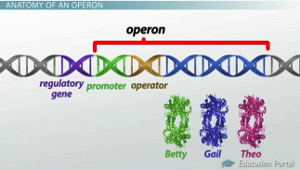
Operon Diagram
I think that all these strange new terms will begin to make sense when we see some examples. Let's go back to repression and induction. Earlier, when we talked about the lac operon, we said that repression is the blocking of gene expression in response to a repressor. But how does a repressor actually block transcription?
To understand repressors, you have to know what they look like. Here's a repressor for the lac operon. It's a funny-shaped protein with a hole in its side and a lumpy arm sticking out in front. It also has little feet designed for sticking to DNA. When the lac repressor is active, it sticks its feet to the operator, and its lumpy arm ends up hanging over the promoter next door. Now the promoter's blocked. So what does that mean? It means that poor old RNA polymerase can't come in and attach to the promoter. If it can't attach to the promoter, then it can't begin building the mRNA. No transcription means no translation. So Betty, Gail, and Theo will never be produced. We won't have any enzymes to help break down our lactose. The lac repressor has succeeded in blocking transcription of our lac operon.
Now that we know more about repressors, let's go ahead and expand our definition. We can say that a repressor is a protein that turns off transcription by binding to the operator and blocking the attachment of RNA polymerase to the promoter.
Does it really matter to us that we can't produce our enzymes now? I mean, how much do we care about Betty, Gail, and Theo? They're just enzymes that break down the sugar lactose. Do we really need them hanging around? Well, if we plan on having dairy anytime soon, then yes. Remember, we owe it to the lac operon of the E. coli in our intestine to help us digest the sugar lactose. So if any lactose gets into our system, then we'd better have a way to get that repressor off the operon. See "How an Operon...."