Pseudogenes
Pseudogenes are dysfunctional relatives of genes that have lost their protein-coding ability or are otherwise no longer expressed in the cell. Pseudogenes often result from the accumulation of multiple mutations within a gene whose product is not required for the survival of the organism. Although not protein-coding, the DNA of pseudogenes may be functional, similar to other kinds of non-coding DNA which can have a regulatory role. Pseudogenes can have introns and extrons. They can also sometimes simply be undiscovered functional or coding genes--i.e. we just don't know yet what they do. See "background Information..." opposite for great website.
Introns and pseudogenes are not the same.
An intron is a segment of DNA that "intrudes" into or "interrupts" a coding stretch of DNA. Many genes in humans have introns, but bacteria seem to have none. To take an extreme example, the human dystrophin gene has 79 exons (separate coding segments) spread over more than 2.3 million base pairs.
A pseudogene is a DNA segment that resembles a functional (coding) gene, but does not itself code for a gene product. It seems likely that pseudogenes arise when a gene is copied within the genome, and one of the copies drifts away from the functional sequence. "Pseudogene" literally means "false gene".
Types of Pseudogenes--- sometimes called Junk DNA or just non-coding DNA
There are three kinds of pseudogenes [Pseudogenes].
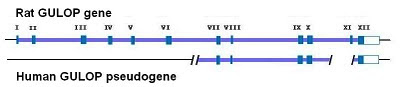
Disabled--The first category contains genes that used to be functional in our ancestors but currently are non-functional. The best example is the human GULOP pseudogene that used to encode a key enzyme in the pathway for synthesis of vitamin C [Human GULOP Pseudogene]. This gene is active in most animals but it has become a pseudogene in primates and, independently, in a few other animals.
Non-Processed or Duplicated--The second category includes genes that arise from a gene duplication event followed by inactivation of one of the copies.
These pseudogenes tend to be located near their active siblings and they retain most of the features of the original gene except they can't produce an active product. Many of them are transcribed, especially if they have only recently become pseudogenes.
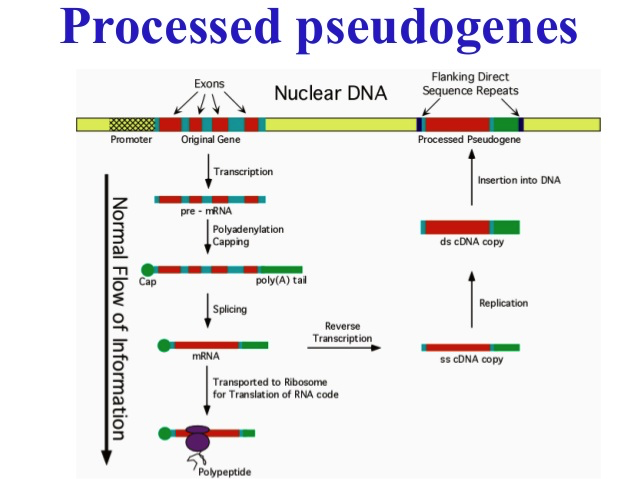
Processed--The third category is called "processed" pseudogenes. They arise when a mature mRNA molecule is copied into DNA by reverse transcriptase and the resulting DNA is integrated into the genome.
Processed pseudogenes will usually not have any introns and when they integrate they will not be near a promoter. Many of them are truncated because the copying process was not complete. Processed pseudogenes were never able to produce their original functional product (protein or RNA) and they accumulate mutations at the rate expected from fixation of neutral alleles by random genetic drift.