Paste
October 31, 2022, 8:36 AM
PASTE This preprint by Ionannidi, Yarnall, Schmitt-Ulms and colleagues aims to simplify and accelerate the insertion of large DNA fragments, especially in non-dividing cells. They develop PASTE (Programmable Addition via Site-specific Targeting Elements): a modified CRISPR-Cas9 system, which builds on Prime Editing and adds recombinases (specifically, serine integrases, which catalyze the excision and integration of foreign DNA ) to enable the insertion of large DNA cargo.
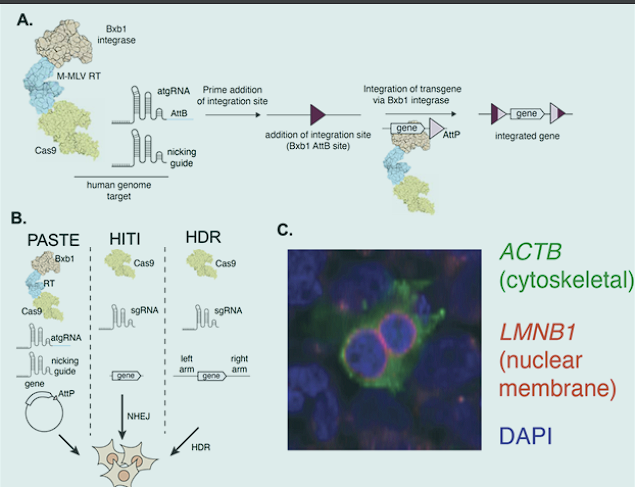
A) Schematic of the novel PASTE system. PASTE uses an engineered Cas9 nickase fused to an RT and serine integrase Bxb1. The RT inserts AttB/AttP integration sites which are then recognized by Bxb1, followed by insertion of cargo DNA. B) Comparison of PASTE, HITI (homology-independent targeted insertion) and HDR. PASTE does not rely on DNA repair pathways for gene integration. C) Representative fluorescence images depicting multiplexed orthogonal insertion of GFP and mCherry reporters at ACTB and LMNB1 loci, respectively. (Figure adapted with the author’s permission from Ionannidi, Yarnall, Schmitt-Ulms et al.)
January 11, 2023, 6:11 PM article in nature added.
CRISPR-Cas9 has been editing the human genome for the past decade. Although the types of edits have varied, an unsolved challenge has been the integration of large pieces of DNA without double-stranded DNA breaks. Now, a team from MIT describes a new tool called PASTE (programmable addition via site-specific targeting elements) which delivered genes as long as 36,000 DNA base pairs to several types of human cells (as well as to liver cells in mice). PASTE uses a CRISPR–Cas9 nickase fused to two enzymes—a reverse transcriptase and a serine integrase—for targeted genomic recruitment and integration of DNA.
g variant-specific treatments,” Muhammad Arslan Mahmood, MPhil, and Shahid Mansoor, PhD, both of Pakistan’s National Institute for Biotechnology and Genetic Engineering, obserPASTE includes a Cas9 enzyme that cuts at a specific genomic site, guided by a strand of RNA that binds to that site. This allows them to target any site in the genome for insertion of the attachment site, which contains 46 DNA base pairs. This insertion can be done without introducing any double-stranded breaks by adding one DNA strand first via a fused reverse transcriptase, then its complementary strand.
Once the site is incorporated, the integrase can come along and insert its much larger DNA payload into the genome at that site.
In this study, the researchers showed that they could use PASTE to insert genes into several types of human cells, including liver cells, T cells, and lymphoblasts. They tested the delivery system with 13 different payload genes, including some that could be therapeutically useful, and were able to insert them into nine different locations in the genome.
In these cells, the researchers were able to insert genes with a success rate ranging from 5–60%. This approach also yielded very few unwanted “indels” at the sites of gene integration.
More specifically, the authors noted that PASTE has editing efficiencies “similar to or exceeding those of homology-directed repair and non-homologous end joining-based methods, with activity in nondividing cells and in vivo with fewer detectable off-target events.”
The DNA sequences that the researchers inserted in this study were up to 36,000 base pairs long, but they believe even longer sequences could also be used. A human gene can range from a few hundred to more than two million base pairs, although for therapeutic purposes only the coding sequence of the protein needs to be used, drastically reducing the size of the DNA segment that needs to be inserted into the genome.
March 18, 2023, 12:11 PM PASTE editing could potentially treat diseases caused by genes harboring a large number of mutations, such as Leber’s congenital amaurosis or cystic fibrosis, where gene editing systems would have to be tailored for specific mutations and each subset of a disease population. In those diseases, programmable insertion of a wild-type gene could address most potential mutations and serve as a blanket therapy.
“Complete replacement of genes at their natural sites can be contemplated instead of creatinved in a recent commentary on the PASTE report, published in The CRISPR Journal(a sister journal of GEN).
Carrying out genome editing without the need for double-stranded breaks in DNA was first laid out by David Liu, PhD, and colleagues at the Broad Institute of MIT and Harvard. In a pair of papers in Naturepublished between 2015–16, Liu’s lab developed base editing, a technique that can make certain classes of single-base substitutions without cleaving the double helix (unlike CRISPR-), two former postdocs in Liu’s lab, Alexis Komor, PhD (now of University of California, San Diego) and Nicole Gaudelli, PhD (now of Beam Therapeutics) recalled in a 2020 episode of The CRISPR Journal’s podcast series GuidePost, available via SoundCloud and Spotify.
Later, in a 2019 paper published in *Nature*, Andrew Anzalone, MD, PhD, and colleagues in Liu’s lab described a “search-and-replace” genome editing technology called prime editing. That approach supplied a desired edit in an extension to the guide RNA, which is then converted to DNA using the RT enzyme. The technology can introduce targeted insertions, deletions, and all 12 possible base-to-base substitutions.