LUCA
Looking for LUCA, the Last Universal Common Ancestor | News | Astrobiology
In biology, "LUCA" is an acronym for the Last Universal Common Ancestor, the most recent population of organisms from which all cellular life on Earth descends. This ancestor is hypothesized to have been a single-celled organism, possibly a prokaryote, with characteristics like a lipid bilayer, a genetic code, and ribosomes for protein synthesis. Scientists study LUCA to understand the fundamental biology of all life and its origins.
In 2025 biology, LUCA (Last Universal Common Ancestor) remains the hypothesized microbe from which all current life (Bacteria, Archaea, Eukarya) descends, with recent research (mid-2024/early 2025) pushing its age back to ~4.2 billion years ago and revealing it as a complex, anaerobic organism using hydrogen/CO2, potentially living near hydrothermal vents, possessing a rudimentary immune system (CRISPR), and forming part of an early microbial ecosystem. Studies use phylogenetics to reconstruct LUCA's genetic makeup, showing shared traits like ribosomes, DNA, and ATP, while ongoing debates focus on its exact metabolism and environment, suggesting a surprisingly rapid evolution of complex life.
Key Characteristics & Life of LUCA:
- Not the First Life: LUCA wasn't the first organism, but the point where all currently known life branches off.
- Microscopic & Prokaryotic: A single-celled microbe, likely similar to modern prokaryotes.
- Habitat: Probably lived in iron-sulfur rich hydrothermal vents, using non-living chemicals for energy (anaerobic, autotrophic).
- Genetics: Had DNA/RNA, ribosomes, and a genetic code, allowing for protein synthesis.
- Metabolism: Used hydrogen, carbon dioxide, and nitrogen, producing compounds like ammonia and acetates, potentially as part of a larger ecosystem.
- Complex Features: Surprisingly, it may have had a basic CRISPR-Cas immune system and a phospholipid membrane.
Last Universal Common Ancestor.
DNA sequencing
DNA sequencing has provided a new approach for studying evolutionary relationships, since:
- all organisms have a genome,
- the genes that code for vital cellular functions are conserved to a remarkable degree through evolutionary time,
- even these genes accumulate random changes with time (usually in the regions that are not vital for function). In this respect the gene changes are rather like the scars on a boxer's face - a record of the accumulated impact of time.
So, by comparing the genes that code for vital functions of all living organisms, it should be possible to assess the relatedness of different organisms. The gene most commonly used for this codes for the RNA in the small subunit (SSU) of the ribosome. [Ribosomes are the structures on which proteins are synthesised]. Some regions of this SSU rRNA (also termed 16S rRNA) are highly conserved in all organisms, whereas other regions are more variable.
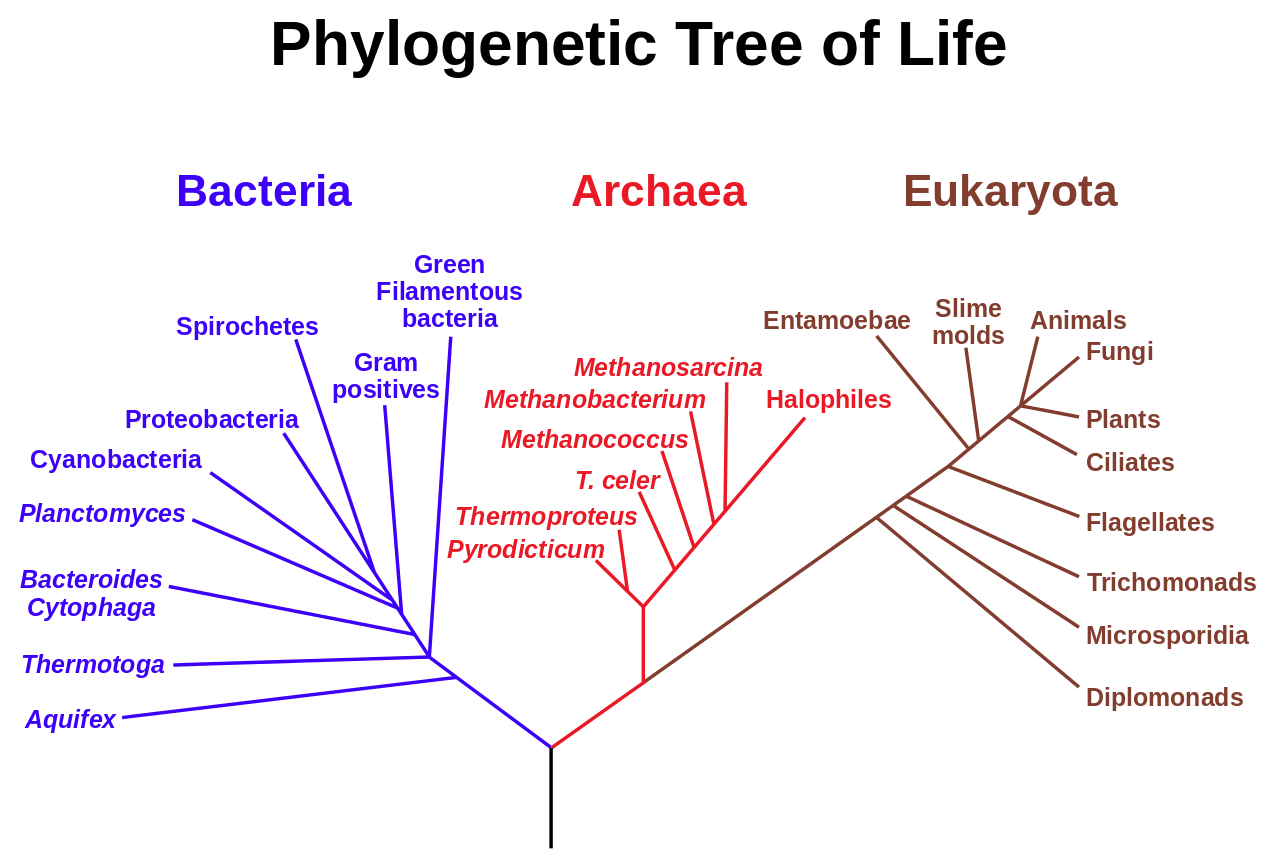
By comparing the DNA sequences for 16S rRNA, Woese and his colleagues constructed a proposed universal phylogenetic tree, shown in simplified form below.

The earliest evidences for life on Earth are graphite found to be biogenic in 3.7 billion-year-old meta-sedimentary rocks discovered in Western Greenland and microbial mat fossils found in 3.48 billion-year-old sandstone discovered in Western Australia.
Considering what we know of the offspring groups (see phylogenetic bracketing), the LUA was a small, single-cell organism. It would have had a cell wall and a ring-shaped coil of DNA floating freely within the cell, like modern bacteria. It would likely not have stood out against a collection of modern generalized small size bacteria.
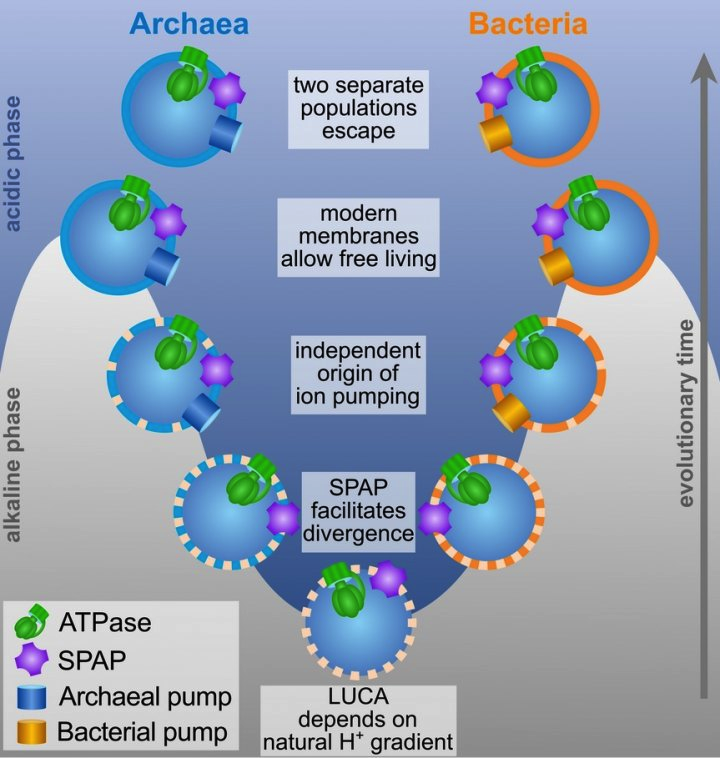

Horizontal gene transfer
Horizontal gene transfer is another term for gene swapping.
Gene swapping (or horizontal gene transfer as it’s often called by biologists) has been known about for decades. What biologists are only now beginning to look at is the extent to which genes are transferred between organisms. Comparing two bacteria from the same species reveals major differences. For example, Escherichia coli is a common gut bacterium that is part of our natural gut flora. But the O157:H7 strain causes severe gastrointestinal ailments. The genomes of both a harmless variant (K-12) and the O157:H7 strains have been deciphered and compared, and the result is striking.
The above is detailed in ActionBioscience.org on opposite page and is a mechanism for comprehending LUCA but it seems that the mitochondrial "Eve" of LUCA studies is a long way off still.