CRISPR Updates
October 31, 2022, 8:37 AM
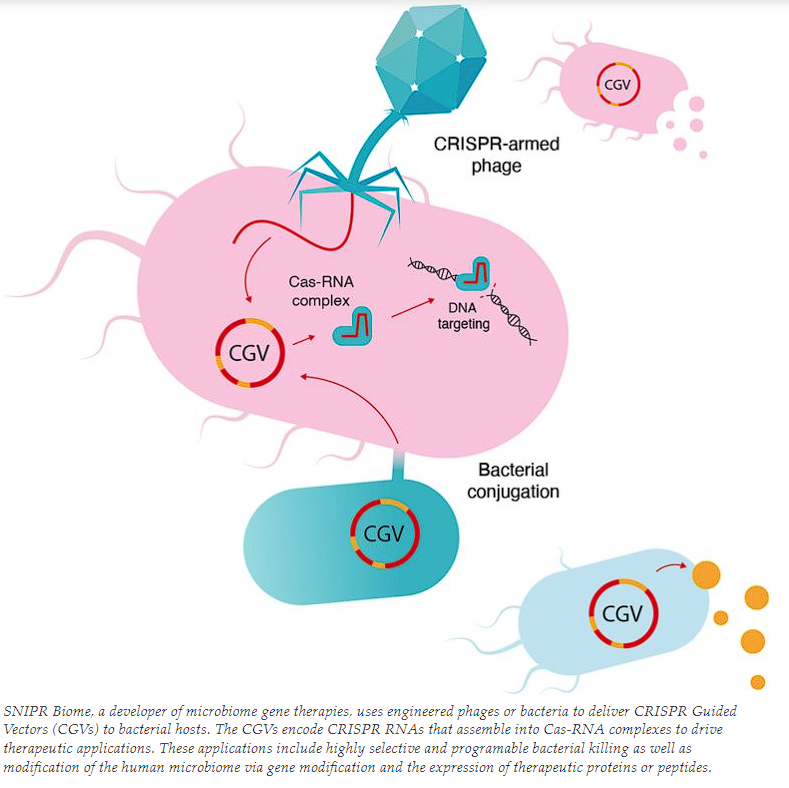
SNIPR Biome--
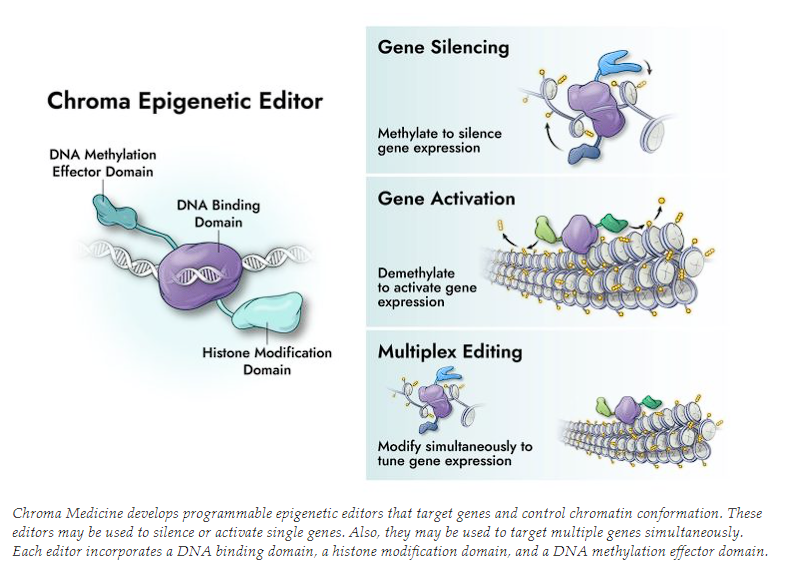
Chroma Medicine is providing a modular, flexible, CRISPR-based platform for developing epigenetic medicines based on the silencing or activation of genes.
Oct 2022 --see CRISPR turns 10 link
April 2019
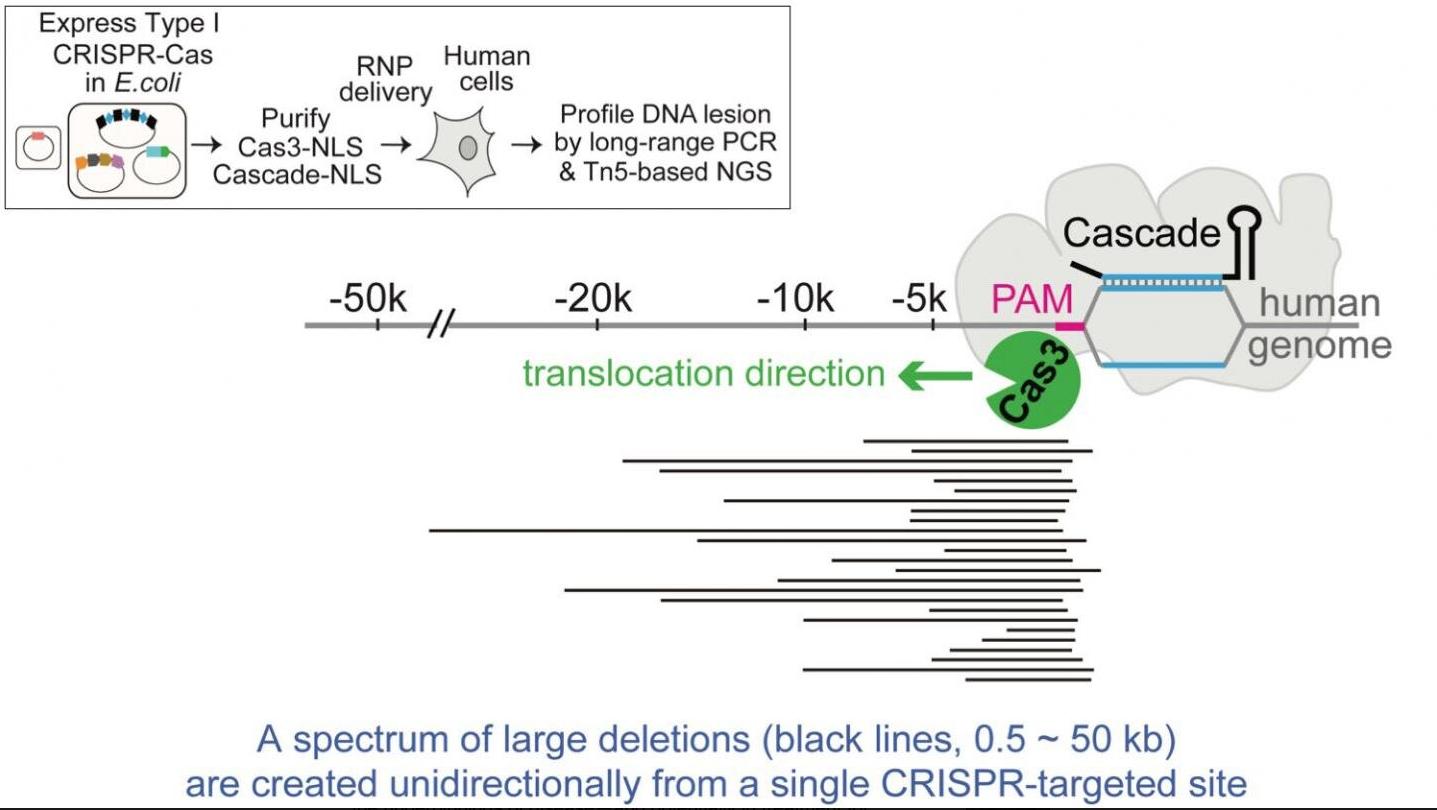
Now, a collaborative international team has unveiled a new CRISPR-based tool that acts more like a shredder, able to wipe out long stretches of DNA in human cells with programmable targeting.
Writing in Molecular Cell, they describe how they succeeded in getting a different kind of CRISPR-Cas system called Type I CRISPR-Cas3 to work as long-range DNA editing tool in human cells for the first time. See New CRISPR Shedder Technique.
April-10th 2018
Rapid patching causes accidental scarring
The technique is based on scars in the DNA, which taken together work like a bar code from which each cell's lineage can be determined. While the zebrafish embryos are still at the single-cell stage, Junker's team injects the CRISPR-Cas9 system. Over the next eight hours, Cas9 repeatedly cut a sequence that the fish will certainly never need: the gene for red fluorescent protein (RFP). The embryo's red glow gradually fades, and thousands of scars form on the DNA wounds. "CRISPR always makes a cut at an exact point. But the cells have no more than 15 minutes to repair before the next cell division takes place," Junker says. "Patching must be done quickly, so the chromosome pieces are sort of glued together. This is where mistakes happen. The scars in the DNA are of random length and their exact position also varies." Daughter cells inherit the genetic scars during cell division. Cells originating from a common ancestor can thus be identified by their genetic scars.
Read more at: https://phys.org/news/2018-04-biological-crisper-cas9-induced-scarring-dna.html#jCp
Secrets of the CRISPR Arms Race See Mar 2017 opposite
Using cryo-electron microscopy, researchers based at The Scripps Research Institute (TSRI) and Montana State University (MSU) analyzed how viruses defeat CRISPR, the bacterial immune system. Viruses, these scientists learned, have at least a couple of anti-CRISPR strategies. One strategy is to simply counterattack. Viruses can deploy proteins that disable CRISPR machinery. Another strategy is to misdirect CRISPR. Evidently, viruses can fool the CRISPR system into binding an expendable viral protein instead of essential viral DNA.
While these strategies have evolved to preserve viruses, they could benefit people too. Adapted for use in our CRISPR genome-editing technologies, these strategies could effectively give us a CRISPR off switch.
This point was emphasized in a paper prepared by the TSRI and MSU scientists. The paper, entitled “Structure Reveals Mechanisms of Viral Suppressors that Intercept a CRISPR RNA-Guided Surveillance Complex,” appeared March 23 in the journal Cell, and focuses on viral anti-CRISPR proteins that subvert the CRISPR system in Pseudomonas aeruginosa. This system relies on a 350-kDa CRISPR RNA (crRNA)-guided surveillance complex (Csy complex) to bind foreign DNA and recruit a trans-acting nuclease for target degradation.
Update Apr 2017 new method of cutting one strand only..
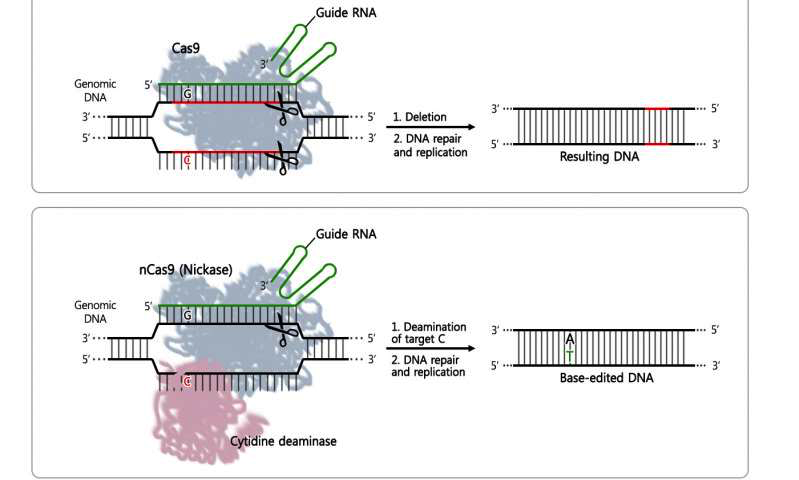 In the original CRISPR-Cas9 technique (top), the guide RNA (green) binds to the target DNA and the cleavage enzyme Cas9 (scissors) cuts out a small DNA sequence (red). A modified version of Cas9 called nCas9 (bottom) is different as it cuts off only one strand of DNA and the cytidine deaminase (pink) transforms a single cytosine (C) into uracil (U). Uracil (U) is then converted to thymine (T) by DNA replication. Credit: IBS
Off Target issues again
Citing persistent concerns about secondary mutations in regions not targeted by a single guide RNA (sgRNA)—concerns also expressed by a number of other scientists—Kellie A. Schaefer, Ph.D., at Stanford University and colleagues at Howard Hughes and Massachusetts General Hospital performed whole genome sequencing (WGS) on DNA isolated from two CRISPR-repaired mice (F03 and F05) and one uncorrected control.
CRISPR/Cas9-treated mice were sequenced at an average depth of 50×, and the control to 30× to identify all off target mutations. The sequencing the authors said identified an “unexpectedly high” number of single nucleotide variations (SNVs), contrary to the widely accepted assumption that CRISPR causes mutations mostly at regions homologous to the sgRNA.
CRISPR’s penchant for promiscuous behavior has spawned an entirely new research field focused on fixing it. Patents have already been filed on the fixes and the developers believe that these advances will incrementally enable more reliable CRISPR performance. Most efforts have concentrated on modifying CRISPR nuclease Cas9 using structure-design based changes in the enzyme, chemical modifications, and amino acid substitutions at critical sights to better predict and control its function.
Writing in Nature in 2015, Benjamin P. Kleinstiver, Ph.D., of the Molecular Pathology Unit and Center for Cancer Research at the Massachusetts General Hospital and colleagues noted that although CRISPR/Cas9 nucleases are widely used for genome editing, the range of sequences that Cas9 can recognize is constrained by the need for a specific PAM." See article Fixing....
Oct 2017 Working in cells taken from patients, Liu and his colleagues used their base-editing tool to correct a point mutation that causes hereditary hemochromatosis, a disorder that causes the body to absorb too much iron from food. This excess iron can build up over time and cause liver cancer and other liver diseases, diabetes, heart disease, or joint disease.Liu and his team also used the base editor in human cells to induce a mutation that suppresses sickle-cell anemia. In both studies, they detected virtually no off-target effects, or unwanted DNA insertions or deletions, which are a concern with the traditional way of using CRISPR to edit entire genes.
Apr 16, 2018 08:49 AM “We've discovered a way to greatly improve the accuracy of gene-editing technology by replacing the natural guide molecule it uses with a synthetic one called a bridged nucleic acid, or BNA,” claims lead researcher Basil Hubbard, Ph.D., Canada Research Chair in Molecular Therapeutics and assistant professor at the University of Alberta’s Department of Pharmacology. Our research shows that the use of bridged nucleic acids to guide Cas9 can improve its specificity by over 10,000 times in certain instances- a dramatic improvement”
“The CRISPR-RNA (crRNA) contains a 20-nucleotide (nt) RNA sequence complementary to the target DNA sequence, while the transactivating crRNA (tracrRNA) acts as a bridge between the crRNA and Cas9 enzyme.” Hybridization of these two elements constitutes the gRNA.
Most of the approaches to improving specificity have involved modifying the Cas9 enzyme itself, but the University of Alberta researchers have instead focused on incorporating synthetic nucleotides—BNAs—at specific locations in crRNAs. “Interestingly, bridged nucleic acids (BNAs) have previously been shown to improve mismatch discrimination in nucleic acid duplexes,” they point out. “We hypothesized that incorporation of these synthetic nucleotides into crRNAs could improve Cas9 DNA cleavage specificity.”
July 2020 See "Tiny CAS Protein---"
Oct 2020 see level up your drug screening article--
Oct 20, 2020 11:49 AM see CRISPR/Cas3 update CRISPR meets pac-man!! “Cas3 is like Cas9 with a motor – after finding its specific DNA target, it runs on DNA and chews it up like a Pac-Man,” Bondy-Denomy said.
This new capability to delete or replace long stretches of DNA will enable researchers to more efficiently assess the importance of genomic regions that contain DNA sequences of indeterminate function, according to Bondy-Denomy, an important consideration in understanding humans and the pathogens that plague them.