Archaea
December 9, 2025, 4:14 PM
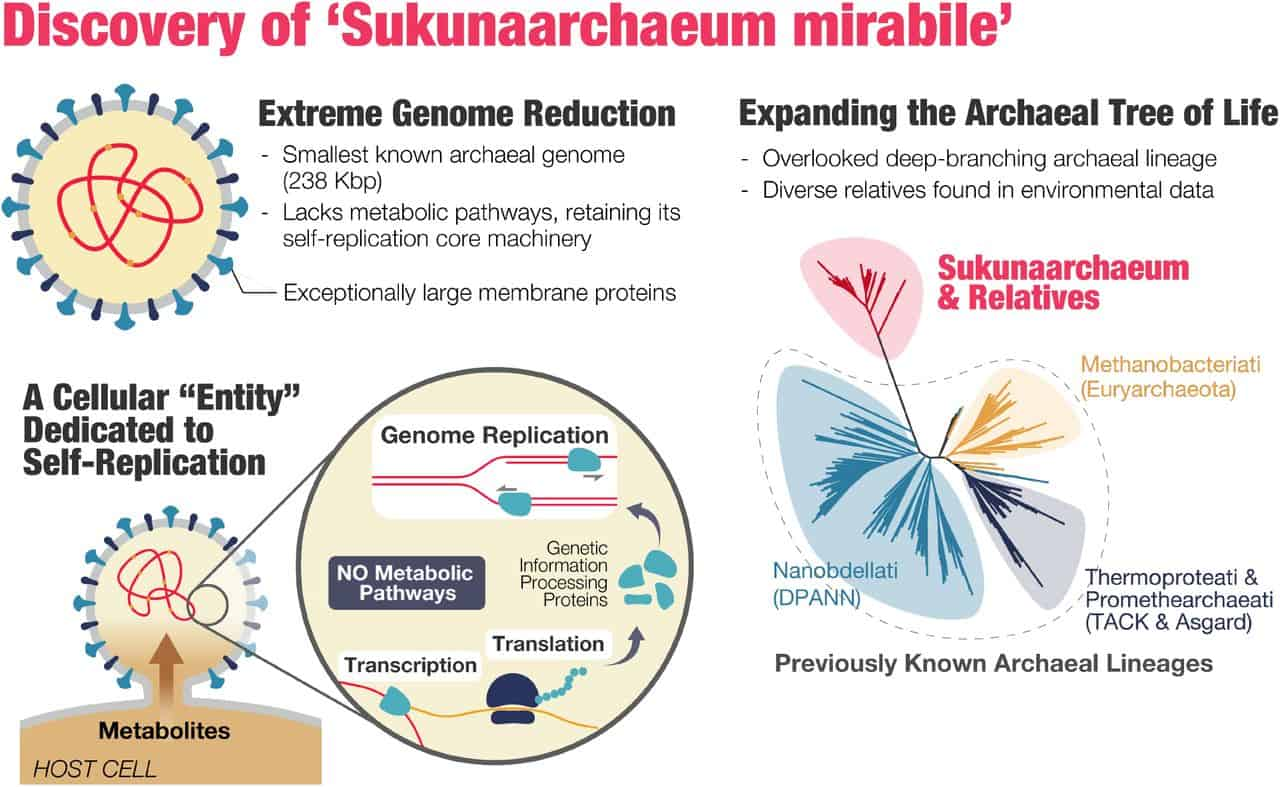
Bramd new find in the ocean near Japan, Candidatus Sukunaarchaeum mirabile. Its genome is just 238,000 base pairs long—less than half the size of the smallest known archaeal genome, that of Nanoarchaeum equitans. The newly described organism has shed almost all of its genes for metabolism—the chemical reactions that sustain life—keeping only those needed to copy its DNA and build proteins.
At just 238,000 base pairs, Sukunaarchaeum’s genome is the smallest ever recorded for any archaeon. By comparison, some viruses have far more genetic material. Yet unlike viruses, which hijack the machinery of their hosts entirely, Sukunaarchaeum carries some of its own replication tools.
“Its genome is profoundly stripped-down, lacking virtually all recognizable metabolic pathways, and primarily encoding the machinery for its replicative core: DNA replication, transcription, and translation,” the authors wrote in their study.
Archaea are a domain of single-celled microorganisms. They have no cell nucleus or any other organelles inside their cells. In the past Archaea were classified as an unusual group of bacteria and named archaebacteria, but since the Archaea have an independent evolutionary history and manifest numerous differences in their biochemistry from other forms of life, they are now classified as a separate domain in the three-domain system. In this system the three primary branches of evolutionary descent are the Archaea, Eukarya and Bacteria.
Archaea were first classified as a separate group of prokaryotes in 1977 by Carl Woese and George E. Fox in phylogenetic trees based on the sequences of ribosomal RNA (rRNA) genes. These two groups were originally named the Archaebacteria and Eubacteria and treated as kingdoms or subkingdoms, which Woese and Fox termed Urkingdoms. Woese argued that this group of prokaryotes is a fundamentally different sort of life. To emphasize this difference, Woese later proposed a new natural system of organisms with three separate Domains: the Eukarya, the Bacteria and the Archaea, in what is now known as "The Woesian Revolution".
Although many archaea have tough outer cell walls, these walls contain different kinds of amino acids and sugars than those found in bacteria. Archaeal cell membranes also are chemically distinct from bacterial membranes with differing lipid structures and chemical links. This means that drugs that slow or kill bacteria by interfering with their ability to produce certain key proteins have no effect on archaea.
There are three main types of archaea: the crenarchaeota , which are characterized by their ability to tolerate extremes in temperature and acidity. The euryarchaeota , which include methane-producers and salt-lovers; and the korarchaeota , a catch-all group for archaeans about which very little is known. Among these three main types of archaea are some subtypes, which include:
Methanogens — archaeans that produce methane gas as a waste product of their "digestion," or process of making energy.
Halophiles — those archaeans that live in salty environments.
Thermophiles — the archaeans that live at extremely hot temperatures.
Psychrophiles — those that live at unusually cold temperatures.

Examples--Members of the archaea include: Pyrolobus fumarii, which holds the upper temperature limit for life at 113 °C (235 °F) and was found living in hydrothermal vents; species of Picrophilus, which were isolated from acidic soils in Japan and are the most acid-tolerant organisms known—capable of growth at around pH 0; and the methanogens, which produce methane gas as a metabolic by-product and are found in anaerobic environments, such as in marshes, hot springs, and the guts of animals, including humans.