Non-Coding RNAs
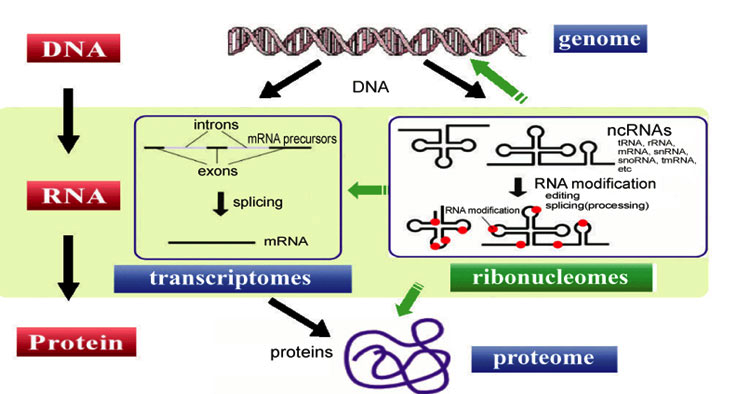
A non-coding RNA (ncRNA) is a functional RNA molecule that is transcribed from DNA but not translated into proteins. Epigenetic related ncRNAs include miRNA, siRNA, piRNA and lncRNA. In general, ncRNAs function to regulate gene expression at the transcriptional and post-transcriptional level. Those ncRNAs that appear to be involved in epigenetic processes can be divided into two main groups; the short ncRNAs (<30 nts) and the long ncRNAs (>200 nts). The three major classes of short non-coding RNAs are microRNAs (miRNAs), short interfering RNAs (siRNAs), and piwi-interacting RNAs (piRNAs). Both major groups are shown to play a role in heterochromatin formation, histone modification, DNA methylation targeting, and gene silencing.
A non-coding RNA (ncRNA) is an RNA molecule that is not translated into a protein. Less-frequently used synonyms are non-protein-coding RNA (npcRNA), non-messenger RNA (nmRNA), or functional RNA (fRNA). The DNA sequence from which a functional non-coding RNA is transcribed is often called an RNA gene. May be called ncRNAs in general.
These ncRNAs include microRNAs and snoRNAs (small nuclear RNAs) (many if not most of which remain to be identified), as well as likely other classes of yet-to-be-discovered small regulatory RNAs, and tens of thousands of longer transcripts (including complex patterns of interlacing and overlapping sense and antisense transcripts), most of whose functions are unknown. These RNAs (including those derived from introns) appear to comprise a hidden layer of internal signals that control various levels of gene expression in physiology and development, including chromatin architecture/epigenetic memory, transcription, RNA splicing, editing, translation and turnover. RNA regulatory networks may determine most of our complex characteristics, play a significant role in disease and constitute an unexplored world of genetic variation both within and between species.
Non-coding RNA genes include highly abundant and functionally important RNAs such as transfer RNAs (tRNAs) and ribosomal RNAs (rRNAs), as well as RNAs such as snoRNAs, microRNAs, siRNAs, snRNAs, exRNAs, piRNAs and scaRNAs and the long ncRNAs that include examples such as Xist and HOTAIR (see List in thought for a more complete list of ncRNAs). The number of ncRNAs encoded within the human genome is unknown; however, recent transcriptomic and bioinformatic studies suggest the existence of thousands of ncRNAs, but see Many of the newly identified ncRNAs have not been validated for their function. It is also likely that many ncRNAs are non functional (sometimes referred to as Junk RNA), and are the product of spurious transcription.
Essentially everything that is not mRNAbut confusing in that they all do something just not coding for proteins as mRNA e.g. tRNA brings amino acids to the Ribosome.
All cells in a single organism carry the exact same genome, so how do we end up with so many varieties of tissues and organs? Scientists know that transcription of many genes in eukaryotic cells is repressed, or "silenced," but in some cases, genes are transcribed into mRNA that never gets translated. Various post-transcriptional mechanisms are in place to add another level of control over the already complex systems that regulate eukaryotic gene expression. These mechanisms are the result of small, noncoding pieces of RNA called siRNA (small inhibitory RNA), or interference RNA, and miRNA (microRNA), or antisense RNA.
siRNA--Small Interference RNA, Single-stranded RNA molecule (usually from 21 to 25 nucleotides in length) produced by the cleavage and processing of double-stranded RNA; binds to complementary sequences in mRNA and brings about the cleavage and degradation of the mRNA. Some siRNAs bind to complementary sequences in DNA and bring about their methylation.
antisense RNA---Small RNA molecule that base pairs with a complementary DNA or RNAsequence and affects its functioning.
Non-coding RNAs can be divided into two main types: infrastructural and regulatory ncRNAs. Infrastructural ncRNAs seem to have a housekeeping role in translation and splicing and include species such as ribosomal, transfer and small nuclear RNAs. Regulatory ncRNAs are more interesting from an epigenetic point of view as they are involved in the modification of other RNAs. They can be further classified into the following:
microRNAs (miRNAs) qv.
miRNAs are small single-stranded molecules (20–24 nt) that derive from transcripts forming distinctive hairpin structures called pre-miRNA. The hairpin is processed into mature miRNA and forms the RNA induced silencing complex (RISC), which contains miRNA-interacting proteins such as Dicer. The miRNAs will pair with complementary sequences on target mRNAs transcripts through the 3’UTR, leading to gene silencing of the target.
Piwi-interacting RNAs (piRNAs)
piRNAs are small ncRNA (24–31 nt) that are able to form complexes with Piwi proteins of the Argonaute family. piRNAs are characterized by a uridine at the 5’end and a 2’-O-methyl modification at the 3’ end. Their main role is the silencing of transposable elements during germ line development.
Small interfering RNAs (siRNAs)
siRNAs are long linear dsRNA processed by Dicer into mature 20–24 nt siRNAs that direct silencing when loaded onto RISC. They mediate post-transcriptional silencing similarly to miRNA by a process called RNA interference (RNAi), where siRNA interferes with the expression of a complementary nucleotide sequence.
Long non-coding RNAs (lncRNAs)
lncRNAsare considered as non-protein coding transcripts >200 nt in length. The majority of non-coding RNAs belong to this group. Many of the lncRNAs are subject to splicing, polyadenylation and other post-transcriptional modifications, and can be classified according to their proximity to protein coding genes.

It is clear that the human genome contains a large number of functional ncRNAs. Indeed it is likely that the list of biologically validated ncRNAs, as listed in the LncRNA Database , will continue to grow. As others have pointed out, even if 10% of current lncRNAs prove to be functional, this would represent a wealth of new biology. However, given our current understanding of biochemistry and evolution, it is likely that most of the RNAs generated from the low levels of pervasive transcription, and likely a substantial number of currently annotated “lncRNAs,” are non-functional. (see article ncRNA etc in links)
Oct 12, 2021 12:00 PM
In a new study, stem cell scientists at the Lund University, Germany, explore the role of non-coding regions of the genome—previously deemed to be functionless “junk” DNA—and find humans and chimpanzees use a part of their non-coding DNA in different ways. This they claim affects how and when the human brain develops.
Chimpanzees are our closest living relatives. Despite significant similarities in our DNA and few differences in our protein-coding genes, the human forebrain is larger and more complex than that of the chimpanzee.
Johan Jakobsson, PhD, professor of neuroscience at Lund University, who is the first author of the paper says, “Previously, researchers have looked for answers in the part of the DNA where the protein-producing genes are—which only makes up about two percent of our entire DNA—and examined the proteins themselves to find examples of differences.”
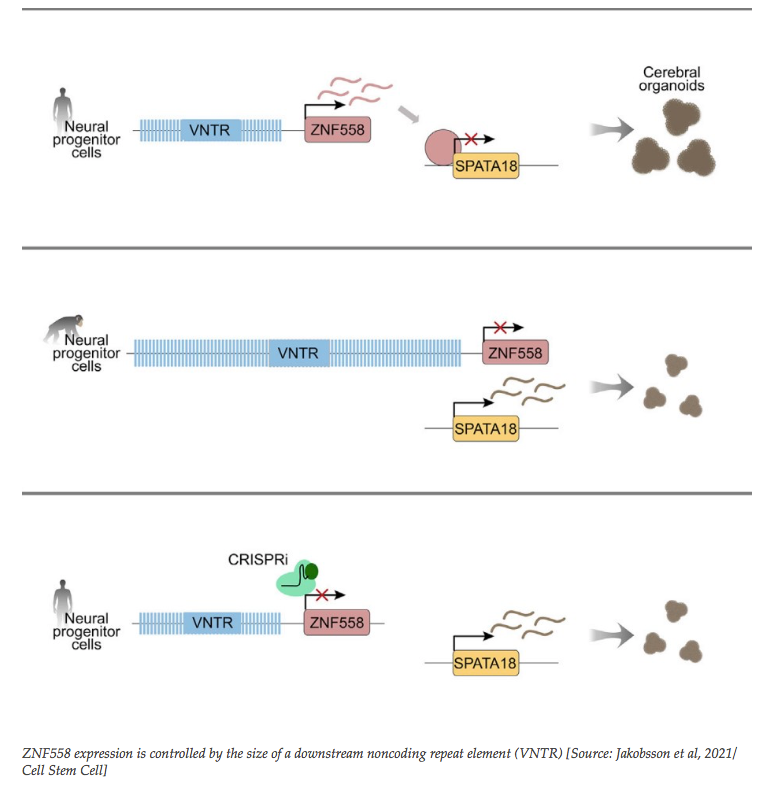
In the new study, the researchers have discovered a transcription regulating protein called ZNF558 that is expressed in the human but not chimpanzee forebrain neural progenitor cells. Originally, about 100 million years ago, ZNF558, evolved to regulate the expression of a family of transposable elements, but now it regulates a gene called SPATA18 that regulates the selective dismantling of mitochondria.
The expression of ZNF558 itself is regulated by the size of a non-coding structural element in DNA called a VNTR, short for variable number tandem repeat that is longer in chimpanzees than in humans. VNTRs, also called minisatellites, are families of DNA sequences where a short nucleotide sequence is consecutively repeated, with variations in length between individuals.
The study is published in an article titled “A cis-acting structural variation at the ZNF558 locus controls a gene regulatory network in human brain development,” in the journal Cell Stem Cell and provides mechanistic insight into how structural variations in DNA establish a regulatory network that affects human brain evolution.